
Music is the universal language
“Glory to God in the highest heaven, and on earth peace to those on whom his favor rests.” - Luke 2:14
General Interest
Luthier on Luthier: Marco Bortolozzo
For Episode 115 of the podcast, we’re joined by classical guitarmaker Marco Bortolozzo.
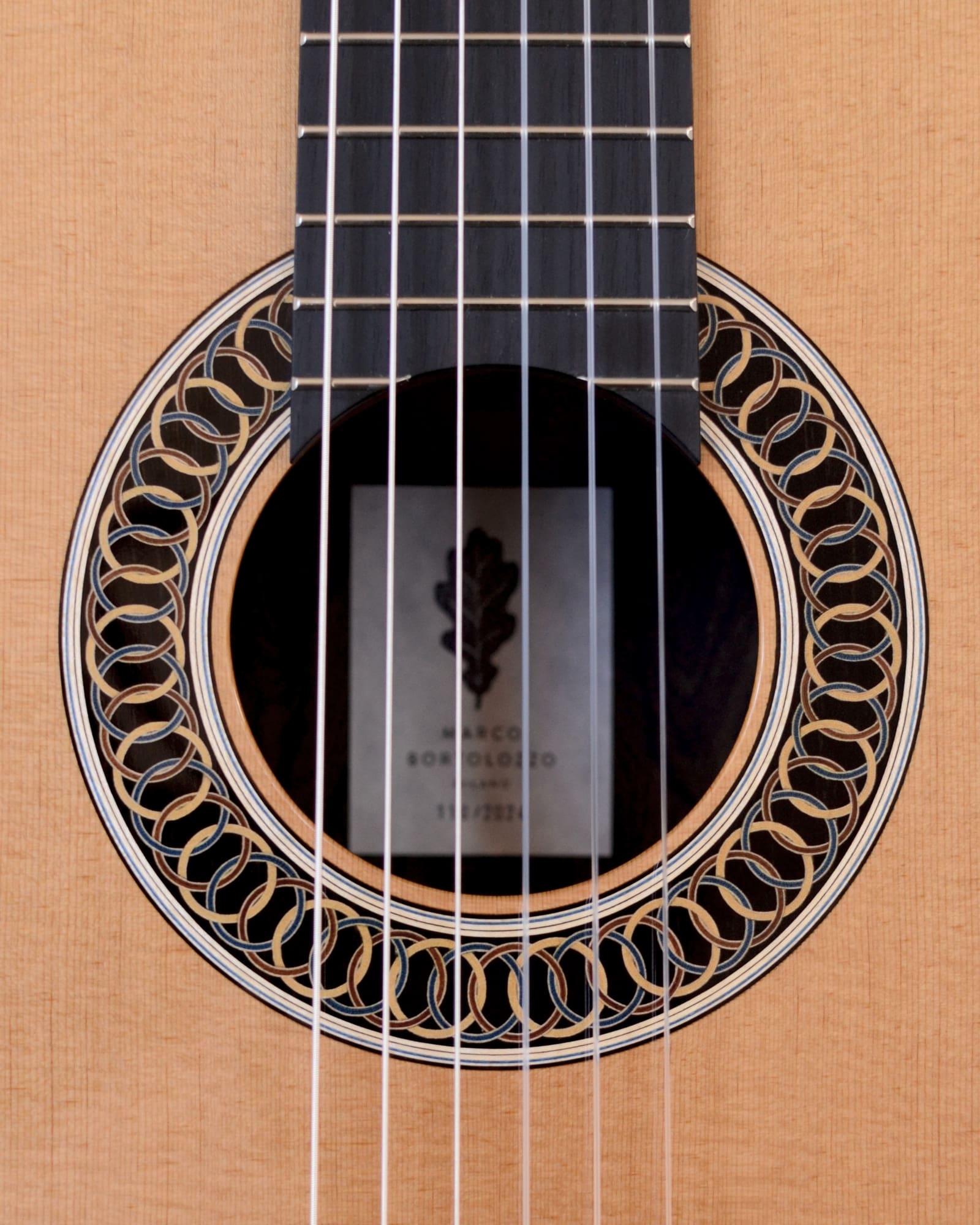
In our conversation, Marco tells us about the mentorship that launched his career, and the story behind his signature Olympic ring rosette, inspired by a 19th-century Spanish guitar. We also discuss his neck joint design, his unique use of shellac records in guitar finishes and much more.
https://www.marcobortolozzo.com/
Luthier on Luthier is hosted by Michael Bashkin of Bashkin Guitars and brought to you by the Fretboard Journal. This episode is sponsored by the Looth Group, Dream Guitars and StewMac.
Want to support Luthier on Luthier? Join our Patreon to get access to exclusive photos and content from Michael and his builds.

The post Luthier on Luthier: Marco Bortolozzo first appeared on Fretboard Journal.
Wintergrass Sessions: Tray Wellington
At the 2026 Wintergrass festival in Bellevue, Washington, the Fretboard Journal teamed up with filmers I Know We Should to capture some of our favorite artists (and talk gear).
First up, banjo player Tray Wellington performing “Moon In Motion I” / “Moon In Motion III” and “False Idols.”
A companion video features Tray going over his banjo, a newer Gibson RB-75 with a radiused fingerboard.
Follow Tray here.
Register now for Wintergrass 2027. The lineup in 2027 will include Sierra Hull, Jerry Douglas Band, East Nash Grass and other bluegrass favorites.
Video by Brad Wagner, audio by Juan M Soria.
We’ll be sharing more highlights from Wintergrass 2026 on a weekly basis here and on our YouTube channel.
The post Wintergrass Sessions: Tray Wellington first appeared on Fretboard Journal.
The KE27 is a 27-fret shred-ready monster conceived by Jackson and metal guitarist Brandon Ellis

Jackson has once again teamed up with metal guitarist and former Black Dahlia Murder man Brandon Ellis, this time on a monstrous 27-fret shred machine, the KE27.
Adopting the brand’s Kelly shape, the Pro Plus Series Signature Brandon Ellis Kelly KE27 arrives as the latest addition to Ellis’s signature line, and is designed for “crushing tone, massive output and high-performance playability”.
Chief on the guitar’s spec sheet are 27 stainless steel frets, offering players access to the extreme high registers of the fretboard. There’s also a Seymour Duncan Signature Dyad Parallel Axis humbucker in the bridge position – which boasts a unique hybrid coil design with a singular bar magnet – and a PA-STK in the neck position, a top-mount Gotoh GE1996T double-locking tremolo system, and a striking Gold Crackle finish personally chosen by Ellis himself.
- READ MORE: Gibson has launched a range of retro-inspired football shirts right in time for the World Cup
Elsewhere, the guitar sports a nyatoh body with a through-body maple neck with graphite reinforcement – plus a scarf joint for enhanced sustain and stability – a 12”-16” compound radius’ board for “pulverising speed”, with black sharkfin inlays, a Floyd Rose R2 nut, three-way toggle switch and Dunlop dual-locking strap buttons.
Despite the extra frets, the KE27 boasts a scale length of 25.1”, within the typical range of 24.75” – 25.5” of most electric guitars.
 Credit: Jackson
“The KE27 has really evolved into a completely different guitar in its own right,” says Brandon Ellis.
“While the first iteration was built on the standard Jackson Kelly spec, this one features meaningful customisations to virtually every aspect including 27 stainless steel frets, a custom 25.1” scale length, top-mount Gotoh tremolo and my signature Seymour Duncan Parallel Axis Dyad pickup, which is otherwise only available as a Custom Shop model. When I pick this guitar up, I’m just in awe. It plays like a custom shop guitar and has a unique feel and sound all its own.”
“Ellis’s new signature is as uniquely designed as his sound,” says Peter Wichers, Product Manager of Jackson.
“It features custom appointments tailored specifically to him, including 27 frets and his custom Seymour Duncan Dyad Parallel Axis bridge pickup, the very elements that define his distinctive tone. This signature gives players the tools to tap into that sound.”
The Pro Plus Series Signature Brandon Ellis Kelly KE27 is priced at $2,199 / £1,799.
Learn more at Jackson.
The post The KE27 is a 27-fret shred-ready monster conceived by Jackson and metal guitarist Brandon Ellis appeared first on Guitar.com | All Things Guitar.
Gibson has launched a range of retro-inspired football shirts right in time for the World Cup

With the 2026 FIFA World Cup well underway, football fans the globe over have been clamouring to support their countries as they vie to lift that coveted golden trophy on 19 July.
We’re now into the knockout stages, and some strong contenders – including Japan, the Netherlands and, shockingly, Germany – have already been eliminated.
Of course, the desire to buy and rep your team’s shirt when they’ve already been knocked out is pretty minuscule, but that doesn’t mean you can’t still look the part…
Thanks to this new collaboration between guitar giant Gibson and Icarus Football – which specialises in custom kit design – you can express your love of both guitar culture and football all at once.
Available at Gibson.com and at the Gibson Garages in Nashville and London, the Gibson x Icarus Football collection reinterprets classic football aesthetics “through the lens of Gibson’s heritage”.
 Credit: Gibson
The drop consists of two limited-edition polo-style shirts, one long-sleeve in white repping “Gibson USA”, and another with short sleeves in a navy blue Gibson Stars aesthetic.
“Each piece blends the craftsmanship and attitude Gibson is known for with Icarus Football’s reputation for storytelling through shirt design,” Gibson says. “The result is apparel that feels equally at home in stadium stands, on festival grounds, or in the wardrobes of fans who move fluidly between music and sport.”
“Gibson chose to partner with Icarus Football for its distinctive position at the intersection of football and music culture,” the brand continues.
 Credit: Gibson
“Beyond its reputation for original, story-driven shirt design, Icarus Football has longstanding associations with numerous bands, including Gibson partners Motörhead and Broken Social Scene, making the brand a natural collaborator for a project centered on creative crossover. Together, Gibson and Icarus Football have created a collection that reflects a shared point of view – where sound, style, identity, and sport all meet.”
It doesn’t look like this drop is the first from Gibson and Icarus Football, either, as the two brands say they plan to explore future collections with design elements drawn from the Gibson Garages in Nashville, London and Miami.
The long-sleeved white shirt is priced at $120, while the short-sleeved blue shirt is $100.
Learn more at Gibson.
The post Gibson has launched a range of retro-inspired football shirts right in time for the World Cup appeared first on Guitar.com | All Things Guitar.
STL Tones is now letting anyone earn royalties from their guitar tones – not just the pros

If you’ve ever spent hours perfecting an amp tone only to have your mates ask, ‘Can you send me that preset?’, STL Tones thinks it could be worth more than just bragging rights.
The company behind ToneHub and ControlHub has announced the public expansion of its artist royalty platform, allowing guitarists, producers, mixers, and artists to upload and monetise their own tones across its software ecosystem.
Until now, the marketplace has largely been reserved for invited artists and producers, with over USD$2.5 million in artist royalties generated in total.
The expansion means independent players will be able to publish alongside signature tones from the guitarists and producers behind acts including Bring Me The Horizon, blink-182, Slipknot, Paramore, Foo Fighters, Turnstile, Ozzy Osbourne, Chris Stapleton, Jack White, Arctic Monkeys and Weezer.
Creators can publish guitar and bass tones in ToneHub, mixing and mastering chains in ControlHub, and earn recurring royalties whenever their content is used across the platforms. Artists will also retain ownership of the tones they upload while STL handles distribution, royalty tracking, usage analytics and payouts.
The tones themselves are captured from real amplifiers and studio gear, with STL aiming to recreate the feel and response of physical rigs inside its software ecosystem.
Rather than limiting official tone packs to big-name artists, STL says the move is about giving its wider community a chance to benefit from the platform they’ve helped build.
“For years, users in the STL community have helped shape the platform through their support, feedback, and creativity. The launch represents a shift toward sharing platform revenue directly with the users contributing to the ecosystem,” says the company.
The move also reflects a wider trend in the music industry, where artists are increasingly relying on multiple revenue streams to build sustainable careers.
“Streaming, touring, merch, fan communities, and digital products have all become part of the modern artist business model. STL believes artist tones should be part of that revenue stack as well, transforming them from one-time product releases into long-term royalty-generating assets,” STL adds.
“Over the years, I have collected amps and hardware that may not be accessible to the average person. ControlHub and ToneHub have allowed me to share the gear I love and have used on countless records while also creating an additional revenue stream. No other company has revolutionised modern-day mixing quite like STL Tones, and I’m stoked to be part of the ride,” says producer and former A Day To Remember guitarist Tom Denney.
Learn more at STL Tones.
The post STL Tones is now letting anyone earn royalties from their guitar tones – not just the pros appeared first on Guitar.com | All Things Guitar.
Patty Griffin on Channelling Illness, Loss, and Renewal into Songs of Resilience

The best single-cut electric guitars to buy, from Les Pauls to Telecasters

“It’s no secret that the Gibson Les Paul is one of the most influential guitar designs of all time. It has seen countless versions from Gibson itself, and inspired plenty more single-cut guitars – whether that’s set-neck designs that offer their own twist on Gibson’s formula, or other brand’s more characterful attempts to fill the same niche – such as Fender’s powerful humbucker-loaded, 1970s-inspired telecasters.
But there are countless Les Pauls, Les Paul-alikes and rock-ready single-cuts out there on the market. So we’ve distilled down the best guitars in the category that we’ve reviewed – let’s dive in!
At a glance:
- Our Pick: Gibson Les Paul Studio Session
- Best Les Paul-style guitar for Metal: Jackson Diamond Rowe Monarkh
- Best high-end single-cut: Heritage Custom Shop Core Collection H-137
- Best affordable humbucker-loaded Telecaster: Squier Classic Vibe ’70s Antigua Telecaster
- Best modern-style HS Telecaster-style guitar: Yamaha Pacifica SC Professional
- Best vintage-style HH Telecaster: Fender American Vintage II 1972 Telecaster Thinline
- Best lightweight single-cut: Harmony Jupiter Thinline
- Best single-pickup Les Paul: Epiphone Jared James Nichols “Blues Power” Les Paul Custom
- Best vintage-style Les Paul: Epiphone 1959 Les Paul Standard
- Best high-end vintage-style single-cut: Heritage Standard H-150 P90
- Best affordable Les Paul: Epiphone Les Paul Special
- Why you can trust Guitar.com
Our Pick: Gibson Les Paul Studio Session

The Les Paul Studio is back. While its return wasn’t without controversy – the revamped version of the instrument is decidedly more pricey than its predecessors – let’s set that aside for a moment and look at what the guitar is, rather than what it isn’t. Our reviewer found plenty to love about this modern take on the format, from the incredibly playable SlimTaper neck to the updated 57 Classic/57 Classic+ pickup combo. While a lot of Gibson’s approaches to the Les Paul are perhaps squarely stuck in the ultra-modern format as with the Modern Lite (a guitar we had less of a good time with) to the thoroughly vintage-indebted, the Les Paul Studio Session balances these two approaches to arrive at one hell of a guitar.
Read our full review of the Gibson Les Paul Studio Session.
Best Les Paul-style guitar for Metal: Jackson Diamond Rowe Monarkh

A good old Les Paul can be great for metal, but what if you want to tune down, or shred up near that chunky neck joint? Jackson’s signature model for Tetrarch’s Diamond Rowe is one of the best modern metal-focused single-cuts out there. It features a Fender-style scale length, comes stock with thick strings tuned to B standard, and has an absurdly comfortable all-access cutaway. Its EMG pickups are no slouch, either – there’s a reason the 81/85 set is a metal staple. Plus, just look at it – it’s one of the most extremely metal takes on a flashy burl top out there!
For the price it’s an amazingly professional guitar, with the only downside being the rather bad gigbag that it comes with. That aside, this could form the beating heart of a heavy AF metal rig.
Need more? Read our Jackson Diamond Rowe Monarkh review.
Best high-end single-cut: Heritage Custom Shop Core Collection H-137

[products ids=”22M1tBqUTRxGBGEpjWC6hA”]
On the hunt for a serious bit of guitar-making? In terms of an all-out, US-made, handcrafted electric guitar in this style, the Gibson Custom Shop isn’t your only option. The legacy of Gibson’s Kalamazoo factory lives on with Heritage – and in this particular case, we have a guitar clearly inspired by the dual-P90 Les Paul Special. It’s a refined take on what was initially a punkier student model – its P90s are punchy and aggressive off the bat, meaning a wide range of tones in the four-control layout. And the overall excellent fit-and-finish of the thing helps it transcends its thrashier roots into something a little more versatile.
Need more? Read our Heritage Custom Shop Core Collection H-137 review.
Best modern-style HS Telecaster-style guitar: Yamaha Pacifica SC Professional
 Image: Adam Gasson
Yamaha’s recent adjustment of the Pacifica line has led to some stellar high-end instruments being released as part of the line. This take on something approaching a Telecaster Custom is a smartly designed – and flawlessly crafted – instrument, featuring some of Yamaha’s own unique twists on the formula. You’ve got the focus switch, for instance, borrowed from the Revstar line, as well as a unique high-end three brass-saddle bridge and a compound radius fretboard. It all combines to make a guitar that truly lives up to the professional assertion in its name.
Read our full review of the Yamaha Pacifica SC Professional.
Best vintage-style HH Telecaster: Fender American Vintage II 1972 Telecaster Thinline

If that Squier Classic Vibe instrument isn’t for you, there’s always of course the other end of the spectrum. This entry into Fender’s American Vintage II line meticulously recreates the 1972 version of Fender’s Telecaster Thinline. There’s an awesome balance going on with this guitar – there’s the characteristic Fender liveliness thanks to the semi-hollow construction, but a pair of Wide Range Humbuckers are ready to bring the midrange grunt to the party. The price tag isn’t for the faint of heart, but if you know that you love a vintage-style Fender, this is a great Les Paul killer from California rather than Kalamazoo.
Need more? Read our Fender American Vintage II 1972 Telecaster Thinline review.
Best lightweight single-cut: Harmony Jupiter Thinline

Looking for a thinline that’s a little different? One of the most affordable USA-made instruments you can get your hands on, this semi-hollow single-cut modernises and streamlines the vintage Harmony vibe, meaning a more sensible set of electronics in the form of a pair of brilliant-sounding gold-foil humbuckers and a single volume/tone control. And thanks to the semi-hollow construction this is a guitar your back won’t hate you for playing for four hours straight!
Need more? Read our Harmony Jupiter Thinline review.
Best single-pickup Les Paul: Epiphone Jared James Nichols “Blues Power” Les Paul Custom

The latest iteration of the blues-rock firebrand’s signature single-pickup Les Paul adds a few major changes to the formula that makes it a fantastic guitar, even without taking into account its relatively modest pricing. With a new bridge pickup – a signature noiseless P90 from Seymour Duncan – the guitar comes a lot more alive with overdrive, and a set of locking tuners make things generally easier to manage in terms of setup and string-changing. But perhaps the killer feature here is that gorgeous Pelham Blue – just look at it. Is this the coolest-looking Epiphone full stop?
Need more? Read our Epiphone Jared James Nichols “Blues Power” Les Paul Custom review.
Best vintage-style Les Paul: Epiphone 1959 Les Paul Standard
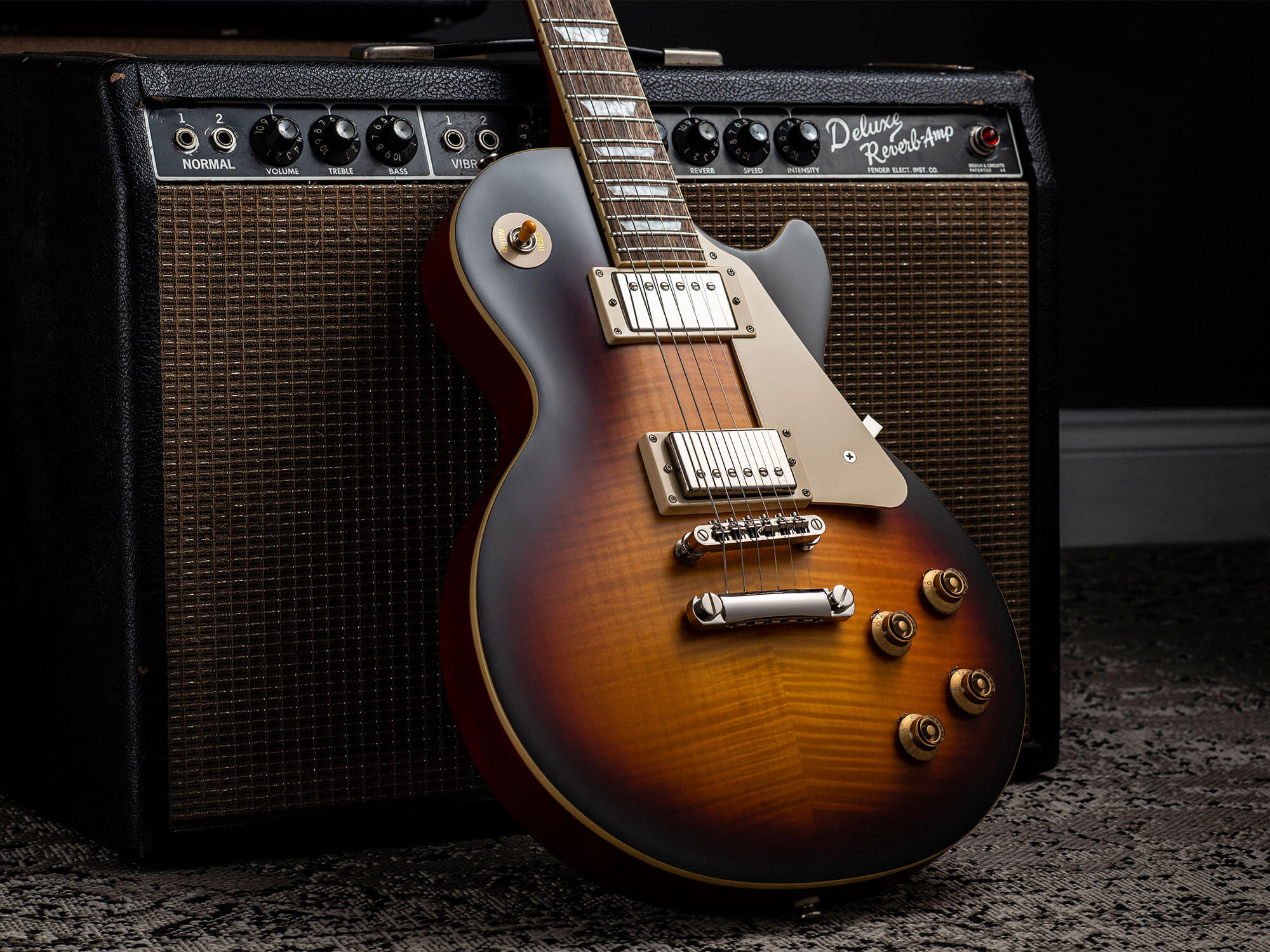
If you want an awesome Les Paul that doesn’t cost an arm and a leg, then this collaboration between Epiphone and the Gibson Custom Shop could be it. Thanks to premium electronics and Gibson-spec pickups, there’s a wide range of responsive tone-shaping options on tap. Construction is solid and mostly sticks to vintage specifications, too – perfect if you want to see why the 1959 Les Paul Standard has remained one of the most legendary guitars of all time. It’s also a smart purchase when you compare it to what’s available at the most accessible end of the Gibson USA catalogue.
Need more? Read our Epiphone 1959 Les Paul Standard review.
Best high-end vintage-style single-cut: Heritage Standard H-150 P90

Guitars like Heritage’s standard H-150 P90 are more than the sum of their parts. Sure, there’s all of the classic Les Paul-indebted specifications on show, like a C-shaped mahogany neck with a rosewood fingerboard, set into a maple-capped body with vintage P90s – but thanks to Heritage’s attention to detail, it all comes together into an incredible sounding and playing guitar packaged in a sleek, stylish look that features a range of subtle updates to the single-cut formula. For the discerning buyer, this may well be the ideal option.
Need more? Read our Heritage Standard H-150 P90 review.
Best affordable Les Paul: Epiphone Les Paul Special
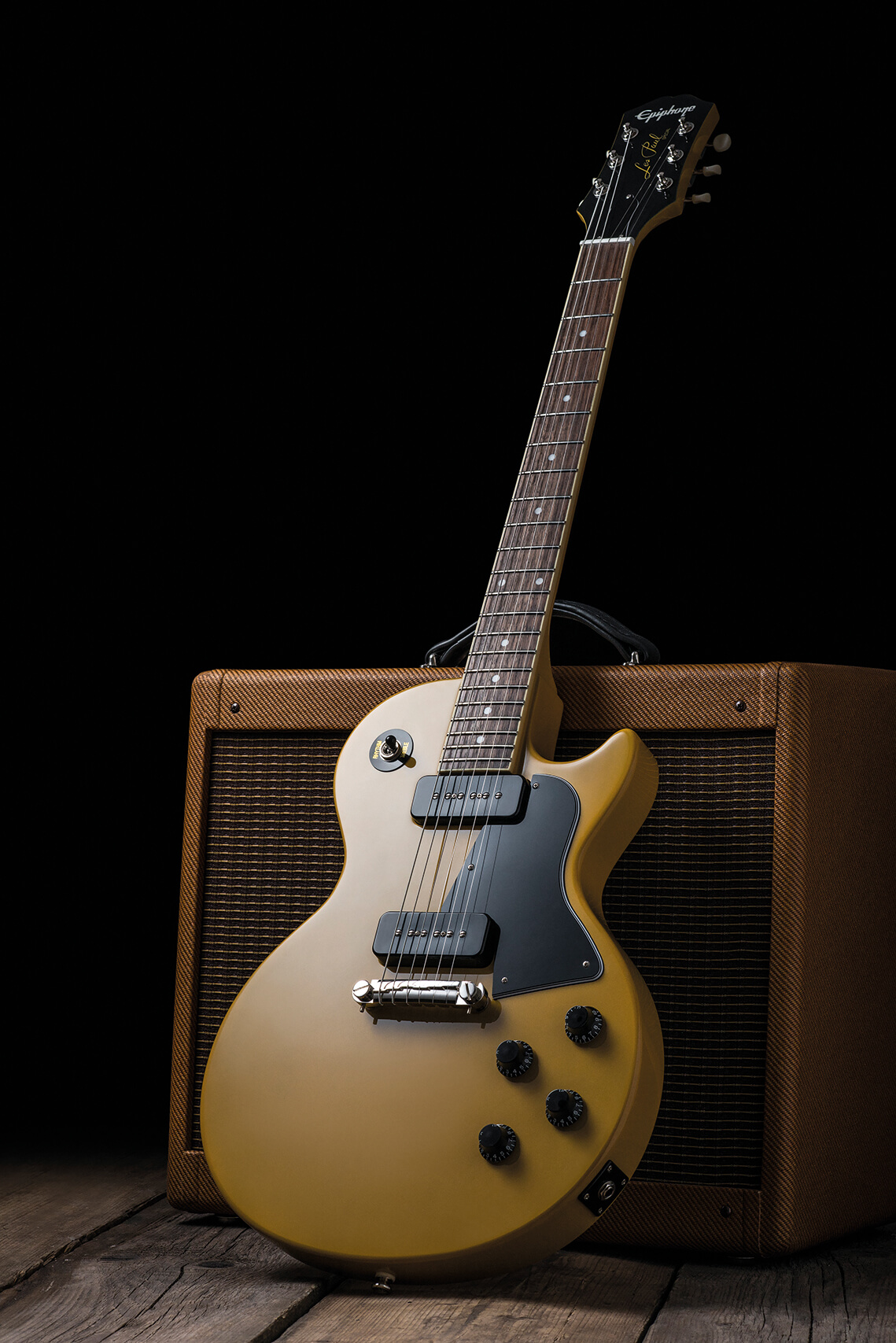
Compared to the pricey Custom Shop collaborations Epiphone likes to shout about, the standard Les Paul special – first launched as part of the Inspired By Gibson range in 2020 – is an affordable workhorse that, unless you really, really hate the Epiphone headstock, has no discernible compromises. Although its neck profile is on the chunkier side, it’s very playable – and not quite as fat as some baseball-bat examples out there. Importantly, its pickups aren’t messing around, either, with all of the vocal midrange P90s are famous for.
Need more? Read our Epiphone Les Paul Special review.
Why You Can Trust Us
Every year, Guitar.com reviews a huge variety of new products – from the biggest launches to cool boutique effects – and our expert guitar reviewers have decades of collective experience, having played everything from Gibson ’59 Les Pauls to the cheapest Squiers.
That means that when you click on a Guitar.com buyer’s guide, you’re getting the benefit of all that experience to help you make the best buying decision for you. What’s more, every guide written on Guitar.com was put together by a guitar obsessive just like you. You can trust that every product recommended in those guides is something that we’d be happy to have in our own rigs.”
The post The best single-cut electric guitars to buy, from Les Pauls to Telecasters appeared first on Guitar.com | All Things Guitar.
“Someone is making money off of this and YouTube is letting it happen”: Rhett Shull slams ‘AI slop channel’ that ripped off his videos and amassed over 600,000 views

Finding out someone has copied your YouTube videos is one thing. Discovering they’ve apparently used them to build an AI creator that’s racked up more than half a million views is another entirely.
That’s the situation guitarist and gear reviewer Rhett Shull recently found himself in after discovering an AI-generated guitar channel that appears to have been built using his content as training material, borrowing everything from his old studio setup and thumbnails to the overall style of his videos while amassing more than 600,000 views and over 5,000 subscribers.
Shull says he first learned about the channel after being tagged by The Bad Guitarist Podcast on Instagram.
“I got tagged in a story by The Bad Guitarist Podcast. [It says] ‘This week, we take a look at an AI guitar YouTube channel that popped up in the last month and has over 5000 subs, 600,000 views, and a ton of comments from unsuspecting viewers.’”
Curious, he clicked through, only to discover that the AI channel – Guitar Gems with Chase – was, in his words, “directly ripping me off in several different ways”.
“I clicked on this last night and honestly was kind of freaked out,” he says.
According to Shull, the similarities are hard to ignore. The presenter appears in a studio designed to resemble the set Shull used before moving house in 2021, wears a jacket reminiscent of one he frequently sported on camera, and even features gear mirroring that seen in his older videos.
“There’s no question that this is someone – some content farm or some person somewhere – who’s feeding my videos to some sort of AI and having it spit out this content,” he says, before joking, “I wish I was as handsome, though, as this guy is!”
For Shull, the issue isn’t simply that his videos appear to have become AI training fodder. It’s the fact that viewers seem to believe the content is genuine.
“These are real people that are watching this and thinking that this is an actual video.”
The uploads also follow a familiar “rage-bait” formula, with titles like Eight Guitars Only Dumb People Buy and thumbnails Shull says closely resemble his own. The difference, he argues, is that some of these videos veer into outright misinformation.
“What this video is claiming is that a company like Gibson or Fender and PRS and these other companies are ripping you off because they’re using the same machines and building the same guitars but in China. It’s completely wrong information. It’s false.”
Because the videos are AI-generated, Shull believes they exist in a legal grey area with little accountability.
“If I said that stuff in a video, if I came out and made these claims that are just objectively false, I could be held liable for slander or defamation because I’m lying about a company,” he says. “But so far as I understand it, because this is an AI creator and AI is completely unregulated here in the United States, there are no rules around this stuff, at least as far as I can tell. And YouTube obviously doesn’t seem to have a problem with it.”
Adding to his frustration, Shull says the channel appears to be monetised and is even promoting paid guitar courses, meaning somebody is profiting from AI-generated content built on his work.
“I’m going to file a takedown request with YouTube and report these videos because obviously this shouldn’t exist,” he says. “The fact that this is allowed to happen on YouTube, the fact that the platform doesn’t immediately crack down on this AI generated slop really sucks… and it doesn’t inspire a lot of confidence in me about the future of this platform.
“People are watching this thinking that it’s real and then being funnelled to buy a product that is equally as fake… someone most likely in Brazil, from what I can tell, is making money off of this and YouTube is just allowing it to happen.”
Whether YouTube ultimately removes the channel remains to be seen (at the time of writing, it is still live on the platform), but Shull suspects he won’t be the last creator to find their work repurposed as AI training material.
“I feel like this is a losing battle. The better these AI tools get at making videos and creating this kind of content, the more prevalent these type of slop channels are going to be on the platform. And that sucks, man. That really sucks.”
Watch the full video below.
The post “Someone is making money off of this and YouTube is letting it happen”: Rhett Shull slams ‘AI slop channel’ that ripped off his videos and amassed over 600,000 views appeared first on Guitar.com | All Things Guitar.
“I am going to take a lot of s**t for this”: Joe Bonamassa reveals he’s using digital amps for his new tour

Just a few months ago, Joe Bonamassa was “beta testing” Fender’s Tone Master amplifiers. Then he admitted he “really wanted to dislike” them, only to end up impressed by how convincing they sounded.
Now, the experiment appears to be over.
The blues legend has revealed that he will be taking Fender’s Tone Master digital amplifiers out on his upcoming summer tour – a decision he reckons is bound to ruffle a few feathers among gear purists.
Sharing a photo of four Tone Master Twins lined up and ready to hit the road, Bonamassa writes in his latest Instagram post, “I am going to take a lot of shit for this but my tone-master high power twins are ready for the summer tour and the backline truck just got a hell of a lot lighter.”
As expected, it didn’t take long for the comments to roll in. When one user suggested he should “get a Tonex pedal and call it a day”, Bonamassa fired back: “Fuck those guys”. Fellow guitarist Andy Wood, meanwhile, joked, “cue the apocalypses”, prompting JoBo to reply: “locusts and frogs falling from the sky!”
It’s quite the turnaround for a guitarist who’s built a reputation as one of the industry’s biggest vintage gear enthusiasts. Earlier this year, Bonamassa revealed he’d been quietly beta testing Fender’s digital amps on tour, before later admitting he was surprised by just how much he liked them.
“I’ve got to be honest with you and admit when I’m wrong,” he told MusicRadar in a recent interview. “I still have my other tube amps behind me. It’s just that the [Fender ‘59] high-powered Twin is now a Tone Master. When I first plugged into it, I realised this shit’s good. I wanted to dislike it, I really wanted to dislike it! But I couldn’t.”
Bonamassa also explained that his production manager, sound tech and fellow guitarist Josh Smith all preferred the Tone Master, adding that the key to making digital amps feel authentic is still “moving air” through a proper speaker cabinet.
Learn more about the Tone Master range over at Fender.
The post “I am going to take a lot of s**t for this”: Joe Bonamassa reveals he’s using digital amps for his new tour appeared first on Guitar.com | All Things Guitar.
Keith Richards on working with Andrew Watt: “He doesn’t put up with any bullshit”

What does it take to keep one of rock’s longest-running bands firing on all cylinders well into its seventh decade? According to Keith Richards, it helps to have a producer who isn’t afraid to keep things moving, and who, crucially, “doesn’t put up with any bullshit”.
Andrew Watt has become one of modern rock’s most in-demand producers, steering projects for everyone from Paul McCartney to Elton John and Ozzy Osbourne. And after producing The Rolling Stones’ acclaimed Hackney Diamonds, he’s back behind the desk for the band’s forthcoming 25th studio album, Foreign Tongues, due 10 July.
Speaking to The Guardian, Richards credits much of the band’s current creative momentum to both Mick Jagger’s recent songwriting streak and Watt’s ability to keep sessions focused.
- READ MORE: Mick jagger says he “absolutely would love to tour” Rolling Stones’ new album Foreign Tongues
“Mick’s been very prolific lately,” Richards says, “which is one reason this album has come out so quick, because he won’t bloody stop. And the momentum from Hackney Diamonds was such that this is basically carrying on in the same breath. I was just letting it roll – we had enough stuff if we wanted to keep pushing, and so Mick and I gave each other the usual wry look and said: ‘Yeah, let’s keep pushing.’”
Richards is equally effusive about Watt, whose resume has increasingly become a who’s who of music royalty. McCartney once described his first impression of the 35-year-old producer as: “I like him, but he’s a bit pushy.” Richards, meanwhile, seems to view that same quality as a feature rather than a flaw.
“[He’s] a breath of fresh air and a kick up the ass,” says the guitarist. “He knows his stuff musically and technically, and he doesn’t put up with any bullshit – he just gets on with it. So I found him very easy to work with. He’s a bit impetuous at times, but then so what?”
When asked whether Watt had ever needed to give him a dressing down, Richards offers the cheeky response. “No. But he may have given somebody a talking-to.”
Elsewhere, the musician also admits he’s “had it up to here with technology” as a whole, preferring instead to “stick to the old ways”.
“I’ve seen records go from being made on two-track tapes stuck to the wall, to suddenly eight tracks, then 16, 24, then digital and it hasn’t really helped the music at all,” he says. “But it’s something you live with.”
“I mean, personally, I think the world would be better off without the damn phone. AI is killing me, you know. Do I fear for the future of music? I fear for the future of everything. They don’t know what the hell it does, so now we all dangle and wait.”
The post Keith Richards on working with Andrew Watt: “He doesn’t put up with any bullshit” appeared first on Guitar.com | All Things Guitar.
The Truth About Vintage Amps, Ep. 167
It’s the 167th episode of the Truth About Vintage Amps, the call-in show where amp tech Skip Simmons fields all of your tube amp and life questions.
Our sponsors: Grez Guitars; Emerald City Guitars; and Amplified Parts / Mod Electronics.
Some of the topics discussed this week:
:00 Skip’s refrigerator dies (but lives!), taking the train to the Chicago Fretboard Summit, electronica band Chessie
10:09 The LA vintage guitar show
13:52 ‘The Angel’s Share’ movie
16:18 Our sponsors and a great 2026 Fretboard Summit amp giveaway (thanks, Andy!)
19:19 A non-tech tip: Silverface control panel amps with peeling film
21:59 What’s on Skip’s bench: Magnatone amps; an early Dickerson amp; using a Trace Elliot Velocette shell for a tube amp build
26:38 How long would it take Skip to build a tube amp (on a game show)?
28:31 Starting an amp repair business, redux (Ahuntsic Amplification https://amplificationahuntsic.ca/homepage-en)
32:45 Solder Smoke Absorber Remover (Amazon link: https://amzn.to/3QPSuv6)
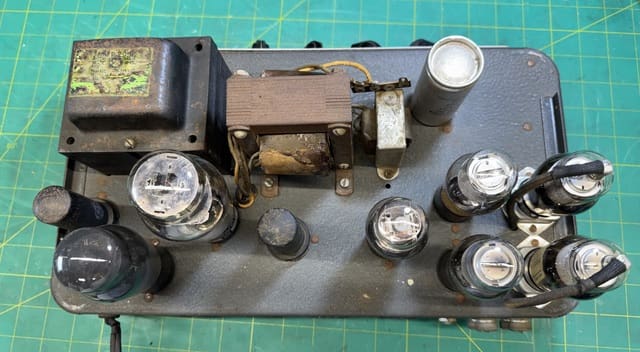
36:16 Modding a Silvertone Powermaster PA for guitar, dogbone resistors, 6J7 tubes
45:21 Novak hybrid guitars; did I fry my transformer?; AI Skip; cooking with duck
53:51 What to do with my dad’s 1959 Gretsch 6161 Electromatic Twin amp?; Uncle Doug on TAVA?
1:00:05 Serge Gainsbourg with a bunch of smoking kids (https://youtu.be/unYu22Ign1E?si=VkCNtOaDbloJqh63)
1:01:03 Warehouse speakers for a 1976 Silverface Vibro Champ (Instagram: @cwg_guitars)
Above and below: Listener Micajah’s Silvertone Powermaster PA.
Want amp tech Skip Simmons’ advice on your DIY guitar amp projects? Want to share your top secret family recipe? Need relationship advice? Join us by sending your voice memo or written questions to podcast@fretboardjournal.com! Include a photo, too.
Want to support the show? Join our Patreon page to get to the front of the advice line, see exclusive pics, the occasional video and more.
Hosted by amp tech Skip Simmons and co-hosted/produced by Jason Verlinde of the Fretboard Journal.


The post The Truth About Vintage Amps, Ep. 167 first appeared on Fretboard Journal.
Oliva Rodrigo’s new LEGO set immortalises her custom Music Man St Vincent in brick form

If there’s one thing that’s even cooler than a regular guitar, it’s a LEGO guitar. Fender realised this a few years ago, and now Olivia Rodrigo’s debut collection with the Danish brick maker has put guitar right at the heart of everything.
Rodrigo is the latest artist to collaborate on a LEGO set but by no means the first – over the years the brand has made sets for everyone from Pharrell and BTS, to The Spice Girls and The Beatles – but her five-set collection is certainly the most involved.
The crowning glory of the LEGO Editions Olivia Rodrigo collection is the Dual Guitar – a 1,228-piece set that represents the duality of Rodrigo’s guitar-playing artistry, as seen on her GUTS world tour and 2025 headline set at Glastonbury.
 Image: LEGO Group
For guitar fans, the half-and-half instrument should certainly raise a few eyebrows – on the one side is a LEGO recreation of her custom Gibson L-00 acoustic, while the other is a pretty bang-on recreation of the purple-finished Music Man St Vincent Goldie that made waves across the guitar scene when she began using it onstage in 2024.
Neither guitar appears to be officially licensed however, as the headstocks for both guitars look a little off and don’t have any headstock decals. Unlike the Fender Strat set, this guitar has more going on under the hood – pop open the top of the St Vincent guitar and you’ll find a pair of guitar-toting Minifigures of Rodrigo in stage attire, one acoustic and one electric.
Disappointingly neither are purple, and it seems like LEGO couldn’t stretch to making a tiny Minifigure-sized version of the St Vincent, but it does give the vibe of the red vintage Mustang she used for much of her Glastonbury 2025 set.
 Image: LEGO Group
The guitar isn’t the only bit of six-string bricking in the LEGO Editions Olivia Rodrigo collection either. The “Secret Storage” set brings some of Rodrigo’s most familiar symbols together in one set, and includes a smaller red guitar that, is apparently a nod to the aforementioned red Mustang she used at Glastonbury.
In truth, it looks more like a Rickenbacker to us, but such are the limits of making things out of tiny bricks – maybe they’re being a little careful about making unlicensed replicas of Fender body shapes in the current climate, ahem. The collection is completed by a “Concert Moon” set, a record player, and a Botanicals flower collection – the first of its kind.
 Image: LEGO Group
“Olivia brings to every lyric, every hidden clue and every album, while giving fans a meaningful way to connect with her,” says Julia Goldin, Chief Product & Marketing Officer at the LEGO Group. “This collaboration is about more than recreating moments – it’s about inspiring fans to build, explore and express themselves through storytelling and creative building.”
Given that it didn’t take long for LEGO fanatics to create a pedalboard to go with the Strat set, surely it’s a matter of time before someone uses this set to create a full Lego Music Man St Vincent and Gibson L-00? Stay tuned…
The LEGO Editions Olivia Rodrigo’s Dual Guitar launches on 1 August 2026 and retails at $119.99. You can preorder the sets from LEGO now.
 Image: LEGO Group
The post Oliva Rodrigo’s new LEGO set immortalises her custom Music Man St Vincent in brick form appeared first on Guitar.com | All Things Guitar.
Simon McBride believes “truss rods suck the tone and sustain out of guitars”

If guitarists needed another excuse to argue about tone, Deep Purple’s Simon McBride may have just provided one.
Speaking to Guitar World ahead of the band’s upcoming album SPLAT!, the guitarist reveals he recorded the entire album with a prototype PRS that ditches one feature found in almost every modern electric guitar: the truss rod.
For those new to guitar anatomy, the truss rod is the metal bar running through the length of your guitar’s neck beneath the fretboard. Its job is to counteract the constant pull of the strings, helping keep the neck straight and allowing relief adjustments over time.
In other words, it’s one of the least glamorous – but arguably most important – parts of a modern guitar. McBride, however, believes it’s also getting in the way of great tone.
“I played everything on this record with a prototype from PRS,” he says. “The idea is that there’s no truss rod. It goes back to the early days when guitars had no truss rods because I’m a firm believer that if you put a truss rod in a guitar, it sucks the tone and sustain out of it.”
According to McBride, the difference was immediately noticeable.
“This guitar is like an animal,” he says. “It’s hard to control because there’s so much natural sustain, and I don’t do high-output pickups.”
“Acoustically, there’s such a difference without the truss rod. [The neck] must be the strongest piece of wood they could find because it doesn’t bend at all.”
Guitarists, of course, are no strangers to passionate debates over what does and doesn’t affect tone. From tonewoods and guitar shape to pick material and even theoretical knowledge, there’s rarely a shortage of opinions. McBride’s truss rod theory is certainly one of the more unusual additions to the conversation, though we wouldn’t recommend anyone start pulling theirs out just yet.
Deep Purple’s new album SPLAT! arrives on 3 July. Check out their latest single below.
The post Simon McBride believes “truss rods suck the tone and sustain out of guitars” appeared first on Guitar.com | All Things Guitar.
“A sh**ty amp is useless”: Wilco’s Jeff Tweedy on why he’d always pick a good amp over a good guitar

If you’re building a rig on a budget, which deserves the bigger investment: the guitar in your hands, or the amp before you? To say that guitarists are split on the subject would be putting it mildly.
Covet guitarist Yvette Young has argued that pairing a great guitar with a bad amp is like “ruining a really nice audio file”, while The Cult’s Billy Duffy believes that “you’re always going to sound shitty” with a bad amp. On the other side of the fence are players like Bon Jovi’s Phil X and Doug Aldrich of Whitesnake, who posit that almost any working amp can sound good with the right guitar.
Wilco frontman Jeff Tweedy has now added his name to team amp, telling Guitarist he’d happily compromise on the guitar before the amplifier.
“A shitty amp is useless,” he says. “I could probably get sounds that I enjoy out of a cheap guitar and a good amp.”
That said, Tweedy doesn’t see the debate as entirely black and white.
“I think it could go both ways… it depends on the cheap amp,” he explains. “Some cheap amps, to me, sound better than the most expensive amps. So it’s all relative.”
Elsewhere in the interview, Tweedy reveals he’s also been favouring Japanese-made guitars from the late ‘70s and early ‘80s of late, even swapping them into his live rig in place of his Gibsons.
The musician, who admits to spending “an insane amount of time” browsing guitars online, says Greco models from the era have become a particular favourite – not least because he feels more comfortable taking them on the road than increasingly valuable vintage Gibsons.
“I’ve been swapping them out for the Gibsons I play live because they’re getting ridiculously expensive,” says Tweedy. “I don’t mind taking [the Japanese guitars] out on the road because they’re supposed to be used, and they’re tools – but I feel a bit self-conscious when I get handed a guitar that I can see somebody in the front row going. ‘Oh, my God, that’s an expensive instrument.’”
“I don’t like that feeling,” the guitarist laughs. “So the Grecos from that era are what I’ve been playing a lot. If you see me playing an SG, it’s usually a Greco.”
The post “A sh**ty amp is useless”: Wilco’s Jeff Tweedy on why he’d always pick a good amp over a good guitar appeared first on Guitar.com | All Things Guitar.
“I’m glad it’s happened so the Americans will stop banging on about it” Iron Maiden’s Steve Harris doesn’t seem too excited about their Rock & Roll Hall Of Fame induction

A Rock & Roll Hall of Fame induction five decades after your debut might sound like the kind of milestone that leaves a band celebrating. But don’t expect Iron Maiden to make too much of a fuss about it.
Speaking in the latest issue of Metal Hammer, bassist Steve Harris and frontman Bruce Dickinson make it clear that while they’re grateful for the recognition, it’s never been something they’ve spent much time thinking about.
Asked whether the band ever discussed turning down this year’s induction, Harris says there was never much of a conversation to begin with.
“No, there have only been comments from a couple of members of the band here and there,” he says. “Bruce has his own strong feelings about it, which is his opinion.”
In fact, the bassist says the honour has never meant all that much to him.
“It’s never really bothered me one way or the other, because awards aren’t what we do this for,” he explains. “But in a weird way I’m glad it’s happened so the Americans will stop banging on about it. To me, if you get offered something, you say, ‘Thank you very much.’ But did I lose sleep over getting it or not getting it? No.”
Dickinson – who famously said he didn’t “give a monkey’s” about the Rock Hall or its approval after the band missed out on induction in 2023 – sounds equally unfazed.
“I can’t even summon the energy to be vitriolic about it,” he says. “I appreciate that a significant number of people are happy for us. That’s nice. It’s not something we’re bothered about.”
The members, who won’t be attending the ceremony due to Iron Maiden’s Australia tour, say they probably wouldn’t have gone anyway.
“I don’t do those sort of things,” Harris says. “I didn’t even go to the recent red carpet thing for the documentary. It’s not me.”
And for anyone hoping the occasion might spark a Live Aid-style reunion featuring every current and former member, the band has already shut down the idea.
“No. That’d just be cheesy,” says Harris.
Dickinson agrees, arguing that those kinds of all-star performances rarely make for great music: “Those kind of things make some people feel, ‘Oh great, what an event’, but musically usually it’s a mess,” he says.
“I absolutely don’t have any problem with Blaze [Bayley, former vocalist] or any of those other guys on the bill – I love Blaze, he’s a fantastic guy. But we’re not planning on having Nicko [McBrain, former drummer] playing three drums during the show or anything like that. No, people have paid money to see this incarnation of Iron Maiden. It will be an Iron Maiden set. This is the band, this is what you get.”
Iron Maiden first became eligible for the Rock & Roll Hall of Fame in 2004, but weren’t nominated until 2021 and 2023 before finally making this year’s class. The 2026 inductees also include Oasis, Billy Idol, Wu-Tang Clan, Joy Division/ New Order and Phil Collins.
The post “I’m glad it’s happened so the Americans will stop banging on about it” Iron Maiden’s Steve Harris doesn’t seem too excited about their Rock & Roll Hall Of Fame induction appeared first on Guitar.com | All Things Guitar.
Al Di Meola on the “big issue that doesn’t get talked about” that’s hindering modern guitar players

Has technology made us worse at practising and making music? Al Di Meola certainly thinks so.
Speaking on the new issue of Guitarist, the jazz fusion icon argues that smartphones and constant digital distractions have fundamentally changed the way musicians work – and not for the better.
Asked about the “big obstacles” that stand in the way of guitarists nowadays, Di Meola says, “Here’s the big issue that doesn’t get talked about. Back then, before cellphones and computers, we practised way more. And it was way more focused on the songs.”
The virtuoso recalls noticing the shift while recording an album at New York’s famed Power Station around 15 years ago.
“I noticed, as soon as we were done with the track, which was killer, everybody ran out in the hallway,” he says. “Now, back in the day, everybody would run into the control room to hear their performance. But everybody was on their phone, like, networking, y’know? And I said, ‘This is not right.’ We went as far as to tell the receptionist to hold all calls.”
For Di Meola, the phenomenon is symptomatic of a wider problem.
“That phone is always right there, within arm’s length,” he says. “We got addicted to something that we can’t break. But back in the time when we didn’t need it because it didn’t exist, our focus on our work was phenomenal.”
He points to The Guitar Trio – his supergroup project with John McLaughlin and Paco de Lucía – as an example of that mindset.
“When I did The Guitar Trio with John McLaughlin and Paco de Lucía: the first tour, we were in our hotel rooms practising for the show that night because we knew we had to be up on our game,” says Di Meola. “There was no ‘let me check my phone’. And when I listen to those records, I cannot do what the hell I did back then now. Not that I want to, by the way. Velocity isn’t my number one desire. I’ve been devoting more time to composing.”
Elsewhere in the chat, Di Meola also reflects on how creative constraints can sometimes be more productive than unchecked freedom in the studio.
“My record company gave me, on my last record, as much time as I wanted,” the musician recalls. “And I went, ‘Boy, that’s a good thing and a bad thing.’ Because in the days when they had deadlines for shipments, you had to be done no matter what. In a way, it was good to have that pressure. Otherwise, you start experimenting, doing so many different things, and then you go, ‘Wait, let me listen to those early takes’ – and you already had it.”
The post Al Di Meola on the “big issue that doesn’t get talked about” that’s hindering modern guitar players appeared first on Guitar.com | All Things Guitar.
“I am not somebody who’s particular about gear” Cory Wong on why the nearest guitar to him was the best for his latest album

Many artists wear multiple hats when they’re making music. Cory Wong accesses different parts of his brain.
- READ MORE: The Close Up: Muse guitarist Matt Bellamy’s most iconic and beloved guitar, the Manson 007
He’s best known for his rhythmic chops on Fender Stratocasters, whether he’s performing his own music or serving with the jovial funk-soul outfit, Vulfpeck. But his artistry goes much further than the fretboard. On his latest album, Lost In The Wonder, he accessed his producer brain, which has a few more goals within the process, other than nailing instrumental parts:
“A producer’s got several jobs. One of them is getting this thing finished and delivered. One of them is being a good casting director, “ Wong says. “I have a whole Rolodex of musicians that I draw from, and that I wanted to work with for this album.”
12 vocalists contributed their voices to Lost In The Wonder. Wong brought in established talents such as Taylor Hanson, one of the three brothers behind the 90s pop trio, Hanson. Cody Fry of American Idol fame did some crooning. So did Benny Sings, who was featured on Rex Orange County’s modern classic, Loving is Easy. In his producer brain, Wong built songs to support their contributions, and his guitar was a tool for doing so, but it was still his music.
“Another side of the producer is bringing the artist’s vision to life, helping the artist discover more about themselves, and express themselves in new and different ways,” Wong says. “In this case, because I am the producer and the artist, I have to separate those things. My artistry comes before my guitar playing. My guitar playing is a byproduct and expression of my artistry, so I think of my artistry as being more important.”
 Image: Harry Levin
Background Actor
And yet, by removing the guitar from the forefront and giving himself a larger overview of the body of work, he still ended up recording what he considers some of the best work on the instrument.
“As a producer, I’m thinking about the writing and how to treat the production of it, knowing that the artist is a guitar player, knowing that the artist is collaborating with a bunch of people, and that the artist is a band leader and arranger. Splitting my brain into different pieces,” Wong says. “Those things are fun on the producer side because then it shapes a little more easily what is being asked of the guitar.”
Throughout the album, Wong selects precise moments for his playing to shine through. Some of them are powerful solos, but others are more reserved instances that demonstrate his deep understanding of what is called for within the song.
The electrified dance jam, Tongue Tied, is fertile with these diverse applications. In the pre-chorus, Wong gracefully fills the spaces between Stephen Day’s syncopated vocals with light, glitchy strums. Then, when the chorus comes in, he doubles Day’s more expressive flares to give them that extra bit of sonic emphasis.
On Better Than This, Wong goes one step further to emphasize the guitar without the instrument dominating the song. At two different points, he delivers detailed guitar melodies, which he emphasizes with creative tones. The first has a gritty crunch from the Beetronics Vezzpa pedal. The second is an exercise in crystal clear picking.
“It’s not solos, but it’s definitely like, ‘Here’s a moment for the guitar.’ Here’s how to incorporate the guitar as a featured instrument. You listen to Stevie Wonder, there’s a vocal melody, and instrumental hooks,” Wong says. “The producer brain of mine gave the guitar a lot of those instrumental hooks, and the artist is a guitar player, so let’s do some weird, cool, interesting tone.”
One of the moments Wong does step into the forefront with a solo is also on Tongue Tied. In it, he has a run he describes as “somewhere between Daft Punk and Eddie Van Halen.” After a career of nearly two decades, his ability to play impressive solos is common knowledge, but this one is as functional as it is flashy.
Instead of building these titanic peaks and valleys like a Comfortably Numb or Stairway to Heaven-style flex, he keeps the 16th-note rhythm consistent throughout, using the quickness to slide between different arpeggios. This technique also serves to maintain the momentum of the song, leading into the grand key change at the conclusion of the solo. He shows off his skills without sucking up all the attention.
“This tune has been featuring vocals the whole time. How does anybody know that the guitar player is part of this?” Wong says. “The song is now asking for the guitar player to step up to the plate, and the producer needs the artist to step up to the plate and be represented.”
 Image: Harry Levin
Tools Of The Trade
On that solo, Wong represented himself with an Epiphone Riviera with some custom modifications. Throughout the rest of Lost in the Wonder, he used his standard tools like his Strat and his Archetype Cory Wong X plugin. He also ventured out into his Music Man Stingray 2, as well as some different pedals, including the JHS Pedals Artificial Blonde.
However, he frankly doesn’t remember most of the instruments he used. At the time of our interview, he didn’t know which Epiphone he used on Tongue Tied. It just happened to be next to him in the studio when it was time to record.
“It was just what was right there, so I just grabbed it and used it. Didn’t even think about it,” Wong says. This was the case for many of the songs as he traveled to various studios around the world to collaborate with the different vocalists. “I am not somebody who’s particular about needing this gear, this thing. I want something that gives me inspiration.”
Whatever was there, in arm’s reach, ended up on the album (as long as it fit the vision he saw in his producer brain).
The post “I am not somebody who’s particular about gear” Cory Wong on why the nearest guitar to him was the best for his latest album appeared first on Guitar.com | All Things Guitar.
Fender Studio Pro 8 and Quantum LT 16 interface review: a guitar-recording match made in heaven?

$499/£429 (interface with software), $199/£169 (software), fender.com
Now, before you check what’s in your URL bar, yes, this is still Guitar.com. While recording software and audio interfaces are not often something we’ll give full reviews, Fender’s new Studio Pro 8 DAW and Quantum LT interfaces cross-pollinate some explicitly guitar-friendly features into what were previously pretty general-purpose things.
The two releases follow Fender’s acquisition of PreSonus a few years ago, and are seemingly an attempt to fold in some of the guitar audience into the more music tech side of things. So will this new DAW/interface combo be a powerful pairing for a guitarist’s home studio?
 Fender Quantum LT 16 interface. Image: Press
Quantum LT 16
Hardware first. The LT 16 is contained within a slim 1U rack panel, with the LT 2 and the LT 4 being smaller standalone desktop variations of the interface. Above the LT range there’s also the much more pro-level (and pro-priced!) Quantum HD interfaces, which boast more extensive I/O, ADAT expandability and higher-end preamps, but for now I’m taking a look at the highest-end of the entry-level series of interfaces.
While the LT 16 is technically a 16-input interface, only eight of these boast mic preamps. The other eight are analogue ¼” line inputs on the back panel. There’s no ADAT expandability here, and so if you want to connect 16 mics in total, you’ll need a bank of eight analogue preamps to go into those line inputs. For most home recording needs, though, this is unlikely to be a roadblock you’ll run into quickly. However, if you want to build a portable full-band recording rig, it does limit your choice of preamp bank to complement it.
The hardware controls and the rest of the I/O are pretty simple – you’ve got eight volume knobs for the preamp-loaded inputs, a master volume for the main monitor outs, and a separate volume control for the ¼” jack, along with phantom power and master switches. There aren’t many bells and whistles here, which I think makes a lot of sense. Looking at it from the perspective of a guitarist who wants to spend more than the absolute bare minimum on an interface but not splash out on high-end pro-grade kit, it’s a good balance of power and usability.
And speaking of guitarists – two of the front panel’s inputs are designated as combination XLR/instrument inputs, whereas the other six are combination XLR/line inputs – it can be a confusing distinction, but the main thing to note here is that the if you’re going straight in, you’ll want to take things like synthesisers and loud preamp pedals into the line-level ¼” inputs, whereas the instrument inputs will provide higher impedance – meaning better performance when you connect a guitar’s pickup straight to them. And, for the purposes of trying out Fender Studio Pro’s new suite of virtual amplifiers, that’s just what I do.
It’s good to know what you’re working with sonically if you are planning to add software amps and effects – and the good news is, that the direct tone is actually quite pleasing by itself. It’s never going to be a mind-blowing sound – it’s dry as week-old crisps by nature. But the sound is bright and clear, and it remains particularly responsive as I roll the volume down. Some interfaces, despite using high-impedance inputs, still manage to introduce a little mud into the equation – here, it’s bright and punchy all the way.
This bodes well for playing around with virtual amps – if only there was a new DAW absolutely chock full of them bundled in with this interface. Oh, there is? Well, let’s look at that then.
 Fender Studio Pro 8. Image: Press
Studio Pro 8
Firstly, what is Fender Studio Pro 8? Well, it’s the follow-up to PreSonus’ Studio One Pro 7, which, thanks to the slightly confusing naming convention of it all, isn’t immediately clear. Given that it removed the now-acquired brand name but didn’t start the enumeration over again, and there were previously two separate numbers in the product’s name, I think we were probably destined for at least some confusion here.
While some PreSonus fans were totally up in arms about the Fender rebrand, some of the furore seems a little overblown. Granted, the Fender branding is now going through its own publicity crisis as I write this, but regardless Fender Studio Pro 8 adds a whole lot of features and has come with what I personally think is a pretty neat design overhaul, with a measured approach to skeuomorphism and – bias at play here – some things that make the previously idiosyncratic aspects of PreSonus’ design language a little clearer to guitarists.
But… that’s not to say I’m totally on board with how Studio Pro 8 has been launched. Upon its announcement, I actually went “Oh, that’s what they were doing”, out loud. Because, up until then, I had been somewhat confused by the existence of Fender Studio, a completely free and slightly limited DAW that had no paid counterpart. At the time it struck this weird middle-ground, a Garageband without a Logic, a little too basic for some use-cases, a little too unwieldy for others.
However, now the existence of Fender Studio Pro 8 means the existence of the free Fender Studio makes much more sense – particularly from the guitar perspective. Alongside a lot of the features that make it a “full” DAW, the upgrade to the paid version also gets you a much bigger suite of virtual Fender amplifiers, and so there’s a bit of a clearer progression from the limited Studio to the heftier Studio Pro 8. Far be it for me to tell Fender how to do things, but if the free version of Fender Studio had arrived simultaneously alongside this fully-fledged DAW, I think I would have been a little nicer to it in my review.
 Image: Press
In use
Anyway, I’m not here to deliberate exactly how Fender should have launched a DAW – instead, it’s time to dive into the thing it has launched, from a guitarist’s perspective. First off – that suite of amps and effects. These are housed in two separate built-in plugins (Mustang Native for guitar, Rumble Native for bass), and if you’ve used any of Fender’s recent multi-effects units or accompanying apps, both will look pretty familiar, as they use an almost identical UI to things like the Tone Master Pro or the tone editing app for the Mustang Micro. You’ve got the standard signal chain line, onto which you can load amps, effects and cabs – the selection of which is pretty huge, much more so than you’d get bundled in with most in-built DAW guitar plugins.
Unlike the free version of Fender Studio, there’s also a pretty wide variance in the types of tones on offer, and amp models include some pseudo Marshalls, Oranges, Hiwatts, Mesa Boogies, and so on alongside the branded Fender stuff you’d expect. Effects are also extensive, with everything included from Klon-clones to Fender’s own effects to Space Echo emulations.
It is not the prettiest thing in the entire world, but boy, is it usable, and the sounds are absolutely there. Are they as dead-on as the highest-of-high-end captures you might get with something like a Quad Cortex or an Archetype plugin? Perhaps not, but they’re definitely in that final percentile of quality that means to truly pit them against each other would be a pretty hair-splitting endeavour. They’re more than good enough for most recording situations, and, coupled with the nice low latency and quality input from the LT interface, they feel pretty great to play, which is more than you can say for some other in-built amp sims.
This quite nicely parallels the newly-designed channel strip interface, which has been designed explicitly to take guitarists into account – as it’s a left-to-right signal chain (OK, yes, pedalboards go the other way, but in virtual software land some traditions won’t be bucked) that displays your plugins as modular blocks. Not totally unique as a thing, but nicely implemented, particularly in the simpler versions of the plugins that display in the wider view, that can then be viewed in more detail by expanding them.
This brings me to a wider point about the interface design, which is, I think, fairly slick and modern, and parsable for my particular self-taught approach to DAWs. In short, most guitarists who want to dabble in this world will likely not be put off by any overly visual complex parts of its design as they might with, say, Pro Tools. Oh, and you can also change the keyboard shortcuts fairly easily – pretty essential when you’re a 60% keyboard user like me, and the default record button is for some reason on the numpad.
Headline new features include some nifty stem separation (one of the few uses of AI in music everyone seems to agree is a pretty neat trick), and the related audio-to-MIDI feature, which lets you pull MIDI data from any recorded audio, and hence play it on software instruments etc. Great for playing a chord progression on your guitar once, and then using that as the base MIDI data for some synth accompaniment – no more dragging out chords in the piano roll, or trying to remember where you left that MPK Mini.
And there’s a lot more besides, of course – here we stand on the crumbling precipice above the ocean-deep feature set offered by this DAW – there’s a lot more to say about what this can do, given that it is, after all, a full release of Studio One. But, to go back to your URL bar for a second, this is still Guitar.com – if you are a guitarist’s guitarist, and have seldom opened a DAW, you could do far worse than the pretty guitarist-friendly design of this one.
The post Fender Studio Pro 8 and Quantum LT 16 interface review: a guitar-recording match made in heaven? appeared first on Guitar.com | All Things Guitar.
Gibson president and CEO Cesar Gueikian steps down
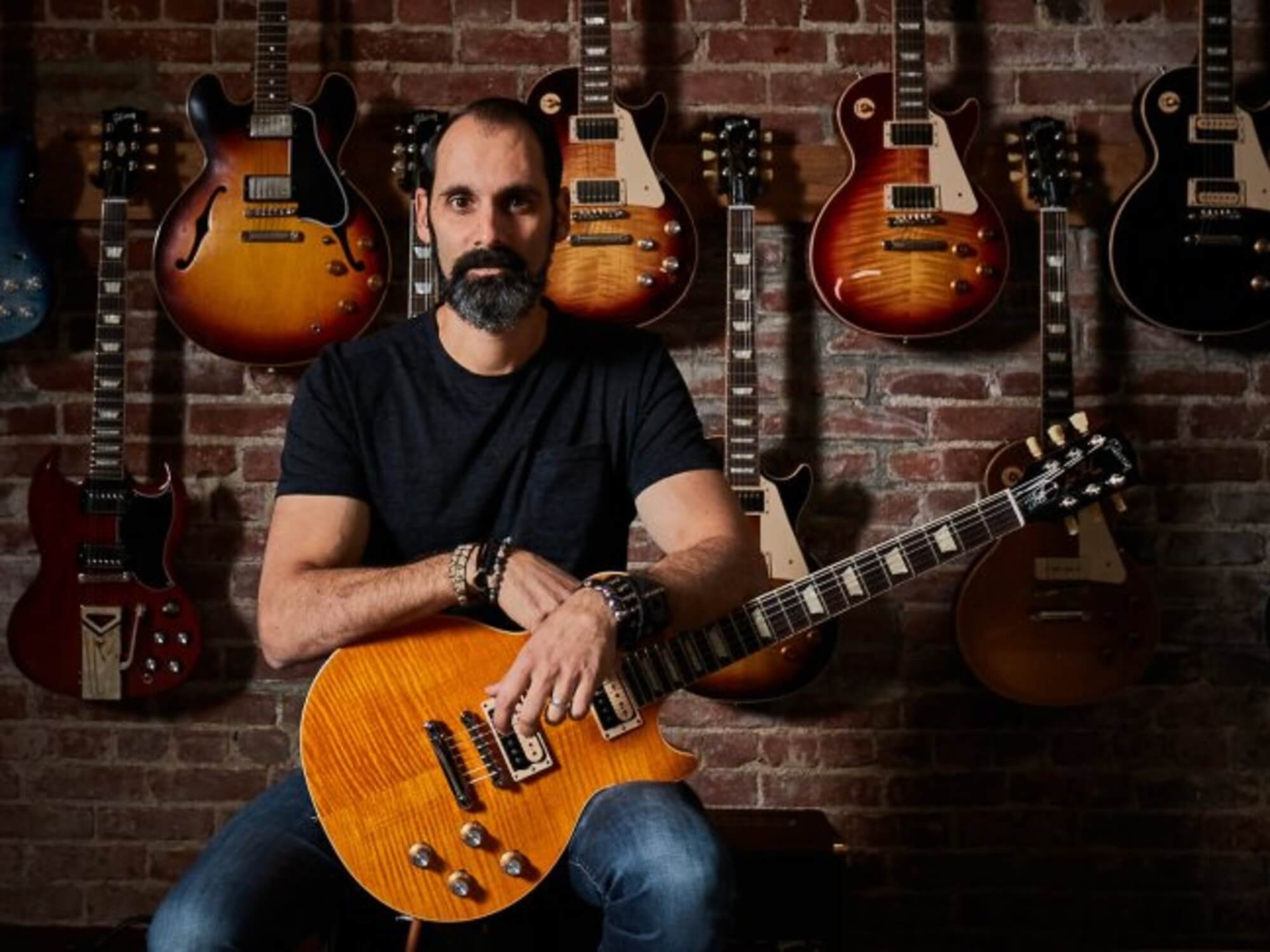
Cesar Gueikian has stepped back from his role as the CEO and president of Gibson, after three years in the position.
In a press statement announcing the change, Gibson revealed that Gueikian will remain “actively involved” at the company, as a strategic advisor to Gibson’s board and an artist ambassador. He will be replaced by interim CEO/president by Anne Rohosy, formerly Gibson’s Chief Commercial Officer, while the company searches for a permanent successor.
Gueikian stepped up to the roles of CEO and president in the summer of 2023, after serving as interim president following the departure of JC Curleigh. Over his tenure, he oversaw a refocusing of the brand on guitars – shortly after he stepped up, he stated that previous leadership had been “losing focus of what makes Gibson Gibson — which is making the best guitars ever made.” Under his leadership the company changed names from Gibson Brands Inc back to just Gibson, something he said reflected this refocusing.
In a statement, Gueikian said: “Gibson is part of my DNA. It has been the honor of my life to help lead Gibson and to work alongside the people who bring this Company to life every day. Gibson is something special – to musicians, to fans, to everyone who has ever picked up a guitar and felt that connection. I am incredibly proud of what we have built together: our team, our culture, our artists, and our global community of artists and fans. I hope to have left a legacy that will be remembered in Gibson’s history as a progressive era. I have enormous confidence in Anne and in the future of this Company, and I look forward to my next chapter as a shareholder, board member, and artist ambassador. Gibson’s best years are still ahead, and I’m excited to be part of what this Company will go on to achieve.”
His interim successor, Anne Rohosy, has been at Gibson since 2021, and in the role of chief commercial officer since 2025. “Gibson means so much to musicians and music lovers around the world, and I am honored to step into this role at such an important moment for the Company,” she added in a statement. “I have spent my time here focused on how we connect with our customers and grow the Gibson name – and that focus does not change. I look forward to working closely with Cesar, the Board, and our leadership team to ensure continuity and build on the strong foundation already in place.”
The post Gibson president and CEO Cesar Gueikian steps down appeared first on Guitar.com | All Things Guitar.
Mick Jagger’s advice to Joe Satriani: “Don’t get hung up on playing all these notes… Person number 91,000 up there cannot hear it”

Mick Jagger once gave some crucial advice to Joe Satriani when it comes to playing at large venues: less shred, more crowd interaction.
Satch, who is currently on tour with The Best Of All Worlds band, feels there are two different components to playing guitar live: the act of being a musician, and the act of being a performer. After playing with The Rolling Stones frontman in 1988 for his solo show at the Tokyo Dome, Satch learned a valuable lesson on why showing off your technical ability can sometimes be less impressive than a simple wave to the audience.
Speaking to Thinking About Guitar, he says (via Ultimate Guitar): “[Mick Jagger] said, ‘When you play places like this, it’s a lot more about this [mimics waving at audience] than it is about this [mimics shredding on guitar].’
“That was his simple way of saying, ‘Don’t get hung up on just playing all these notes, because the number 91,000 up there, they cannot hear it, they cannot see it. But if you do this [wave] and hold one note, you just made their year, because they’re going, ‘He just waved to me when he hit that unbelievable note!’ It gives you perspective about what your job is as a musician and a performer.”
Despite Satriani having a reputation for being a shreddy virtuoso, when it comes to live environments, it seems he also feels far more shy than his typical playing style might convey.
In an interview with D’Addario last year, he said: “I think the history of performing live has been a recurring subject nightmare for me, because I’m not really a kind of a people person. I don’t seek out to be in a crowd and be in front of an audience, but I love music and I want to share it. So there’s the typical artist conflict right there.”
Find out where to catch Joe Satriani on tour with The Best Of All Worlds band via his official website.
The post Mick Jagger’s advice to Joe Satriani: “Don’t get hung up on playing all these notes… Person number 91,000 up there cannot hear it” appeared first on Guitar.com | All Things Guitar.
Pages
