
Music is the universal language
“Glory to God in the highest heaven, and on earth peace to those on whom his favor rests.” - Luke 2:14
General Interest
MESA/Boogie's 90s Triple Rectifier Standard Returns With 150 Watts of Rectifier Power
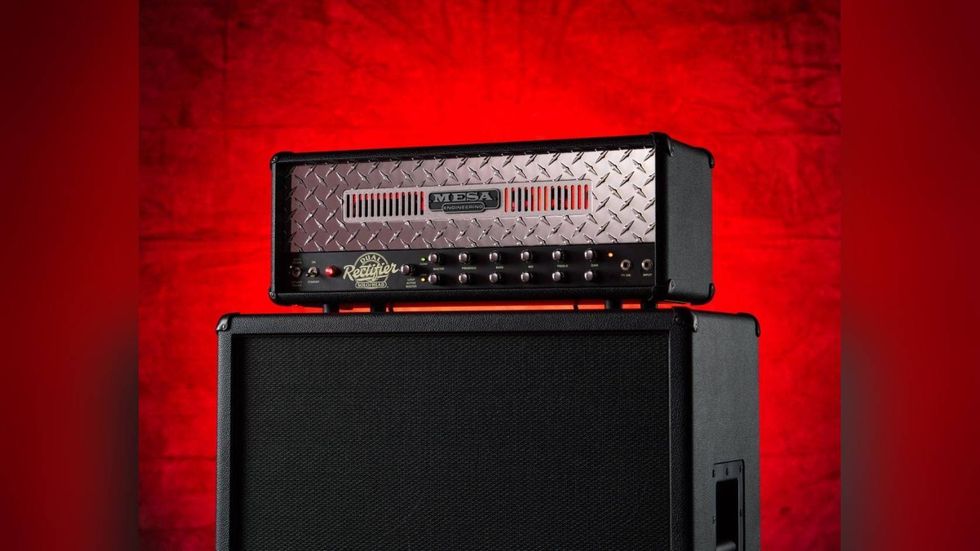
Following last year's return of the 90s Dual Rectifier Standard, MESA/Boogie is reissuing its 150-watt sibling, the 90s Triple Rectifier Standard. Like the original, it's built by hand in Petaluma, California.
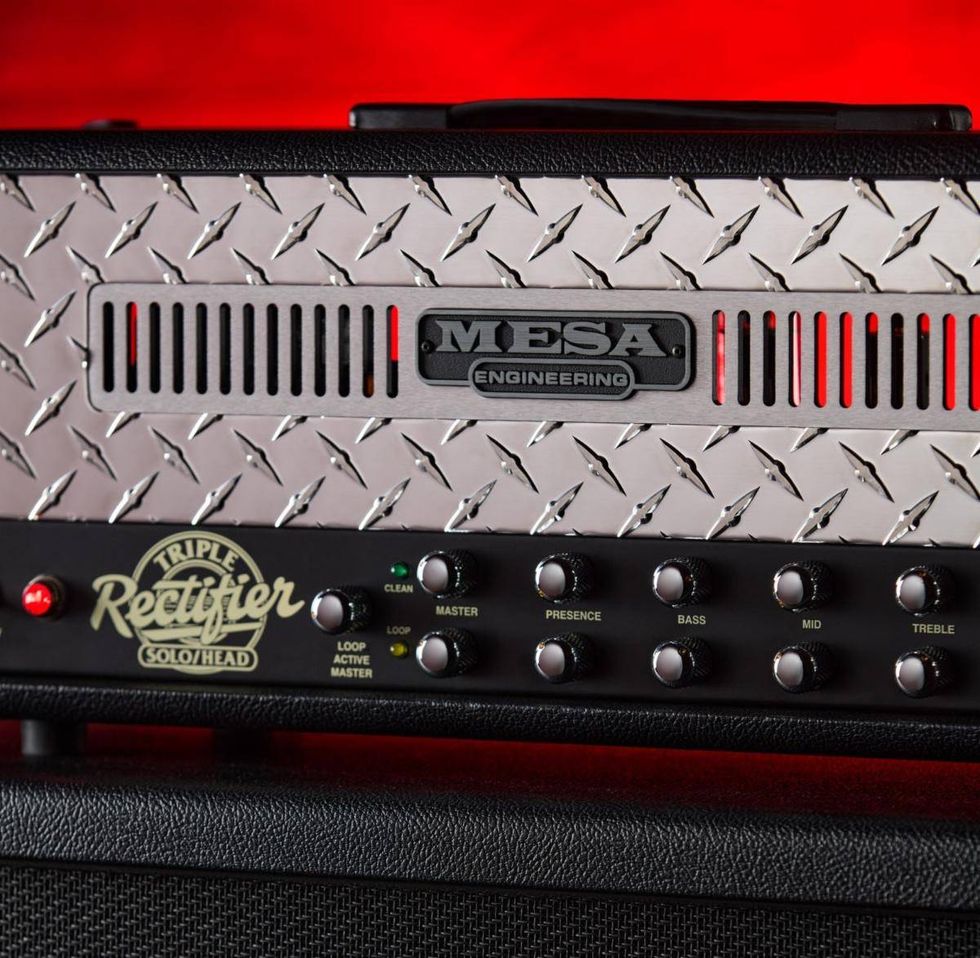
The Triple Rectifier arrived in 1992 alongside the Dual Rectifier Solo Head, scaling the design up to six power tubes and three rectifier tubes. It became a staple of '90s heavy music, especially among players using low tunings. The reissue comes in the original Standard Dress: black chassis, chrome knobs, Black Bronco vinyl, black leather corners, and a polished aluminum Diamond Plate grille.
"For players who tune low and play loud, the Triple Rectifier delivers the massive, unmistakable high-gain sound that changed the way heavy music sounded—and continues to define it today," says Andrew Ladner, MESA/Boogie's marketing manager.
The amp uses the early Rectifiers' two-channel layout. Channel 1 offers Clean and Vintage high-gain (Orange) modes and can be switched to the Modern (Red) voicing. Channel 2 defaults to Modern and can be switched to Vintage, and it adds a Normal/Tight switch for low-end control. Each channel has its own gain, treble, middle, bass, presence, and master controls.
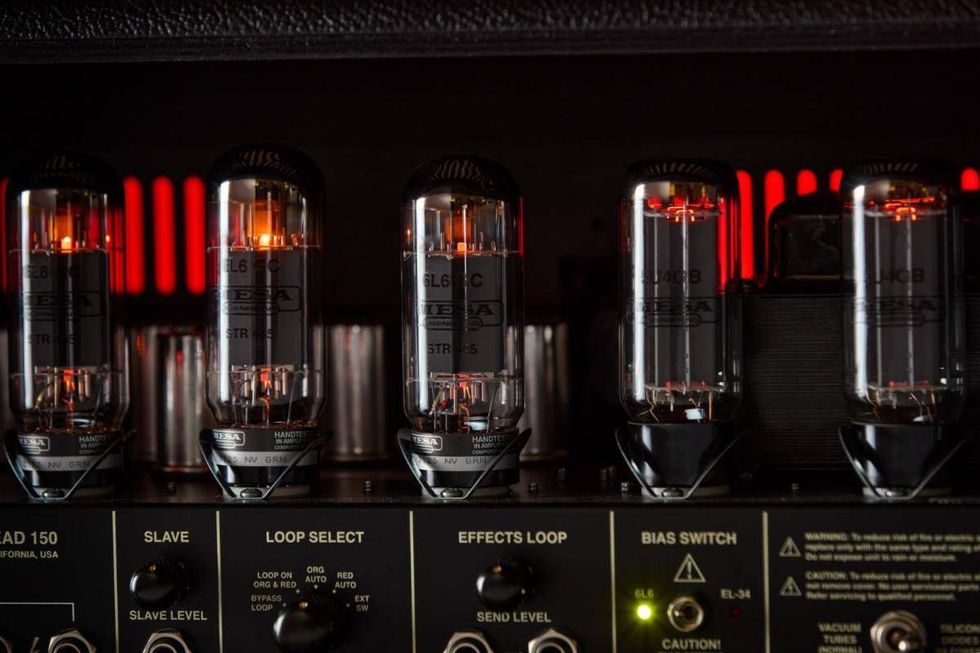
Six 6L6s drive the Class AB power section, and a rear-panel bias switch accommodates EL34s. Players can choose between three 5U4GB tube rectifiers and silicon diode rectification, and a Bold/Spongy switch alters the power section's response. Five 12AX7s run the preamp.
Key features:
- Dual channel simplicity – Simple, straightforward design (as compared to the current three-channel 2010 model), delivering killer tones and ease of use
- Channel Style/Cloning – Allows “cloning” of the mode voicings of either channel
- Patented switchable rectifiers – Tube or silicon diode rectification to tune the sound, character, and feel
- 150-watts of robust Class A/B tube power – Bias Select for stock 6L6 or a swap to EL34 tube types
- BOLD/SPONGY “Variac” switch – Reduced voltage setting for increased harmonics and elastic feel
Other features include a tube-driven series effects loop with a global output level control, external switching jacks, a slave output, and five speaker outputs (one 16-ohm, two 8-ohm, and two 4-ohm). The head is housed in a Baltic birch cabinet with a cooling fan, measures 10" x 25 1/2" x 9 7/8", and weighs 48.6 lb. It ships with a one-button footswitch, a slipcover, and a five-year warranty.
The 90s Triple Rectifier Standard head carries a street price of $3199. For more information visit mesaboogie.com.
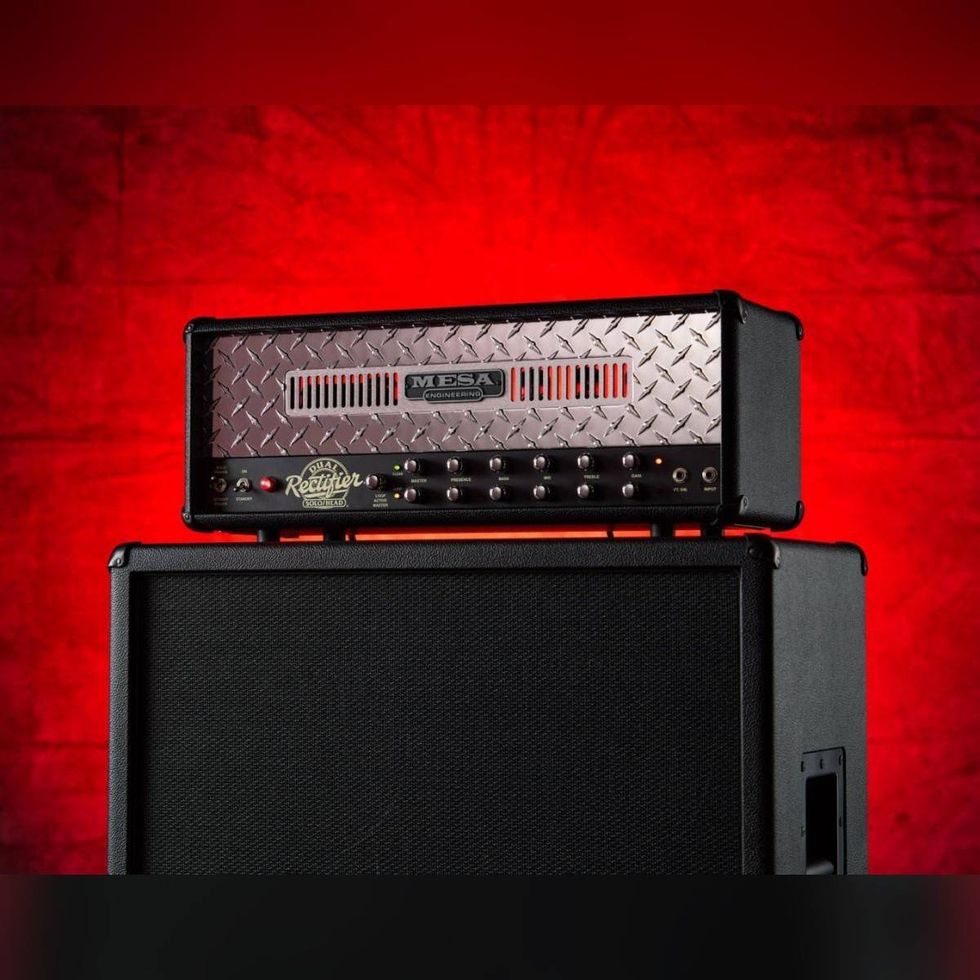
90s Triple Rectifier Standard
Following last year's return of the 90s Dual Rectifier Standard, MESA/Boogie is reissuing its 150-watt sibling, the 90s Triple Rectifier Standard. Like the original, it's built by hand in Petaluma, California.
Esoterica Electrica: Why I Quit Making, and Playing, Guitars
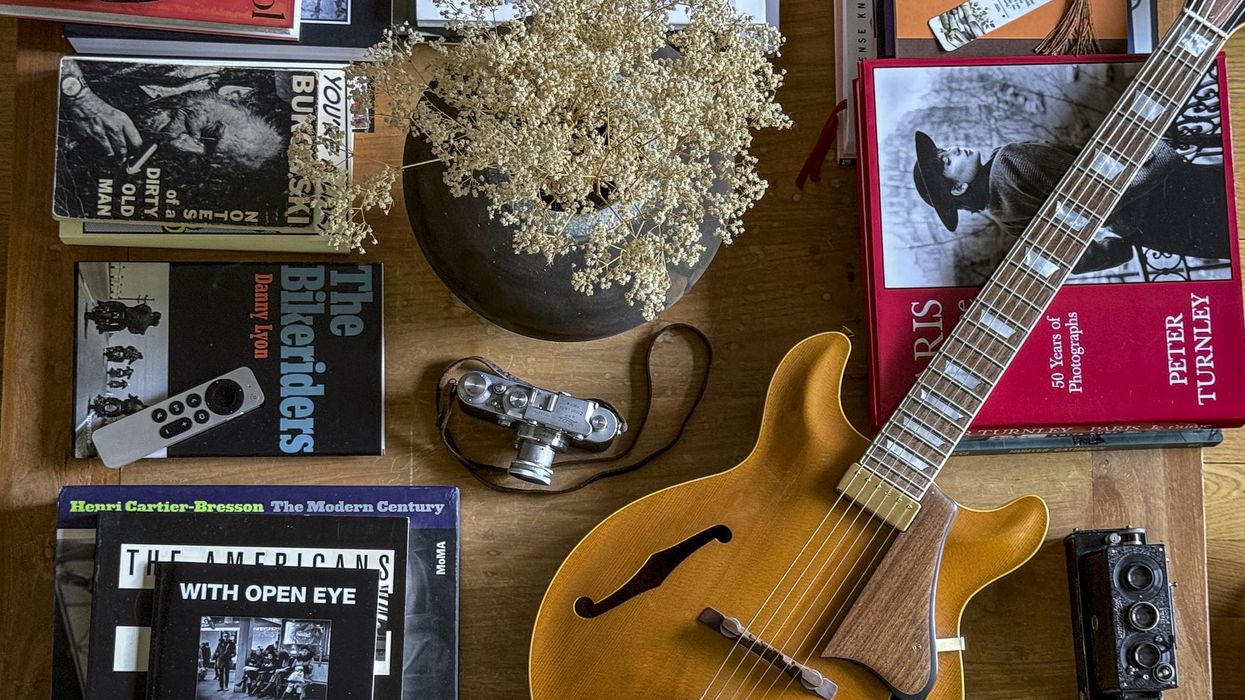
Have you ever wanted a reset? Not exactly a clean slate, total erase, and start over, but maybe a window into a fresh perspective? Most of us want to get better at what we do, and expand our vocabulary within our craft. You can double down on your work or spend more time reading, watching, practicing, and experimenting with your artistry. Those are the building blocks of mastery, but sometimes you get stuck. Inadvertently, I found something that broke the cycle of repetition both in my playing and my building. I stopped.
I wasn’t planning to quit, but a series of events conspired to allow me to pause two of the practices closest to my heart. Going on vacation was the most obvious of breaks, but even before wheels up, I had stepped away from playing and making guitars, something I’ve done almost every single day of my life for six decades. It wasn’t a conscious decision—it happened slowly and almost invisibly. I was just tired, mentally and physically. I’ve written previously about creative block (“Jump Start,” in the October 2019 issue), but this was something totally different, closer to indifference. I felt guilty about it. I have to confess that, as puzzling as it was, it also felt like relief. What I hadn’t known was that there are actually names and tactics for doing what happened organically for me—I’d become a “reframer.”
In psychology and skill development, the name for this action is known as a strategic reset, or sometimes habit unbundling. I don’t care much for bullshit jargon, but the theory is legit. Playing an instrument or almost any other pursuit for a long time, your brain develops deep neural pathways. Over time you naturally plateau and/or pick up habits that are difficult to abandon. Stepping away for an extended period completely forces your brain to forget, or at least diminish automatic and stale routines. When you begin again, you can rebuild skills more consciously, sort of like from the ground up.
“The distance reminds you why you fell in love with music in the first place, which injects soul back into your own playing later.”
Refraining from the actual act of your pursuit is also called de-coupling. It can be done for short periods—or, as in my case, months. This doesn’t necessarily mean you shouldn’t enjoy listening to music, but there are some strategies to employ. Guitarists naturally pick out the guitar track in any recording, just as drummers and bass players have a tendency to focus on their own instrument’s role in any song. This unconscious habit is what I call “player brain.” Musicians tend to automatically translate the sounds they hear into the physical actions required to make them, which is natural, but can also make you deaf to the total ecosystem and emotion of the music. It can be intimidating as well because it focuses on technique. Turning off the “player brain” allows you to feel the raw tension, release, and mood of a track. That’s why stepping away can be important. The distance reminds you why you fell in love with music in the first place, which injects soul back into your own playing later.
Interestingly, the time I’d spent immersing myself in the world of guitars had also been a reset. I found that my retreat from guitar and my workshop bench opened up time to rekindle other passions that had laid dormant. Before I made guitars I went to school for photography, but life happened and playing and making instruments became my focus. When I picked up my camera again, it felt like the first time I played an electric guitar to make beautiful sounds and express myself. So instead of playing and building, I buried myself in photography, and surrounded myself with books, and doubled down on museums. It is a world that feels new, yet deeply familiar, in a satisfying way.
Lately I’ve returned to the guitar with a newfound appreciation for sounds beyond my old go-to licks and patterns. I’m no Allan Holdsworth, but I’m happy to make noise again. The workshop bench now beckons with the old feeling of getting to the end of the day and having something rewarding to show for it. In my case, it wasn’t a planned abeyance, but that doesn’t mean it can’t be. I hope that, if you are in need of a reset yourself, you’ll find the chance to join me in walking away—and returning to find more than what you left.
Rig Rundown: Mr. Phylzzz
Chris Kies met up with Clinton Jacob of Mr. Phylzzz at the Cobra in East Nashville, where the two-piece was touring behind Fear the Lord. His rig is built to survive a player who squeezes guitars to death and plays anywhere that’ll have him—including, once, a public restroom. Have a look at some quick highlights below, and tune into the new Rig Rundown for all the details.
Brought to you by D’Addario.
Buzz Told Him So
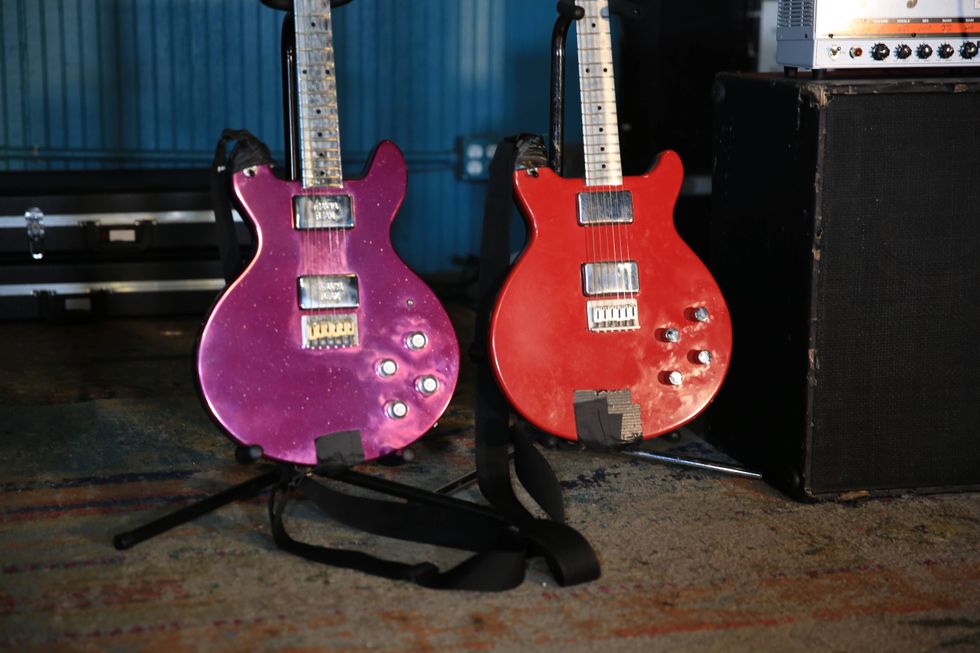
On the Twins of Evil tour with the Melvins and Boris, Clinton watched King Buzzo go almost 40 nights without adjusting a thing on his guitar, while his own guitars kept cracking and breaking. Buzzo’s pitch: you’ll get one, you’ll hate it, then you’ll love it. Clinton ordered an Electrical Guitar Company King Buzzo model, hated the paper-thin neck, and two weeks later couldn’t imagine playing anything else. It’s hollow with a plastic back, it’s a tank, and the strap locks are a wad of gaffer tape.
Hannah Montana Purple
The newest EGC arrived the night before the shoot. Clinton asked for something the builder had never done before, then handed the color chart to his partner, who picked it. It’s got a side-mounted toggle and the same pickups as the original Travis Beans, which run hot. Two things here aren’t standard: the hollow plastic back, done because Clinton wants his guitars light, and the slim neck, since this model normally comes with a chunky C.
Wood Tones
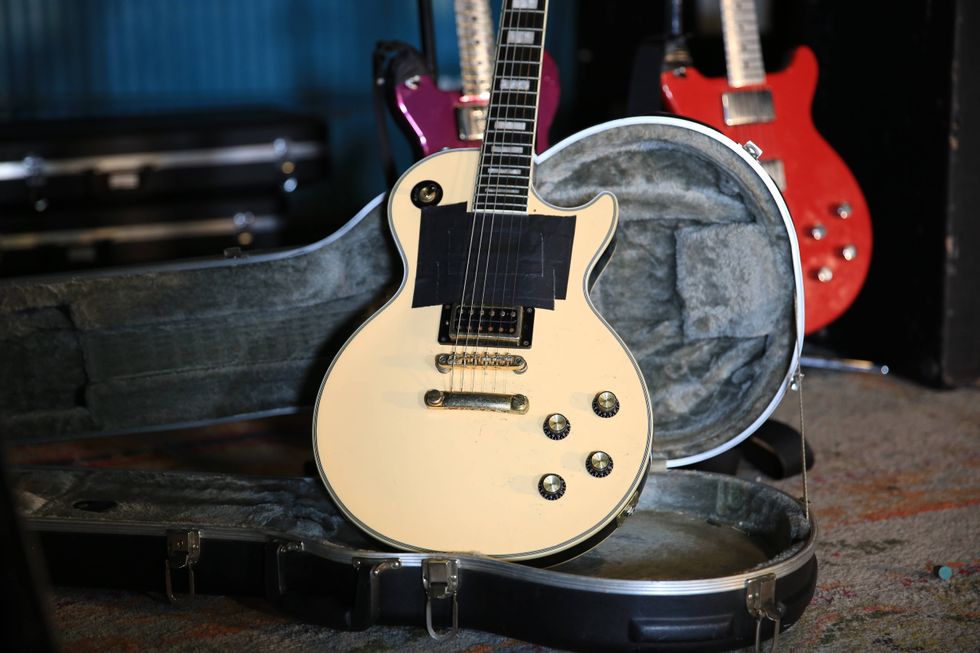
This Epiphone is named Chase—a gift from Clinton’s partner in Texas after he snapped the neck off an earlier one—and it was his main guitar for years before the EGCs arrived. It’s been “dumbed down” to a volume knob and the bridge pickup. Now it’s what saves him from getting electrocuted: an EGC is metal all the way through, so a ground tester is mandatory equipment, and any venue with an open ground means wood or nothing.
Both On, All Night
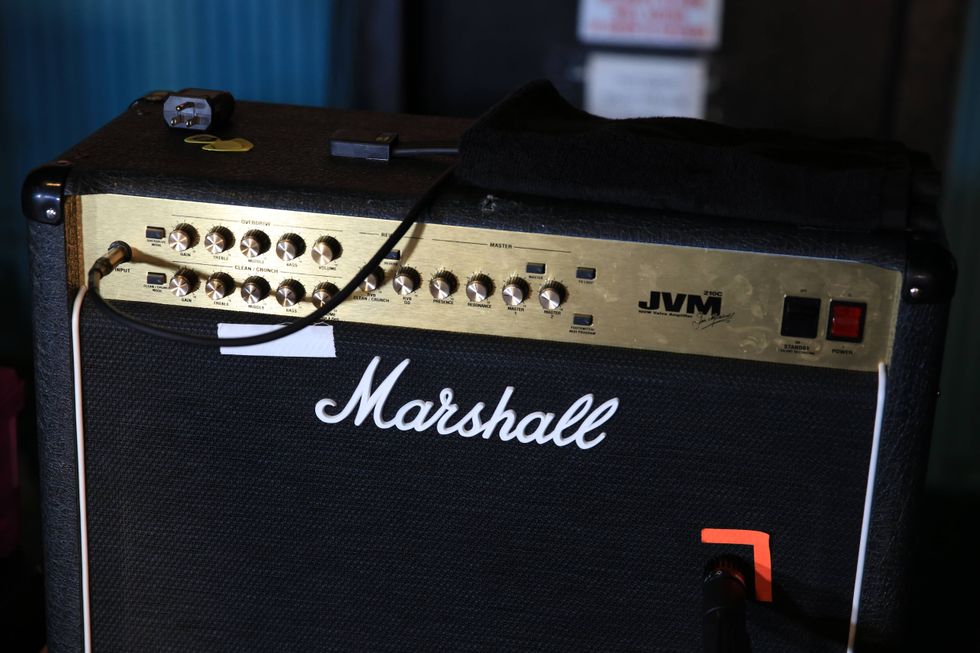
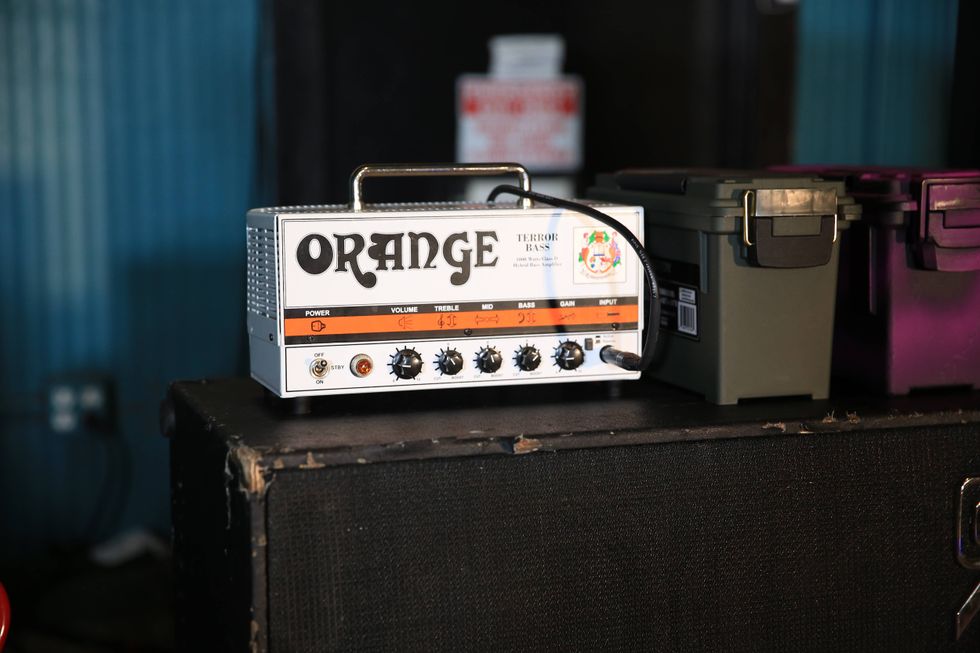
A Marshall JVM410 combo and an Orange Terror Bass run at the same time and never get switched off. He keeps it on one channel at three and watches for the green light. The Orange is dialed darker to offset how bright the aluminum guitars are, and both run clean—the guitars are nasty enough on their own. Cabs are a 2x12 and a 4x10.
Mr. Phylzzz’s Pedalboard
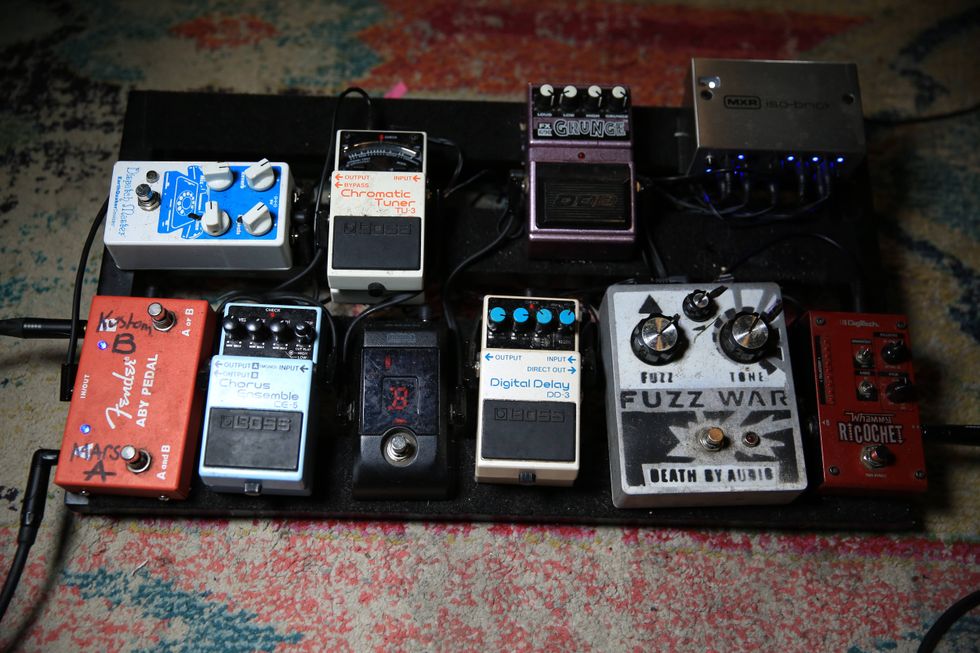
The Death by Audio Fuzz War is the whole tone, with everything set at 2 o’clock and marked so it stays there. A DOD Grunge, everything peaked, supplies a thin AM-radio nastiness for dynamic drops. A Boss DD-3 holds the wall of noise out longer before he cuts it, an EarthQuaker Devices Dispatch Master handles the haunted-house material, a Boss CE-5 Chorus Ensemble adds a little color for “Emma Draws a Dog,” and a DigiTech Whammy Ricochet covers dive bombs.
Unlock the crucial wah tone of Iron Maiden’s Killers album with this discounted signature Cry Baby pedal

Calling all Iron Maiden fans – you can now get your hands on the signature Iron Maiden x Dunlop Cry Baby wah pedal that launched earlier this year at The NAMM Show for less.
Now reduced to £169 at Thomann as part of its Guitar Day deals for a limited time only, fans and collectors alike can own the crucial wah tone used across the band’s landmark Killers album from 1981, which is certified Gold in both the US and UK.
- READ MORE: The best picks for electric guitar and acoustic guitar, from Jim Dunlop, Fender, Ibanez and more
The pedal has a rather cool design on its face, featuring none other than the band’s skeletal mascot, Eddie, taken right from the Killers album artwork. It also features the Killers title in the same font it appears in on the album’s cover, while the band’s logo runs along the side of the unit.
At the time of its release earlier this year, Metallica’s Kirk Hammett was one of the first artists to get his hands on the pedal. He shared a video to Instagram opening the pedal, in which you can also get a glimpse of its packaging – also worthy of display.
Beneath its Iron Maiden design and fittingly metal exterior, the pedal itself is essentially the classic GCB95 Cry Baby Standard Wah. Find out more and get a better look in the short video below:
Iron Maiden were inducted into the Rock & Roll Hall of Fame this year, five whole decades after their debut. But interestingly, the band haven’t felt like making much of a fuss about it.
Speaking to Metal Hammer in June, bassist Steve Harris and frontman Bruce Dickinson made it clear that while they’re grateful for the recognition, it’s never been something they’ve spent much time thinking about.
Harris said, “It’s never really bothered me one way or the other, because awards aren’t what we do this for. But in a weird way I’m glad it’s happened so the Americans will stop banging on about it. To me, if you get offered something, you say, ‘Thank you very much.’ But did I lose sleep over getting it or not getting it? No.”
Shop the Iron Maiden CryBaby pedal at Thomann now.
The post Unlock the crucial wah tone of Iron Maiden’s Killers album with this discounted signature Cry Baby pedal appeared first on Guitar.com | All Things Guitar.
“I’m going to play in front of how many? 40,000?!”: America’s Got Talent winner Nene Royal on being invited to open for Avenged Sevenfold
![Nene Royal [main], M Shadows of Avenged Sevenfold [inset]](https://guitar.com/wp-content/uploads/2026/09/Nene-Royal-hero@2000x1500.jpg)
It’s the stuff dreams are made of. Just months ago, 16-year-old Rattikarn Amloy was a relatively unknown guitar player. But following an audition on the 2026 season of America’s Got Talent – during which she performed a blistering cover of Cranberries classic Zombie – her life changed forever.
Performing as Nene Royal, the guitar sensation – who originally hails from Phuket, Thailand – stormed her way through the competition, dazzling audiences and the nation with covers of Soundgarden’s Black Hole Sun, The White Stripes’ Seven Nation Army and Muse’s Hysteria, and even joining Linkin Park themselves for a performance of their track The Emptiness Machine, before going on to win the entire show last week.
Yep, Amloy is just 16 years of age and she’s already achieved success most musicians only dream of. But she’s just getting started. In fact, her whirlwind story continues, as she’s been invited to open for one of metal’s biggest bands, Avenged Sevenfold, for their upcoming Singapore show on 13 October.
In the past few months, she’s gained considerable experience performing to large audiences – not to mention millions viewing from home. But opening for A7X, one of her favourite bands? The pressure’s on…
Speaking to Metal Hammer in a new interview, the guitarist explains how she landed the gig to open for Avenged. “The managers in Singapore text me: ‘Oh, I hear you wanna play with Avenged Sevenfold?’” she recalls.
“I was like, ‘Yeah!’ They said, ‘Well, Avenged Sevenfold want you to support them.’ They asked for me, ‘Do you wanna do it?’ And I was like, ‘Yeah!’”
As for her feelings in the runup to the show, she confesses she’s both excited and scared in equal measure.
“It’s my first time playing support to Avenged Sevenfold, so I was like, ‘I’m scared!’ And I’m going to play in front of how many? 40,000!”
Elsewhere in the interview, the Royal reveals she had no idea she was going to perform with Linkin Park before doing so during the AGT final. “I was practising on my own. I thought I was going to play alone,” she says. “But when I practised, a cameraman just came in, and then Linkin Park came in. I was like, ‘What’s going on?!’ I don’t know if Linkin Park are just gonna come and take a video, some shot, that’s all. But actually, [they] say, ‘We’re gonna join together onstage,’ and I was like, ‘There’s no way!’ My dream’s come true.”
You can catch Nene Royal opening for Avenged Sevenfold on 13 October at the Singapore Indoor Stadium. Tickets are available via the Avenged Sevenfold website.
The post “I’m going to play in front of how many? 40,000?!”: America’s Got Talent winner Nene Royal on being invited to open for Avenged Sevenfold appeared first on Guitar.com | All Things Guitar.
John Mayer thinks big guitar makers have “punished” affordable guitars by making them look worse than expensive ones
![John Mayer performing live [main], PRS Silver Sky Defender [inset]](https://guitar.com/wp-content/uploads/2026/09/John-Mayer-PRS-colour-hero@2000x1500.jpg)
One of the coolest guitar releases of the year so far – hell, in recent memory – was the spate of limited-edition PRS Silver Skys outfitted in classic Land Rover Defender colourways launched last earlier this month.
It marked the announcement of an unexpected partnership between the guitar maker and Jaguar Land Rover, driven chiefly by the Silver Sky’s namesake John Mayer’s love of the legendary SUV.
The collab consists of eight Silver Sky models boasting Defender finishes: four USA-made ones sporting classic Defender colourways like Arles Blue and Sandglow Yellow, and four SE models wearing some more contemporary finishes, like Petra Copper and Woolstone Green.
 Credit: PRS
And a big part of the collaboration for Mayer was ensuring those with more SE-adjacent budgets weren’t being shortchanged in terms of the look of the guitars in comparison to the more expensive USA-made models.
In a new interview with Guitar World following the launch, the guitar maestro – who has also just announced a huge six-night residency at the Las Vegas Sphere, his second stint at the venue after a lengthy residency with Dead & Company in 2024 and 2025 – explains why it was important to make sure the more budget-friendly Silver Sky Defenders also looked the part.
Notably, the SE models – which despite their limited run are priced at a reasonable £799 apiece – are the first Silver Skys to feature a highly requested black pickguard.
“It’s almost like the first appearance of Wolverine. Everyone’s waiting for it,” Mayer says. “I think it’s interesting that it makes its appearance on the SE line as opposed to just having it trickle down from the Core line.”
“I thought it was nice to give something to the SE,” he continues. “When I was growing up, the more accessible guitar got punished for being more accessible. I learned a lot from the SE.
 Credit: PRS
“I originally had the idea like, ‘Oh, you tier it.’ Then guitar lovers of the world spoke to me. I learned that some people are going to have an SE forever. It doesn’t have to be a consolation and someday you’ll work your way up. That’s when I thought, ‘There should be a little bit to separate the lines.’”
It is, indeed, common for guitar companies to separate colourway options for their differently priced guitar lines, and some argue that the more aesthetically pleasing colours tend to be available on more expensive models. But that was the opposite of Mayer’s approach to the Defender collaboration.
“Teaming up with Defender to offer the Silver Sky guitar in their legendary 4×4 colors is a dream come true,” said Mayer, a keen Defender enthusiast, when the collab was announced.
“I’ve always chosen colourways based on objects and materials that inspire me in the world, and as a collector and lover of Defenders, this collaboration is the perfect crossover between two great passions of mine.”
Learn more about the new limited-edition Silver Sky Defender guitars at PRS.
The post John Mayer thinks big guitar makers have “punished” affordable guitars by making them look worse than expensive ones appeared first on Guitar.com | All Things Guitar.
Need a new guitar? Pining for a pedal? Get 30% off loads of gear goodies with Guitar Center’s Guitar-A-Thon

[Editor’s note: Guitar Center caters to US customers. If you’re reading from elsewhere, you’ll be shown similar deals.]
Guitar Center is currently offering up to 30 percent off a range of popular gear across its website, all thanks to its big Guitar-A-Thon event.
Running right now all the way through 7 October 2026, you can save on guitars from Fender, Epiphone, Squier, and even on a range of popular pedals too.
- READ MORE: Want to test the prototype from Guitar Center’s new in-house guitar brand? Here’s how you can
If you’re new to guitar, or perhaps you’re looking to upgrade your rig, then we’ve found some great deals to help you out. We’ve rounded up some of the best highlights for players of all tastes and abilities below.
Fender Player II
Get up to 30 percent off on a range of Fender Player II models, including GC exclusive models such as the Fender Player II Telecaster in British Racing Green (now $679.99), Fender Player II Stratocaster HSS Plus Top in Blue Burst (now $650.99), and the Fender Player II Stratocaster HSS in Ocean Turquoise (now $622.99) – just to name a few.
Epiphone Les Pauls
Epiphone offers a range of Les Paul models for a more accessible price point than your typical Gibson models, but with even more savings on top, you can really grab a bargain. Most of these discounted models are also GC exclusives, with some particularly spectacular finishes. Get a Les Paul Modern Pro model in Wine Red for $499 or a Les Paul Custom Quilt model in Cobra Burst for $649.
 Credit: Guitar Center
Squier starter kits
Perfect for beginner players of all ages, Squier guitars make for a great starting point, and these discounted packs come with everything you need to get learning. For just under $300, you can get a Stratocaster in either Arctic White or Sonic Blue, with a compact Squier Frontman 10G amplifier, a gig bag, instrument cable, plus a strap and picks.
Save on big-brands across pedals
In need of a new distortion pedal? Obsessing on the idea of an overdrive? Grab a colourful BOSS Super Overdrive or Distortion pedal with a matching colour-coordinated cable included, now for $69.99 each, discounted from $99.99.
You can also save on further pedals such as an MXR EVH 5150 Bumblebee Overdrive, now down to $199.99, the ProCo RAT2 for $88, and many more, as well as deals on pedalboards and accompanying cases.
 Credit: Guitar Center
To view all Guitar-A-Thon deals, head over to the Guitar Center website.
The post Need a new guitar? Pining for a pedal? Get 30% off loads of gear goodies with Guitar Center’s Guitar-A-Thon appeared first on Guitar.com | All Things Guitar.
Warm Audio Announces Mod Series Pedals, Including Black Keys Peach Fuzz
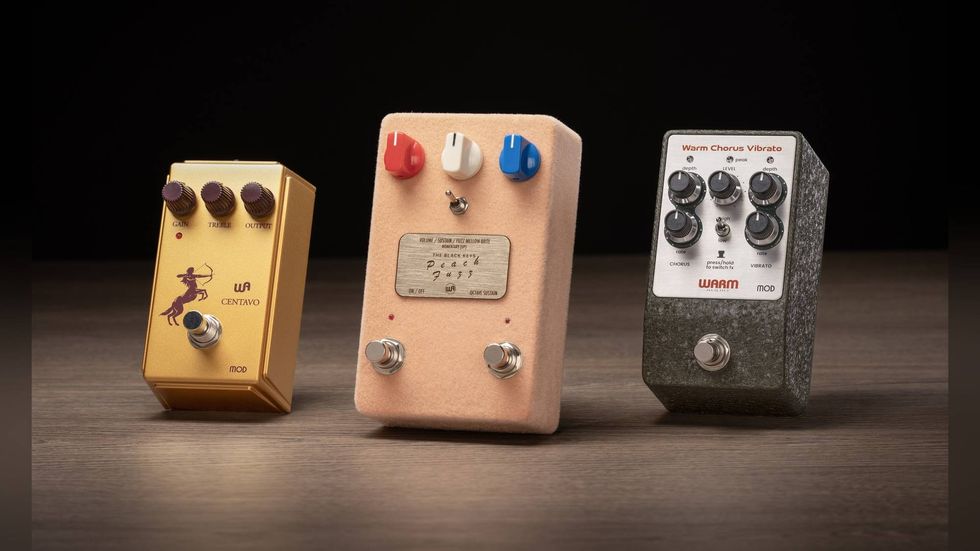
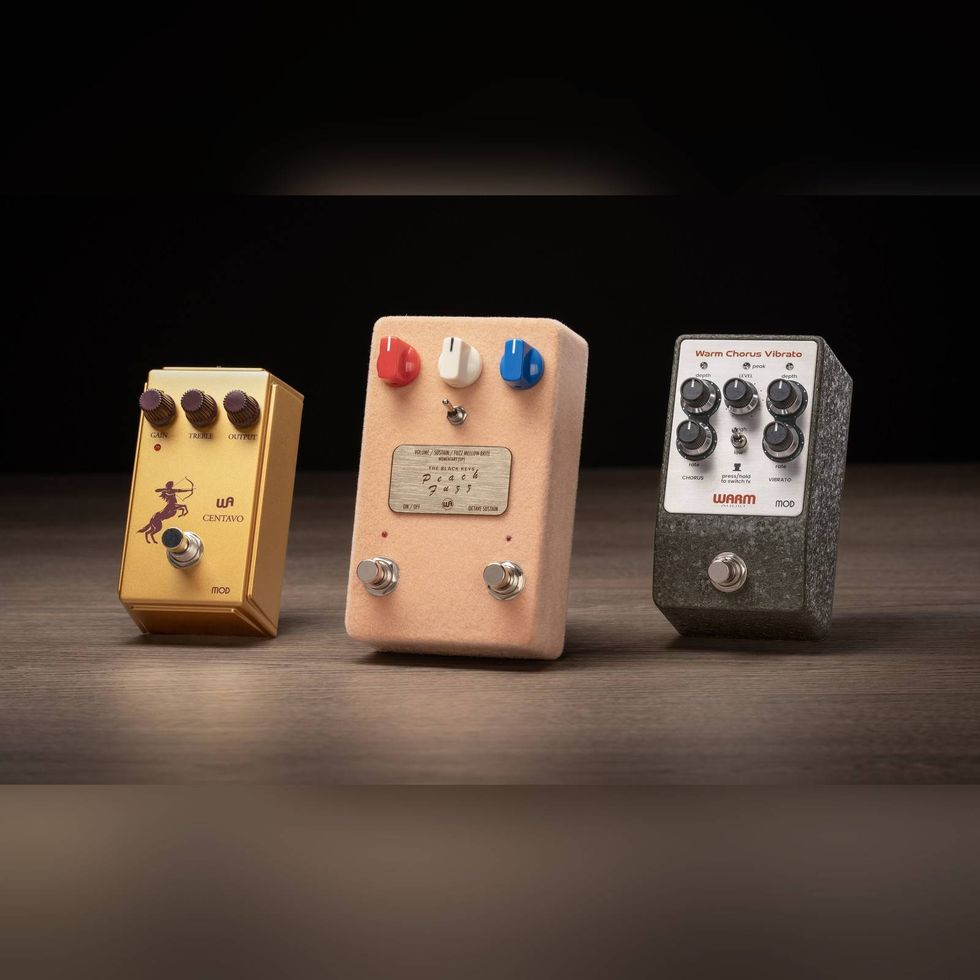
Warm Audio has introduced the Mod Series, a new line of guitar pedals that redesigns select Warm Audio recreations with slimmer, more pedalboard-friendly footprints and added features on select models.
The Mod Series debuts with three modified pedals, establishing a new and expanding lineup within the Warm Audio pedal family:
- Centavo Mod | A slimmer, pedalboard-friendly design of Warm Audio’s recreation of the most sought-after golden overdrive, while preserving the same vintage-accurate circuit and premium components.
- WA-C1 Mod | A compact design of Warm’s faithful recreation of the celebrated all-analog chorus and vibrato circuit, now with an added preamp bypass.
- The Black Keys Peach Fuzz | Developed in collaboration with Dan Auerbach, guitarist for The Black Keys, a pedalboard-friendly version of Warm Audio’s vintage-inspired ’70s Foxy-style fuzz and octave circuit, customized with selectable momentary or latching octave-up control.
Centavo Mod: Compact High-Headroom Professional Overdrive Pedal
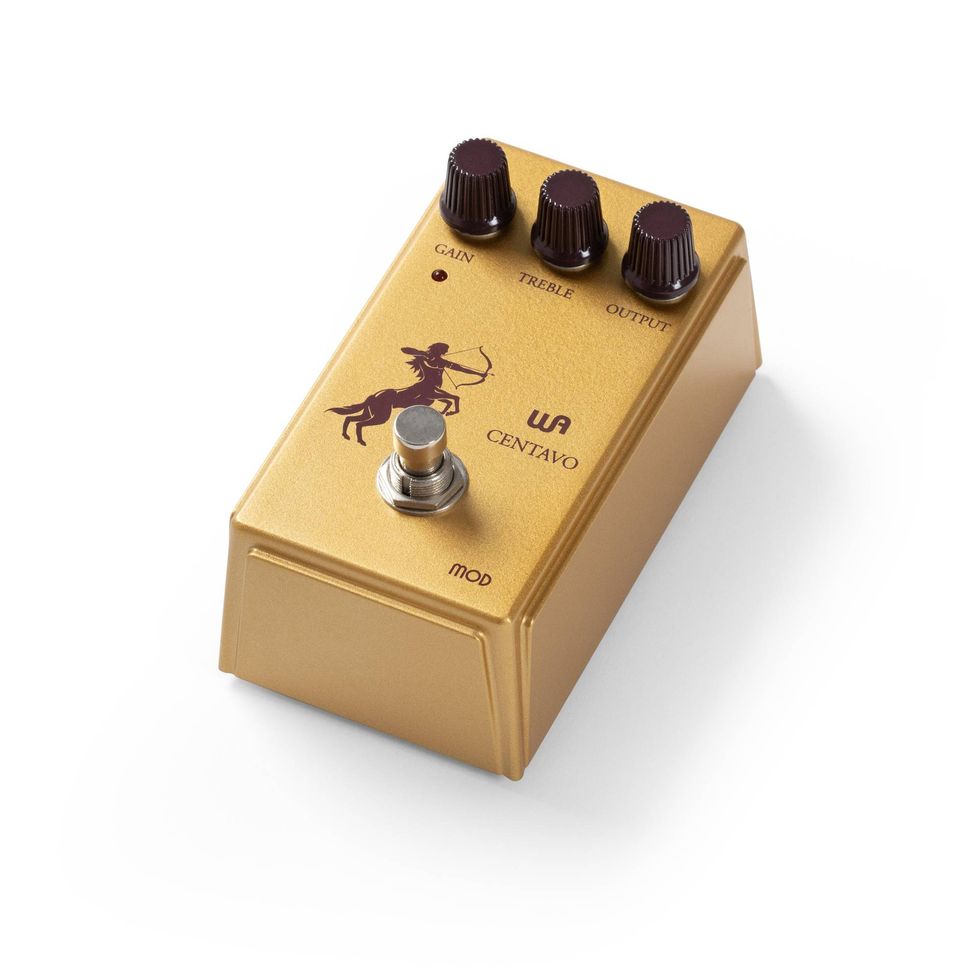
The Centavo Mod delivers the same vintage-accurate circuit and premium components as the full-sized Centavo in a slimmer design with top-mounted jacks for easier pedalboard integration. Built for everything from clean boosts and transparent overdrive to pushing an already-driven amp, it retains the familiar gain, treble, and output controls along with the MOD switch from Warm Audio’s original recreation, which extends low-end response for a fuller, throatier character on the lower strings. Inside, carefully selected components including TL072 op amps and premium diodes preserve the signature clean boost, edge-of-breakup, and hard-clipping tones of the original circuit.
Enjoy the videos and music you love, upload original content, and share it all with friends, family, and the world on YouTube.
WA-C1 Mod: Compact Stereo Chorus & Vibrato Pedal With Added Preamp Bypass
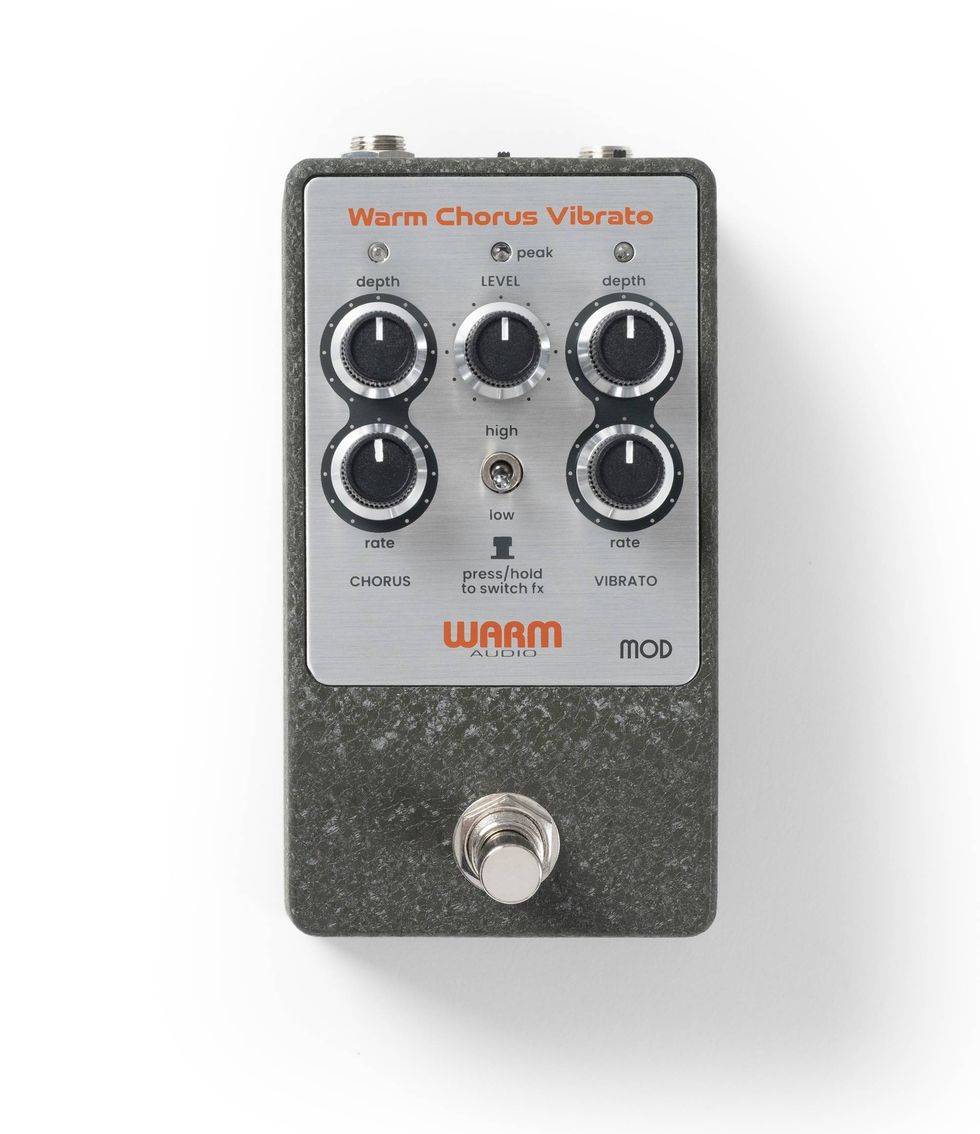
The WA-C1 Mod preserves the rich, all-analog chorus and vibrato character of Warm Audio’s original recreation in a slimmer, more pedalboard-friendly design with top-mounted jacks. New to the Mod version, the celebrated analog preamp can now be bypassed for greater control over gain staging in complex signal chains. The WA-C1 Mod retains the expanded control of Warm Audio’s original recreation, including independent chorus depth and rate controls, selectable Hi-Z impedance, wet/dry stereo outputs, and the lush BBD chorus and three-dimensional vibrato at the heart of the legendary circuit.
Enjoy the videos and music you love, upload original content, and share it all with friends, family, and the world on YouTube.
The Black Keys Peach Fuzz: Fuzz FX Pedal With Selectable Octave-Up Hold
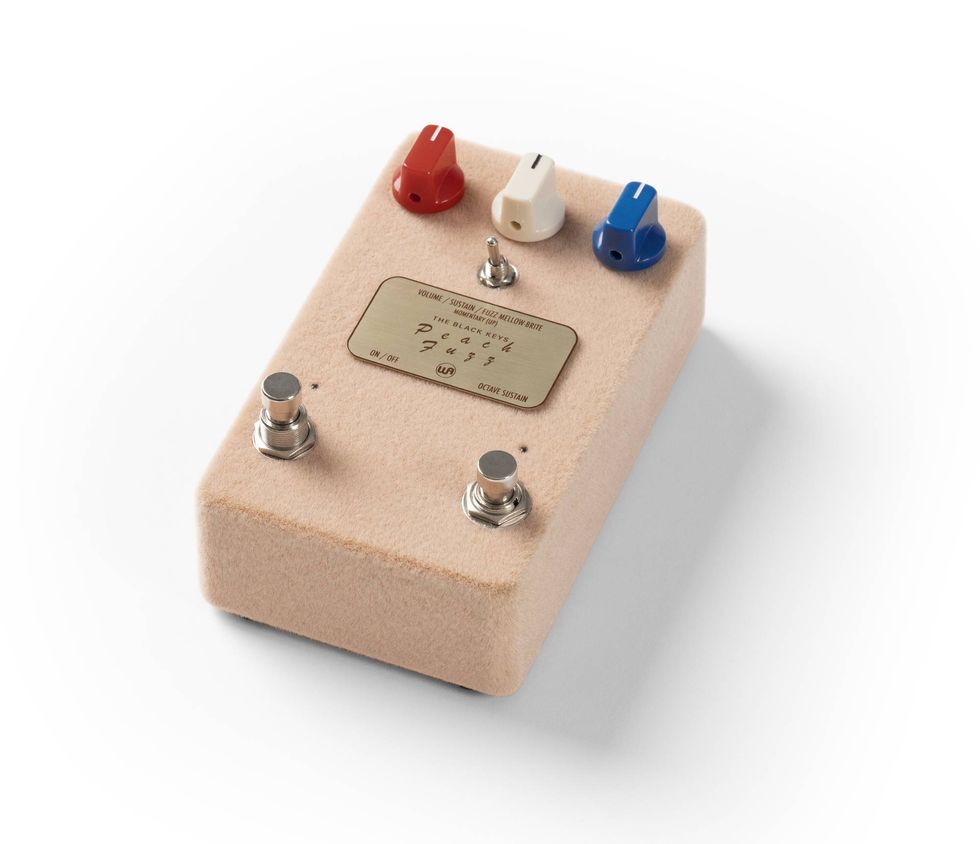
A collaboration between The Black Keys and Warm Audio, the limited-edition Peach Fuzz delivers Warm Audio’s vintage-inspired ’70s Foxy-style fuzz and octave circuit in a new slimmer design, with the searing saturation and octave-up solo magic that define the original. Covered in thick flocked velvet in a special peach color celebrating The Black Keys’ 2026 release, Peaches!, the pedal moves from mellow fuzz and gritty crunch to huge, saturated tones and soaring octave leads. Working closely with The Black Keys guitarist and frontman Dan Auerbach, Warm Audio added a selectable momentary/latching octave-up hold switch, making it easy to kick in octave tones for riffs, solos, and creative studio moments.
Like all Warm Audio gear, the Mod Series pedals are meticulously hand-tested and inspected and come with a 5-year warranty.
Enjoy the videos and music you love, upload original content, and share it all with friends, family, and the world on YouTube.
The Warm Audio Mod Series pedals carry the following street prices:
Centavo Mod — $189 USD | €219 inc. VAT | £189 inc. VAT
WA-C1 Mod — $199 USD | €229 inc. VAT | £199 inc. VAT
The Black Keys Peach Fuzz, Limited Edition — $199 USD | €229 inc. VAT | £199 inc. VAT
Mod Series
Warm Audio has introduced the Mod Series, a new line of guitar pedals that redesigns select Warm Audio recreations with slimmer, more pedalboard-friendly footprints and added features on select models.
How to Play “Heart of Gold,” Neil Young’s Simple but Enduring Hit

Martin D-X2E Molly Tuttle review: “if I closed my eyes, I really could tell myself I was playing a 1940s guitar”

$999/£999, martinguitar.com
The world of bluegrass flat-picking acoustic guitar is in rude health at the moment, as a new generation is elevating and propagating the form to new audiences and new levels – from Billy Strings and Trey Hensley, to Chris Eldridge and Cody Kilby, and many others.
And then there’s Molly Tuttle. The 33-year-old Californian is a two-time IBMA guitar player of the year and back-to-back winner of the Grammy Award for Best Bluegrass Album, and was even nominated in its hugely prestigious Best New Artist category in 2023. That’s an honour shared in recent years by everyone from Noah Kahan and Gracie Abrams, to Ice Spice and Chappell Roan.
All of which to say is that Tuttle is not just a flatpicking guitarist of rare talent, but one whose artistry is crossing the floor to bring a whole new audience into the realm of bluegrass and Americana.
As is usually the case with flatpickers, Tuttle has been a great exponent of the Martin dreadnought throughout her career, and so it makes all the sense in the world that Martin would honour her not just with one signature model, but two. There’s a fancy Nazareth-made D-18 for the well-heeled ($4,199.99), but interestingly also a more affordable Mexico-made version, we’re looking at the latter.
What is it?
The DX-2E Molly Tuttle is, like its US-made sibling, inspired by Tuttle’s most beloved and cherished Martin: a 1943 D-18. The most notable thing that sets it apart from a regular X Series dreadnought is the neck profile, which is a fast, comfortable 1940s carve with the same 1 11/16″ nut width. This 1941 carve has a soft V to it, and unlike most of the X Series guitars, it has a standard taper, so it doesn’t get narrower as you move up the neck.
The other striking differences are mainly cosmetic – the spruce top is finished with a lovely vintage sunburst, while the satin-finished HPL back and sides have a vintage mahogany pattern. The ebony fingerboard features a faux abalone and pearl custom Moon Phase pattern on it, and you also get a silver logo on the headstock, plus a set of open-gear tuners with custom oval buttons.
Otherwise, it’s pretty much the same as a standard Martin DX-2E – with a solid top, HPL back and sides, a select hardwood neck, and Martin E-1 electronics. You also get a plush Martin-branded gig bag.
 Image: Press
Build and playability
Upon pulling the guitar out of the aforementioned gig bag, the aesthetics of Tuttle’s DX-2E really grabbed my attention. The satin-finished top with its vintage sunburst gives a very ‘old’ vibe, and sat on a guitar stand across from my desk, it really does look like a pre-war Martin, at first glance at least. The more rounded shape of the headstock compared to a modern Martin, combined with those open-gear tuners, really does change the vibe of the guitar and make it seem more classic and worn in – a nice touch.
Picking it up, and on close inspection I’m less taken with the lack of binding – a feature common to all X Series but one that really does make the guitar feel less premium. I understand that there are likely cost and range-differentiation reasons behind this (the Road Series exists after all!) but on a signature model like this, especially one that costs $200 more than a regular DX-2E, it’s a shame to have the illusion broken so easily.
Because when you play the thing, it’s very easy to forget that you are in fact playing an X Series, because this satin-finished 1941 neck is an absolute superstar. I’ve played a few pre-war Martins, and you can tell the care and attention that’s gone into getting this profile and feel just right. When I closed my eyes, I really could tell myself I was playing a 1940s guitar.
What’s more, in contrast to say, the slimmer nut of the Billy Strings model that seemed more readily designed for bluegrass picking at speed, the fingerboard here feels like a nice, accommodating middle ground that will suit any playing style. It’s something that the original 40s Martin dreadnoughts did so well, and it’s very impressive that the company has recreated it here.
 Image: Press
Sounds
It might be damning the DX-2E with faint praise to say that it sounds like a standard Martin dreadnought, but in truth that’s exactly what it’s supposed to be. It’s absolutely not going to trick my ears into thinking that it’s a 1940s guitar in the way it fooled my eyes and hands, but this is a sub-$1,000 guitar we’re dealing with here, c’mon!
What it offers is a powerful, strident voice that’s warm and subtle, and I do notice a bit more treble and mid-frequency bite than a typical Martin dread, which is all rather pleasant.
Plugged into an amplifier, I found the E-1 system to be very usable and effective – it does a nice job of replicating the unplugged sound. The subtle soundhole controls are really handy in the heat of battle, as is the onboard tuner, which looks up at you from inside the bottom of the soundhole. Some may not love what it does to the aesthetics of the guitar, but I like how the E-1 system’s battery is stowed behind a flip-up plastic cover around the strap button – it’s a lot easier than fishing around the guitar for a velcro’d battery inside!
 Image: Press
Should I buy one?
This is another really impressive Mexico-made signature model from Martin – the Navojoa team is doing some really fantastic work right now, and we’re seeing the best of it in how they’re being entrusted with artist guitars like these.
The great thing about this guitar in particular is how much of a great all-rounder it is – that neck is one of the finest Martin carves I’ve felt outside of the Nazareth factory, and you can tell it’s put a lot of time and effort into nailing the playability and feel of Tuttle’s guitar.
It’s a shame that the aesthetic appointments let things down somewhat, but the thing about looks is that they’re subjective – and the rest of the package far outstrips its price tag.
Alternatives
The regular D-X2E ($/£749) doesn’t have the wonderful neck of the Tuttle version, but it’s still a fine guitar for a lot less money. The other signature guitar in the X Series is the D-X2E Billy Strings ($949) and is another fine guitar that’s more ready to shred. Taylor’s Academy 10E ($799) is another quality Mexico-made dreadnought for not a lot of money.
The post Martin D-X2E Molly Tuttle review: “if I closed my eyes, I really could tell myself I was playing a 1940s guitar” appeared first on Guitar.com | All Things Guitar.
Strymon Unveils La Brea Analog Tape Drive
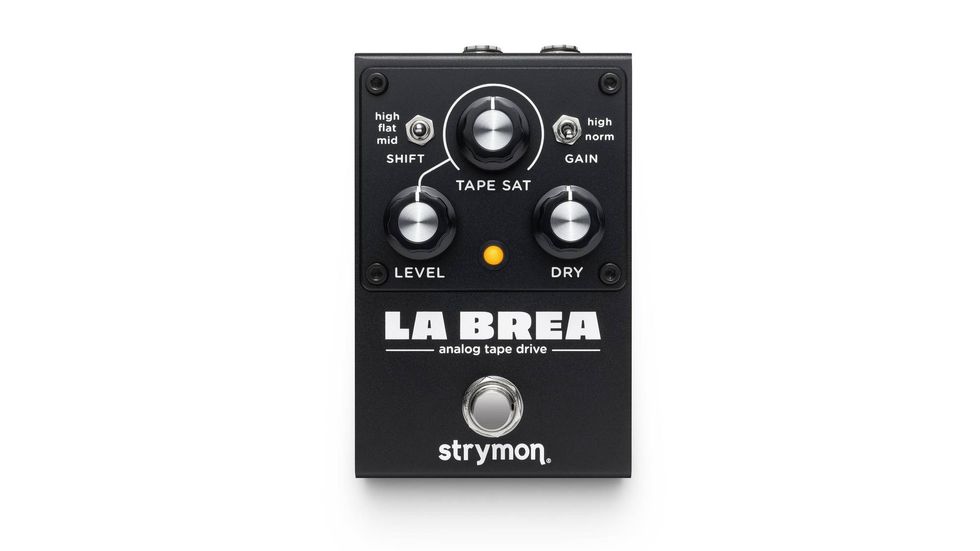
Strymon Engineering (www.strymon.net), has introduced a new analog tape drive pedal called La Brea.
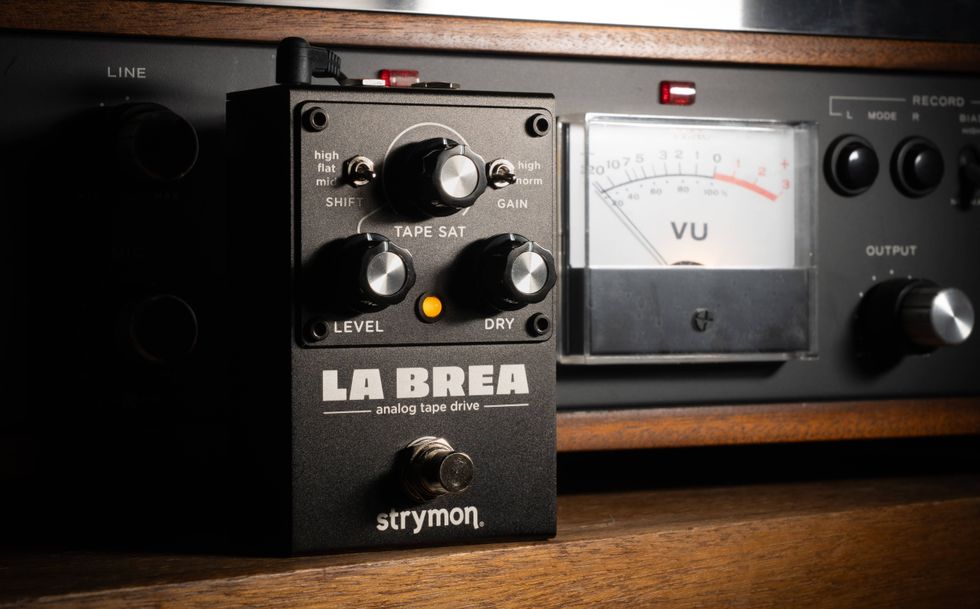
Incorporating multiple stages of analog gain using techniques learned from studying vintage tape machines, La Brea delivers a wide range of saturation from a simple interface. The pedal never sounds harsh even at extreme settings, and piling on the gain just makes things fatter and more saturated without getting crispy or painful to listen to, just like a real mastering tape deck.
Initially inspired by the white paper that co-founder Pete Celi wrote on the development of Strymon’s iconic Deco pedal, analog engineer Josh Forbes aimed for true tape behavior in a fully analog design.
In addition to the tape saturation side, La Brea also features a fully discrete dry path, giving the pedal two distinct personalities that players can use to craft personal sounds. The dry path always stays in phase with the saturated output, meaning you can add a little or a lot with no comb filtering or other artifacts. The discrete operation also means that it can be used as a pure clean boost, or a clean boost that allows you add saturation (as much or as little as desired) to fatten up single notes and chords.
As tape has a tendency to saturate high frequencies first as the gain increases (making them less prevalent), La Brea also features a three-position Shift switch that allows the player to add some of those high frequencies back in to the output. One position concentrates on adding high frequencies only, and the other adds upper midrange frequencies to the high boost to help notes poke though the mix. It’s a powerful tool that can help wake up dark humbuckers, add bite to older strings or make setting up a rig even easier.
“It’s crazy to think that Josh read Pete’s whitepaper on the making of Deco over twelve years ago, which was before he even worked here”, said CEO and chief analog guru Gregg Stock. “He’s been thinking about how to recreate tape behavior purely in the analog domain ever since, so it’s great that we now have the Series A line of analog pedals to showcase these great ideas our guys come up with. La Brea is a drive pedal with a unique voice and response, so it fits really well with the other pedals in Series A.”
“It’s quickly become the favorite drive pedal for a bunch of people at the office”, said Sean Halley, Strymon’s marketing guy. “The fact that it’s based on tape means that it never gets harsh, never gets strident, and mates really well with all different types of amplifiers. I’ve had one on my gigging board since the beginning of the year in disguise, so I’m excited to take the tape off and finally let people see what it is!”
La Brea carries a street price of $199 US. For more information visit Strymon.net.
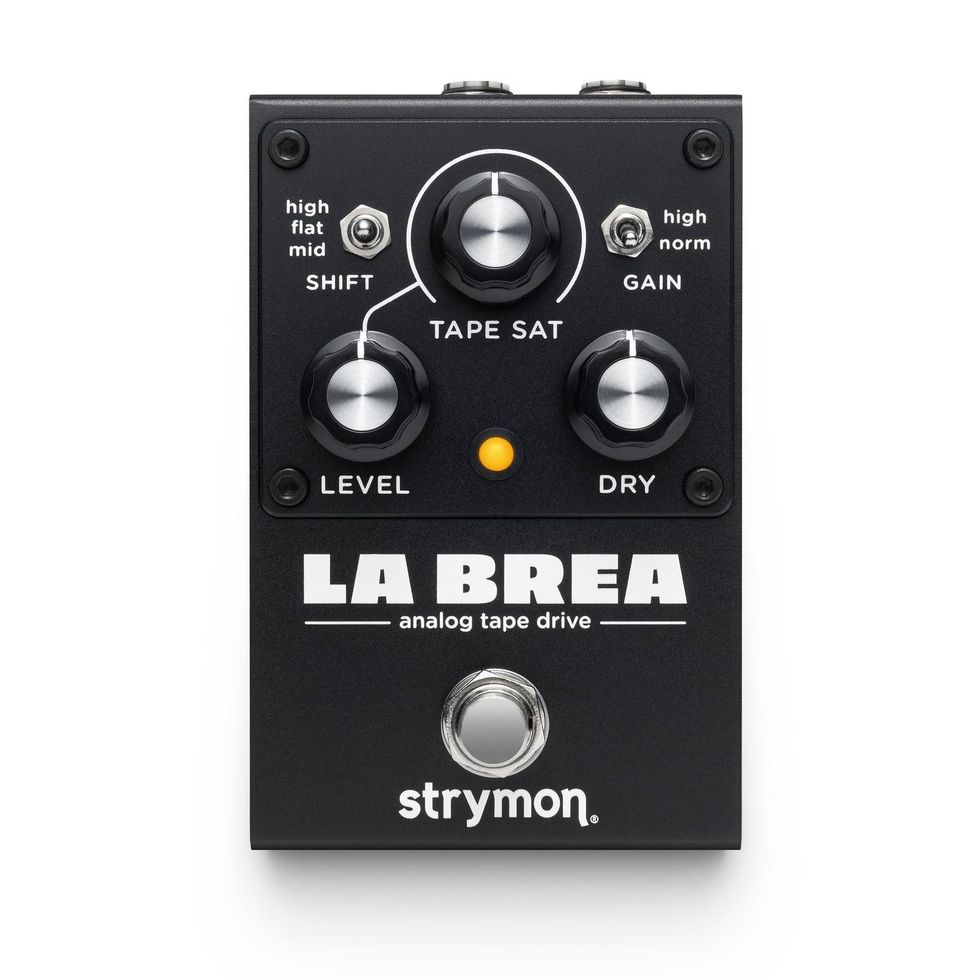
La Brea
Strymon Engineering (www.strymon.net), has introduced a new analog tape drive pedal called La Brea.
Factory Tour: Keeley Electronics
John Bohlinger gets an in-depth tour from founding mod scientist Robert Keeley who peels back the curtain to show how his Oklahoma City facility can turn an idea into a pedal within a week. As you'll discover during the video, Keeley handles the majority of all manufacturing inside their OKC headquarters, including production of enclosures, procuring onsite prototype tests, populating circuit boards, component testing, painting cases and adding custom graphics, overseeing quality control, and conducting repairs. Check out how they shape your guitar tone!
Factory Tour: Keeley Electronics
John Bohlinger gets an in-depth tour from founding mod scientist Robert Keeley who peels back the curtain to show how his Oklahoma City facility can turn an idea into a pedal within a week. As you'll discover during the video, Keeley handles the majority of all manufacturing inside their OKC headquarters, including production of enclosures, procuring onsite prototype tests, populating circuit boards, component testing, painting cases and adding custom graphics, overseeing quality control, and conducting repairs. Check out how they shape your guitar tone!
Podcast 563: Frank Gross of Thunder Road Guitars
Frank Gross, founder of West Seattle’s Thunder Road Guitars, joins us this week.
Thunder Road is a unique brick-and-mortar success story. Thanks to some smart business moves (online and off), Thunder Road has thrived. In fact, Frank recently purchased and renovated a commercial space for the store!
During our chat, we talk about Seattle’s thriving independent guitar stores; Thunder Road’s offerings (they carry big brands like Fender and Gibson alongside consignment instruments); and so much more.
We are brought to you by Peghead Nation: https://www.pegheadnation.com
(Get your first month free or $20 off any annual subscription with the promo code FRETBOARD at checkout).
Mike & Mike’s Guitar Bar: https://mmguitarbar.com


The post Podcast 563: Frank Gross of Thunder Road Guitars first appeared on Fretboard Journal.
Eric Clapton says he made a “big, big mistake” auctioning off his legendary “Blackie” Stratocaster

Over the years, guitars played by Eric Clapton have commanded some eye-watering price tags at the auction block. Just last year, among the vast guitar collection of late billionaire and Indianapolis Colts owner Jim Irsay lay Clapton’s SG, the Fool, which ended up fetching just over $3 million at auction.
Indeed, Clapton’s guitars have a long history of earning vast sums of money; in a 2004 auction at Christie’s in New York, the guitarist’s Cherry Red 1964 Gibson ES-335 – which he played during Cream’s last show at the Royal Albert Hall in 1968, and was recently remade as an Epiphone Inspired by Gibson model – sold for $847,500 (just over $1.5 million in today’s money, per usinflationcalculator.com).
The star of that 2004 auction, though, was Clapton’s black Fender Stratocaster, nicknamed “Blackie”. That one sold to Guitar Center for $959,500 (approximately $1.7 million in today’s money). It was the most expensive guitar ever sold at auction at the time. That figure was eclipsed quite significantly last year, though, by another black Strat belonging to David Gilmour, which fetched a staggering world-record $14,550,000.
The guitars at Clapton’s 2004 Christie’s auction were sold off to support his Crossroads Centre in Antigua, a substance-abuse rehabilitation centre which supports recovery from alcohol and drug addiction.
Clapton – a former alcoholic and drug addict himself – continues to champion the importance of his Crossroads organisation, and recently held the 2026 Crossroads Guitar Festival with proceeds benefitting the Crossroads Centre.
Though he admits it was ultimately the right decision to sell off some of his most prized instruments for a good cause, he jokes in a new interview with Guitar Center that it was a “big, big mistake” letting go of Blackie and his Cream-era 335.
“When the auction was going on, I had to constantly keep [reminding] myself: ‘This is your purpose. You are an alcoholic and if you don’t stay sober, you won’t be able to help other alcoholics to achieve sobriety. So this is all for that purpose. Crossroads is for that purpose. So I’m out [disproportionately] obsessed with the survival of that place.”
“So these things, as sacred as they are, they have to be given away – sacrificed. That’s my thing – I really need to keep Crossroads alive, if I can.”
He continues: “My primary purpose is to stay sober, and help other alcoholics to achieve sobriety. That’s above me being a musician or a husband or a father. It’s the number one thing.”
Elsewhere, Clapton speaks on the transformative power of musical instruments. “It’s the most reliable source of inspiration, salvation, if you like,” he says.
“If you’re in a bad place, and you pick up a guitar, there’s a strong chance you’ll get out of that. You’ll transcend whatever the problem is… They’re very sacred things to me, these guitars.”
Watch the full clip below:
The post Eric Clapton says he made a “big, big mistake” auctioning off his legendary “Blackie” Stratocaster appeared first on Guitar.com | All Things Guitar.
MXR Textures Granular Synth Engine Review
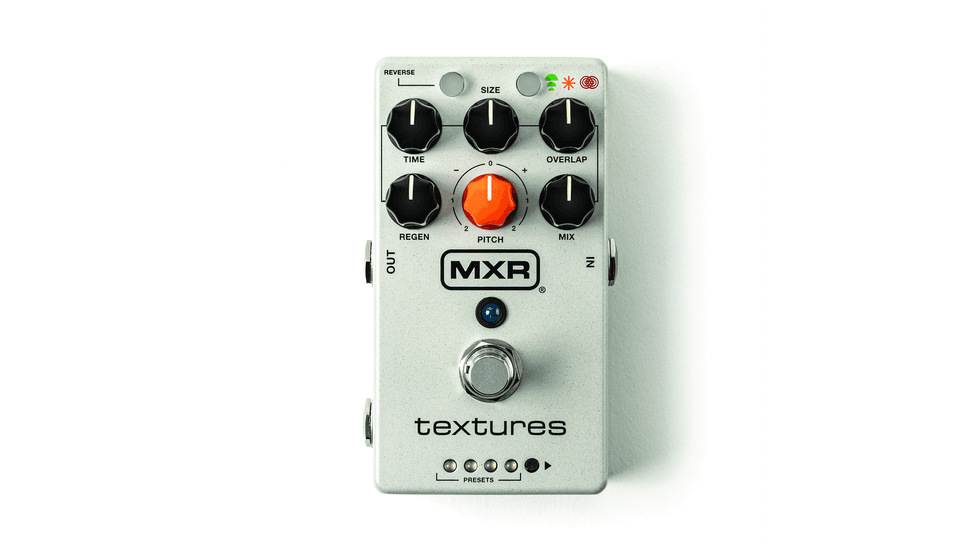
Experience your guitar in the fifth dimension.
Every so often a pedal shows up that doesn’t just add a new flavor to your rig, it quietly rewires your understanding of what a stompbox is for. The MXR Textures Granular Synth Engine is one of these. On paper, it’s a humble delay pedal—record the signal, play it back, repeat. In practice though, Textures takes that lineage and does to it what a jazz musician does to a standard: keeps the bones but discards the obligation to play it straight.
Grains, Not Repeats
Granular synthesis has been kicking around since the mid-20th century—originally achieved with tape loops sliced into fragments by composers patient (or masochistic) enough to do it by hand—and it’s taken guitar pedals an embarrassingly long time to catch up to what modular synth heads have known for decades. MXR’s approach chops your incoming signal into tiny audio “grains,” then hands the controls over to you to stretch, reverse, pitch-shift, and reassemble those grains into something your original note never asked to become. Think less in terms of “digital delay” and more like “your guitar tone, run through a very articulate blender, with the blender’s speed and blade angle fully in your control.”
Three modes anchor the experience—delay (green), auto-freeze (orange), and layers (red)—and each one reframes what the same core engine does. Delay mode is the pedal’s most familiar face: granular rhythmic repeats that can range from clean and delay-like to smeared and shimmering, depending on how aggressively you mangle the size, overlap, and regen controls. Auto-freeze is where things get genuinely magical. The pedal listens for what you play, grabs it, and sustains it into a lush, evolving wash. Put another way, you can hold one chord and let Textures turn it into an ambient soundtrack, leaving your hands free to do something else. Layers, meanwhile, samples up to four notes or chords, and each takes on its own fade characteristics. It essentially lets you build a tiny orchestra out of whatever you just played.
The Controls, Demystified
Time, size, and overlap set the length, density, and stacking behavior of your grains. Pitch and reverse handle playback speed and direction. Dial the pitch through the pedal’s +/- 2 octaves and you can cover everything from subtle chorus-like shimmer to full-on alien transmission. Delay and regen govern how those grains move and feed back through time, and mix (the great equalizer of any effect pedal) moves between bone-dry signal and granular soup. Built-in reverb, filter, and vibrato round things out, along with randomization options for players who’d rather let the pedal surprise them than try to manage every parameter by hand. (Certainly, there’s something almost meditative about hitting the randomize function and just seeing what Textures decides to do.)
Eight factory presets across two banks get you playing immediately, which matters: A pedal this deep can easily intimidate a player who just wants a cool sound now, and MXR clearly understood that. Full stereo I/O, expression pedal compatibility, and MXR’s split + tap ecosystem round out a spec sheet built for players who take their signal chain seriously.
“Think less “digital delay” and more “your guitar tone, run through a very articulate blender, with the blender’s speed and blade angle fully in your control.”
Who’s This For?
Ambient and post-rock players are the obvious audience, anyone chasing the cavernous, cascading textures of Michael Brook, David Torn, or Christopher Willits at their most exploratory, or the wall-of-sound shimmer that shoegaze and dream-pop guitarists have been building toward since Kevin Shields decided a whammy bar could be a compositional tool.
But Textures isn’t limited to reverb-drenched noodling. Layers mode alone opens doors for composers and sound designers scoring film cues, and the granular-glitch textures achievable in delay mode will appeal to anyone building the kind of unsettling, fragmented soundscapes that modular synth players will feel comfortable with. Even a straight-ahead rock player looking for one genuinely weird moment in a set—a solo breakdown that sounds like it’s dissolving into static and light—will find real utility here.
Incidentally, I ran Textures through both a clean Vox/Marshall-style amp and a Line 6 Helix modeler, and the difference in character was substantial. Through the clean amp, the grains retained more organic edge and pick-attack definition, while the modeler smoothed things into denser, more synth-like pads. Either way, this is not a pedal that requires distortion or effects loops of other units to sound complete. It’s a remarkably self-contained universe all its own.
The Verdict
At a street price of $269 Textures won’t be an impulse buy for most. But it’s genuinely deep, playable, and unique compared to other granular-synthesis pedals. Where a lot of weird pedals trade usability for strangeness, MXR found a smart middle path: three clearly defined modes, sensible presets for instant gratification, and a control set deep enough to reward the players willing to actually dig in.
Is this a pedal for everyone? No. If your board is built entirely around tight, traditional tones, Textures will sit there mostly unused, a strange and expensive houseguest. But for the ambient explorer, the film composer, the noise-curious rock player, or anyone who’s ever wondered what their guitar might sound like if it forgot what a guitar was supposed to sound like, this is a genuinely rare device: a pedal that expands your musical vocabulary rather than just adding another voice to your existing diatonic dialect.
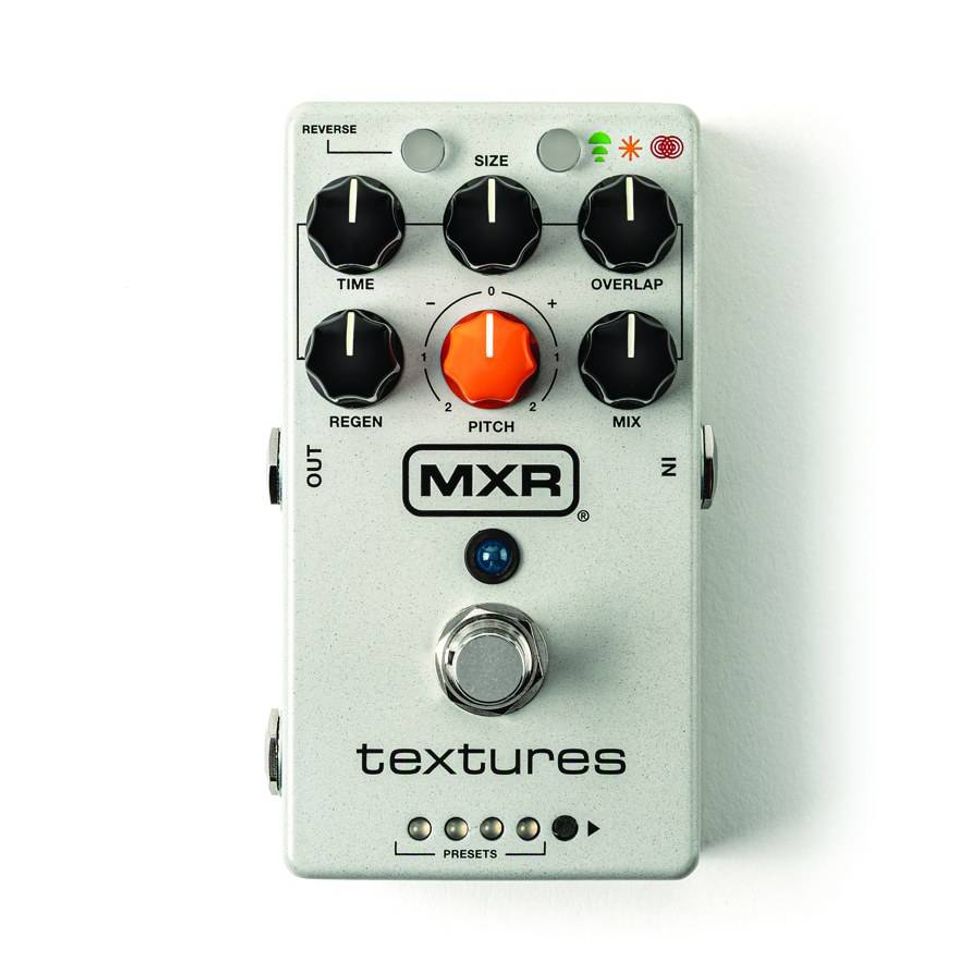
MXR Textures Granular Synth Pedal
D’Addario launches five-string set designed for the Jacob Collier’s signature five-string Taylor guitars

After partnering with Taylor last year to launch two new signature five-string acoustic guitars, musical mastermind Jacob Collier has now teamed up with D’Addario on a new set of strings “engineered specifically” to support the symmetrical D-A-E-A-D tuning used on the guitars.
A musician who’s anything but ordinary, Jacob Collier found his voice in a five-string guitar 10 years ago. “In 2016, I figured out a way for the guitar to make sense to me – it was by ripping one of the strings off a six-string guitar and leaving only five,” he told Guitar.com 2024.
“And I tuned it in a very unusual way. I did this for the first time on the day of a gig, and then I played it on the gig, which was a very funny experience.”
That love of five-strings reached a high point in 2025 when Collier launched, alongside Taylor Guitars, an Academy 22e and GS Mini.
Hand-picked by Taylor CEO Andy Powers, Collier’s new Specialty XS Phosphor Bronze String Set is designed for these signature guitars, with a custom .012-.053 gauge range optimised for D-A-E-A-D tuning. The wound strings in the set feature an ultra-thing XS film coating, while the plain steel strings feature a unique polymer treatment for “maximum corrosion resistance and extended tone life”.
And if that wasn’t enough, the strings are launching alongside a new D’addario Jacob Collier Signature Vegan Guitar Strap, which features colourful custom artwork reflecting Collier’s vibrant aesthetic.
“An artist’s voice isn’t something you find; it’s already there, like the Michelangelo quote: ‘Remove what’s not the sculpture, and the sculpture was there all along,’” says Collier.
“Trying to find my voice led me to fall in love with the five-string guitar. For me, it’s important that a string has a lot of life to it. D’Addario strings embody that – they are made with incredible care and attention to detail.”
He continues: “There is a miraculous tone and sublime feel to these D’Addario strings. This set was handpicked by Taylor’s own Andy Powers to balance the tension, feel, and pitch accuracy of this symmetric five-string tuning that forms the backbone of my custom Taylor guitar models.”
The 12-53 Jacob Collier Taylor 5-String Set and Signature Vegan Strap are both available now via D’Addario.com.
The post D’Addario launches five-string set designed for the Jacob Collier’s signature five-string Taylor guitars appeared first on Guitar.com | All Things Guitar.
Here’s how you can get the Guitar.com September/October 2026 issue

Guitar.com Magazine is back this week – here’s how you can get the September/October 2026 issue, which comes as part of a bundle with NME Magazine.
So far, the relaunched print edition of Guitar.com Magazine has had Mateus Asato, Yvette Young, Jacob Collier and Grace Bowers grace the cover. This Thursday, the fifth Guitar.com Magazine will launch. Mark your calendars for October 1 at 2pm BST – that’s when the cover star will be revealed and when this issue will go on sale exclusively via retailer Dawsons. If you’d like a sneak peek at the issue, solve the mini crossword in the waiting room, which is open now.
Subscribe here for more information about the Guitar.com Magazine and for the chance to receive an exclusive queue jump opportunity, where readers can get their hands on a copy before anyone else. Guitar.com will be sending out queue jump tickets shortly before the magazine goes on sale to randomly chosen subscribers.
The post Here’s how you can get the Guitar.com September/October 2026 issue appeared first on Guitar.com | All Things Guitar.
“The Foo Fighters stuff is in our DNA”: Nothing But Thieves on reference culture, musing on their past and falling in love with Fairlane Guitars

“It’s actually annoying how long we’ve been working on this music for,” Joe Langridge-Brown quips from the other side of a Zoom call, the heads of a couple Fender and Gibson guitars poking out from behind his head. The Nothing But Thieves guitarist is talking from his London home about the band’s fifth studio album Stray Dogs, out 25 September, before bandmate and fellow guitarist Dom Craik pops up on screen too.
“This record was built for live,” continues Langridge-Brown, “which we’ve never really done before. We started [lead single] Evolution in March, I think, and we’ve been keeping an eye on how we want to tour it from the beginning, which has taken a long time. But I’m looking forward to it.”
“It’s a long time living with music, but it’s time for the world to have it,” adds Craik.
Ten years after debuting with a critically-acclaimed self-titled album, Nothing But Thieves found themselves back where it started in Angelic Studios. Three other albums had passed since the rock quintet returned to record Stray Dogs, but this record won’t try anything experimental. The writing process was based on what the band sounds like live – allowing the five-piece to dissect footage of themselves to compose new material that feels… bespoke. Like a tailored suit. For an album themed around familiarity, community and togetherness, they’ve quite literally stuck to what they know.
“To be totally honest, Angelic is an amazing studio,” says Langridge-Brown. “It’s for residency so you go and stay there for a few weeks, and there aren’t many of those in the UK, so we love it there. But it also just made sense. We’re referencing something that harnesses how we sound, and there’s also the subject matter being about our lives and community, so it felt right to go back somewhere we were familiar with.”
 Image: Steve Gullick
True Path
For a seasoned outfit like Nothing But Thieves, every album is a stylised foothold on the journey to their true identity. 2023’s Dead Club City turned tables with a riskier route down a pop-tinted road, for example, with experimentally layered tracks and a lot more groove than fans were used to. But 2020’s Moral Panic leaned into girthy guitar and streaky choruses which, judging by the album’s angst and self-assuredness, felt like the band’s ultimate comfort zone.
“I do think the Foo Fighters stuff is in our DNA,” says Langridge-Brown, coming from his own perspective when a comparison is made between Stray Dogs and the shredded gnarliness of Dave Grohl’s rock megastars. “I listened to Wasting Light in the car for about two years every single day, and I don’t think that’ll ever leave. But in terms of other references in the guitar tones, either consciously or subconsciously, there’s probably a bit of Smashing Pumpkins and early nineties stuff in there. Pearl Jam too, which is kind of grunge, but with incredible guitars and some progressive stuff as well.”
“It’s quite interesting because it’s not like we sit down at the start and go, ‘Well, what’s the palette of the guitar tones?’”, says Craik. “Often the song comes first, and we try to shape the guitar tones around Connor [Mason’s] voice. Sometimes the heavier the guitar tones, the more challenging it can be. We’re almost steered by trying to accommodate Connor’s vocal and the song best.But there were those touch points like Smashing Pumpkins, Pearl Jam, the rawer nineties and the grunge stuff.
“There are always guitar tones that we take inspiration from, like Radiohead, as I’m sure a lot of bands do,” he continues, “just because of the variety and level of experimentation that they always do. There’s an endless pool of sonics to dive into there, so that’s something that we try and incorporate. But when we were writing this record, it was quite fun because we hadn’t really experimented with this wall of fuzz guitar sound before, and that gave Joe and I an opportunity to dig out some pedals, old and new, and plug those in to see how we could make it work with our sound.”
The Fast Lane
Talking of old and new, there were a few other changes this time round for Craik and Langridge-Brown, most notably their introduction to South London boutique builder Fairlane Guitars. The pair were approached by Fairlane – who you can read all about in their recent Guitar.com cover story – before they started using the brand’s flagship Zephyr.
“Reuben just approached me and said, ‘Look, I’ve got some guitars; would you like to try one?’”, chuckles Craik at the memory. “And I couldn’t believe this thing, it was unbelievable. It’s like an inverted Firebird body with a mastery bridge and a Fender scale length. It’s not anything too crazy, but the build quality is unreal, and they have these Monty’s handwound pickups which are just, again, unbelievable.”
The quirky Zephyr was so mesmerising that it became a feature on almost every Stray Dogs track. And it’ll likely feature pretty heavily on tour, too. “I remember when we started writing, we’d play just one chord and the boys were like meerkats at the back of the room,” Craik continues, grinning wide. “Their ears pricked up. And it’s one of those guitars that sounds like something new, so it was hard not to put it on everything. I think it might be on every song in one way or another. It’s just a beast of a guitar.”
The band’s something old, if you like, had to be all the other gear; the amps and pedals and speakers they’ve used for decades gone by whilst getting to grips with their identity. Stray Dogs might be decorated by a few shiny ornaments like the Fairlane Zephyr, but it’s those same sturdy foundations that give it a touching thrill of familiarity.
“This album was asking us to delve into all the gear that we’ve collected over the last decade and the new bits that we’ve been acquiring and not only learn them, but try and find new applications for them,” says Craik. “We were using a lot of sixties Fender Bassmans – we had a black and a silver one, which were both amazing. But I was also slowly getting to grips with the sound of different speakers: the difference between a 10-, 12-, and even a 15-inch speaker, which I know is quite unusual. But by the end of the process, I was able to dial in amp tones pretty quickly. It was definitely like going to the gym, though; it took a while to warm up.”
 Image: Steve Gullick
Playground Games
With the right gear, the writing process in the studio becomes a playground for inspiration. “That’s what’s so exciting as a guitarist,” says Langridge-Brown. “When you pick up a guitar and it makes you play something that you’ve not played before, or you put a pedal in the chain and it comes out as something completely new. When we were travelling in the US, I picked up this 12-string Strat and that made me think in a different way. There’s a song called Number Five on the record which has this chorus-y 12-string sound on it and I think that was a change in the arrangement that we didn’t initially have. So, it’s always fun as a guitarist to pick up a piece of gear and be like, ‘What can I make of this?’”
But there’s trouble with a project harnessing too much familiarity; it gets too comfortable, even a little stale. A few fresh perspectives on gear and a couple different tricks up sleeves might not be enough to salvage it. But Stray Dogs is crisp. It’s a record evolved from the past – for sure – but it’s emboldened and vitalised by nuanced songwriting and pulsing vigour that’s, to be honest, pretty palpable. It’s fresh because Nothing But Thieves have themselves as their muse. There are sly winks of Foo Fighters and Smashing Pumpkins and Pearl Jam if you claw back the thick, wiry layers of raw guitar power, but those guys aren’t the blueprint.
“It’s a weird balance where you’re trying to make a guitar-based record that isn’t cliche,” agrees Langridge-Brown. “It’s nineties-influenced, but you don’t want to come out with a record that feels like it belongs in the nineties. It’s got to have another added part of the conversation.
“You could look at our pedal boards now,” he continues. “I’m using this Chase Bliss Preamp MKII, which is a really posh distortion preamp, but with a RAT pedal. Those things together – even the order you put those pedals in – creates something completely new. And that’s one of the fun parts of the job, playing around with the sound and getting to call it a living.”
Reference Points
In truth, we’re moving through a period of reference culture where every art form has a standard of success. We’ve seen the best of what’s come before us, and it still stands up today – so how do you recreate the same effect without copying the past? “There’s a David Mitchell quote which is about culture eating and re-eating itself,” says Craik. “It’s about regurgitating anything that was good in the first place. It’s funny, because there’s definitely a bit of an eighties resurgence and the nineties has definitely been the ‘in’ thing. Whether we fell into that was definitely by accident, but we’ve always been inspired by the nineties, and it’s no bad thing for guitar music, especially in the UK, to be having a real moment. But it never goes anywhere.”
As Craik speaks, Langridge-Brown is in his own world of contemplation. “I think the David Mitchell quote Dom’s talking about is the human centipede of music,” he begins. “I think that’s where the magic is. There’s a song called Baby Kool on this record and a reason why it’s one of my favourites is because you have two worlds that are really the antithesis of each other. There’s a glam verse, and then there’s this nineties grungy chorus. If you just made a record that’s derivative of the nineties, that’s less appealing.”
Craik nods, adding: “Taking the best bits of multiple facets of genres – that’s the sweet spot. It’s hard to do, but when we land on it, something magical happens.”
Now that the album’s finally out, the biggest thing left to do – and perhaps the most important thing all along – is tour. And it’s the largest headline tour Nothing But Thieves have ever done, so it’s going to be huge.
“We’ve been doing a bunch of rehearsals, making sure the tone is bang on and making everything feel as powerful as possible, translated best from the record,” says Craik.
“At the heart of the record,” adds Langridge-Brown, “it’s us playing in a room with that simplicity of what makes a band good – without the bells and whistles. We’ve just got to give it the best version of itself live.”
Stray Dogs is out now.
The post “The Foo Fighters stuff is in our DNA”: Nothing But Thieves on reference culture, musing on their past and falling in love with Fairlane Guitars appeared first on Guitar.com | All Things Guitar.
Guitar legend John Mayer is playing six nights at the Las Vegas Sphere – here’s everything you need to know

Hold on to your hats, as guitar maestro and all-round six-string heartthrob John Mayer has just announced a six-night residency at the Las Vegas Sphere for 2027.
Mayer will take to the stage at the much-talked-about spherical venue on 8, 10, 11, 15, 17 and 18 April 2027, with each night split into three distinct sections: a solo set, a section where Mayer performs alongside his full backing band, and finally a segment with the John Mayer Trio, which also features bassist Pino Palladino and drummer Steve Jordan. The residency also marks the John Mayer Trio’s first live shows since 2017.
Of course, it won’t be the first time John Mayer takes to the stage inside the Sphere, after a hugely successful and lengthy residency with Dead & Company in 2024 and 2025.
And Mayer’s long shown his praise of the Sphere as a venue and how it facilitates “big league” bands putting on their best show.
“I think what we all love is that there’s finally once again a live-music space race,” he said in 2024. “There’s the social-media space race, the podcast space race, the AI space race. But live music pretty much stayed the same for such a long time.”
“I think this is the first time in a long time where we feel kind of honoured to be a part of something that’s so culturally right up in everyone’s view,” he added. “We’re all sort of like, how cool is this?”
So while his Sphere experience to date has been limited to Dead & Company shows, expect to hear Mayer’s biggest hits like Slow Dancing in a Burning Room, Gravity and Your Body Is a Wonderland when he returns to the venue next year.
The announcement comes on the heels of a new collaboration between John Mayer and Jaguar Land Rover, which saw a limited drop of both his signature SE and USA-made Silver Skys outfitted in classic colourways seen on the car maker’s legendary Defender SUV. Will he take a couple for a spin during his Sphere shows? We’d put money on it…
John Mayer marks the latest high-profile artist to play a residency at the Las Vegas Sphere. So far, the venue has seen residencies from the likes of Eagles, Dead & Company, U2 and electronic artist Anyma, while Metallica are scheduled to begin their Life Burns Faster residency from 1 October.
John Mayer at the Sphere – how to get tickets
Tickets for John Mayer’s Sphere residency start at $129, with Artist Presale beginning on Wednesday, 7 October at 10AM PT. A SiriusXM presale will also begin on 8 October, followed by general public on sale from 9 October at 10AM PT. Limited VIP packages will also be available from 30 September.
Learn more at johnmayer.com.
The post Guitar legend John Mayer is playing six nights at the Las Vegas Sphere – here’s everything you need to know appeared first on Guitar.com | All Things Guitar.
Pages
