
Music is the universal language
“Glory to God in the highest heaven, and on earth peace to those on whom his favor rests.” - Luke 2:14
General Interest
“Next thing you know, I get handed one of Kirk Hammett’s Les Pauls!”: System Of A Down‘s Daron Malakian reflects on filling in for James Hetfield during Metallica‘s Summer Sanitarium tour
![[L-R] Daron Malakian and James Hetfield](https://guitar.com/wp-content/uploads/2026/01/Daron-Malakian-James-Hetfield@2000x1500.jpg)
Prior to the release of 2001’s Toxicity, System Of A Down were scrambling to make their mark on heavy metal. When Metallica offered them a support slot on their 2000 Summer Sanitarium tour, it was the perfect opportunity to reach new audiences – and it would even see Daron Malakian temporarily joining the world’s biggest metal band – onstage at least.
When the Summer Sanitarium tour kicked off in June, all was well. However, on 7 July, Metallica’s James Hetfield was injured in a jet ski accident right before a show, leaving him unable to perform. “They didn’t know what to do, because James wasn’t there,” Malakian tells Rick Rubin on his Tetragrammaton podcast.
Rather than cancelling the tour, Metallica enlisted the help of their support acts. “Jason Newsted was singing, and then they brought the guys from Korn on and they [covered a] Cheech & Chong song,” he recalls.
- READ MORE: Trivium’s Matt Heafy names the five up-and-coming metal bands everyone needs to watch in 2026
Seeing fellow openers Korn up onstage, Malakian thought he’d try his luck. He knew “a lot of [Metallica’s] shit”, and he was adamant that his guitar tech should communicate this detail to Metallica’s team. “My tech goes and talks to their guitar tech,” he explains. “Then my tech comes back like, ‘All right, come with me.’”
“Next thing you know… I get handed a Les Paul,” he continues. “I think it was one of Kirk Hammett’s Les Pauls. And [Metallica’s guitar tech] is like, ‘All right. Go.’”
Up until that point, Malakian hadn’t properly met Metallica. System Of A Down were the first openers of the evening, and there had been no opportunity to meet the stars of the tour. “I met Metallica on stage playing with them,” he reveals. “I’d never met them before – we were the first band. Nobody knows us.”
“You gotta understand – our band’s not big yet,” he emphasises. “I’m still a kid – I’m 22 years old! I can’t even believe that we’re even allowed to open up for Metallica. So this is all new to me.”
Suddenly, Malakian finds himself out on stage with his metal heroes. “I turn and I’m, like, ‘Hey – it’s Lars, it’s Kirk, it’s Jason Newsted,’” he says. “They’re, like, ‘What do you know?’ I go, ‘I don’t know… Master Of Puppets?’”
And, just like that, the band are counting in to perform one of Metallica’s biggest hits – but, without frontman Hetfield around, Malakian had a burning question on his mind. “I’m up there with Metallica playing Master Of Puppets in front of 60,000 people… and I’m, like, ‘Who’s gonna sing?’” the guitarist recalls.
Quickly, Malakian decides who is going to sing: him. “I said, ‘Fuck it, I’ll go sing!’” he explains. “And I sang. You would think we’d rehearsed it, but we didn’t rehearse it. And I didn’t even know it was gonna happen! And it happened.”
The fateful day was even captured on film, and you can see the band deliberating on-stage. Someone else even gets picked out of the crowd to perform with the band first, before Metallica decide to boot him off and invite Malakian out instead. Then, the System Of A Down guitarist and vocalist absolutely smashes it.
As he puts it, it was a true ‘pinch me’ moment. “I’m up there, and I’m playing Metallica with Metallica, in front of an audience where I would’ve been in the fucking cheap seats just three years ago,” he says.
The impromptu performance was so good that Metallica even asked Malakian to keep performing with them until Hetfield was well again. “I got off stage, and next thing you know, [Metallica’s team] are coming to me like, ‘Hey, James isn’t gonna be able to play for a few nights, [the band] want you to play with them,’” he explains.
Suddenly, Malakian was moving his suitcase out of a shoddy tour bus and into Metallica’s private jet. “They were, like, ‘Hey, get your shit from your bus, because you’re flying on the private jet with us now,” he recalls. “Oh, man. I’ll never forget it.”
Malakian went on to perform with the band for the following few dates. On 8 July, Malakian was even joined by bandmate Serj Tankian to help Metallica perform Mastertarium, as well as Korn’s Jonathan Davis emerging to perform One.
“Even though my band is where we’re at right now, it still brings goosebumps that I had a chance to experience that at that point of my career,” he concludes.
This year, System Of A Down are set to embark on a European arena tour, which will see them playing two nights at London’s Tottenham Hotspur Stadium in July. For more information, head to the band’s website.
The post “Next thing you know, I get handed one of Kirk Hammett’s Les Pauls!”: System Of A Down‘s Daron Malakian reflects on filling in for James Hetfield during Metallica‘s Summer Sanitarium tour appeared first on Guitar.com | All Things Guitar.
Mateus Asato ends decade-long partnership with Suhr: “I will never forget this journey we built”

Brazilian guitar virtuoso Mateus Asato has announced he’s ending his decade-long professional relationship with Suhr.
The quintessential social media guitar star, Asato has been with Suhr since 2013, launching a number of signature models with the brand since.
“After 12 years of a very successful partnership, I’ve decided to part ways [with] my professional relationship with Suhr Guitars,” Asato writes in a new Instagram post. “My deepest gratitude to Mr. John, Kevin, Aura and Katelyn Suhr for everything you’ve done to me as a musician and person…
“Thank you so much Felipe Raposo [Brazilian Suhr Guitars representative] for being the bridge that started all of this,” he goes on (translated from Portuguese).
“And the biggest thanks to all Suhr employees who made this company so special and one of the greatest brands [in the] history of this instrument I passionately love. History was made. I will never forget this journey we built.”
At the time of writing, it’s unclear where the 31-year-old will go next, but the move coincides with the imminent release of his debut album, which is expected some time in early 2026. So might we see a new partnership announcement with another guitar maker some time in the coming days or weeks?
Despite cultivating a million-strong following on Instagram – and a vibrant, decade-plus career working with A-list musicians including Bruno Mars, Jessie J, John Petrucci and Joe Satriani – Asato is still yet to release an album. But one is on the way, and soon.
Asato – the guitarist’s debut full-length outing – features singles Cryin’ and The Breakup Song, which can be heard below:
The road hasn’t always been plain sailing for Mateus Asato, who famously announced a hiatus from social media back in 2021 citing burnout, saying he had felt like a “rat in a maze”.
“It’s been 10 years of a lot of doubts and questions… and some identity crises about who I am in terms of music,” Asato told Guitar.com last year.
“The album is definitely a journey through all the sides of Mateus. The Mateus who’s a sideman, Mateus as the Instagram boy, and then the Mateus that got more mature over the years. Who developed a different vision regarding music, regarding how I see guitar.”
The post Mateus Asato ends decade-long partnership with Suhr: “I will never forget this journey we built” appeared first on Guitar.com | All Things Guitar.
Fender Musical Instruments Corporation Appoints New Chief Executive Officer
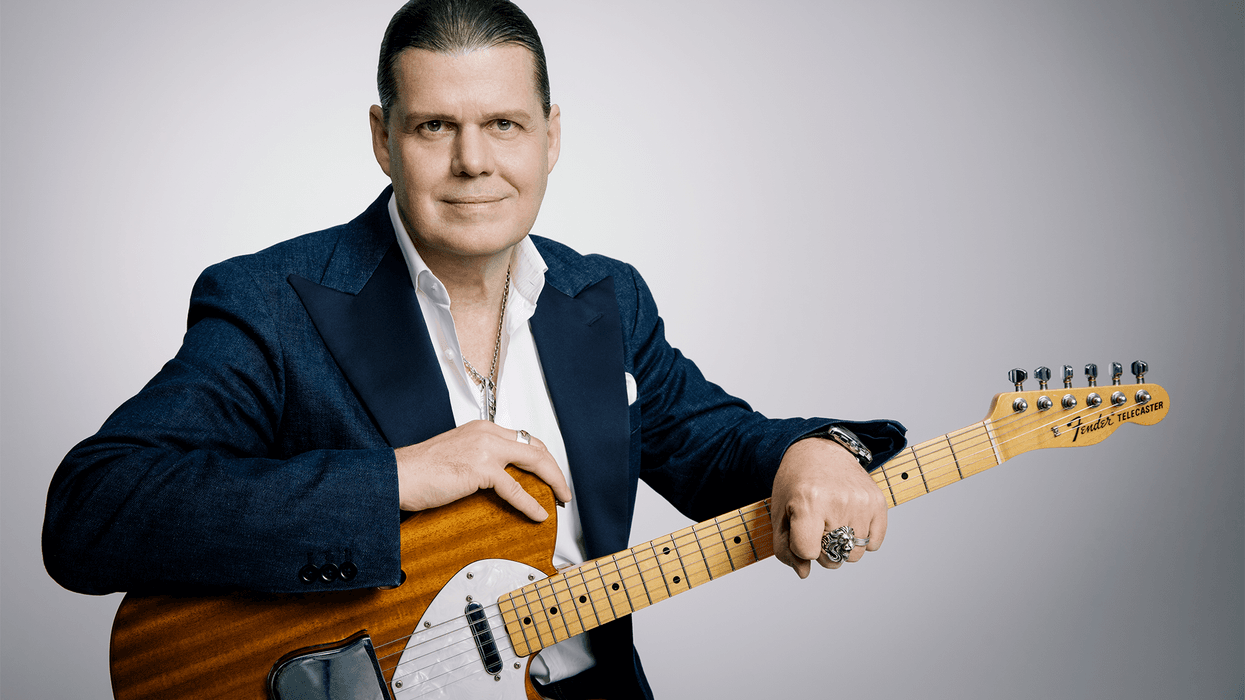
Fender Musical Instruments Corporation (FMIC) today announced that its Board of Directors has appointed Edward “Bud” Cole as Chief Executive Officer and member of the FMIC Board of Directors. Cole will serve as CEO-Designate effective January 19, 2026, and will officially assume the CEO role on February 16, 2026. He succeeds Andy Mooney, who will retire from the company following a decade of transformative growth and innovation.
Cole currently serves as President of Fender Asia Pacific (APAC) and brings a multi-decade global career across consumer, lifestyle, luxury, and FMCG brands to the role. During his decade-long tenure at FMIC, Cole has shaped some of the company’s most significant growth initiatives, leading the expansion of Fender’s business across 14 countries in the APAC region.A bilingual English/Japanese speaker and seasoned global operator, Cole has played a pivotal role in strengthening Fender’s presence worldwide, including launching Fender’s APAC headquarters in Tokyo and establishing full regional commercial and operational capabilities; building robust direct-to-dealer operations in Australia, resulting in a significant increase in efficiency, brand control, and distribution performance; and expanding Fender into mainland China and Korea, including developing direct-to-consumer (DTC) capability through e-commerce and driving long-term growth strategies across the region.
He also spearheaded the creation of the world’s first Fender Flagship retail experience in Harajuku, Tokyo, redefining Fender’s brick-and-mortar retail presence and consumer immersion, and developed a robust artist ecosystem across the APAC region, driving successful product innovation, including multiple Made-in-Japan launches that became standout global performers and strengthened Fender’s cultural influence and credibility throughout the region.
Before joining FMIC, Cole held senior leadership roles across several global lifestyle, luxury, and consumer brands — including Pernod Ricard, LVMH, QVC, and Ralph Lauren — where he led commercial expansion, brand development, and regional strategy across international markets. A visionary, who has conducted business in more than 60 countries, Cole’s global perspective has been shaped by a multi-decade career building and managing world-class brands at scale.
“Bud has been one of the most impactful leaders within our organization,” Mark Fukunaga, Executive Chairman of the FMIC Board. “He has a deep understanding of the Fender brand, our global players, and the commercial and operational foundation required to propel us into the future. His track record of building teams, expanding markets, and elevating Fender’s presence around the world makes him uniquely qualified to lead the next chapter of growth. On behalf of the Board, I also want to thank Andy Mooney for his leadership over the past decade and for the significant contributions he has made to the company.”
Since joining Fender in 2015, CEO Andy Mooney has more than doubled the size of the company and extended Fender’s worldwide leadership in the Musical Instruments category. Mooney championed product and marketing innovation at Fender and led the company's successful entry into subscription based digital software.
“Leading Fender has been a highlight of my career,” said Andy Mooney. “I'm deeply grateful for the creativity and commitment of the Fender teams around the world and proud of what we’ve accomplished. I’m excited to pass the baton on to Bud and confident that under his leadership, Fender will continue to inspire players for generations to come.”
A lifelong musician, Cole bought his first electric guitar — a Fender Made-in-Japan 1969 Thinline® Telecaster® reissue — as a teenager and still plays it today. His personal connection to Fender’s legacy and to the player community continues to shape his approach to leadership.
“To lead Fender is the honor of a lifetime,” said Edward “Bud” Cole. “This brand has been a part of my life since childhood, and I’m committed to ensuring Fender continues to empower players everywhere, from beginners picking up their first guitar to the artists shaping the sound of today and tomorrow. Together with our global teams, partners, and loyal community of players, we will write the next era of Fender’s history.”
Cole’s appointment marks the beginning of a new chapter for Fender as the company continues to expand its global footprint, deepen its commitment to players, and shape the future of music worldwide.
BzzzzKill Launches New Players Series
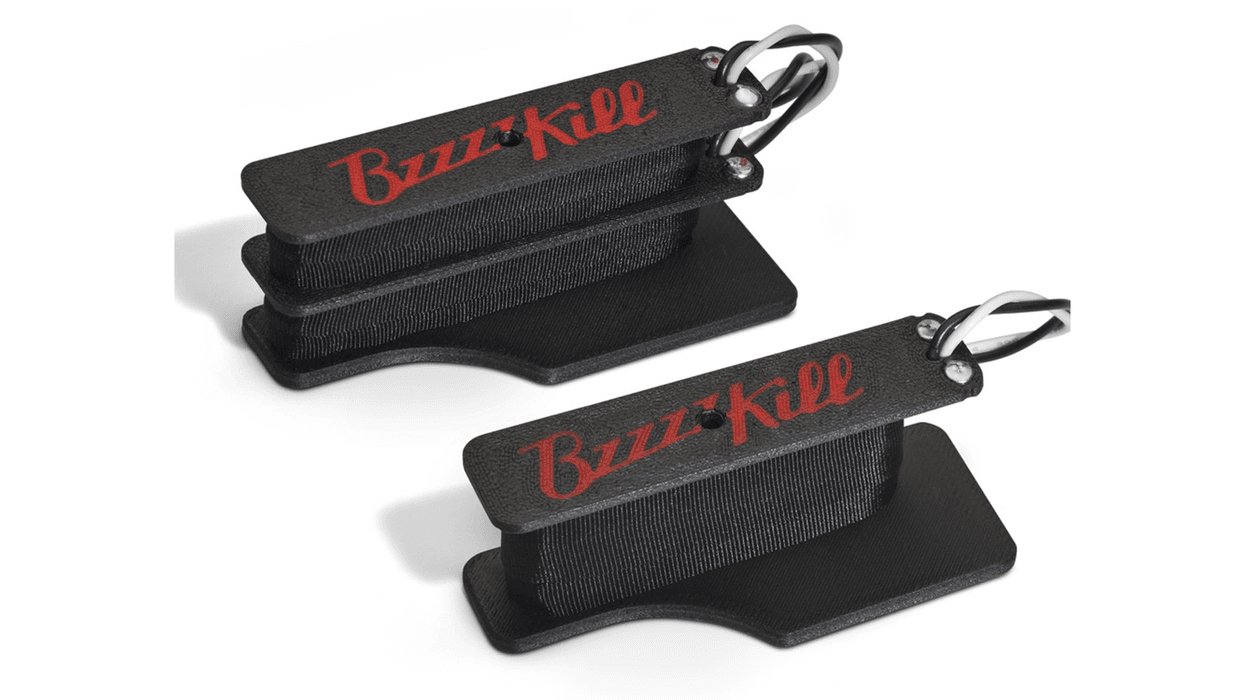
BzzzzKill has announced the launch of the Players Series, a new streamlined version of its innovative hum-reduction device engineered for Stratocaster-style guitars. Built around the same Smart Noise Reduction Coil™ architecture introduced in the company's debut product, the Players Series brings buzz-free single-coil performance to a wider audience with a modern, cost-efficient construction.
At $99 USD, the Players Series sells for approximately half the cost of the original BzzzzKill model. The Players Series virtually eliminates 60-cycle hum (50Hz in UK/EU) across all pickup positions while preserving the natural dynamics and clarity that define Strat-style tone. Like the original model released in 2025, installation is non-invasive, requires no power source, and leaves the guitar’s value intact. Installation remains fully reversible – no routing, active electronics, or pickup replacement needed.
Alongside the new Players Series, BzzzzKill is officially naming its original model the Custom Series. Built with hand-assembled vulcanized fibre flatwork, steel rods, and vintage-consistent cloth pullback wiring, the Custom Series remains the preferred choice for performing musicians, recording artists, and
custom builders, including Fender Custom Shop co-founder John Page, who is now integrating Custom Series BzzzzKills into his latest Artist Series Stratocasters.
BzzzzKill’s Players Series offers the same noise-reducing purpose in a modern, streamlined build featuring a precision-formed PETG structure and durable rubber-jacket wiring. Both series maintain compatibility with existing effects chains and operate passively in all pickup positions.
“We designed the Players Series to broaden access without compromising what makes BzzzzKill so special,” says inventor and co-founder Richard Moreton. “My greatest hope when I developed the original BzzzzKill was to bring it to every Strat player,” says Moreton. “I'm happy to see the Players Series taking us closer to that goal.”
With strong demand from guitarists worldwide, BzzzzKill is now preparing Players Series versions for Telecaster and other popular single-coil formats. As with current models, installation will remain fully reversible and will not require rerouting, active electronics, or pickup replacement.
The BzzzzKill Player Series carries a street price of $99. For more information visit www.bzzzzkill.com.
Chuck Berry: The Original Rock 'n' Roller with Jason Sinay
Singer-songwriter Jason Sinay, maybe best known for his work alongside Mike Campbell in Dirty Knobs, joins us to talk about the most foundational rock ’n’ roll guitarist of them all, the man who started the ball rolling, Chuck Berry. When it comes to his guitar playing, his influence can be heard across all styles. Without his licks, his songs, his vocal phrasing, who knows what path the electric guitar would have taken!
While we’re at it, we get some cool Keith Richards and Neil Young stories from Jason, and we dream about what it would be like to have those guys step onto our own stage.
Thanks to our sponsor!
 This Episode Brought to You By: www.premierguitar.com
gibson.com
“The honour of a lifetime”: Fender appoints Edward “Bud” Cole as new CEO, as Andy Mooney announces retirement

Fender has appointed Edward “Bud” Cole as its new CEO, with outgoing CEO Andy Mooney retiring after a decade in the top job.
Cole is set to serve as CEO-Designate from 19 January, and will officially assume the role of CEO when Mooney steps down on 16 February 2026.
A bilingual English/Japanese speaker, Edward “Bud” Cole has served as President of Fender Asia Pacific (APAC) for over 10 years, and overseen some of the company’s most significant growth initiatives, leading the expansion of the Fender business into 14 countries across the APAC region.
During his tenure at FMIC (Fender Musical Instruments Corporation), Cole – who has previously worked in commercial expansion, brand development and strategy at luxury brands including Ralph Lauren and Pernod Ricard – was the brains behind the opening of Fender’s APAC headquarters and flagship store in Tokyo, Japan.
With the flagship store – still, at the time of writing, Fender’s only dedicated retail space in the world – Cole sought to redefine the brand’s approach to “brick-and-mortar retail presence and consumer immersion”.
Outgoing CEO Andy Mooney hinted when the store opened in 2023 that it could herald the opening of more Fender brick-and-mortar stores, saying, “The Tokyo store perhaps will be used as a model to create franchise retail throughout Southeast Asia.”
And now that the Tokyo store’s mastermind Edward “Bud” Cole is in charge of the company’s global operations, might we even see physical Fender stores opening up outside of the Asia Pacific region? Only time will tell…
 Credit: Fender Japan
Elsewhere during Cole’s time as President of Fender Asia Pacific, he has helped establish full regional commercial and operational capabilities, built “robust” direct-to-dealer operations in Australia, overseen the expansion of Fender into mainland China and Korea, and helped develop the brand’s direct-to-consumer capability through e-commerce.
Cole has also played a pivotal role in numerous Made-in-Japan launches, which have helped strengthen Fender’s cultural influence and credibility throughout the Asia Pacific region.
“Bud has been one of the most impactful leaders within our organisation,” says Mark Fukunaga, Executive Chairman of the FMIC Board.
“He has a deep understanding of the Fender brand, our global players, and the commercial and operational foundation required to propel us into the future. His track record of building teams, expanding markets, and elevating Fender’s presence around the world makes him uniquely qualified to lead the next chapter of growth.
“On behalf of the Board, I also want to thank Andy Mooney for his leadership over the past decade and for the significant contributions he has made to the company.”
“Leading Fender has been a highlight of my career,” says outgoing CEO Andy Mooney. “I’m deeply grateful for the creativity and commitment of the Fender teams around the world and proud of what we’ve accomplished. I’m excited to pass the baton on to Bud and confident that under his leadership, Fender will continue to inspire players for generations to come.”
Aside from being a deeply accomplished businessman with decades of experience, Edward “Bud” Cole is also a lifelong musician, having bought his first electric guitar – a Made-in-Japan 1969 Thinline Telecaster reissue – as a teenager, and still owning it today.
 Credit: Naoki Tsuruta
As Cole tells Guitar World in a new interview, he actually tried – and failed – to get a job as a PR assistant at Fender straight out of college. “My very first real job interview out of college was with Fender as a PR assistant,” he says. “I didn’t get the job!” He says that now he’s about to step into the role of CEO of the whole company, “everything really has come full circle for me”.
“To lead Fender is the honour of a lifetime,” he says. “This brand has been a part of my life since childhood, and I’m committed to ensuring Fender continues to empower players everywhere, from beginners picking up their first guitar to the artists shaping the sound of today and tomorrow. Together with our global teams, partners, and loyal community of players, we will write the next era of Fender’s history.”
Learn more at Fender.
The post “The honour of a lifetime”: Fender appoints Edward “Bud” Cole as new CEO, as Andy Mooney announces retirement appeared first on Guitar.com | All Things Guitar.
Led Zeppelin bassist John Paul Jones is auctioning off a bunch of studio gear – including a blown amp he left at Dave Grohl’s house

Led Zeppelin bass player John Paul Jones is auctioning off a trove of studio-used equipment, saying he no longer needs it and he’d rather it fall into the hands of musicians who will put it to good use.
Heading up the collection is a Guild Thunderbass amplifier, which Jones used with Them Crooked Vultures, and ended up leaving to sit at Foo Fighters frontman/former Nirvana drummer Dave Grohl’s house.
John Paul Jones was a member of Them Crooked Vultures alongside Grohl and Queens of the Stone Age frontman Josh Homme.
According to Soundgas – the auctioneer in charge of the sale – the amp currently has blown speakers after “someone borrowed it”. It says it will “check and report back”. Otherwise, the amp is said to be in “good overall condition” aside from some road wear and other visible marks. The amp is estimated to sell for between £1,200 and £1,400.
 Credit: Soundgas
The collection spans well beyond guitar and bass gear though; other items include a pair of Yamaha NS-10M speakers, a Simmons SDS V electronic drum kit, a rare ‘60s Arbiter Soundimension echo unit, and a pair of Akai digital samplers, among a bunch of other rack-mount effects units.
Soundgas points out that none of the items in the auction have a connection to JPJ’s time in Led Zeppelin, and are instead taken from his own private studio.
“John is still very active musically – writing, recording, and performing – but no longer requires so much studio equipment – most of which he has owned from new,” Soundgas writes.
“He feels it should be in the hands of people who will put it to good use, so it is offered here without formal provenance, with the intention that it continues to be used as intended.”
You can take a look at all the items available over at Soundgas.
The post Led Zeppelin bassist John Paul Jones is auctioning off a bunch of studio gear – including a blown amp he left at Dave Grohl’s house appeared first on Guitar.com | All Things Guitar.
“You wake up, lay on the floor and roll around laughing for a couple of minutes”: Sammy Hagar on what it was like selling his tequila company for $80M

Last year, Iron Maiden’s Adrian Smith claimed that only a “tiny percentage” of musicians are able to live off of music alone. A 2023 study suggested the same, revealing almost half of UK artists struggle to earn from their music, often only raking in an average of £14,000 a year. Even Sammy Hagar used to stress over money – that is, until he sold his tequila company Cabo Wabo.
In a new interview with Classic Rock, the ex-Van Halen star reflects on how rock ‘n’ roll alone wasn’t enough to ensure his financial stability. In his case, selling off 80% of his tequila brand was how he earned the big bucks. “I sold my tequila company for 80 million dollars…” he recalls. “That money changed my life.”
Despite earning a respectable amount through music, Hagar claims that the explains that the deal allowed him to stop worrying about money. “With music you’re always insecure,” he explains. “You’re always thinking: ‘Well I’m rich now, but it could all end tomorrow.’ I grew up poor. I didn’t ever want to be poor again.”
Hagar first launched the tequila company back in 1996, nurturing it for 11 years before selling a majority of his shares to Gruppo Campari in 2007. He would later go on to sell his remaining 20% of the company in 2010 for a further $11 million.
For most people, $80 million is an inconceivable amount of money. When the first sum of $80 million was deposited into Hagar’s bank account, he explains how it felt surreal. “I’ll tell you what it feels like to wake up with $80 million in the bank… you wake up, you get out of bed, you lay on the floor and you roll around laughing for a couple of minutes,” he says.
“Then you get up and take a piss and have your coffee… and then you roll around on the floor laughing for a couple more minutes,” he continues. “And you think: ‘How the fuck did I do that?’”
Of course, a hefty sum in your bank account can result in acquiring more expensive tastes. “I like Ferraris, I like a nice house and fine wines,” Hagar explains. “I couldn’t live the way I’m still living right now if it hadn’t been for that [deal].’
He expands on his love of Ferraris elsewhere in the interview, notably reminiscing on when he “was driving to Lake Tahoe and doing a hundred and sixty miles per hour in my LaFerrari”.
This indulgent love of fast cars has been a persistent theme in Hagar’s life. Even before making it big, the musician was indulging in the rush of high speeds. “Before I wrote the song I Can’t Drive 55, I had 34 speeding tickets and my license taken away three times and was paying $135,000 a year for insurance – and that was in 1984!” he explained on his 2024 AETV biography special.
Of course, fame has helped cut back on the speeding ticket front. “I’ve been stopped by the cops for driving too fast, but they always let me off because I’m Sammy Hagar,” he tells Classic Rock. “I’ve been stopped 40 times, maybe more, and I’ve had two tickets.”
Despite his expensive lifestyle, Hagar hasn’t forgotten where he came from. He formed the Hagar Family Foundation in 2008, and, to this day, continues to support numerous charities and donate to local foodbanks while touring.
The post “You wake up, lay on the floor and roll around laughing for a couple of minutes”: Sammy Hagar on what it was like selling his tequila company for $80M appeared first on Guitar.com | All Things Guitar.
From playing Botch to Cate Le Bon to finally understanding the Stones, the oddball guitar story of Dry Cleaning’s new album, Secret Love

Often, the only way to help another person understand what you’re getting at is to show them something. And that’s how Dry Cleaning’s Tom Dowse ended up playing Botch’s classic mathcore face-melter We Are The Romans to Wales’ leading psych-pop auteur Cate Le Bon, who was producing the band’s new record Secret Love at the bucolic Black Box studio in the Loire Valley. Her immediate response? “Nah, absolutely not,” Dowse recalls with a laugh.
But the guitarist soon found that Le Bon has earned her rep as someone who isn’t out to put limits on things. Soon, she was reconfiguring the spirit of Dave Knudson’s gear madness into something that would make sense in Dry Cleaning’s world of oddball melody and guitar skronk. “There’s one track on We Are The Romans where he used four DL-4s playing into each other,” Dowse says. “But I tried to do it with a Boss DD-3, using the hold function. I was making separate loops and then we went back into the control room and chopped them up really brutally.”
You can hear the fruits of this particular labour in a guitar breakdown following the second chorus of Rocks, a song that neatly encapsulates Secret Love’s abrasive spirit by being both furiously hooky and ferociously weird. “Each bar is completely isolated from the last one,” Dowse elaborates. “It’s a hard cut. Cate put a lot of effort into making it work, and it did work. She could have shut that down, but she let me have a go.”
Having broken out with the sardonic post-punk of 2021’s New Long Leg, Dry Cleaning have continually reframed their ambitions. On Secret Love we see more of what makes them tick than ever before, with Florence Shaw’s peerlessly droll spoken-word running alongside Todd Rundgren-esque piano stabs, Richard Dawson-adjacent fingerpicking, brittle no wave leads and the dangerously danceable interplay between drummer Nick Buxton and bassist Lewis Maynard.
 Image: Max Miechowski
They have arrived at this point by allowing even more of themselves to bubble to the surface in hours-long writing sessions that sound from the outside like egalitarian jams. “We’re all equal songwriters,” Dowse observes. “You don’t have a dominant person, you explore what you’re interested in.”
As reliant as they are on the chemistry that exists between the band’s four members, though, they’re not insular. Secret Love is as much about finding other voices that might create a new harmony, leading them to ditch their Peckham rehearsal space for a spell demoing ideas at Jeff Tweedy’s Chicago studio the Loft, where they crossed paths with Le Bon during her stint producing Wilco’s Cousin record.
“One of the things we tried to do there was play a bit more casually,” Dowse says. “The way Tom Schick, the engineer, works is that everything is always mic’d up. Jeff goes there every day to write. I was thinking, ‘While we’re working this out, I’ll sketch it.’ Tom had captured all of it, even incidental things, and he pieced it together really quickly. By the time you’d put the guitar down, he’d mixed it, and you’re like, ‘Fuck, that sounds really good.’ Usually, you’d bug out on mistakes – I’m not a very technical guitarist, I’m quite sloppy – but this is the first time I realised those are the good bits. I really thought about that when we were working with Cate.”
Once they’d left Chicago, there were different itches to scratch. “You’re working with the engineer’s taste, and I wanted to go much more extreme,” is how Dowse puts it. That’s how Dry Cleaning ended up in Dublin, throwing things at Sonic Studios’ walls with the help of Gilla Band’s Alan Duggan and Daniel Fox. “We had a song called Blood,” he recalls. “It starts with a jangly guitar – Johnny Marr is a huge influence – but we couldn’t get it to go anywhere.
“Gilla Band pushed to get an industrial edge on the drums. I thought they’d probably shred all the guitars and start again, but they didn’t. They focused on the drums and made a palette that’s really different to what the guitars are doing. Once they did, things started to open up. Cate heard that and really liked it, and it seeped into a lot of other songs.”
 Image: Max Miechowski
Alongside taking that spirit over to France with them, Dowse sought out a guitar that he’d first encountered in Chicago to make the trip. “Between Jeff and the rest of the band there are about 600 electric guitars and hundreds of acoustic guitars, and they’re all accessible,” Dowse says of his time at the Loft.
“Racks and racks of pedals, all these amps. I sat in Nels Cline’s chair playing one of Jeff’s custom SGs or his olive green ES-335s. The one that really caught me, though, was a Danelectro 1449. He had two lipstick pickups in it. I played that so much. It was a bit of a lightning bolt moment – these crap sounds sat really well with everything else.”
In particular, they took up room where Dowse might have immediately turned to his SG in the past. “A lot of the heavier riffs were done through a ‘70s Hi-Watt with an Expandora I bought in Japan,” Dowse says. “This is the third version of it, which is the best one. When you put that through a Hi-Watt with those shitty lipsticks and a guitar that is basically plastic, it sounded so good.
“For a lot of the harsher sounds, Cate was very keen for me not to use my SG. Usually, we went to the Danelectro so it kept a bit of crapness, it wasn’t too macho or something. I think she was really keen for it not to be really hench. It had to be more unhinged.”
Throughout the course of our chat, Dowse reels off influences with the speed and zeal of someone who really, truly loves this stuff. On the unhinged end of the spectrum there’s the dystopian punk of Helios Creed’s work in Chrome, on the noisy front there’s a deep love of Kevin Shields and My Bloody Valentine. But there are a few that stick out when he thinks of Secret Love – read on to discover the five formative guitar sounds that drove the record.
The trashy brilliance of Moses Brown and Peace De Résistance
“A big influence was Berlin-period Bowie, Lou Reed, all those characters. That bit of glam distortion with a chimey guitar over the top, even an acoustic, that’s really bummed out. There’s an album Lullaby for the Debris by a guy called Moses Brown, who has a project called Peace De Résistance. We listened to that a lot, just for how loose and trashy it was. I used my Laney AOR 50 quite a lot for that kind of thing. He seems like a good amalgam, he was in a post-punk band from Texas called Institute that was inspiring, and then he’s gone down this Lou Reed route. That was a big touchstone.”
Jimi Hendrix’s take on The Star-Spangled Banner
“I wanted a really fucked sound. I was thinking a lot about Jimi Hendrix playing The Star-Spangled Banner, and how fucking crazy it was. I put that performance of guitar up there with any 20th century artistic gesture. I immediately think of those Jasper Johns paintings of the American flag, covered in this thick, gloopy paint. It’s not a patriotic thing he was doing. He was criticising Vietnam. He was a vet, you know? He’s criticising America by doing that solo. I just love how expressive that was. That made me up my game on Hit My Head All Day. I wanted something that had more space in it.”
The weirdo listenability of Guided By Voices
“When we wrote Joy, I was thinking a lot about Guided By Voices. There’s a guitar-pop sound that they did, like an approximation of the British Invasion bands. It was so immediate. If you think about their songs, they’re like a minute long — they get straight to the point. I can hear the Kinks in it, and I absolutely love the Kinks. There’s an album called Half Smiles of the Decomposed, it’s got Girls of Wild Strawberries on it. I wanted Joy to be like that. I wanted this refreshing-sounding chord sequence, even those little licks in the chorus. Actually, for once, I wanted to write something that sounded fun, something that’ll work at a festival.”
Tuning into the Rolling Stones
“The one [big] thing for me as a guitarist over the past five years is finally understanding the Stones. Nick said that he thought I sounded the most Keith on My Soul Half Pint and Cruise Ship Designer. I’m trying to think, ‘What would Keith do?’ Other than the drugs, obviously. What I noticed was that he’s like a party started on the guitar but once he gets going it’s very even-sounding. There are no peaks and troughs, and that’s why he works so well with Mick Taylor. Even when Mick does a ripping solo, it doesn’t jump out of the mix. The song starts, they get a vibe going, and you don’t want it to stop. I was listening to Sticky Fingers — I think that’s their best record — and on Can’t You Hear Me Knocking it’s got those toasted valves. I had my Champ with me. It’s not as good as those ones but that’s definitely something I was going for.”
Anarcho-punk’s unusual chords
“The thing I like about anarcho-punk is they use much weirder chords, they’re not doing the straightforward punk of the time. Icons of Filth have a song called Mentally Murdered and it’s drier, you know? I think what’s happened to hardcore and punk as production has gone on is that it’s lost a little bit of that. Early ‘80s hardcore, like Bad Brains and SS Decontrol, it’s like Keith Richards joined those bands, just how dry it sounds. You have to play hard. There’s no studio trickery in it. I like modern hardcore, but it doesn’t have quite the same character.”
Dry Cleaning’s Secret Love is out on January 9 through 4AD.
The post From playing Botch to Cate Le Bon to finally understanding the Stones, the oddball guitar story of Dry Cleaning’s new album, Secret Love appeared first on Guitar.com | All Things Guitar.
Nuclear Audio Introduces Fission Drive
Boutique effects company Nuclear Audio has introduced their debut pedal: the Fission Drive is two drives in one pedal, each acting on different parts of your guitar or bass signal.
With the Fission Drive you can split your signal into highs and lows at a frequency you select, then drive them each separately – from subtle breakup to thick distortion. Apply separate outboard effects to each channel using the independent effects loops. Use the recombined signal from the output jack or just use the send jacks from the effects loops to drive separate rigs – or use all three.
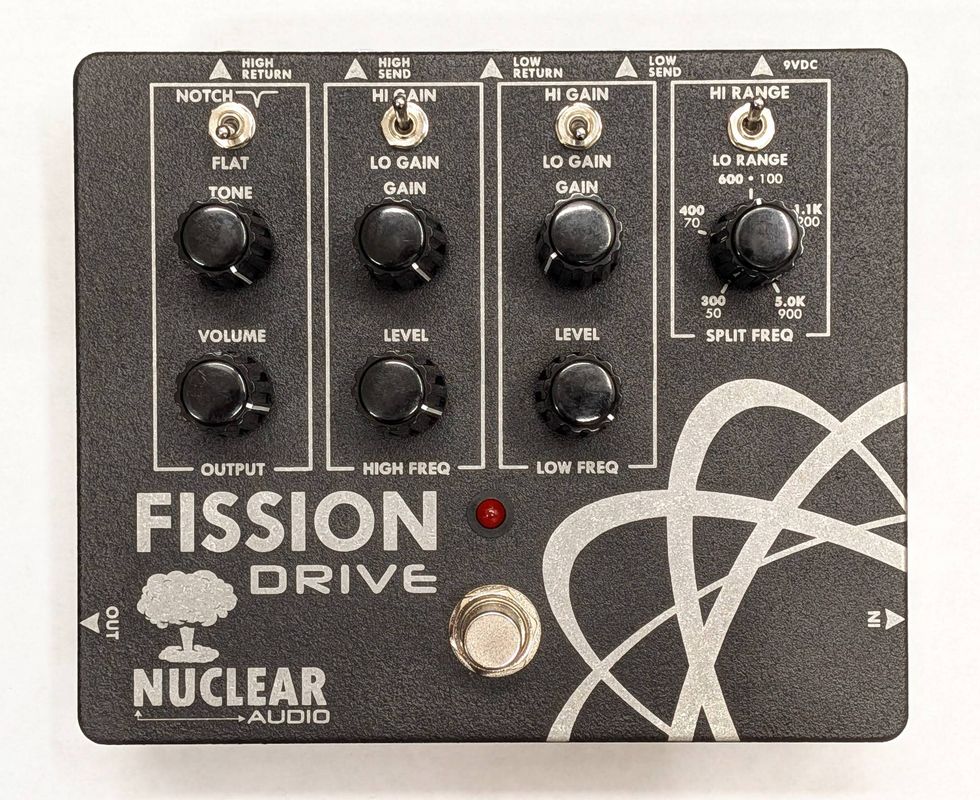
Nuclear Audio’s unique approach to clipping, not based on any previous circuits, smoothly and dynamically transitions between clean, soft clipping, and hard clipping, providing unparalleled responsiveness and dynamics while maintaining exceptional clarity.
Fission Drive highlights include:
- Separate drives for highs and lows, each with their own gain and level controls
- High/Low gain switch on each drive channel
- Control the frequency where the high and low channels are divided
- Post-drive effects loop send/return jacks for each channel
- Notch switch enables an aggressive scoop at the selected split frequency
- True bypass on/off stomp switch
The Nuclear Audio Fission Drive is available now for $300 street price from www.nuclear-audio.com and select retailers.
“Anything but the guitar”: Marcus King claims he never plays guitar at home – and thinks it makes him a better musician

To get to a level of guitar proficiency possessed by blues maestro Marcus King, you’d think you’d have to be practicing around the clock. But as King tells Guitar World in its new print issue, he actually prefers to play just about anything else – while at home, at least.
The 29-year-old ace explains that guitar playing is so deeply rooted within him that playing other instruments is actually beneficial when he comes back to his main instrument.
“When I’m at home, I don’t like to touch the guitar,” he says. “I play a lot of piano, which I write on. Or I’ll sit and I’ll play my pedal steel guitar or my fiddle, banjo, ukulele – anything but the guitar. If I do pick up a guitar, it’s a gut-string, fretless number.
“The guitar is something that I’m so familiar with. It’s like riding a bike or speaking the English language. If I moved abroad and only spoke Spanish for six months, it’s not like I would forget how to speak English. Guitar is so deeply rooted in me.”
It’s certainly true that taking time out of any creative endeavour often means you come back to it with a refreshed creative spark. Marcus King explains that the idea of being a musician first – not just a guitarist – was instilled in him by a book by bass virtuoso Victor Wooten.
“I like to play different instruments, and it helps my playing when I go back to the guitar. I read Victor Wooten’s book [The Music Lesson] and he harped on about the importance of being a musician, not a bass player, and I’ve always been influenced by that idea.
“It’s a holy experience to be able to sit at a guitar and say exactly what I have on my mind.”
Marcus King’s latest album Darling Blue arrived last year. Check out its lead single Honky Tonk Hell below.
The post “Anything but the guitar”: Marcus King claims he never plays guitar at home – and thinks it makes him a better musician appeared first on Guitar.com | All Things Guitar.
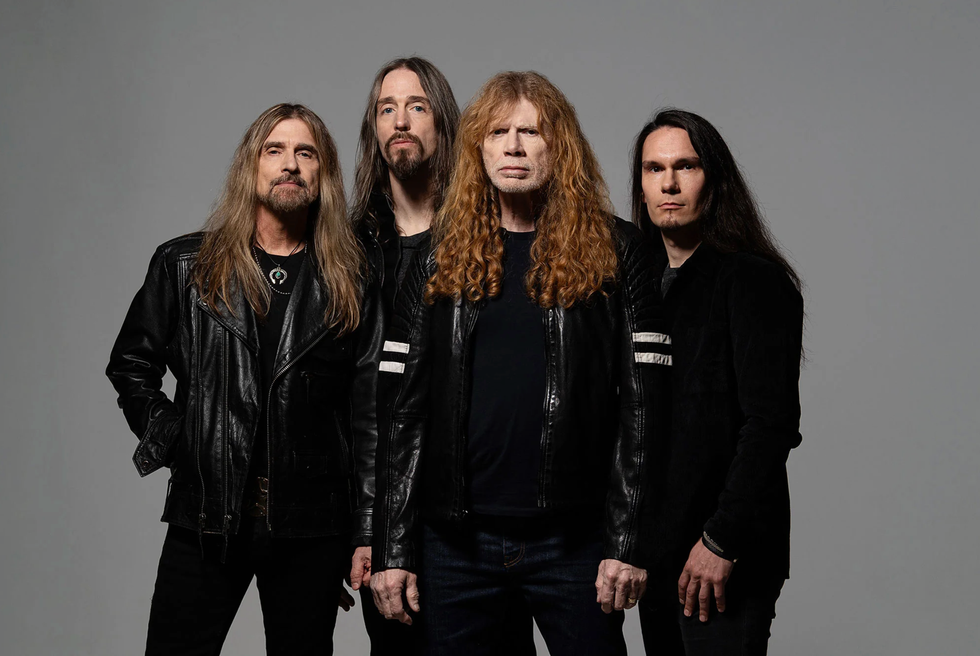
Set the World Afire: Dave Mustaine on Megadeth's Final Album and a Lifetime of Riffs
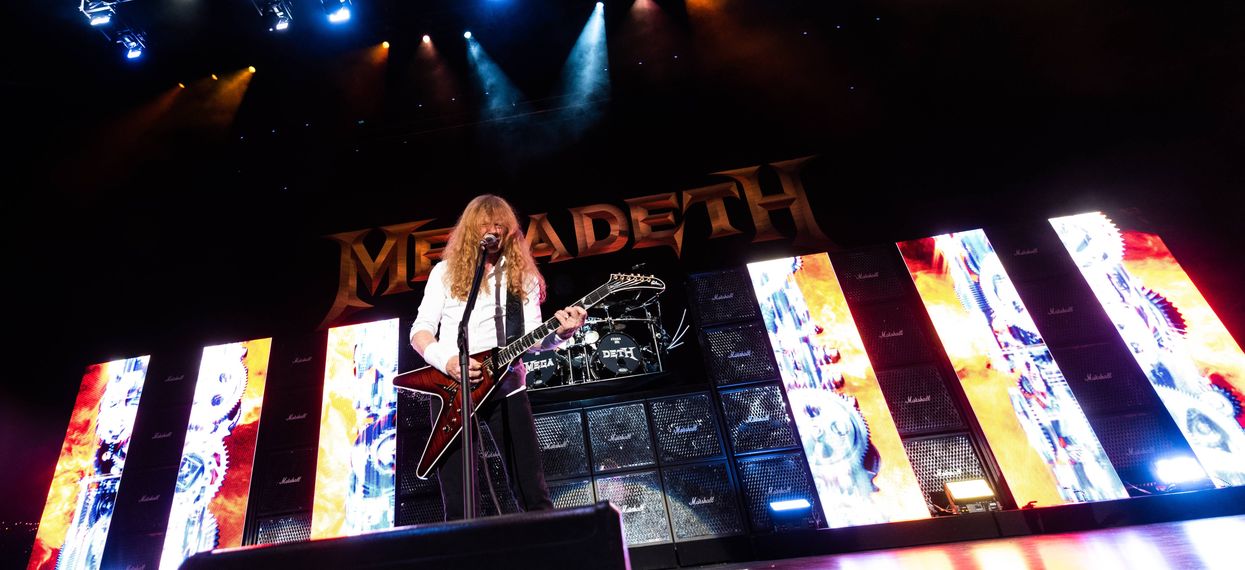
Dave Mustaine didn’t think he’d make it this far. Not the 40 years, not the 17 albums, certainly not the moment he’d be sitting down to talk about Megadeth’s final studio record. But here we are, more than four decades removed from that first gig at Ruthie’s Inn in Berkeley, California (February 17, 1984, to be exact), where the ceiling was so low “you could touch it from the stage,” and Mustaine was still figuring out if he even wanted to be a singer.
Could he have imagined that, in 2025, Megadeth would still be his band? “I didn’t think I was gonna live this long, honestly,” Mustaine admits during a video call, his voice still recovering from a bout of bronchitis that plagued him throughout a recent tour of Europe and the U.K. with Disturbed. Now 64, he’s dealing with health challenges that would have sidelined most musicians years ago—throat cancer, a “fused” neck, radial nerve damage in his arm. But he’s still here, still playing, still shredding. And that first Megadeth show is etched in his memory with remarkable clarity. “The history of that band was, we liked to party,” he recalls. “Ruthie’s was also a jazz club, so we had that temptation running through the band.” They played with drummer Lee Rausch—“I don’t know what happened to Lee, he was a good kid”—that night, and the lineup was still in flux. On guitar alongside Mustaine was Kerry King, on loan from Slayer, and Mustaine hadn’t even fully committed to singing yet. That decision didn’t come until bassist Dave Ellefson asked him why he wasn’t handling vocals. “I said, ‘Because I don’t want to—and that should be good enough for you,’” Mustaine recalls with a laugh. “But I also didn’t wanna hurt the guy’s feelings, ’cause Dave was younger and looked up to me. So I said, ‘Okay, I’ll try it.’ In a weird way, I have David Ellefson to thank for my singing career.”
Fast forward through the decades—through 1986’s Peace Sells... But Who’s Buying?, through 1990’s Rust In Peace, through 12 Grammy nominations and one win, through lineup changes and personal demons conquered—and Mustaine finds himself at an unexpected crossroads. The band’s latest album, simply titled Megadeth, will mark their 17th and final studio effort.
The decision wasn’t made lightly, and it wasn’t made in a single moment. “I would still keep going if I was not battling these things,” Mustaine explains, referring to his ongoing health struggles. “But I just don’t want to go out onstage when I’m not my best. There were many nights on the Disturbed tour where I was in full-blown bronchitis, hopped up on antibiotics and steroids to get rid of the inflammation. That doesn’t feel good. I’m not a guy that likes being sick.”
“I didn’t think I was gonna live this long, honestly.”
The recording process itself proved physically grueling. Working with producer Chris Rakestraw at various points throughout 2024, Mustaine and his current lineup—virtuosic Finnish guitarist Teemu Mäntysaari, Belgian drummer Dirk Verbeuren, and bassist James LoMenzo—did sessions in marathon stretches. “We did about four weeks straight, 12-hour days,” Mustaine recalls. “And I told my management, ‘I don’t know how much longer I can do this.’ My hands were throbbing and my back was hurting from sitting up for that long. What I remember during some of those sessions was torture, when they make people sit for long periods of time.”
Yet despite the physical toll—and the weightiness of knowing this would be Megadeth’s final statement—there was an openness and fluidity to the sessions. The songs were numbered rather than titled during recording—“Tipping Point,” the album’s explosive opener, was “song number nine”—because Mustaine changed titles so many times. “Going into the studio, I don’t really ever have a plan,” he says. “I have songs and we go in to record them, but I think open-mindedness going into the studio has been really good for us. A lot of times you’ll be working on a song and you’ll get an idea, and then you’ll have a completely different song come out of it.”
STUDIO GEAR
Guitars
- Gibson Dave Mustaine Flying V EXP
- Gibson Flying V with Evertune bridge
Amps
- Marshall JVM410HJS Joe Satriani Edition
- Marshall 1960DM Dave Mustaine 4x12 cabinet
- Mesa Boogie 4x12 cabinet
- Neve Brent Averill 1272 preamp (no EQ, no FX)
Effects
- TWA Chemical Z overdrive
- MXR Phase 90
- MXR Flanger
- Fortin ZUUL+ noise gate
- Source Audio EQ2
- Peterson StroboStomp HD tuner
- Peterson StroboRack tuner
- Korg DTR-1 rackmount tuner
Picks & Strings
- Dunlop medium picks
- Gibson Dave Mustaine strings, signature gauge (.010-.052)
That openness extended to his bandmates. “Dirk wrote music. James wrote music. Teemu wrote music,” Mustaine notes. “Even our producer chimed in a couple times. Good producers are supposed to do that.” The democratic approach reflects both his confidence in his current lineup and his recognition that fresh perspectives keep the music vital. “I believe with James and Dirk and Teemu’s ideas, this record had a lot of really fresh ideas. Obviously I have my fingerprints on it, but we’re a band.”
The album’s 11 tracks find Megadeth operating with deadly precision—economical, direct, savage. “Tipping Point” kicks off with a blistering guitar solo that gives way to Mustaine’s unmistakable snarl. “I Don’t Care” channels punk fury into defiant aggression. “Let There Be Shred” celebrates guitar virtuosity with mythic, apocalyptic imagery about thrash metal’s birth—a “Mount Olympus kind of thing,” as Mustaine puts it—while cuts like “I Am War” and “Made to Kill” deliver the technical thrash assault the band has honed across four decades.
For Mustaine, the division of labor between himself and Mäntysaari came down to serving the song. “If the rhythm’s really difficult, I’ll usually play the rhythm and let my guitarist do the solo,” he explains. “And if the rhythm’s really easy, I’ll let them do the rhythm and me solo. A lot of that is because these guys are all virtuosos and I’m self-taught, so there’s a limit to what I know how to do. A lot of what my soloing is, is just statements. We could be listening to a really beautiful solo, and then I’m gonna come and stomp through your gardens with combat boots.”
He points to the solo in “Let There Be Shred” as an example. “It’s kind of a hippie solo,” he says. “Teemu’s shredding, and then you go into this kind of slow-motion riff in the middle of the song. And I felt that having a burning solo over that part would be wrong because the rhythm was a really cool rhythm. A lot of times when people play solos, they think the solo’s more important than the song.”
It’s a philosophy Mustaine has carried throughout his career, one rooted in his identity as what he calls “a guitarist that sings” rather than a rhythm player or lead guitarist. “The term ‘rhythm guitar player’ seems a little diminishing for me,” he says. “I love the riff.”
And how committed is he to that principle? When asked what he sees as Megadeth’s main contribution to metal over the decades, he doesn’t hesitate: “Riffs.” It’s the riff—more than the solos, more than the hooks, more than even his distinctive snarl of a voice—that defines the band’s legacy in his mind.
“Sometimes you just want to hear something that makes you wanna kick trash cans over.”
That riff-centric approach announced itself the very first time Mustaine plugged in with his pre-Megadeth band, Metallica. “When I went to Norwalk [California] the day that I met James Hetfield and [original Metallica bassist] Ron McGovney, I didn’t know what was gonna happen,” he reflects. “Nobody did. But I had my style, and it was based around the riff.”
That style made an immediate impression. “I went in there and I didn’t have any Marshalls yet because I was just starting to get serious. I had these Risson amps—they were tan, so from the moment I set up my stack, I was different. I plugged in my guitar and I started warming up, and I kept warming up and warming up. And I finally said, ‘Where the fuck are these guys?’ I set my guitar down and switched my amp to standby. And then I went out there and I said, ‘Man, where’s my audition?’ They said, ‘You got the gig.’ So I got my job just by warming up.”
That period of time proved to be the crucible when thrash metal’s DNA was forged. When Hetfield picked up a guitar at a subsequent rehearsal—they’d been working with a second guitarist who showed up to a gig at the Whisky a Go Go, “in Def-Leppard-circa-’86 clothes, with a giant feather in his ear”—Mustaine was floored. “It blew my mind because he was so good. I kind of thought, where were you when we were auditioning a second guitar player? He was as good as he is today. James is a masterful guitarist.”
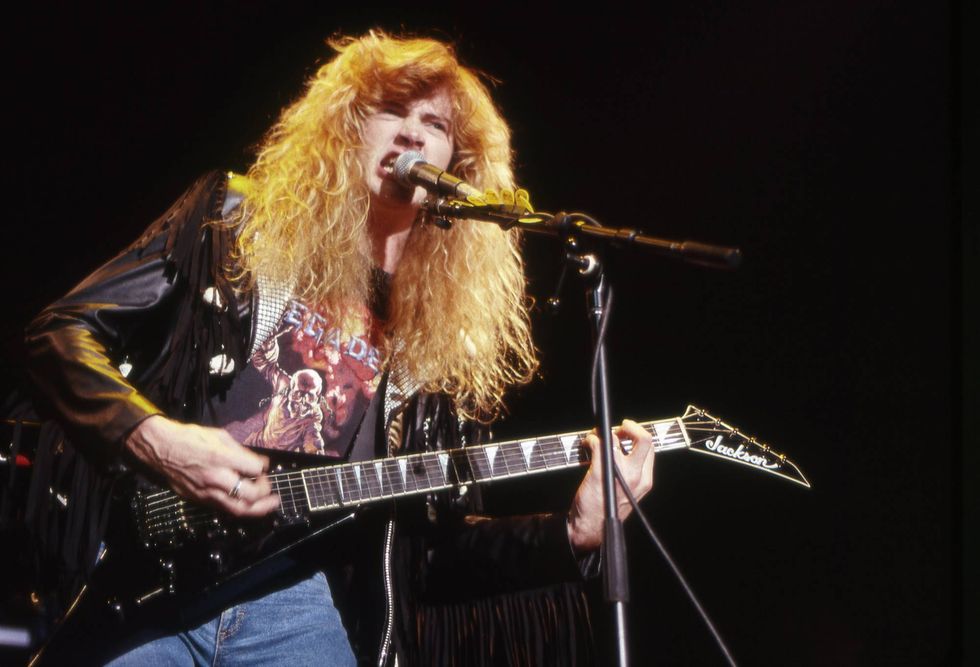
The fact that two musicians who would essentially define thrash guitar—the palm-muted down-picking fury, the intricate riffing, the speed and precision—were sitting in the same room together as teenagers remains remarkable. “I hear influences on everything,” Mustaine says. “I’ll be listening to a TV show and somebody will be playing the soundtrack, and it’s either copying a lick from me or from Metallica. I just take it all in stride. I feel very honored to have been able to make a name for myself.”
That history—and Mustaine’s complex, decades-long relationship with Metallica following his dismissal in April 1983—informs one of Megadeth’s most surprising inclusions: a version of Metallica’s “Ride the Lightning,” which Mustaine co-wrote with Hetfield, Metallica drummer Lars Ulrich, and late Metallica bassist Cliff Burton.
“As I come full circle on the career of a lifetime, the decision to include ‘Ride the Lightning,’ a song I co-wrote with James, Lars, and Cliff, was to pay my respects to where my career first started,” Mustaine explains. “It showcases the spider riffing and the grunting fretting—you fret a G flat power chord and you slide up into the G—technique that I brought [to the band]. I thought it was just a great way to pay my respects to James and Lars and to close the circle.”
Does he consider his take on “Lightning” a cover version? “No, because I wrote the song too. I think other people will say that, but if you’re asking me, I don’t think it’s a cover song. When we played it for people who are fans of that band and that song, the consensus has been that we did a fitting homage. I think we did it at least as good.” He pauses. “It’s a little faster.”
The album closes with “The Last Note,” perhaps Mustaine’s most introspective song—a reflection on career’s end that acknowledges both the cost and the glory. “They gave me gold, they gave me a name / But every deal was signed in blood and flames,” he sings, before delivering a final testament: “I came, I ruled, now I disappear.” Yet Mustaine insists he’s not dwelling on endings. “I’m at a place in my life right now where I’ve been reflective, but not too much,” he says. “I do have days full of satisfaction, a lot of contentment with everything that’s going on.”
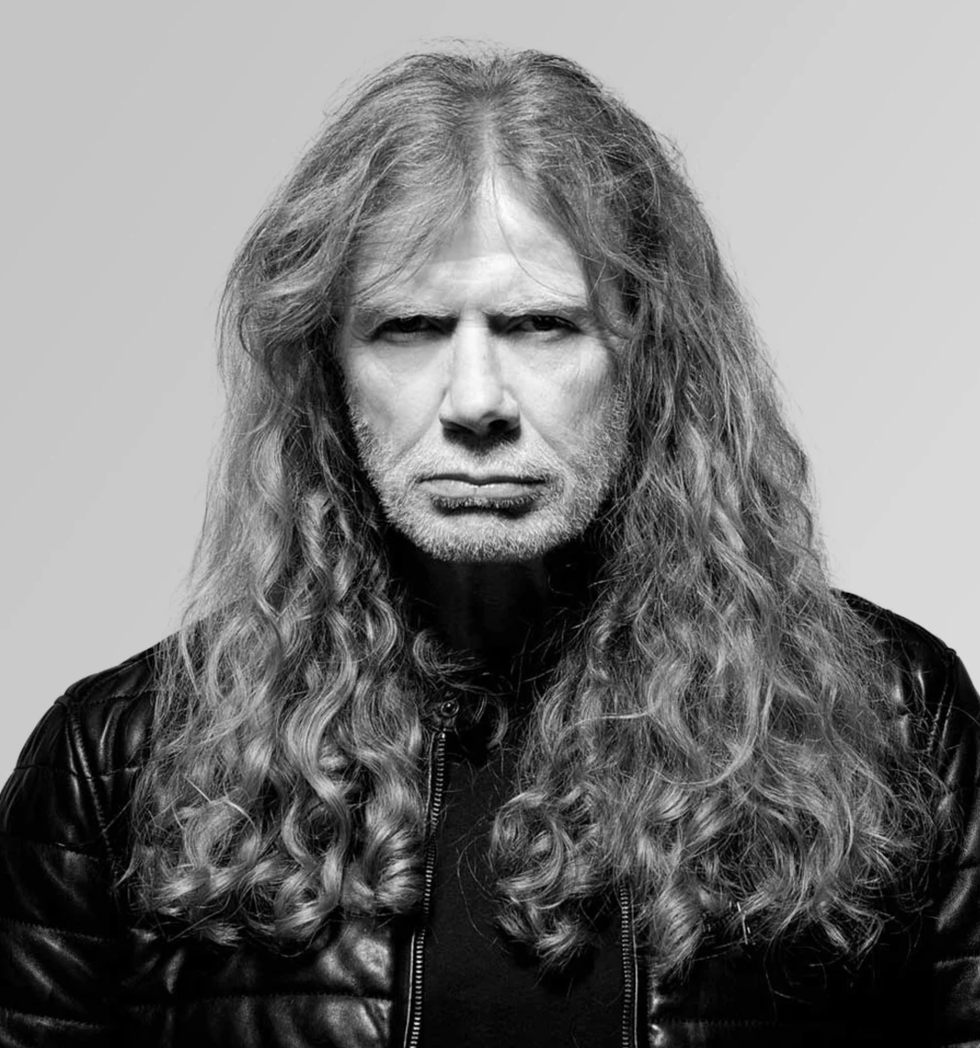
As for the tools that helped forge this final statement, Mustaine has come full circle. After years playing various Flying Vs, he’s now a Gibson ambassador, wielding a signature model that he describes with genuine reverence. The collaboration, he says, enabled him to dial in exactly what he desired—the right pickup configuration, the electrical schematic for his knob placement, a neck that’s very different from the standard Gibson Flying V. “Flying Vs are the most popular guitar in music,” he notes. “When people think of rock bands, they always draw one guy with a Flying V. I grew up loving the V, and to be [Gibson’s] number-one guy right now with it—the guitar is a monster.”
That monster will get plenty of use in the years ahead. Megadeth’s farewell tour will extend well into the future—Mustaine estimates three to five years of dates to properly close out Megadeth’s legacy, including runs supporting Iron Maiden and headlining with Anthrax and Exodus in support. “[Exodus guitarist] Gary Holt and I are like this,” Mustaine says, holding up crossed fingers. “Blood. He’s actually my oldest friend in the music business besides the guys in Metallica.”
“The term ‘rhythm guitar player’ seems a little diminishing for me. I love the riff.”
But he’s already gaming out how to handle that final show. “I was joking around and I said to my management, you should book the tour and then have a couple fake shows listed at the end. So I’ll do the last show thinking there’s still a few more to go, and then you’ll tell me that was it. And I’ll punch you in the face instead of breaking down and sobbing on stage.”
End it in anger instead of sadness? “Yeah,” he says with a laugh. “It’s more ‘Dave.’”
It’s quintessential Mustaine, wrapping emotion in, to use his words, a combat boot. From that first show at Ruthie’s Inn (where Mustaine wielded a pretty killer natural-finish BC Rich Bich that was later stolen) through countless tours and lineup changes, through personal and professional battles, he’s persevered. Does he wonder if younger musicians understand his place in metal history, the role he played in shaping thrash? “I don’t really know how much modern musicians know,” he admits. “If they’re influenced by a band that was influenced by a band that was influenced by me or Metallica, do they know the story? But I’m okay with myself, so I don’t feel the necessity to have people sing my praises. I’m really comfortable with who I am.” He laughs. “A freckle-faced redhead. You don’t think I was picked on growing up?”
For now, though, Mustaine is very much still here, and still vital. The hands may throb and the voice may rasp, but the fire that drove a red-haired kid to pick up a guitar and create a sound no one had heard before still burns. Megadeth delivers on that fire. “Sometimes you just want to hear something that makes you wanna fuck or fight, you know?” he says with a laugh. “Something that just makes you wanna kick trash cans over.”
As for that final show, whenever it arrives, Mustaine will walk offstage knowing he gave everything he had. And whether or not his management actually pulls off those fake extra gigs he joked about, there likely won’t be anger or tears—just gratitude for what was. “I’m really blessed,” he says. “And I’ve loved every moment of this.”
“It’s not puppet show Megadeth”: Megadeth’s final tour won’t feature appearances by the band’s many former members

Megadeth made waves in the metal world last year when Dave Mustaine announced that their self-titled 17th studio album – set to arrive later this month – will be their swansong.
The album will be the band’s only outing with guitarist Teemu Mäntysaari – who replaced Kiko Loureiro in 2023 – and will also, notably, feature a cover of Metallica’s Ride the Lightning, a song Mustaine helped write during his Metallica tenure in the early ‘80s.
Mustaine, Mäntysaari, bassist James LoMenzo and drummer Dirk Verbeuren will hit the road this year – starting in Canada next month – for a mammoth world tour celebrating the new record and the band’s multi-decade career. But as Mustaine confirms, don’t expect appearances from any of the group’s long list of previous members.
In an interview in the latest issue of Guitar World, the 64-year-old frontman is asked whether he plans to give any former Megadeth members a moment in the spotlight on the band’s upcoming trek.
“We’ve already done that with Marty,” he says, referring to the times Marty Friedman joined the band onstage twice in 2023. “And I mean, let’s look at the other people we’ve played with… there’s a lot of people. [laughs]
“That would be a huge undertaking. I don’t think I want to do that. I’d rather keep doing what we’re doing and let the fans [experience] Megadeth music and be happy about it. It’s not ‘puppet show Megadeth.’”
Elsewhere in the interview, Mustaine reflects on still being a highly active thrash metal musician at the age of 64.
“I wish I would have kept in touch with [late Megadeth drummer] Gar [Samuelson],” he says. “You see that Ace Frehley passed away and how sad that is. Whenever stuff like that happens, I feel fortunate because I’m still kicking. But on the opposite side of the coin, I think, ‘Fuck… that could have been me,’ but by the grace of God, it’s not.”
Dave Mustaine famously revealed in 2019 that he had been diagnosed with throat cancer. He confirmed he was “100% cancer-free” the following year, but in 2022 revealed he had nearly lost control of his left hand while undergoing chemo.
Megadeth’s final tour kicks off 15 February in Victoria, British Columbia – part of a string of Canada shows before the band head to South America, Mexico, Europe and the US later in the year.
“There’s so many musicians that have come to the end of their career, whether accidental or intentional,” says Dave Mustaine. “Most of them don’t get to go out on their own terms on top, and that’s where I’m at in my life right now. I have traveled the world and have made millions upon millions of fans and the hardest part of all of this is saying goodbye to them…
“We have done something together that’s truly wonderful and will probably never happen again. We started a musical style, we started a revolution, we changed the guitar world and how it’s played, and we changed the world. The bands I played in have influenced the world. I love you all for it. Thank you for everything.”
For tickets and a full list of upcoming Megadeth dates, head to the band’s official website. You can also check out the album’s lead single Tipping Point below.
The post “It’s not puppet show Megadeth”: Megadeth’s final tour won’t feature appearances by the band’s many former members appeared first on Guitar.com | All Things Guitar.
The ’58 Goldtop Slash couldn’t walk away from: “He said, ‘I don’t need any more of these.’ And then he plugged it in and said, ‘Alright, I’ll take this one!’”

Gibson’s Certified Vintage Program was created to bring clarity, transparency, and confidence to the often opaque world of vintage guitars. And few stories capture that better than a 1958 Goldtop Les Paul that ended up in Slash’s hands – despite his initial insistence that he didn’t need another one.
Speaking to Premier Guitar, Gibson Certified Vintage Manager Mitch Conrad explains that the program was created to bring clarity and confidence to the vintage guitar market.
“The vintage world can be a murky place to navigate,” Conrad says. “It can be hard for people to feel confident about what it is they’re adding to their collection.”
At its core, the goal is simple: “We really wanted to provide the best possible experience when buying a vintage Gibson or a Gibson-made instrument.”
To that end, every Certified Vintage guitar is accompanied by extensive documentation, including a certificate of authenticity, a detailed appraisal letter, and a deep dive into every component on the guitar – down to sourcing vintage-correct replacement screws when needed.
“And, as far as I’m aware, we’re the only ones [offering] a new, limited lifetime warranty,” Conrad adds. “We want to send them back out with that same level of confidence that these instruments will make it another lifetime in the hands of their next caretaker.”
While the goal is always to find the best examples possible, Conrad notes that “best” doesn’t always mean flawless.
“We try to stay away from things that have been broken. Still, we’ll make an exception,” he explains. “We sold a killer 1958 Goldtop that had a headstock repair. But this guitar was incredible. It was not in museum-grade condition, but it was one of the best ’50s Goldtop, darkback, PAF-equipped Les Pauls that we’ve had around.”
That guitar, as we now know, ended up in Slash’s hands.
“When I took it down for him to try out, he told me, ‘I really don’t need any more of these,’ Conrad recalls. “And then he plugged it in. He was like, ‘All right, I think I’ll take this one.’ [laughs]”
Tracking down guitars of that calibre, however, isn’t always a storybook affair.
“A lot of folks reach out directly,” says Conrad. “But there’s a lot of digging around as well. It’s stopping into shops on a long drive and asking, ‘Do you have anything else?’ And then somebody pulls out an old black rectangle case, and it’s a 1969 Les Paul Custom. There’s also Facebook Marketplace, Craigslist, all those spaces. So, not every story has the romantic ‘found it at a garage sale’ start to it.”
The post The ’58 Goldtop Slash couldn’t walk away from: “He said, ‘I don’t need any more of these.’ And then he plugged it in and said, ‘Alright, I’ll take this one!’” appeared first on Guitar.com | All Things Guitar.
Fender unveils its first consumer headphones and speakers – including wireless cans with up to 100 hours of battery life

Fender is officially stepping beyond guitars and amps, unveiling its new Fender Audio line with two landmark releases: the ELIE portable speakers and MIX wireless headphones.
Leading the launch is the ELIE (Extremely Loud Infinitely Expressive) portable Bluetooth speaker series, available in two models: the E6 and E12. Designed to balance portability with serious output, both speakers feature built-in subwoofers and a world-first Waves system-on-a-chip (SOC) implementation to deliver distortion-free sound across a wide dynamic range. The result, says Fender, is “greater volume and acoustic clarity” than rival speakers of the same size.
 Credit: Fender Audio
In terms of raw output, the ELIE 6 delivers 60 watts of power, while the larger ELIE E12 doubles that to 120 watts. Battery life is rated at up to 18 hours for the E6 and 15 hours for the E12, depending on usage.
Beyond simple playback, ELIE speakers are designed to double as flexible, multi-source audio hubs. Each unit can handle up to four audio channels simultaneously with low latency, allowing users to mix different sources with ease. Aside from Bluetooth, both models also feature a combined XLR and ¼” input, meaning you can plug in a guitar, microphone, or other line-level source directly and start playing.
Additional wireless channels can be added using compatible Fender Audio accessories, while multiple ELIE units can be linked together in stereo mode for true left/right separation or connected in multi-speaker mode to fill larger spaces.
 Credit: Fender Audio
Alongside ELIE, Fender Audio has also introduced the MIX headphones – a fully modular, over-ear wireless design aimed at listeners who want longevity as well as performance. At the heart of MIX is the FWD Tx USB-C transmitter, which enables lossless (LHDC-V), low-latency (LC3) and Auracast transmission across a wide range of devices.
The headphones feature 40mm graphene drivers, hybrid active noise cancellation, dual microphones with Environmental Noise Cancellation, and support both wired and wireless playback.
Fender Audio claims up to 100 hours of battery life with ANC switched off, dropping to around 52 hours with ANC enabled. And thanks to their modular design, key components can be replaced over time as opposed to replacing the entire unit.
Pricing-wise, the Fender ELIE E6 will retail for $300, the E12 for $400, and the MIX headphones for $300. All three products will be showcased at CES 2026, offering a hands-on look at Fender Audio’s take on modern, musician-friendly personal audio.
Learn more at Fender Audio.
The post Fender unveils its first consumer headphones and speakers – including wireless cans with up to 100 hours of battery life appeared first on Guitar.com | All Things Guitar.
Big Wreck guitarist says no one can replicate Eddie Van Halen’s feel, even if they can play his music note-for-note: “It’s just an innate feel. It sounds like he’s smiling”

You can learn Eddie Van Halen’s licks, memorise his solos and even play his music note-for-note. But according to Big Wreck guitarist Ian Thornley, there’s one aspect of Eddie’s playing that cannot be replicated no matter how good your technique is – and that is the feel the late legend brought to his playing.
Reflecting on Van Halen’s influence while discussing Big Wreck’s latest album The Rest of the Story, Thornley explains why Eddie’s playing continues to defy imitation, even among the most technically accomplished guitarists.
Despite the lasting impact of Van Halen’s style, Thornley admits Eddie wasn’t an early obsession in the way he was for many players of his generation. Asked whether he grew up as an ‘80s metal fan, he’s quick to set the record straight.
“If I’m being honest, not even a little bit,” he tells Guitar World in its new print issue. “That was more Brian [Doherty, Big Wreck’s late co-founding guitarist]’s thing. The heaviest thing I heard growing up was the Beatles’ Helter Skelter.”
Instead, Thornley’s path into heavier music came via Led Zeppelin III, which he counts as his “first personal exposure to heavy, riff-driven stuff.”
“I fell in love with the second side, with That’s the Way and Tangerine, but then I remember flipping it over and it’s Immigrant Song,” says the musician. “Like, ‘OK, what’s this?’ So I didn’t really know that era of metal. The Van Halen song I really liked was Dance the Night Away, you know what I mean?”
When the interviewer points out the chunky, start-stop swing in Big Wreck’s Believer – a feel often associated with early Van Halen, Thornley replies: “Yeah, I could see that. I mean, a lot of that stuff has seeped in over the past 15 to 20 years.”
“I’ve gone back and listened to all the greats,” he continues. “With Eddie Van Halen, you can learn the licks, and you can learn the songs as he was doing it, but it’s still going to be missing a certain bounce or swing. It’s just an innate feel; it sounds like he’s smiling. [Laughs] It sounds like he’s having the best time.”
The post Big Wreck guitarist says no one can replicate Eddie Van Halen’s feel, even if they can play his music note-for-note: “It’s just an innate feel. It sounds like he’s smiling” appeared first on Guitar.com | All Things Guitar.
“It ain’t the same, man”: Lenny Kravitz thinks modern guitar gear and digital emulations still don’t sound as good as vintage gear

Few topics divide guitarists quite like the modern-vs-vintage gear debate. While digital modellers and boutique recreations promise classic tones at the push of a button – with a large and growing cohort of converts – there’s still a devoted camp that insists the real things can’t be replaced. Count Lenny Kravitz firmly among them.
For Kravitz, whose records are steeped in the warmth of analogue gear and vintage instruments, modern technology still falls short – even after years of rapid advancement. Speaking in the new issue of Guitar World, the rock icon explains why he remains unconvinced by digital emulations and newer equipment.
Asked whether he could recreate the sound of his classic albums using modern gear, Kravitz replies: “It ain’t the same, man. It really isn’t the same. I A/B test everything, and while technology has come a long way and some things are very close, they’re just not close enough.”
“Plus, there is the effect of the accumulation of one thing on top of the other, one old piece combined with something else vintage,” he explains. “It begins to build up a sound that modern equipment can’t reproduce. Just look at old guitars – the age of the wood, you know? That’s something almost indefinable.”
His longtime collaborator and guitarist Craig Ross echoes the sentiment, pointing to the physical changes instruments undergo over decades.
“Wood ages and dries; it’s almost like there’s something in the air that imparts a unique sonic effect,” says Ross. “I think you can’t deny that the pickups in old guitars age in a way that is very hard to reproduce.”
The pair were speaking while revisiting Circus, which has recently been reissued as a 30th-anniversary expanded deluxe edition packed with bonus material.
Kravitz, who remains an avid collector of old instruments, also reveals that the Les Paul Goldtop he’s currently using on tour is one of his most recent acquisitions.
“The Goldtop I’m using now on tour. I have several, but this one is a conversion,” he says. “Someone in its history put PAFS on it and took off the tailpiece. It is the most amazing sounding guitar. I think it’s from around ‘54.”
Not every guitarist, however, sees vintage gear through the same lens. While Kravitz swears by the character and tone of older instruments, others argue that age alone doesn’t determine quality. Blues-rock guitarist Chris Buck, for example, has been vocal about his scepticism toward the idea that older guitars are inherently better.
“I don’t subscribe to the idea that all vintage instruments are great,” Buck told Guitar World, “because I’ve definitely played some dogs. Some of my favourite guitars were made after 2020, and some were made in the ‘60s.
“There’s a synergy between you and a great instrument. That could be a $300 Squier or a $5,000 Gibson. It doesn’t matter. If it speaks to you, it’s the one.”
The post “It ain’t the same, man”: Lenny Kravitz thinks modern guitar gear and digital emulations still don’t sound as good as vintage gear appeared first on Guitar.com | All Things Guitar.
Horrothia Effects Triage Deluxe review – the ultimate all-in-one gain machine for fussy tonehounds?

£240, horrothia.com
The word ‘preamp’ was invented by Satan in order to sow discord and confusion. Does it mean the front half of an amplifier, a DI device with speaker simulation, or just a glorified overdrive pedal? Take your pick, it’s all of them! So let me make it clear that the Horrothia Effects Triage Deluxe falls into the third category… except that it’s not so much glorified as glorious.
This British boutique stompbox has enough gain on tap to replace your Timmy or ODR-1, but it also has the tone-sculpting power to transform your sound in a number of ways, some of them less orthodox than others.
 Image: Press
Horrothia Effects Triage Deluxe – what is it?
There was a non-Deluxe version of the Triage, with just three knobs and a mids switch; this unit has replaced it in the Horrothia line-up, but it’s apparently a whole new design rather than just a more complicated take on the old one. So let’s have a look at what’s going on inside.
The first stage of this preamp is a FET preamp – yes, that’s right, a preamp can also be part of a preamp, when will this madness end!? – which runs into a variable high-pass filter, followed by a discrete op-amp (with adjustable headroom) to bring the grit, and a treble-cutting tone section on the way out.
More importantly than all that, though, did you clock the footswitch? It looks like one of the buttons off an old arcade game, and it’s adorable. This kind of thing should be compulsory on all stompboxes from now on.
 Image: Press
Horrothia Effects Triage Deluxe – is it easy to use?
There are no surprises with the lower three knobs: ‘breath’ is for treble, and gain and output are self-explanatory. For the other two, however, you might have to put your brain into reverse.
The HPF’s cut-off frequency ranges from 20Hz all the way up to 1kHz, so as you turn it up you’re effectively turning the bass down; and the headroom sets the voltage in the second gain stage between 6v and 16v, so as you turn this one up you’re actually reducing the drive and compression.
But hang on, how can you run a pedal at 16v with a 9v power supply? Well, in this case you can’t: the Triage Deluxe will work fine with a standard adapter but it really wants 18v, otherwise you’re basically fixing the headroom at minimum. So, out comes the voltage doubler cable (what would we do without you, Voodoo Lab?) and it’s on with the testing…
 Image: Press
Horrothia Effects Triage Deluxe – what does it sound like?
It’s always nice when a pedal gives you a starting point of absolutely nothing. With clipping off, the filter at minimum and the headroom at maximum, the Triage Deluxe can produce something very close to total transparency… which might not be terribly useful on its own, but does bode well for when the gain and output levels start heading north.
That brings us quickly to two easy wins: as a clean boost, and as a transparent low-gain overdrive, this thing is just impeccable. If you simply want to hear your clean tone but louder and/or grittier, it’s right here. The drive feels quite fluffy and uncompressed but tonally it remains tight; in this sense it’s unlikely you’ll find the HPF necessary to sharpen things up – not with single-coils anyway – but it does allow you to shift the emphasis to the midrange, Tube Screamer style, with total control over just how lean the bottom end gets.
The effect of reducing the headroom can be a lot more subtle, depending on other settings, but it’s step one on the journey from preamp to proper drive pedal – and step two is the clipping switch. This makes things pretty hairy, but still without any suggestion of raggedness or unwanted bloom. The Triage Deluxe is a wonderfully entertaining pedal for sure, but it’s also a master of self-discipline.
 Image: Press
Horrothia Effects Triage Deluxe – should I buy it?
This is not a cheap pedal, but it’s actually something of a bargain by Horrothia standards (the excellent Berkeley vibe is currently going for £370)… and what you’re getting for your money is undoubtedly of the highest quality. Running it off 9v feels a bit like fitting a 50mph limiter to an Aston Martin; but if you have a power supply with 18v outputs, or don’t mind the hassle of using a voltage doubler, it will let you zone in on the exact sound you’re after with a rare level of precision.
Horrothia Effects Triage Deluxe alternatives
Other pedals that trample all over the line between high-class overdrive and tone-shaping preamp include the Hudson Electronics Broadcast (£179) and Origin Effects RevivalDrive Compact (£329). Or for a very different kind of flexibility, you could go for a dual stomper like the Crazy Tube Circuits Crossfire (€218/£178).
The post Horrothia Effects Triage Deluxe review – the ultimate all-in-one gain machine for fussy tonehounds? appeared first on Guitar.com | All Things Guitar.
State of the Stomp: In Defense of the Mono Pedal
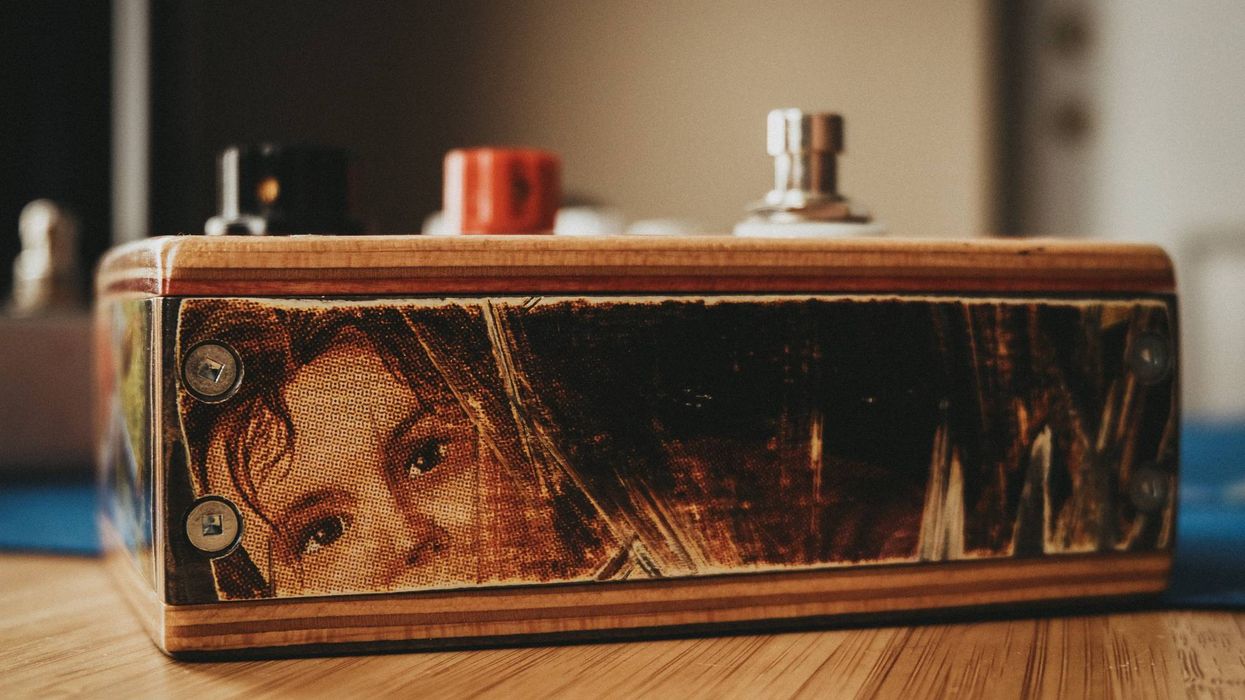
If you scroll through the comments section of most pedal demo videos, you’ll see a familiar refrain: “Why not stereo?” And while stereo has its merits, I’m here to defend the mono signal chain. Before treating stereo as an automatic upgrade, it’s worth taking a closer look at when it helps, when it hinders, and why mono might actually be the more powerful choice for most players.
Stereo is often seen as a bonus for a pedal, a feature that a player may use in the rare case they have a stereo signal. But I’d argue that it can sometimes hurt the pedal’s design. Even with digital pedals, stereo requires extra circuitry to account for both signal paths. This means the pedal will certainly be more expensive. It also means the pedal will likely be bigger, to house both the added circuitry and the additional jacks to support the stereo in and out. So if you’re playing in mono most of the time, don’t worry about that stereo option.
For those who actually use a stereo pedalboard, there’s still plenty to consider. I’ve noticed that the majority of stereo players tend to use it in recording scenarios, but this is also where I find stereo to be the most harmful. Say you’re cutting a track with single takes of each part recorded through stereo effects—while each individual track is wider than a mono recording, together they add up to create a flattened mix because each track is occupying the same area in the stereo field. While it may sound backwards, a mix with multitracked guitars recorded in mono allows for a wider sound. Each track being slightly different creates a perceived physical space, much like a choir sounds fuller and richer than an individual voice.
Furthermore, let’s be honest: Most people don’t listen to music in stereo, either. Have you ever been to a friend’s house where their “stereo” setup consisted of two speakers placed across the room at different heights? And certainly even those who care about stereo have listened to music through a mono Bluetooth speaker or a single headphone.
“While it may sound backwards, a mix with multitracked guitars recorded in mono allows for a wider sound.”
Mono is a great option for guitar signal chains because the guitar is ultimately a mono instrument, a sound created from a single source. By not changing the nature of the guitar, you end up getting more out of it. Embracing mono ultimately empowers every part of your signal chain—guitar, pickups, pedalboard, amp—to be used to its full potential, because you’re not trying to fit it into the needs of stereo. There’s a reason why a two-guitar band sounds so good, or why multitracking works so well. Each part can sit in its own space, live or in a mix, complementing the other to create a greater whole.
There is one use for stereo that I will admit I am very fond of. Wet/dry rigs are a great way to break out of the standard signal chain without losing some of the power of mono. This type of setup has two separate signal chains, one containing the dry signal, including simple effects like compression and distortion, and one containing the more prominent effects like delay and reverb; each runs into a separate amp to be played side by side. In fact, while wet/dry is often thought of as a type of stereo rig, I would argue that it is a version of leveled-up mono—dual mono. Here you can have all of the benefits of two signal chains without the worries of keeping that perfect stereo even-ness, and the two work together to create something larger that is defined by the differences between each signal.
To sum up, stereo isn’t inherently bad—it’s just not the universal upgrade it’s often assumed to be. For many players, chasing stereo introduces more compromises than benefits. By embracing the guitar’s mono nature, you can make more intentional choices about your rig and the playing experience itself. And by understanding these distinctions, you’ll be better equipped to choose the right tools and get the most out of the instrument you already love.
Pages
