
Music is the universal language
“Glory to God in the highest heaven, and on earth peace to those on whom his favor rests.” - Luke 2:14
Fretboard Journal


Podcast 563: Frank Gross of Thunder Road Guitars
Frank Gross, founder of West Seattle’s Thunder Road Guitars, joins us this week.
Thunder Road is a unique brick-and-mortar success story. Thanks to some smart business moves (online and off), Thunder Road has thrived. In fact, Frank recently purchased and renovated a commercial space for the store!
During our chat, we talk about Seattle’s thriving independent guitar stores; Thunder Road’s offerings (they carry big brands like Fender and Gibson alongside consignment instruments); and so much more.
We are brought to you by Peghead Nation: https://www.pegheadnation.com
(Get your first month free or $20 off any annual subscription with the promo code FRETBOARD at checkout).
Mike & Mike’s Guitar Bar: https://mmguitarbar.com


The post Podcast 563: Frank Gross of Thunder Road Guitars first appeared on Fretboard Journal.
Luthier on Luthier: Chris Holcomb
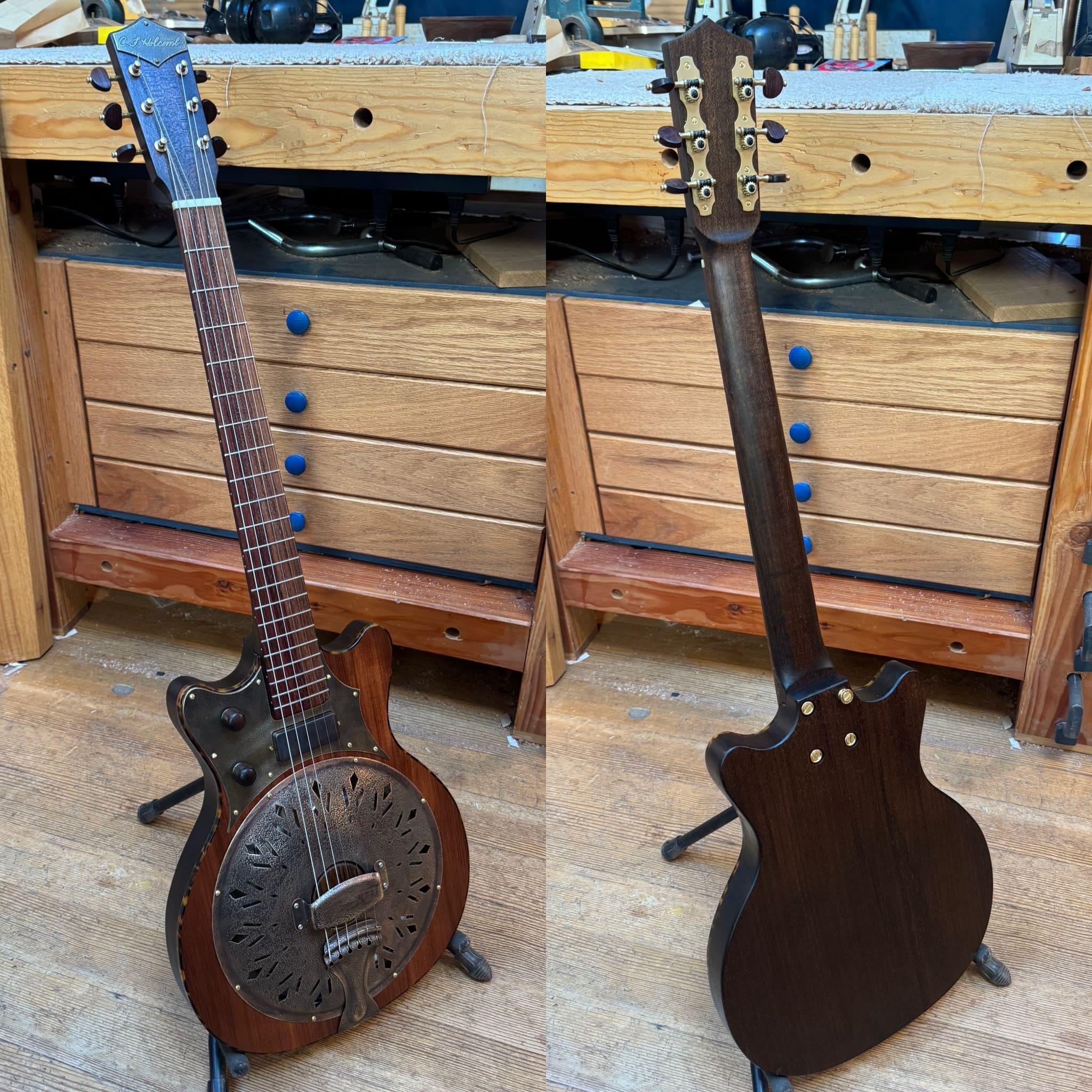
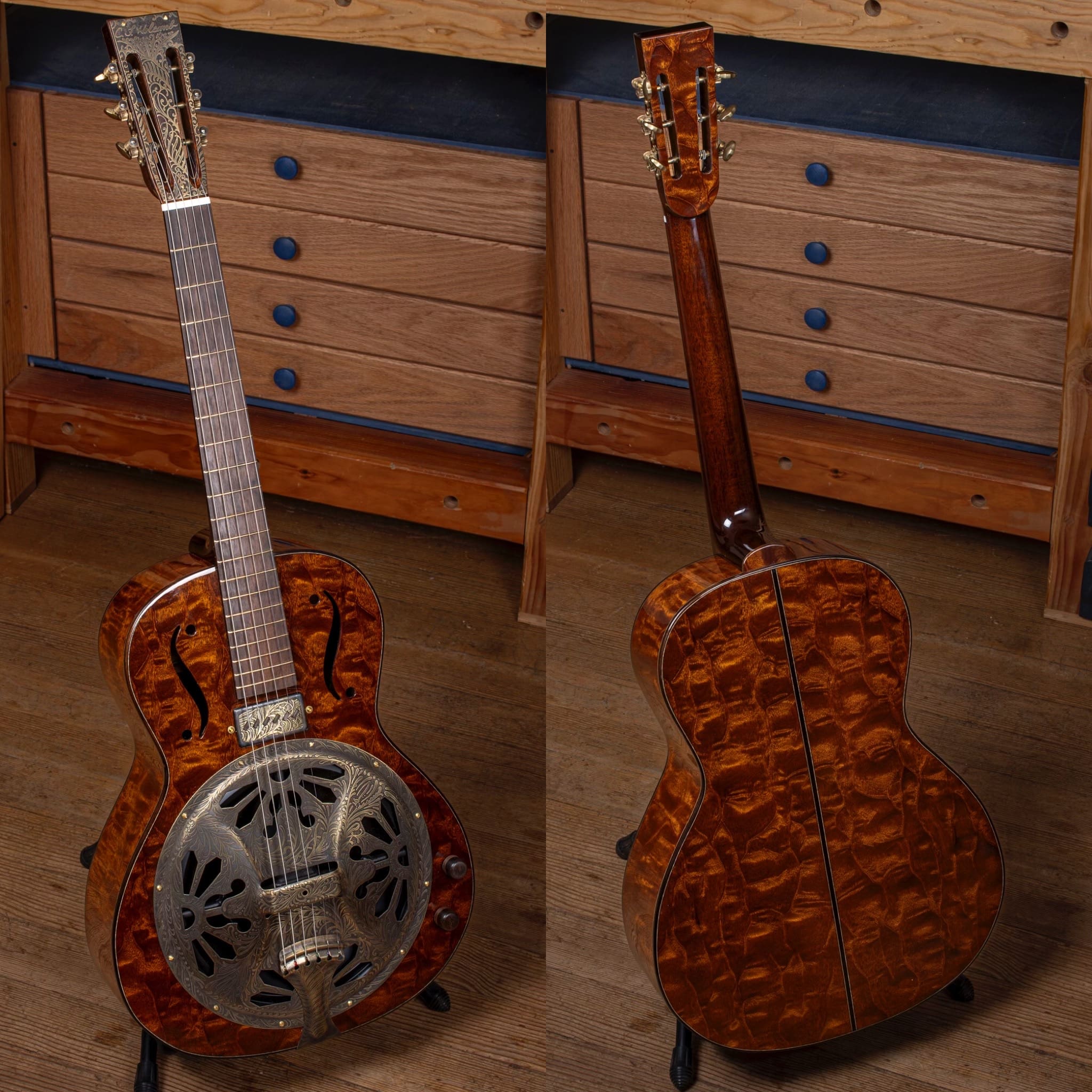
Chris Holcomb specializes in making world-class resonator guitars in Santa Cruz, California.
Chris built a guitar in his teens and has pursued the craft ever since. In episode 118, Chris tells us this wasn’t a straightforward path, but one of persistence and dedication that ultimately paid off as he achieved his goal of making a life and living through his hands.
Link: https://www.cfholcombguitars.com
https://www.instagram.com/c.f.holcombguitars
Luthier on Luthier is hosted by Michael Bashkin of Bashkin Guitars and brought to you by the Fretboard Journal. This episode is sponsored by the Looth Group, Dream Guitars and StewMac.
Want to support Luthier on Luthier? Join our Patreon to get access to exclusive photos and content from Michael and his builds.

The post Luthier on Luthier: Chris Holcomb first appeared on Fretboard Journal.
Truth About Vintage Amps, Ep. 171
Skip is back from a long-overdue road trip and has tales to tell and amps to fix. We also hear about the Fretboard Summit’s vintage amp room (watch that baby Leslie video), Christopher Guest in the new Fretboard Journal and so much more.
New Truth About Vintage Amps discount from Amplified Parts on all Apex matched-tube products: TAVAAPEX10 gets you a one-time discount of 10% off Apex products now through October 31, 2026. Stock up! https://www.apexmatching.com
Thank you to our sponsors: Grez Guitars; Emerald City Guitars; and Amplified Parts / Mod Electronics.
Some of the topics discussed this week:
2:21 Skip hits the road to Pendleton, Oregon and Spokane, Washington: White’s Boots (link); the Pendleton Roundup (link); Kirishian rug cleaning (Instagram)
17:22 Why do DC-powered amps need a vibrator, explained!
21:37 Summit recap from Brian McAllister (follow him on Instagram); more Skip road trip highlights
27:01 Figuring out the taper on NOS pots, how does the hum control work on my Bell Pacemaker PM10?, and jalapeno salsa
34:00 I want a tweed 5F1 Champ: Should I build one or buy one?
37:59 What should I do with this Peavey Classic? Ludwig, the TV series
44:54 A wild K&F pickup restoration story (find it on our Patreon)
45:33 Putting a harmonica mic into a guitar?
48:53 Amp tech knowledge gaps; Uncle Doug and cheap solder (YouTube video), Solder Smoke Remover (Amazon link)
56:02 Vintage Sound 50; a potential guest Peter Miller?
1:02:23 Help for my Harmony H306A; 7408 power tubes
1:07:40 Paul Simon guitarist Mark Stewart (Wikipedia); more roadtrip talk (Hwy 395); Christopher Guest in the Fretboard Journal 60 (order it here)
Want to be a part of the show? Join us by sending your voice memo or written questions to podcast@fretboardjournal.com! Include a photo, too.
Hosted by amp tech Skip Simmons and co-hosted/produced by Jason Verlinde of the Fretboard Journal.
Above: Listener Bernie’s Bogen Pacemaker PM10.

The post Truth About Vintage Amps, Ep. 171 first appeared on Fretboard Journal.
Wintergrass Sessions: John Reischman & Patrick Sauber
At the 2026 Wintergrass Festival in Bellevue, Washington, the Fretboard Journal teamed up with filmers I Know We Should to capture some of our favorite artists (and talk gear).
In this session, we sit down with bluegrass greats John Reischman and Patrick Sauber.
We hear John and Patrick play three tunes and then the duo walks us through their cherished instruments, including John’s Lloyd Loar-signed Gibson F-5 from 1924, which has been featured in our print magazine and in other FJ videos.
Register now for Wintergrass 2027. The lineup in 2027 will include Sierra Hull, Jerry Douglas Band, East Nash Grass and other bluegrass favorites.
Video by Brad Wagner, audio by Juan M Soria.
We’ll be sharing more highlights from Wintergrass 2026 on a weekly basis here and on our YouTube channel.
The post Wintergrass Sessions: John Reischman & Patrick Sauber first appeared on Fretboard Journal.
Luthier on Luthier: Andy McKee
Andy McKee exploded to prominence in 2006 with this video of his track “Drifting,” released on the nascent CandyRat record label.
Twenty years later, Andy’s career has taken him to audiences around the world, with collaborations ranging from Dream Theater to Prince.
I’ve been looking forward to sharing this episode of Life on the Fretboard since we recorded it during Andy’s latest world tour. But first let me set the scene…
A few weeks ago, I was in Japan, a country that I had not visited since my late teens. The first time I was there, I managed to blow almost all of my budget for the trip on a secondhand Fender Telecaster I found in Osaka…a Keith Richards-style ’72 Custom with a wide-range humbucker and the four knobs. (That was on day two of a two-week trip, and an indication of seventeen-year-old me’s value priorities and impulse control.) On this trip, I resolved to be more cautious.
This time, I was in Japan as producer for Australian fingerstyle guitar supremo Alan Gogoll. He’s a previous guest on this podcast and, to my mind, one of the most impactful and iconoclastic acoustic guitar voices of this century. That is no idle exaggeration.
Alan was playing a set at the Osaka Sound Messe show, the Japanese equivalent of the Fretboard Summit. After that, the plan was to get some peace and quiet in the historic city of Kyoto, where we would record an album (our sixth together). All of this has now happened.
Note: In the Fretboard Journal‘s 59th issue, you will find an article I wrote about my experiences on the producer’s side of the glass at the legendary Hansa Studios in Berlin for the recording sessions that would become Alan Gogoll’s album Lioness Lullabys.
The reason that I mention this is that, during my time in Japan, my guest for this episode, the mighty ANDY MCKEE, was also in Osaka. Despite the twin charms of tight schedules and crushing jet lag, we were able to get together one evening as a small group that included Alan, Andy and fellow guitarists Adrian Bellue (the acoustic one) and Japan’s own Kousuke Miura. We enjoyed a dinner together at an all-you-can-eat wagyu beef emporium in Osaka.
It was at dinner when I heard Alan Gogoll say that if it hadn’t been for Andy’s “Drifting,” he never would have picked up an acoustic guitar and would probably still be shredding on some sort of pointy Ibanez with a Floyd Rose.
That meant that, if it hadn’t been for Andy, neither Alan nor I would have been sitting at that table in Osaka; that Fretboard Journal article would never have been written, and none of the albums we had made together would exist!
This was quite a moment of realization for me – a sudden sense of time and place – and it made me stop and consider the impact that Andy McKee has had on the acoustic guitar world. He represents a true paradigm shift for instrumental acoustic players. He even toured with Prince as a solo acoustic guitarist…come on!
From my own point of view, Andy represents something of a duality: I first met him in Montreal some 15 years ago and every time I have had the pleasure of hanging out with him, he’s been affable, easygoing, and a genuine delight…the sweetest dude who is also a ferociously gifted guitarist, composer and performer.
We can learn a lot from Andy McKee. During the course of this conversation, I certainly did.
We talk about Andy’s early years in Topeka, Kansas; formative exposure to Eric Johnson’s “Cliffs of Dover,” which is how it all started for him; the deep influence of players such as Michael Hedges, Preston Reed and Don Ross; social media and the visual aspect of modern life as a musician; Prince; and the joy of working with celebrated acoustic guitar maker Michael Greenfield, who is also the sponsor for this episode.
This conversation actually took place several months before our meeting in Japan at a small hotel near Gatwick Airport, prior to Andy flying to the next leg of his world tour. There had been logistics and details and all manner of little moving parts that needed attending to, but Andy was handling it all with his typical good nature.
We had just had dinner when we recorded this and that’s where you join us during this podcast.
Life on the Fretboard is a Michael Watts production for Fretboard Journal.
Theme music by me with Dan Western on drums.
Branding by Michael Johnson.
Some links I mentioned:
Guitars of the British Isles with Martin Simpson (YouTube)
Andy McKee
https://andymckee.com
https://www.instagram.com/therealmckee
https://www.youtube.com/channel/UC4SlCAeLGLONquLmwYBkttA
Michael Watts
https://www.michaelwattsguitar.com
https://www.instagram.com/michael.watts.guitar/
https://www.youtube.com/@MichaelWatts
Sponsored by Greenfield Guitars.
Be advised that the conversation does contain some adult language.
The post Luthier on Luthier: Andy McKee first appeared on Fretboard Journal.
Podcast 562: Nate Mercereau
On today’s episode, guest host Ryan Richter sits down with multi-instrumentalist, composer, and producer Nate Mercereau.
Renowned for pushing the boundaries of stringed instruments, Nate continues to redefine what it means to play and compose with the guitar as the centerpiece.
In this conversation, Ryan and Nate dive into the making of Mercereau’s compelling new album, Fantastic Thoughts. They discuss the creative philosophy, gear setups, and spontaneous moments of inspiration that shaped the record, giving listeners an insider’s look into Nate’s unique artistic process.

We are brought to you by Peghead Nation: https://www.pegheadnation.com
(Get your first month free or $20 off any annual subscription with the promo code FRETBOARD at checkout).
Mike & Mike’s Guitar Bar: https://mmguitarbar.com
Above photo: Alyssa Mercereau
The post Podcast 562: Nate Mercereau first appeared on Fretboard Journal.
Fretboard Summit 2026 Highlights
No one could quite explain it (and I still can’t), but our 2026 Fretboard Summit quickly became everyone’s favorite Summit to date.
Vibes were high, countless guitars were sold, but – most importantly – everyone just seemed to be smiling the whole time.
We had three days of talks, master classes, and panel discussions; around 100 exhibitors/luthiers; and a series of concerts with our most eclectic programming to date. Most importantly, we had fun.
Our next Summit takes place August 19-21, 2027 at Chicago’s Old Town School of Folk Music. Stay tuned for details.

Chris Martin IV (Martin Guitars) with an extra special talk featuring John Lennon’s old D-28.

Steve Dawson not only played in the Volcano Brothers with Richard Bennett at this year’s Summit (their first appearance outside of Nashville), but he also interviewed Richard about his extensive career as a guitarist. The interview will be shared soon on the Fretboard Journal Podcast.

Musician, historian and Fretboard Journal contributor Cameron Knowler opening for Jake Xerxes Fussell.

Offerings from Santa Cruz Guitar Co.

Fretboard Summit picks from Tone Slabs!

Maryland’s Cartouche Guitars.

Luthier Todd Lunneborg (TL Guitars) reprising his role as our Pinewood Derby emcee and officiant. This year we had around 20 luthiers build Pinewood Derby cars to compete.

New York’s Gillander Guitars knows how to make a flattop and a fast Pinewood Derby car.

Acclaimed bassist/cellist Gabe Noel shortly before his mind-blowing master class and Summit set, where he performed on a 1930s Rickenbacker tenor guitar.

Jacob Jolliff and Michael Daves.

Josh Scott of JHS did a session called Can You Hear It?, a blind taste testing featuring players trying to identify a coveted pedal versus its clones.

The Fretboard Journal’s Sofia Wolfson introduces Jessica Dobson of Deep Sea Diver.

The Fretboard Summit, where you may just catch Taylor Guitars’ co-founder Bob Taylor checking out the guitars of others. In this photo, he’s hanging out at the Breedlove booth.

Our first-ever Guitarmaking for Kids class at the Summit, where the next generation of luthiers learned about guitar construction, pounded some frets, and had some laughs.
Our next Summit takes place August 19-21, 2027 at Chicago’s Old Town School of Folk Music.
The post Fretboard Summit 2026 Highlights first appeared on Fretboard Journal.
Podcast 561: Molly Tuttle
Molly Tuttle joins us this week to talk about guitars (of course), her touring rig, life on the road and so much more.
We chat about vintage Martins, the new Martin double-neck guitar she’s using (the Martin Grand J-28E DN), why she hasn’t gone electric yet, and so much more. It’s a fun chat with one of the bluegrass world’s most inspiring artists.
https://www.mollytuttlemusic.com
We are brought to you by Peghead Nation: https://www.pegheadnation.com
(Get your first month free or $20 off any annual subscription with the promo code FRETBOARD at checkout).
Mike & Mike’s Guitar Bar: https://mmguitarbar.com
The post Podcast 561: Molly Tuttle first appeared on Fretboard Journal.
Wintergrass Sessions: Woody Platt and the Bluegrass Gentlemen
At the 2026 Wintergrass festival in Bellevue, Washington, the Fretboard Journal teamed up with filmers I Know We Should to capture some of our favorite artists (and talk gear).
In this session, we hear from Woody Platt and the Bluegrass Gentlemen.
In this video, we get a rundown on the band’s favorite gear, including Platt’s Collings and mandolin player Darren Shumaker’s Gilchrist.
Register now for Wintergrass 2027. The lineup in 2027 will include Sierra Hull, Jerry Douglas Band, East Nash Grass and other bluegrass favorites.
Video by Brad Wagner, audio by Juan M Soria.
We’ll be sharing more highlights from Wintergrass 2026 on a weekly basis here and on our YouTube channel.
The post Wintergrass Sessions: Woody Platt and the Bluegrass Gentlemen first appeared on Fretboard Journal.
Truth About Vintage Amps, Ep. 170
New Truth About Vintage Amps discount from Amplified Parts on all Apex matched-tube products: TAVAAPEX10gets you a one-time discount of 10% off Apex products now through October 31. So stock up! https://www.apexmatching.com
It’s the 170th episode of the Truth About Vintage Amps, the call-in show where amp tech Skip Simmons fields all of your guitar amplification questions (or at least the ones involving tubes).
Thank you to our sponsors: Grez Guitars; Emerald City Guitars; and Amplified Parts / Mod Electronics.
Some of the topics discussed this week:
:32 What’s on Skip’s Bench: A Voice of Music 8810
2:40 Jason’s Fretboard Summit 2026 report
10:13 Recommended reading: Willie Dixon’s ‘I Am the Blues,’ ‘Bo Diddley: Living Legend,’ and ‘Buzz Busby: Father of Washington DC Bluegrass’
12:35 Is this Fender Super Champ safe to use?
20:06 Aotearoa New Zealand Amplifier History Project (support it here); New Zealand pop and punk; building guitars in the Congo (Fretboard Journal #56)
25:19 MusicMan HD130; Sun O))); a typewriter at the 2027 Summit?
33:34 Who made Rickenbacker amps? Talk to me about my Rickenbacker M11
41:14 Bix Beiderbecke’s birthday (August 6); conversing with your amp heroes; frozen udon noodles and mushroom stock powder; Red Norvo’s “In a Mist”; Donald Brosnac’s ‘Guitar Electronics for Musicians’
50:06 Warming up a two-pronged amp through a Variac; if a Jenson speaker has been re-coned, can I stop worrying about its value?
55:35 Listener recommendation: A cheap Amazon wall outlet meter (link)
57:36 Mark Bartel’s prototype line-out interface (see Instagram pic!)
58:24 The magic of purslane
1:00:29 Why a vibrator? (on old DC amps/PAs)
1:04:19 The Savage Croaker amp; Bloodstone’s “Natural High;” Mesa Boogie Mark I repairs and Jim Washburn
Want to be a part of the show? Join us by sending your voice memo or written questions to podcast@fretboardjournal.com! Include a photo, too.
Hosted by amp tech Skip Simmons and co-hosted/produced by Jason Verlinde of the Fretboard Journal.
Above: Listener Bryan’s Fender Super Champ.
The post Truth About Vintage Amps, Ep. 170 first appeared on Fretboard Journal.
Podcast 560: Bryan Sutton
Bluegrass guitar hero Bryan Sutton joins us this week to talk about his brand-new album, From Roots to Branches, Vol. 1( Mountain Home Music Company).
The album features Sutton in duos with a bevy of friends, including Tommy Emmanuel, Billy Strings, Joe Bonamassa, Sierra Hull, the late Doc Watson, and others. As you’ll hear, the performances range from straight bluegrass to a rather rocking song with Billy Strings.
We also talk about his Blue Ridge Guitar Camp, session work, the joys of downsizing your guitar collection, and the secret studio weapon known as the Epiphone Seville (who knew?). We even brainstorm on a rather hilarious Fretboard Summit golf tournament.
https://www.bryansutton.com
https://www.blueridgeguitarcamp.com
We are brought to you by Peghead Nation: https://www.pegheadnation.com
(Get your first month free or $20 off any annual subscription with the promo code FRETBOARD at checkout).
Mike & Mike’s Guitar Bar: https://mmguitarbar.com
Above photo: Ali Hasbach
The post Podcast 560: Bryan Sutton first appeared on Fretboard Journal.
Luthier on Luthier: Jamie Gale
Jamie Gale is one of the most influential and forward-thinking voices in the guitar world. He is the founder of the Boutique Guitar Showcase, but his perspective goes far beyond guitars. His work has taken him into areas like artificial intelligence and robotics.
For episode 117, we talk about the changing cycles of the guitar industry, the rise of the Boutique Guitar Showcase, and some hard-earned lessons in business. Most importantly, Jamie shares his thoughts on what it takes for an independent guitar maker to build a distinctive identity.
Link: https://www.jamiegale.net
Luthier on Luthier is hosted by Michael Bashkin of Bashkin Guitars and brought to you by the Fretboard Journal. This episode is sponsored by the Looth Group, Dream Guitars, and StewMac.
Want to support Luthier on Luthier? Join our Patreon to get access to exclusive photos and content from Michael and his builds.
The post Luthier on Luthier: Jamie Gale first appeared on Fretboard Journal.
The Truth About Vintage Amps, Ep. 169
It’s the 169th episode of the Truth About Vintage Amps, the call-in show where amp tech Skip Simmons fields all of your tube amp and life questions. This week, returning guest Steve Soest joins us for a chat about the vintage days of vintage guitar buying; playing alongside Chuck Berry and Dick Dale; Leo Fender’s dining habits; and more.
Thank you to our sponsors: Grez Guitars; Emerald City Guitars; and Amplified Parts / Mod Electronics.
Some of the topics discussed this week:
:55 What’s on Skip’s Bench: A messed-up Masco MA-17
4:06 Special guest: Guitar and amp legend Steve Soest (Soest Guitars)! A meeting of the amp minds, Danelectro tales, Standel heads, David Lindley, G&L, consulting for Fender, Dick Dale tales, and so much more!
1:16:25 A possessed Ampeg, redux
1:18:26 Skip’s Disney picks
1:20:57 The Tone Quest Report
1:22:58 Woodinville in the WSJ
1:24:43 Gain knob/master volume 101, cleaning Tolex
1:34:02 Hollywood Bob’s Bandmaster
Want amp tech Skip Simmons’ advice on your DIY guitar amp projects? Want to share your top secret family recipe? Need relationship advice? Join us by sending your voice memo or written questions to podcast@fretboardjournal.com! Include a photo, too.
Want to support the show? Join our Patreon page to get to the front of the advice line, see exclusive pics, the occasional video and more.
Hosted by amp tech Skip Simmons and co-hosted/produced by Jason Verlinde of the Fretboard Journal.
Above: What Skip removed from his client’s Masco PA.
The post The Truth About Vintage Amps, Ep. 169 first appeared on Fretboard Journal.
Podcast 559: Maisy Owen
Nashville-based singer-songwriter Maisy Owen joins us this week to talk about her gorgeous debut album, Dark on a Sunny Day (Tompkins Square).
Maisy talks about her music-filled upbringing (her dad is songwriter Gwil Owen; radio programming legend Rob Bleetstein is a family friend); her decision to take up the guitar; unlikely jobs (and songwriting sessions); her newfound love for British folk and so much more. Maisy also performed some songs while visiting us, available on our YouTube channel.
We are brought to you by Peghead Nation: https://www.pegheadnation.com
(Get your first month free or $20 off any annual subscription with the promo code FRETBOARD at checkout).
Mike & Mike’s Guitar Bar: https://mmguitarbar.com
The post Podcast 559: Maisy Owen first appeared on Fretboard Journal.
Excerpt: Bad Religion’s Brian Baker in the Fretboard Journal 60
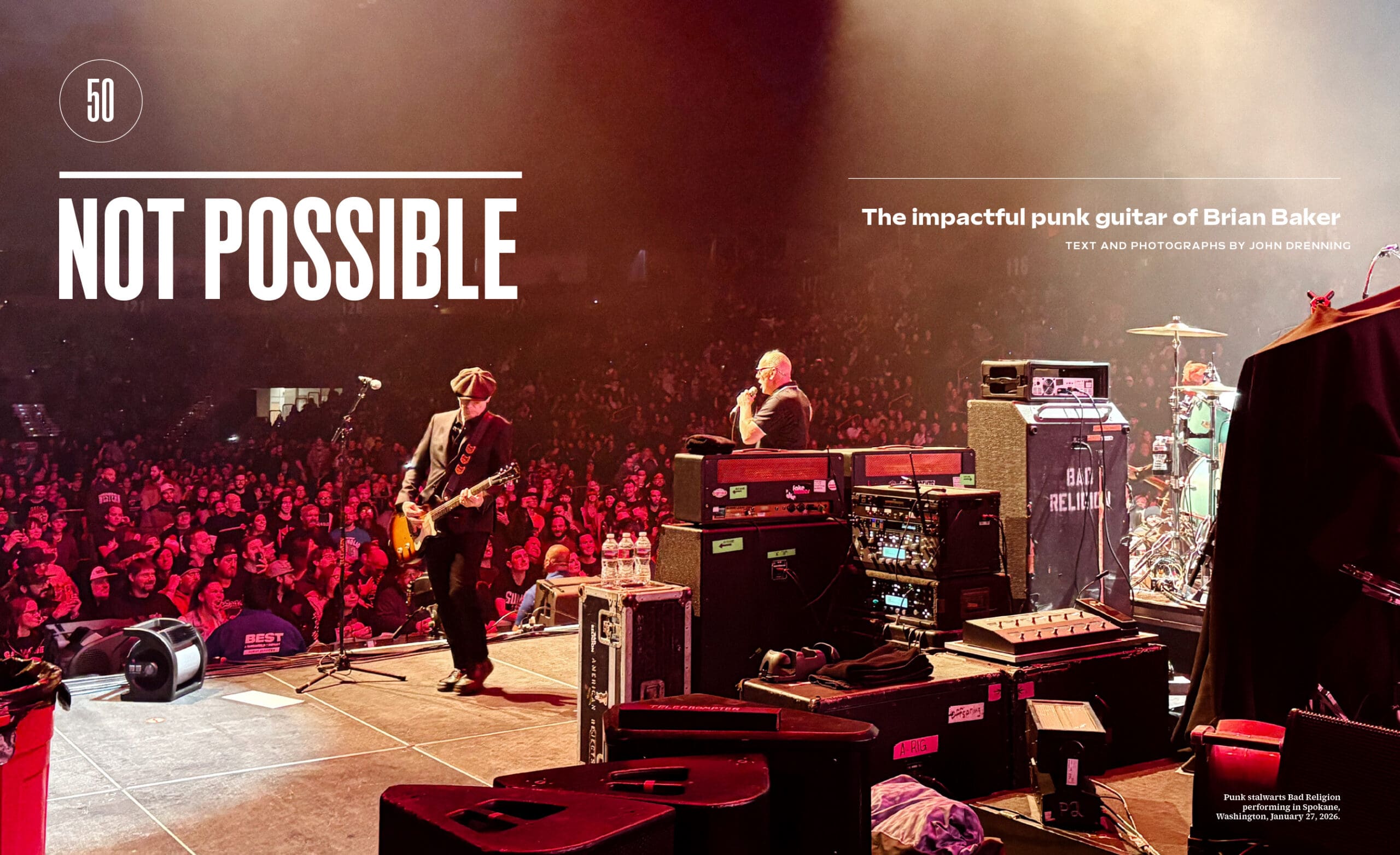
In our 60th issue of the Fretboard Journal (out now), John Drenning sits down with Brian Baker of Bad Religion/Minor Threat fame. The result is an 8,000-word interview that spans some 14 pages of our magazine. As a reader-supported publication, we seldom post stories online, but we thought we’d share a few choice excerpts for all to see. The complete article can be purchased here. -Editor
What’s the point of asking a guitar player their influences? It’s like asking someone their top five albums; it very quickly becomes an exercise in taste and curation. What does it say about me if I name Tom Verlaine instead of Ace Frehley? It’s more honest to think in terms of musical DNA: the guitarists who, when you come up with a riff, you realize they already wrote it; the ones who were the godparents of your own style because you couldn’t do what they did. This imitation isn’t self-conscious. These are the players who made you want to play, and taught you how. Tastes change; DNA doesn’t.
Have you ever met one of these players? What would you say if you did? I met Brian Baker by chance in 1993, backstage at the Whisky. Brian wasn’t just in one of the bands that was most important to me when I was a teenager just a few years prior, learning to play, write, and gig. He was in two of them. There is no question I’d play guitar differently, and maybe even be a different person, if I’d never heard those bands.
I introduced myself and asked what he was doing musically. The man couldn’t have been nicer. After some chitchat and feigned nonchalance, I told Brian his guitar playing and the songs he wrote were more important to me than I could begin to explain, and I just wanted to thank him for that.
He thanked me, very graciously, and then said: You should hear the other guitar player in my band.
Over 30 years later, Brian describes his own talent the way Fonzie apologizes: hesitantly, and under duress. “It was one of those weird things: I could play guitar in a weirdly good way for a very small baby boy…good enough to where it was like a carnival act.” Early influences—DNA, if you will—were “Angus and Malcolm [Young], Billy Gibbons, Eddie Van Halen…My debt to Angus is immeasurable, but if you truly understand Malcolm — talking about him gets me emotional; he’s that good.”
Brian took lessons as a kid, but wasn’t a serious student — “I was a child, and I wanted to skateboard.” In 1978, when he was 13, Brian went full Frehley and added a third pickup and two toggle switches to his Norlin-era Les Paul Deluxe, because it was 1978, and he was 13. Instead of cranking his first amp, a Princeton, or using a pedal for distortion, Brian plugged the speaker into the extension speaker jack. (Amp guru Andy Marshall told me that when you plug a speaker into the external jack only, the main speaker out becomes a “dead short,” and 95% of the amp’s power goes to ground. Per Andy, don’t try this at home unless you like the smell of smoke.)
Brian told me that by ninth grade, “guitar was already my personality, and my entree into polite society.” Guitar was also his entree to the stage at Detroit’s Cobo Hall, where he jammed onstage with Carlos Santana in March of ’79, the month after he turned 14. Did he think at this age he would play guitar for a living? “No, because that’s not possible…I was going to go to college, because that’s what one does.” But then, “almost accidentally,” Brian became a founding member of the most influential high school band of all time.
Minor Threat was one of the first D.C. hardcore bands, which means it was one of the first hardcore bands. As Michael Azzerad put it in Our Band Could Be Your Life: “Black Flag may have been its godfathers and the Bad Brains may have revved up its tempo to light speed, but hardcore has no more definitive band than Minor Threat.” In 1980, Lyle Preslar asked his classmate Brian to play bass. Then 15, Brian had “gone punk” shortly after moving back to DC from Michigan. “I was just one of the few people around who wasn’t already in a band, and knew how to play an instrument. That’s how I got in. I cut my own hair, and I knew how to play guitar.”
Minor Threat didn’t last long—very few of these bands did—but they developed fast, and by the time I discovered hardcore in 1984, a year after they broke up, they were one of the genre’s defining bands. Their eponymous first 7″, with eight songs, runs a little over nine minutes. As Bad Religion co-founder Brett Gurewitz said, 1981’s Minor Threat “set the rule book. It showed how fast, and how tight, hardcore can be, and what it should be.” It was ground zero for straight edge, which altered the trajectory of a lot of kids’ lives, mine included. Later that year they released their second 7″, In My Eyes, having grown rapidly in the intervening six months. Describing songs like “In My Eyes” and “Look Back And Laugh,” author Ben Merlis jokingly called it “prog-ified hardcore—let’s make a three-minute song with lots of parts, but still have it be really hardcore and still have it be really catchy. Good luck doing that. Look how many lesser bands tried copying that later, and it didn’t work.” As a teenage member of one of those lesser bands, I can testify that while the exact recipe was impossible to recreate, the general approach scaled well.
Minor Threat recorded Out Of Step in January 1983. The nine-song EP, 15 seconds shorter in its entirety than the Yes song “The Gates Of Delirium,” has cast the longest shadow, but by this point the internal pressures in the band had become unsustainable. Their last show was September 1983. How do you know your hardcore band is breaking up? Your guitar player sells his Marshall, and buys a Roland Jazz Chorus.
Brian has always been forthright about his belief that, as he told me, “If I hadn’t been in Minor Threat, I do not believe we’d be having this conversation.” If Preslar had asked a different classmate to play bass in his high school band, it’s not hard to imagine Brian as, say, an American history professor. And Brian is quick to credit singer Ian MacKaye’s focus and foresight as key to Minor Threat’s lasting influence. “I was lucky enough to be close to someone with that vision and skillset… those of us who were lucky enough to make records with him when we were very young go on to have conversations with John who’s in Seattle right now for Fretboard Journal.” I don’t believe this is false modesty. The music industry is bleak.
And yet. Seneca: “Luck is what happens when preparation meets opportunity;” Picasso: “Inspiration exists, but it has to find you working.” Etc. Brian may be the most influential musician in the genre, and his playing easily passes the Les Paul test: asked about the hyper-technical shredders of the 80s, Paul responded, “but when they’re on the radio, can their mother tell it’s them?” And multiple collaborators described how Brian’s intuitive contributions could improve their material: he occupies that rare shared territory between technical excellence, which usually arises from ego, and an egoless ability to make the song better. If punk has a Mike Campbell (who has played on two Bad Religion tracks), it’s Brian Baker.
I asked Brian if he thought in his teens and twenties that he could be a professional musician. He responded, “I didn’t know I could do it for a living until I was already doing it for a living.” By then he was in his 30s and had been in Bad Religion for a couple years, and would get home from tour and not have to get a day job. He’d been touring half his life by then: longtime friend and current Fake Names bandmate Johnny Temple (Soulside, Girls Against Boys) told me he and Brian were in high school chemistry class together, and he remembered “Brian leaving class to go on tour with fucking Minor Threat.” Brian said, “There are times when I should have just stopped, but I didn’t know, I just kept going.”
Formed in 1985, Dag Nasty was the second legendary band Brian was in, but was the only band where he was the primary writer, sole guitarist, and, for a time, lyricist. (Brian would be equally comfortable having the descriptor “felon” in the same sentence as his name as “legendary.”) Their first album, Can I Say, was recorded and mixed with minimal overdubs (Brian: “Did we all make it through? OK, let’s keep that take”) in about 20 hours the following year. Brian used his regular gigging rig, as anyone would have on a punk record at the time: an early-70s Les Paul Deluxe Goldtop into a 100-watt ’78 Marshall JMP100, along with an MXR M-134 chorus pedal that was lying around the studio.
Can I Say has the visceral punch of Out Of Step. But the songwriting is revelatory, the well-rehearsed band having shaped Brian’s riffs into songs that didn’t conform to the hardcore mold. The rhythm section of Colin Sears and Roger Marbury was seamless, packing more low-end punch than their hardcore contemporaries. Dave Smalley’s vocals were delivered with uncommon conviction, perfectly blending melody and power. And the lyrics are, well, emotional, not what subsequent Dag vocalist Peter Cortner called “made-to-order anthemic lyrics.” Ben Merlis told me, “The songwriting is incredible; just the right balance of melody and aggression. The recording sounds impeccable—it sounds fresh, and it sounds like you’re in the room with them.” Pete Chramiec, guitarist for Verbal Assault, described hearing Dag Nasty and “immediately turning the ship in that direction. It was a necessary course correction, that you could be way more interesting, and way more musical. We were already getting sick of the macho shit.” End on End podcast cohost Jeff Kaplan told me: “There were already traces of melody in hardcore, including Minor Threat. But Can I Say is the point where you could say, this isn’t just hardcore that’s experimenting with some melodic elements; this is the record that invents melodic hardcore. And I feel like hardcore, even with Minor Threat, had to have this toughness to it, even though Minor Threat weren’t your prototypical tough hardcore guys. It wasn’t macho, but there was still this tough edge to it. Whereas with Can I Say, it was okay to be vulnerable. For the first time in hardcore, we don’t need to be so fucking tough.”
Can I Say is where Brian’s distinctive playing style fully emerged. Like another much-“borrowed from” player, Stevie Ray Vaughan, it’s not that his style was unique; instead, like SRV, Brian was able to meld a variety of pre-existing techniques into one cohesive package, and then execute it with feel, technical precision, and originality. And as with SRV, countless pale imitations ensued. (I was a pale imitator of both.) Brian drew from the deep well of Captain Sensible (i.e., the single-note lines), George Harrison (i.e., the riff-based melodicism), and Malcolm Young (well, Malcolm fucking Young), rather than cookie-cutter punk players, but took those influences in an entirely different direction.
No single part of Brian’s style is revolutionary. What made it unique was doing it all, in tune and in time, in service of the song. Brian Gathy, founder of End On End, told me, “It was all about his choices. He didn’t sound superhuman, but he was so laser-focused in his choices…Every guitar part on Can I Say supports the bones of the song.” Jeff Kaplan remarked that “if we had to pick one record in his entire catalog where we said, this is the defining artistic statement made by Brian Baker, I think it has to be Can I Say. Brian was playing at a different level than his peers. He brought a level of tightness, a level of discipline, that was so rare in hardcore in the early-mid 80s. And he was about the song first—you can be this really great guitar player without making it about you, and instead, just make it about the song.”
Dag Nasty, like Minor Threat, had about a three-year run. After two more albums and numerous lineup changes, Dag played their last show in July 1988. The wind had gone out of the sails. And Brian had run into Chris Gates—formerly the bassist of the Big Boys, who Minor Threat played their last show with in DC, not quite five years ago—in the parking lot of an L.A. 7-Eleven. Gates was playing guitar in Junkyard, recently signed to Geffen, and short a guitar player. The switch from melodic hardcore to Skynyrd-meets-Motorhead rock was not a premeditated career move by Brian; he just wanted to keep playing guitar. In their book on the exploding 1980s L.A. hard rock scene, describing the intense competitiveness of the genre, Tom Beaujour and Richard Bienstock observed that “no one stumbled into this (okay, maybe Brian Baker of Junkyard did).”
As Brian pivoted “mainstream” with Junkyard, and hardcore obstinately stayed put, “alternative,” or “college rock” as we called it back then, was pivoting mainstream, too. This was well underway before the release of Nirvana’s Nevermind in September 1991. This arc is best captured by the ur-college rock band, REM. Document, in 1987, sold a million copies, almost doubling the previous year’s Life’s Rich Pageant. 1988’s Green more than doubled the sales of Document, at 2.6 million. Out Of Time, released six months before Nevermind, sold 12 million copies; next year’s Automatic For The People sold 18 million.
When I met Brian backstage at the Whisky in February 1993, a year after Junkyard’s demise, Peter Buck was also backstage. Neither Brian nor I remembered this, though REM bestrode the earth like a colossus at the time. A year later, Brian was REM’s second guitarist.
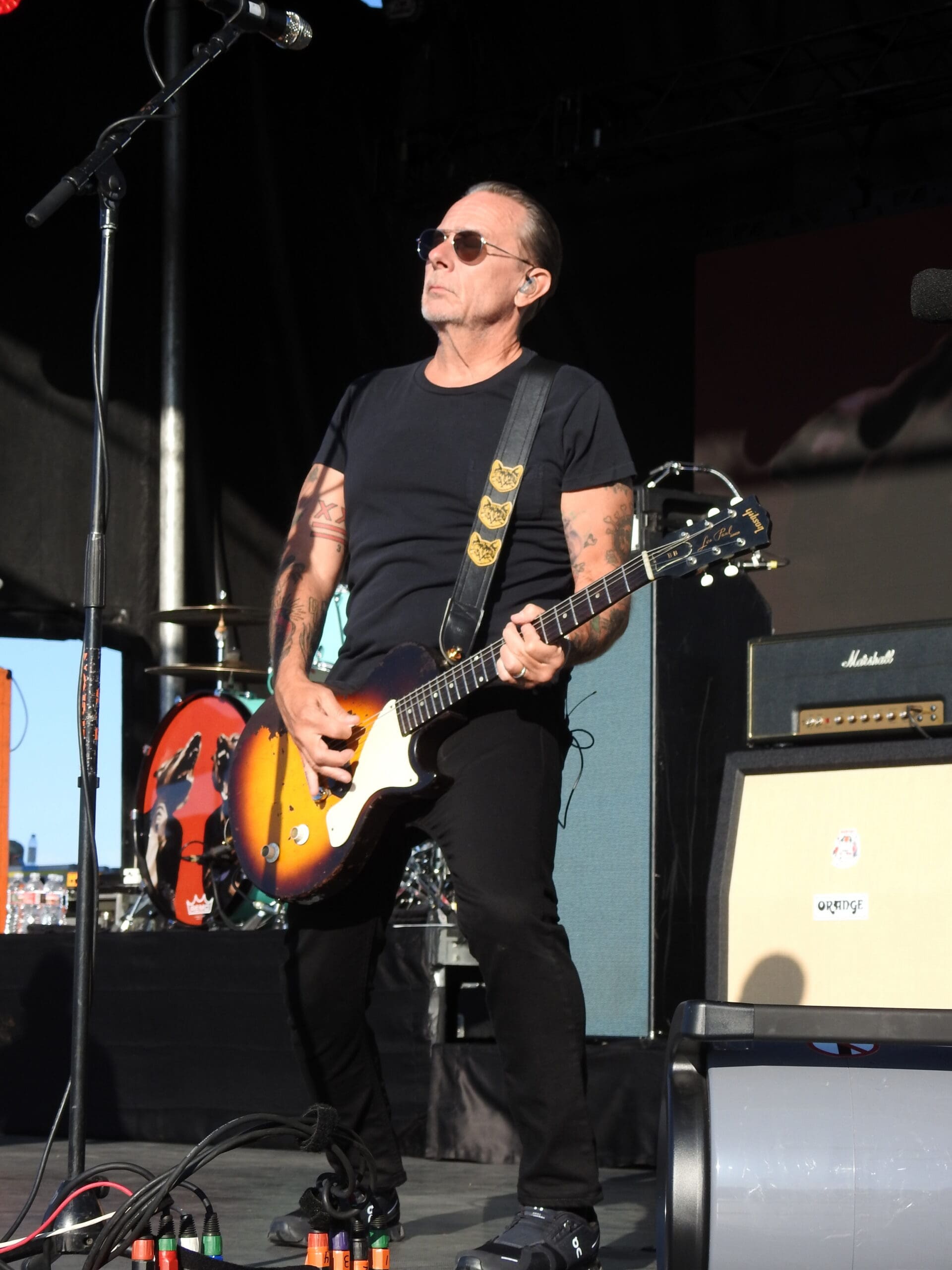
Except, he wasn’t. Shortly after accepting the gig as REM’s touring guitarist, Brian was offered a job as a card-carrying member of Bad Religion. Brian’s chair in Bad Religion had previously been occupied by Brett Gurewitz, founding member and one of the chief songwriters. This is kind of like being offered John Lennon’s spot in The Beatles. In Jim Ruland’s book on Bad Religion, bassist Jay Bentley explained: “When someone leaves the band and people want to know what happened, my answer is, ‘You’ll have to ask him.’ But when someone like Brett leaves and you’ve lost one of your songwriters, you can’t just go, ‘You’ll have to talk to him’ because that’s not going to fly. So having someone like Brian Baker from Minor Threat helped get us out of that awkward conversation. ‘What happened? Here’s Brian!’ It buffered the situation without completely ignoring that we’d lost a major player in our band by replacing him with another major player.”
Hardcore is as obsessed with lineage as the Old Testament. Greg Graffin, Bad Religion’s singer, wrote in his memoir Punk Paradox that a minority of the band’s fans expected the band to fall apart in Gurewitz’s absence. Brian’s pedigree got him in the door, but doesn’t explain why he’s still there: “Once those naysayers realized ‘That’s Brian Baker up there,’ the credibility portion of their criticism would be canceled immediately. But his sound, which is one of the most signature sounds in all of punk, and his virtuosity would do the rest of the talking. It complemented our songs, and blended perfectly with our style, and the audience would soon be treated to hearing a greatly enhanced live set from Bad Religion.”
Brian joined Bad Religion over 30 years ago; only founding members Graffin and Bentley have been in the band longer. As Graffin said, this longevity comes more from Brian’s lineage; Brian’s later collaborator Alec Bourgeois (Severin, Capital City Dusters) described it as “a stroke of luck for all of them.” When I asked Brian about what he brought to a band, he told me that “whatever personality trait” is required for longevity in a band, “I seem to have it.”
Ian MacKaye described Brian’s musical discernment from the beginning; his musical contributions were a big part of why Minor Threat were, as Michael Hampton (S.O.A., Embrace, Fake Names) explained, “heads, and tails, and shoulders above everybody else.” Bourgeois told me, “You talk about musicianship—he was the ringer in Minor Threat, and the reason they were so fucking tight: Brian was the glue there.” And Chris Gates called Brian “literally the perfect definition of a sideman. Without Brian, Minor Threat’s not Minor Threat. Brian’s playing in Junkyard was integral to the sound and how great the band was.”
MacKaye described Brian’s nascent professionalism simply: “Brian is definitely an ambitious guy. He wanted to play guitar for a living.” In the DC scene in the 1980s, this was abnormal, and, arguably, not punk. Brian Gathy said of Brian, “it was clear he had ambition, which, even talking about it now, seems strange to say it as a negative thing [laughing], but it was obvious he wanted a bigger stage, both literally and figuratively…it was clear that he had his eyes on bigger things than being in a good band in DC and maybe touring a little bit; he wanted a career. To some, and we’re talking people in their teens and early 20s, who were high on their own supply of idealism, this professionalism was suspect.
Regarding Brian’s exacting nature, Bourgeois told me: “That precision—it’s not just his playing. And it really does bring people along.” Seattle amp builder and luthier Jesse Quitslund told me that when he’d been working on guitars for almost a decade, Brian asked him to set up his Les Pauls for his first album with Bad Religion. He “did as good a job as I thought was possible,” and returned them to Brian, who “literally played every note on the guitar neck in, like, five seconds, and found the one dead spot.” Brian told him, “This is a really important rock and roll note; can you do anything about this?” This was the first time anyone had asked Quitslund to improve his work; he’d “never set up a guitar for a guitar player who was that technically proficient before.” At the onset of recording, producer Ric Ocasek played all the guitars, declaring Brian’s the only guitars ready to record. Quitslund described it as “a career high point, to have Ric Ocasek praise my work. And Brian, of course, proceeded to nail everything in one take, as he does, and impress everyone, including Ric Ocasek, who then had Brian play in his solo band.”
Everyone I spoke to characterized Brian as very funny, but acerbic, and not one to suffer fools gladly. At some point in every interview, I thought of John McPhee’s description of physicist Edward Teller as having “a sense of humor that could penetrate bone.” Bourgeois said, “Cynical, funny: he is all those things, right? But I think at the center of it, he’s got a giant fucking heart. He’s got a wit that he’s just too tempted by. Brian’s too fucking smart, and too funny.” The corollary to this is that most of the people I spoke to attained prominence as a musician as a teenager. Bourgeois said, “You can’t overemphasize how young everyone was. People were putting out albums and touring before they were out of high school…All the DIY, all the shit that we built is just based on kids not waiting for life to happen to them.” A former bandmate of mine put it succinctly: “we were all kind of assholes back then.”
It’s worth quoting Bill Barbot (Jawbone, Burning Airlines) at length here. When Bill told Ian MacKaye he was joining Foxhall Stacks with Brian: “Ian told me: ‘That motherfucker’s a changed man.’ I think that was Ian’s way of acknowledging that the Brian that he knew, as a young teenager, and the Brian I was in a band with now were completely different people, as far as he was concerned…. Brian went through a lot of transformations, as a person, and as a musician, between when he was ‘launched into fame’ as bass player and guitarist for Minor Threat—that’s a lot of attention to have, at that age, as a kid, that was ‘celebrity’ in our circles—and so the rumor, and the reason I was so nervous about being in a band with Brian Baker, was not just because I knew him to be an exceptional musician, but also because, like, What’s the ego going to be like in the room? Is he going to be critical of my singing or my guitar playing, or look down on me? And he could not have been more the opposite…You could tell he just loved making music so much. And his suggestions came from an intuitive sense of how a song should go. His way of putting things was really positive, and constructive, and helpful. And it’s rare to find someone in life who has that level of expertise in their genre, who also has a sense of how to deliver feedback and be a constructive critic in a way that doesn’t come off as: I’m better than you, because I’m a godfather of hardcore. It felt genuine, and it felt constructive, and it felt like it was offered in the interest of the songs being better.”
One of those transformations was addiction, and then sobriety. Brian said to me, simply, “I lived a lifestyle that allowed me to get away with a lot of shit for a very long time, and it finally got to the point where I was just not able to function, and something had to give.” MacKaye, not one given to sentimentality, seemed to allude to this when he told me, “I think Brian was able to center himself and his life in the last few years in a way that made him really finally reveal what a glorious human being he is. He’s a really lovely dude.”
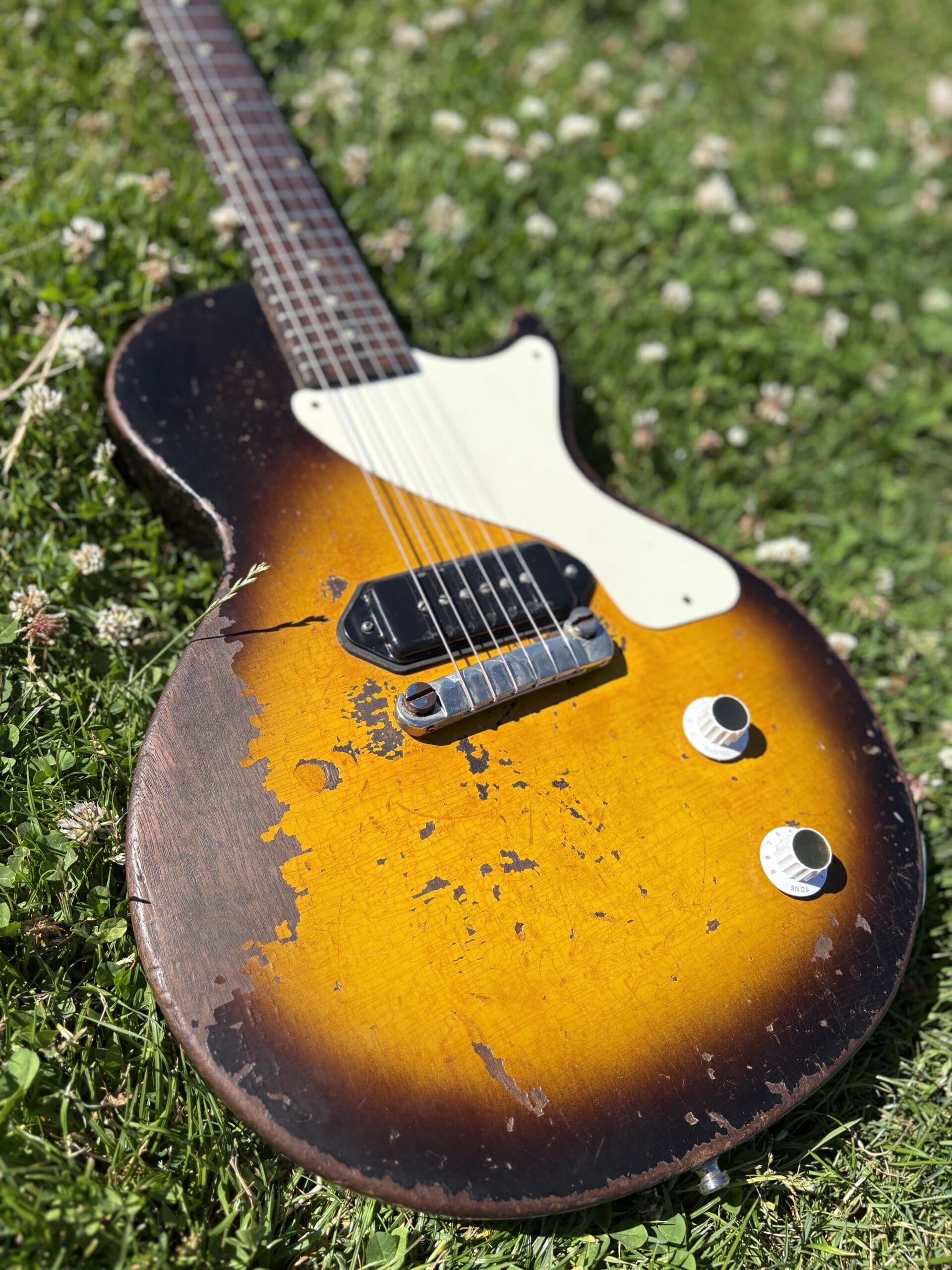
Brian’s primary touring guitars with Bad Religion are a pair of ’55 Les Paul Juniors. Brian is incredibly particular about his gear, but he’s not precious about it. But, in keeping with what Temple called, with approbation, his “fastidiousness,” Brian doesn’t like refins. Every friend of Brian’s I spoke to had a different way of describing him as a perfectionist. He is, however, completely unsentimental about gear. (Brian is the only guitarist I’ve ever spoken to for more than fifteen minutes who didn’t rue a guitar they should never have sold.) Given his minimalist/punk approach to gear, I asked why he didn’t just tour with a reissue. He explained that the older ones have more life, more bloom. And they smell better!
It’s rare to just spontaneously get into vintage Juniors. But when someone puts a Junior in your hands, it’s a revelation. Some years ago Tacoma Luthier Joe Riggio handed me his ’55, with divots in the body from when its original owner used it to drive stakes into the ground. It was the loudest unplugged solid body guitar I’d ever played. As Brian said, “there’s the least amount of things in the way of the vibration” on a Junior.
Brian’s LP Junior sherpa was Bad Religion’s other guitarist, Mike Dimkich. Dismissing complaints about tuning and noise, Dimkich described tuning more as a function of the player than the guitar. (It is very punk rock to view tuning as a matter of personal agency.) He acknowledged the noise, but noise management, like tuning, comes down to personal agency; both Bad Religion guitarists ride their volume knobs relentlessly.
Brian explained that previously, “I didn’t like P-90 guitars because they buzzed and I didn’t like wraptail guitars because you couldn’t intonate them.” But Brian thought Mike “sounded so great…and I was attracted to the economy of the guitar.” Regarding noise, Brian credited a combination of volume knob control and “getting over it.” At first, his “inner nerd” was still obsessing over intonation, but he realized—and I can’t tell you how liberating this epiphany is—“it was the idea of the lack of precision that was bothering me; it wasn’t the lack of precision itself.”
Purchase the issue to read the entire feature.
The post Excerpt: Bad Religion’s Brian Baker in the Fretboard Journal 60 first appeared on Fretboard Journal.
What’s Inside: Fretboard Journal 60
We’ve been setting a high bar for ourselves for 21 years now, but Fretboard Journal 60 may just be our best issue yet. Included are features on actor/comedian/musician Christopher Guest, Brian Baker of Bad Religion, guitarist Andy Pitcher and so much more.
Here are some highlights found in this issue’s 128 keepsake pages.
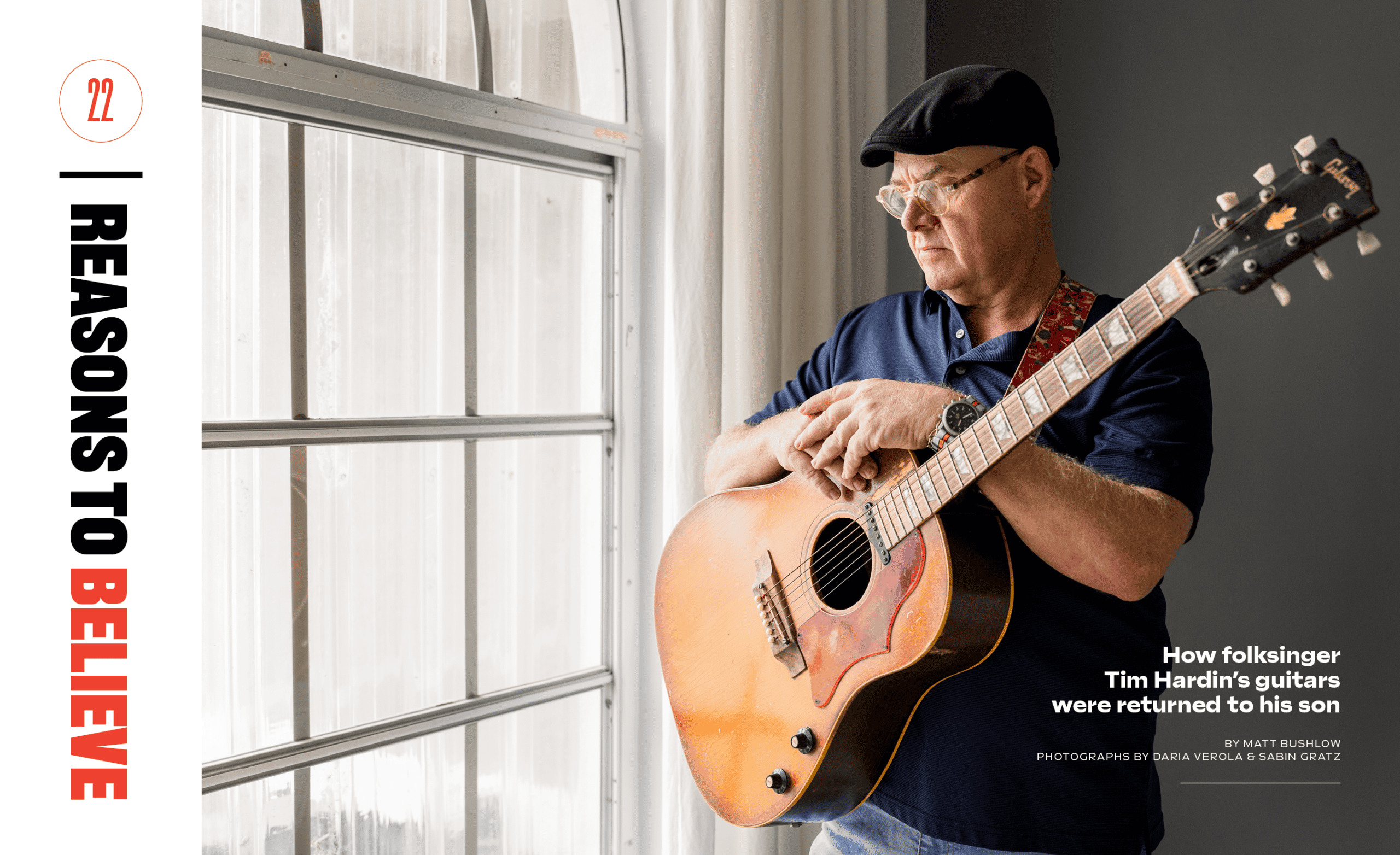
Matt Bushlow hears the story of Damion Hardin, son of 1960s folksinger Tim Hardin (“How Long Can We Hang On To a Dream”). Though his father passed away when he was just a teenager, Damion is busy honoring Tim’s legacy through his guitars, including a Gibson J-160, an unlabelled and utterly beguiling classical (pictured above), and an Ovation Balladeer.

Experimental music is seldom sensitive, but Andy Pitcher is not your typical experimental guitarist. Cameron Knowler talks to the musician about his solo project, dot, an album that reflects on Pitcher’s first 30 years, loss and love. It’s a beautiful record and an equally beautiful conversation.
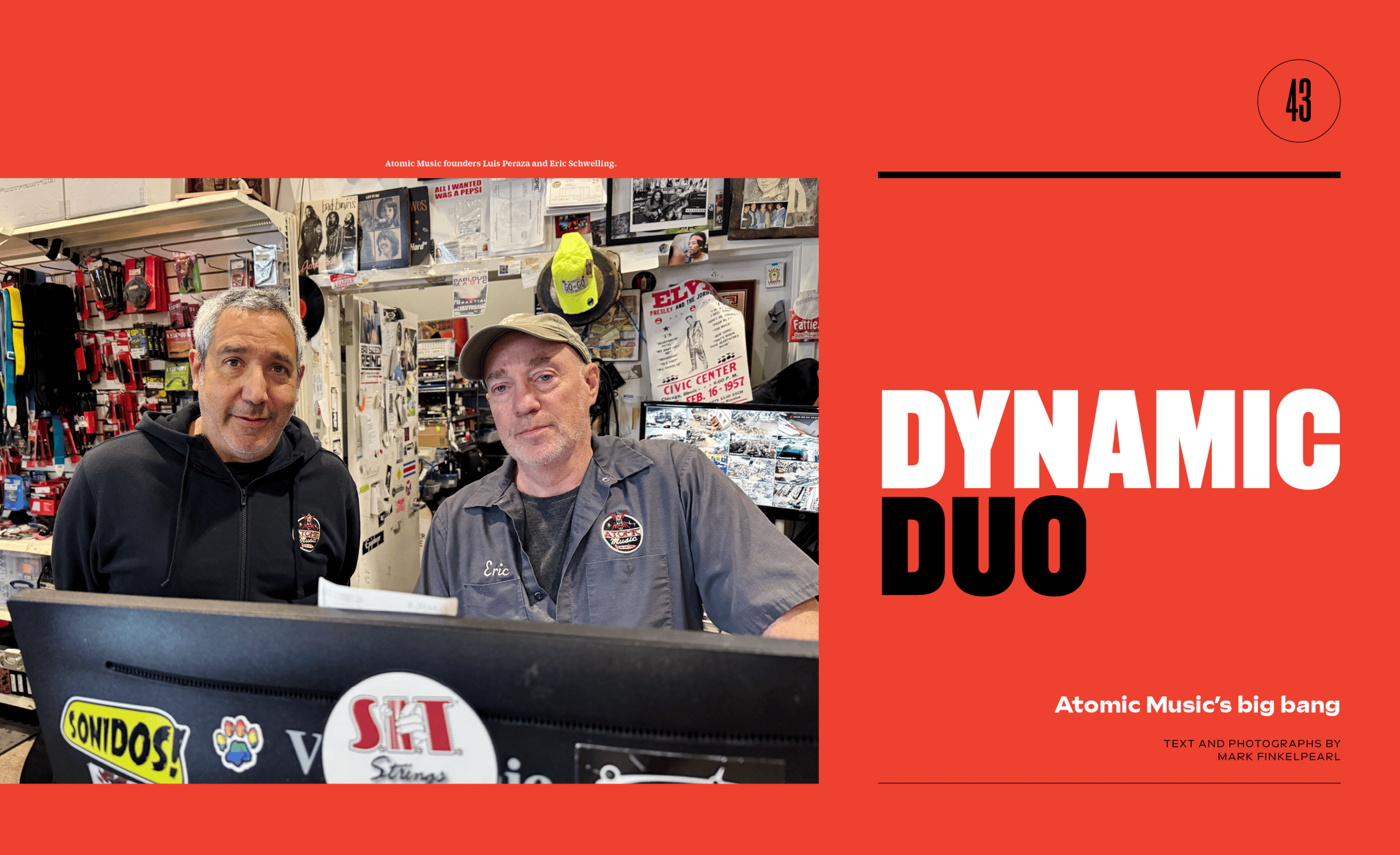
In a world of cookie-cutter guitar stores, Maryland’s Atomic Music stands out. For starters, it’s housed in a former Circuit City location inside a strip mall. More important is what’s inside: Thousands of pieces of rare and vintage gear lining the aisles that used to house Samsung TVs and laser printers. FJ contributor (and Atomic regular) Mark Finkelpearl talks to the store’s owners about its charming quirkiness, and massive inventory.
John Drenning sits down with one of punk’s true guitar icons, Bad Religion’s Brian Baker. Baker talks about his Les Paul Junior obsession, formative days in Minor Threat, Marshalls and more.
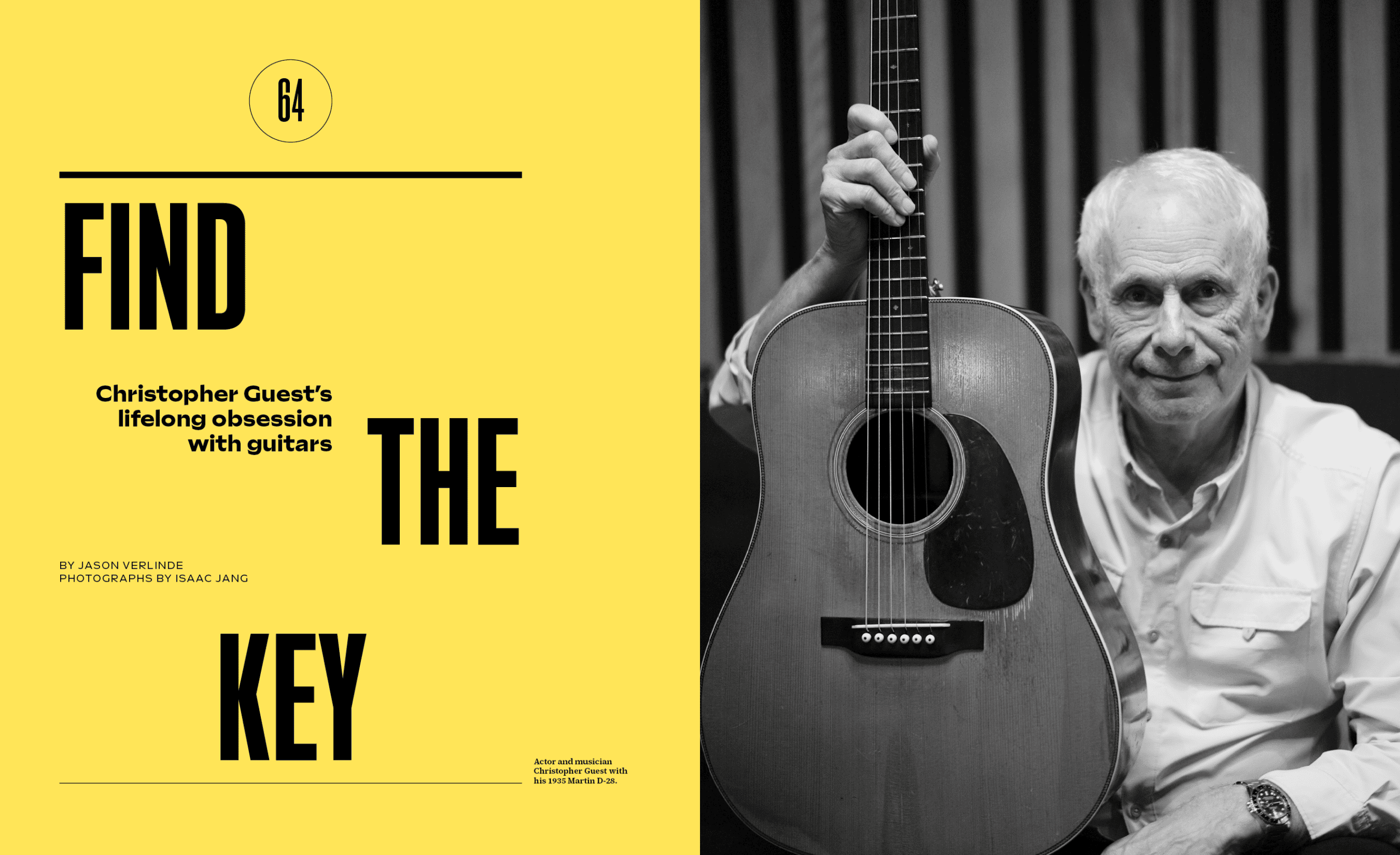
Fretboard Journal Publisher Jason Verlinde sits down with Christopher Guest, one of the funniest people in the world who also happens to be extremely serious about guitars. We talk Spinal Tap, his love for old Martins, his current gear obsessions and so much more.
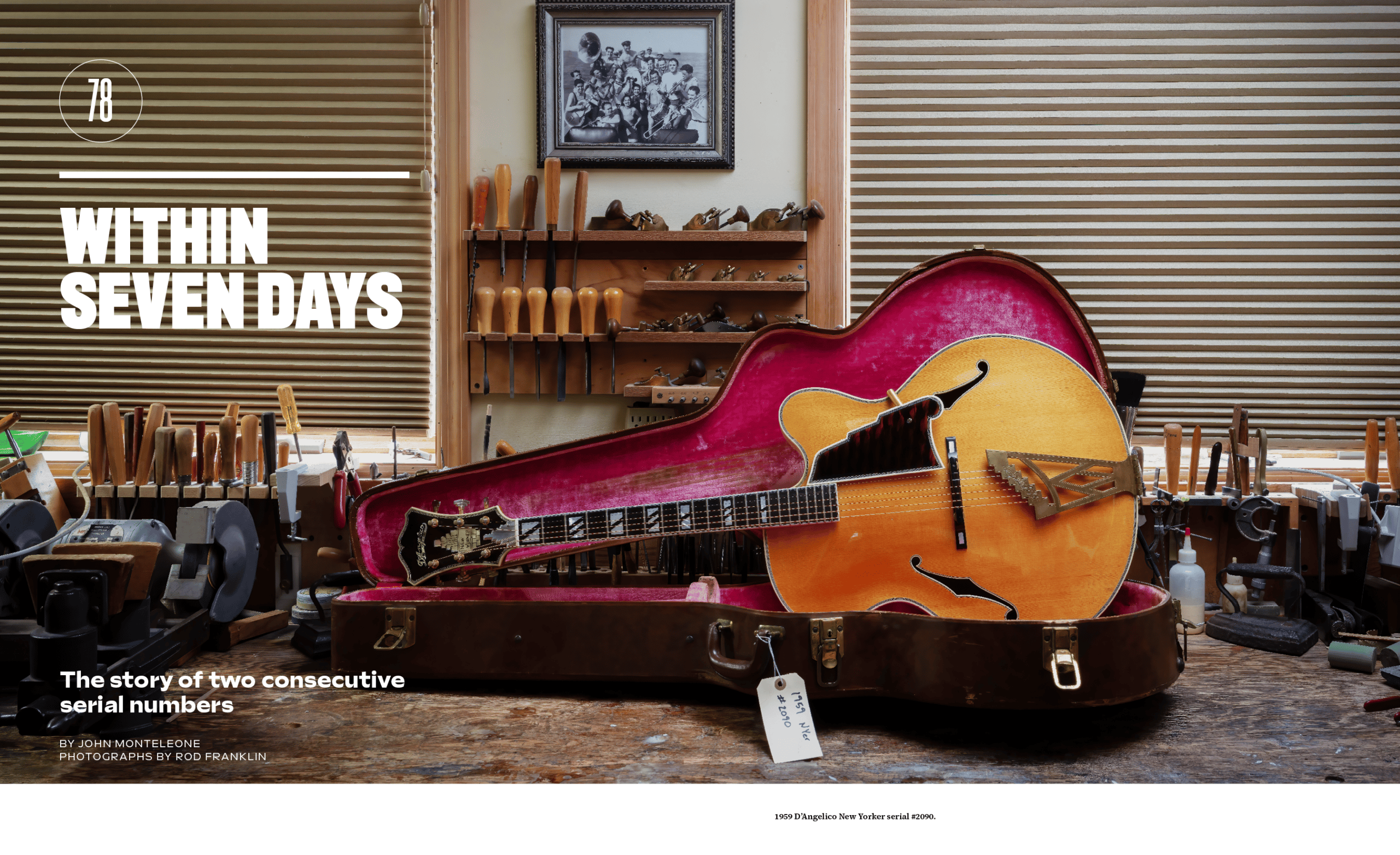
Famed archtop luthier John Montleone pens the never-before-heard story of two consecutive John D’Angelico instruments currently in his possession. D’Angelico’s #2090 and #2091 were both built in the late summer of 1959 and more than a little pedigree. In fact, 2091 was the first D’Angelico that Monteleone ever saw (at the ripe old age of 12). It’s a deep dive into instrument history and inspiration.

You may not have know Peter Nevins by name, but chances are you’ve seen this Portland, Oregon’s artist’s poster and album designs. A musician in his own right, Nevins has designed for Gillian Welch, Old Crow Medicine Show, John Prine and other Fretboard Journal favorites. Jamie Etherington talks to Nevins about his printmaking process, his old Gibson, influences and more. Guitarist Eric Skye captures the photos.
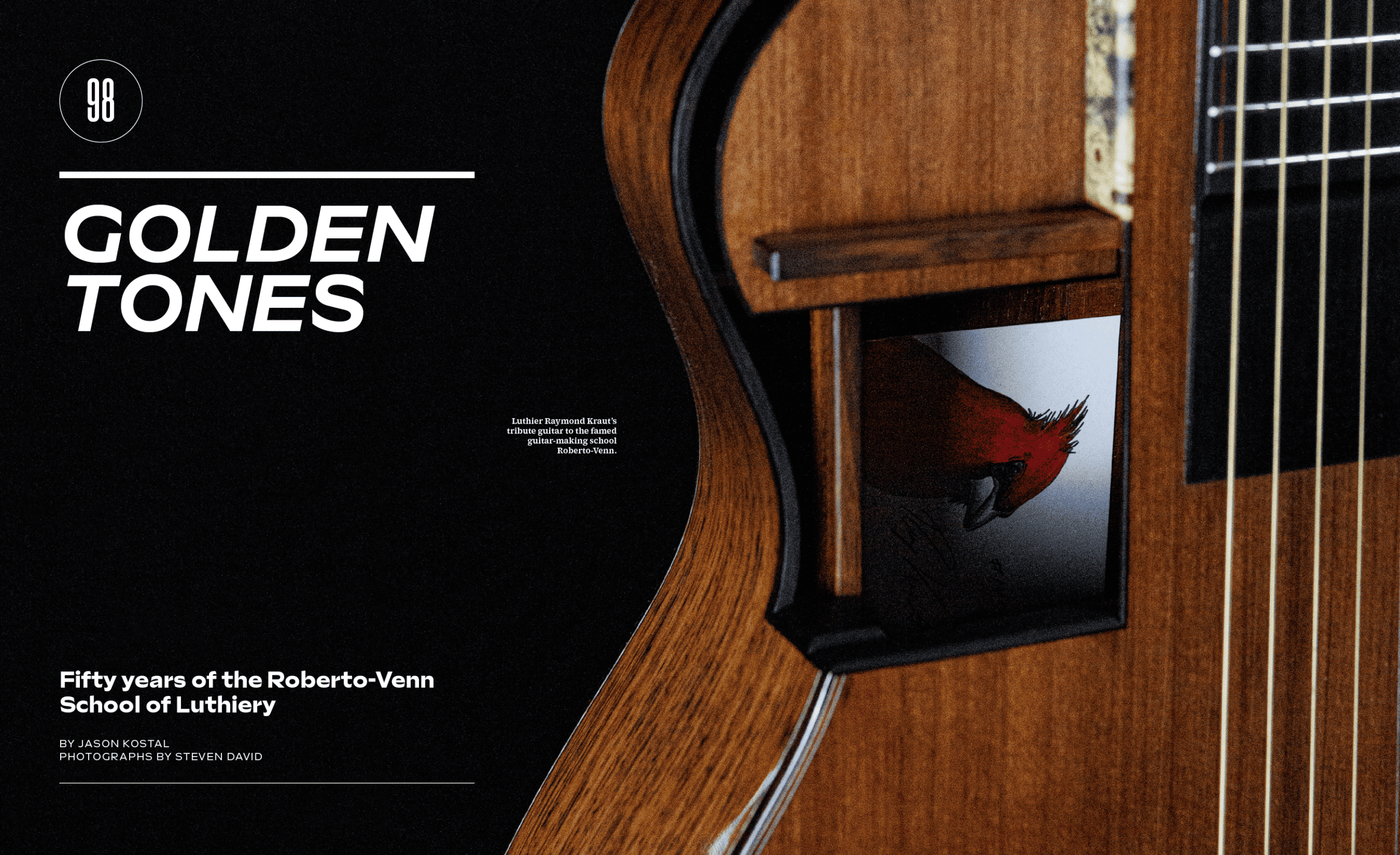
Roberto-Venn, the world’s most famous school for lutherie, recently celebrated their 50th anniversary through (what else?) a bunch of guitar builds. In this case, some of their most famous graduates of the Phoenix institution honored their alma mater with one-of-a-kind instruments. One of those grads, Jason Kostal, pens the story.
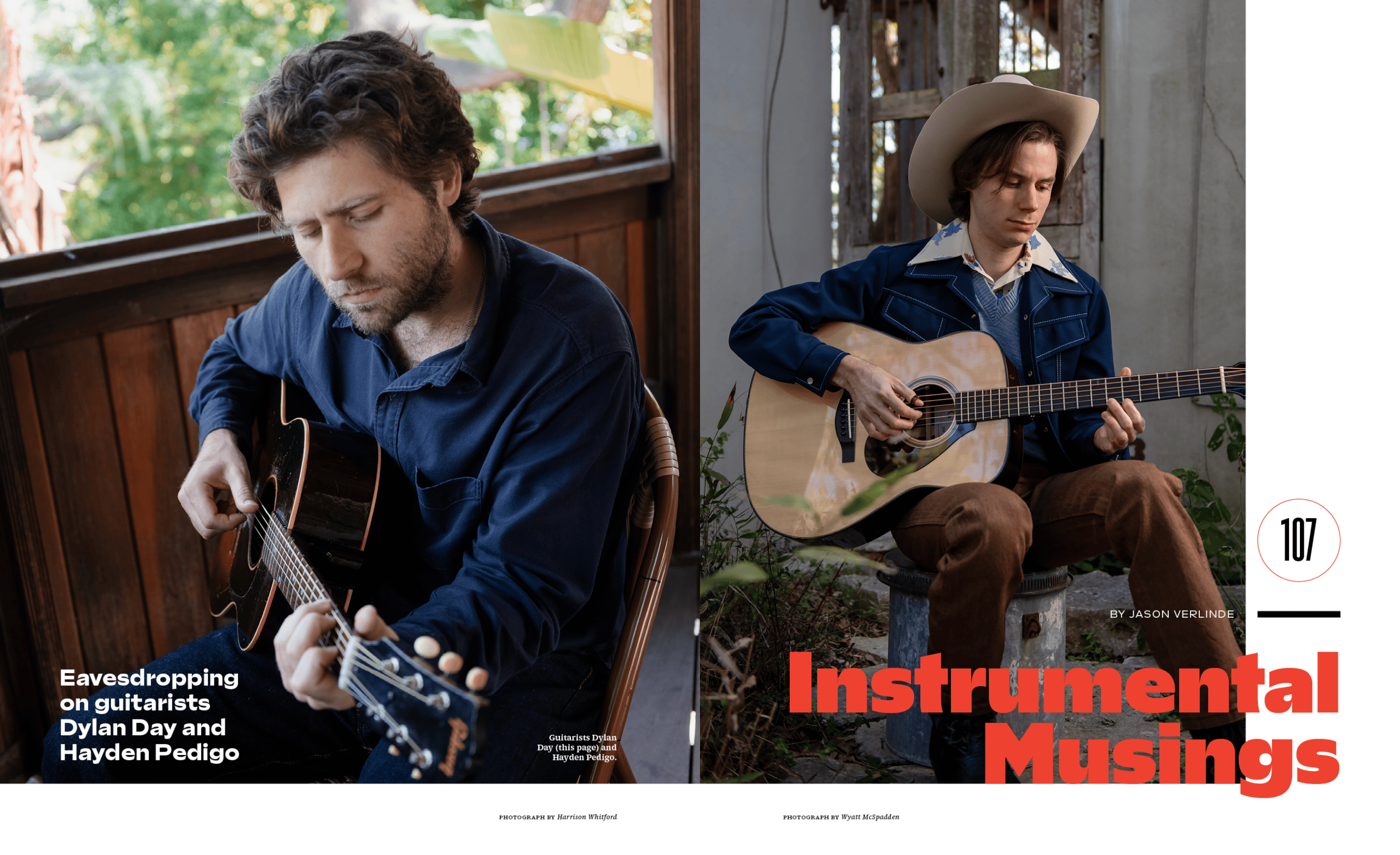
Dylan Day and Hayden Pedigo are two of the most creative acoustic guitarists on the scene today. Though they approach the instrument in vastly different ways, they also happen to be phone buddies. The Fretboard Journal crashes one of their ongoing conversations to talk guitar, taste, Genesis (the band and the book), and more.
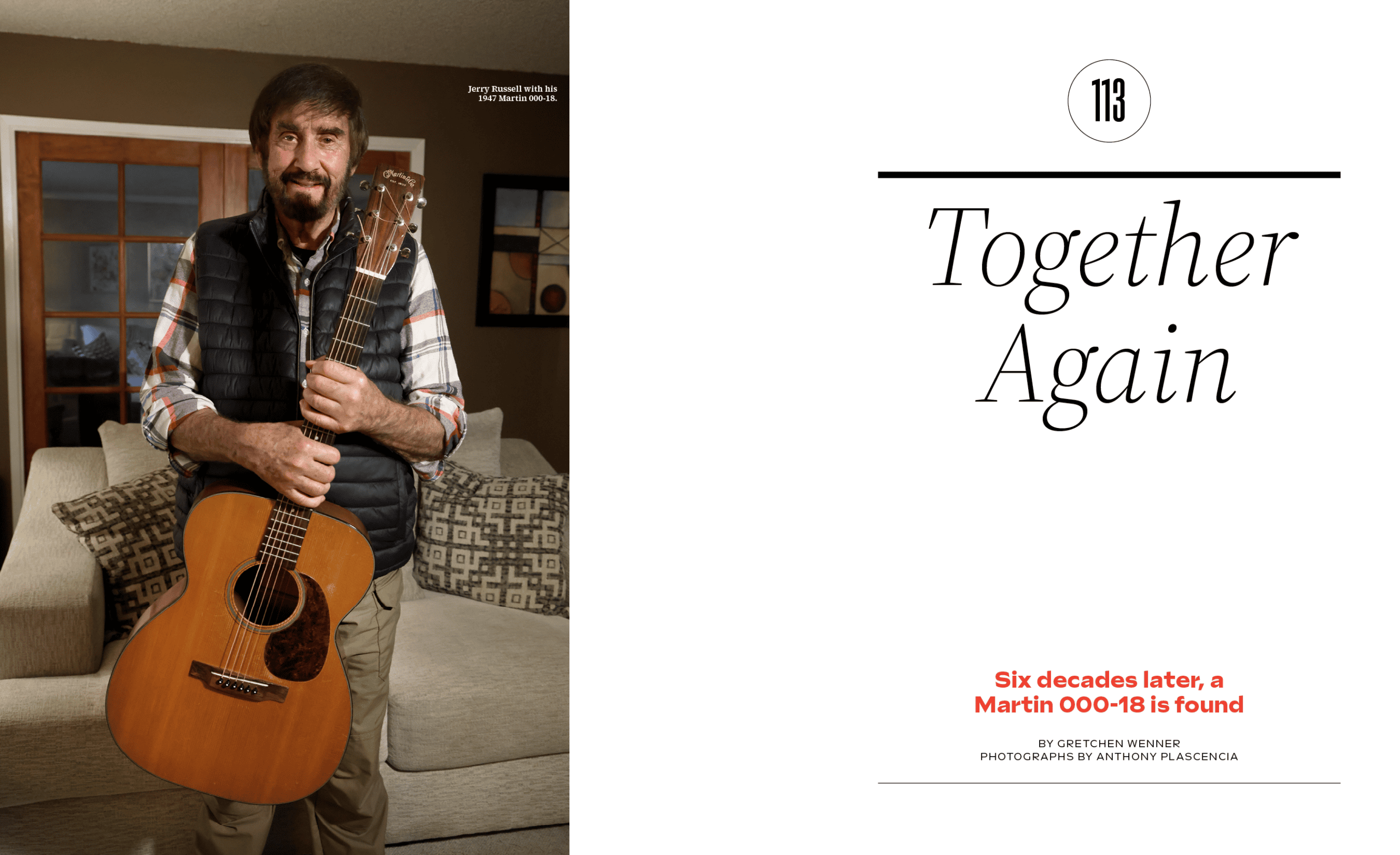
Plus: Apprenticing for Roger Sadowsky; reuniting with a lost Martin 000-18; Riverhorse on Big Tex; and so much more. Subscribe today to get this issue.
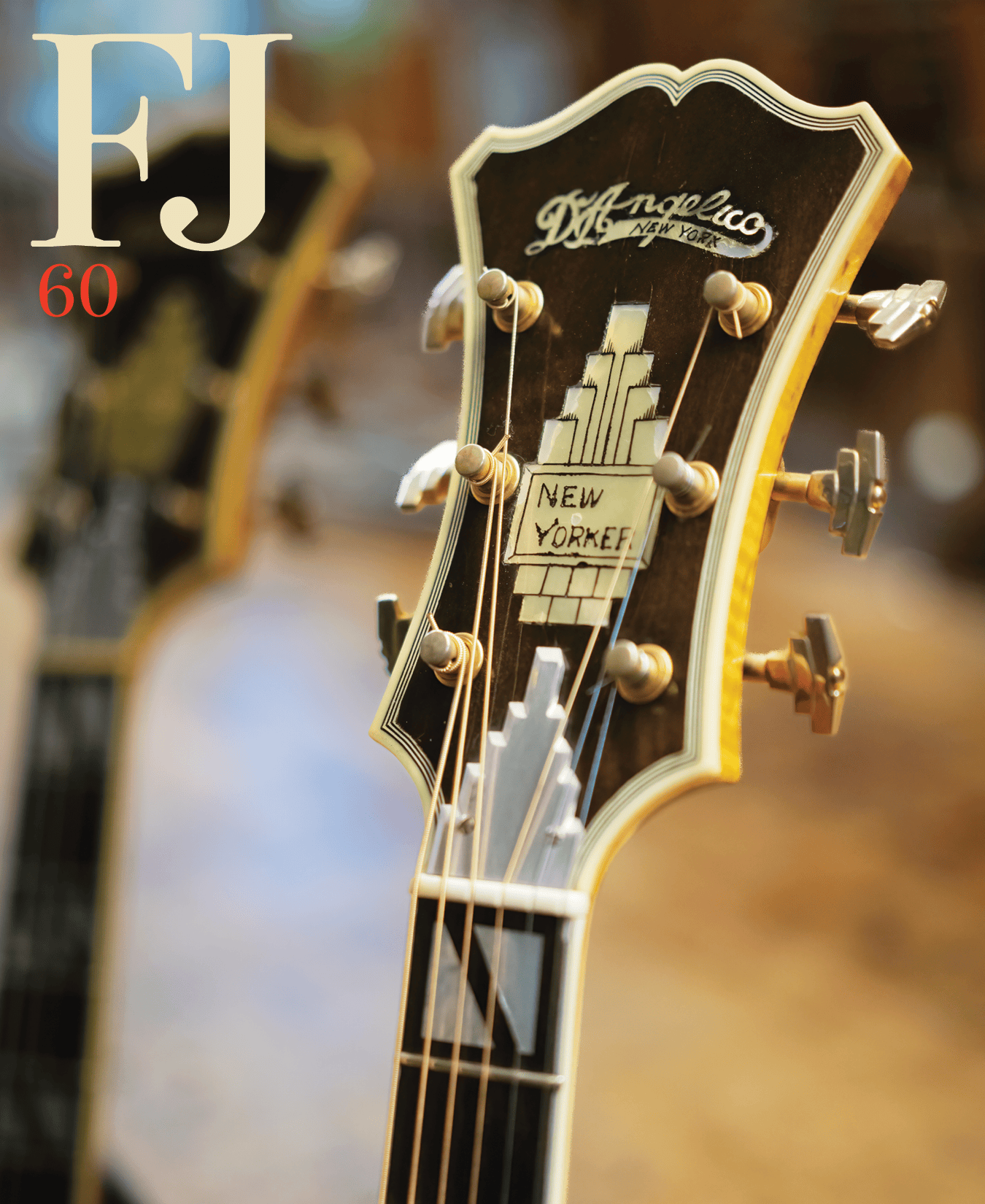
The post What’s Inside: Fretboard Journal 60 first appeared on Fretboard Journal.
Luthier on Luthier: Paco Chorobo
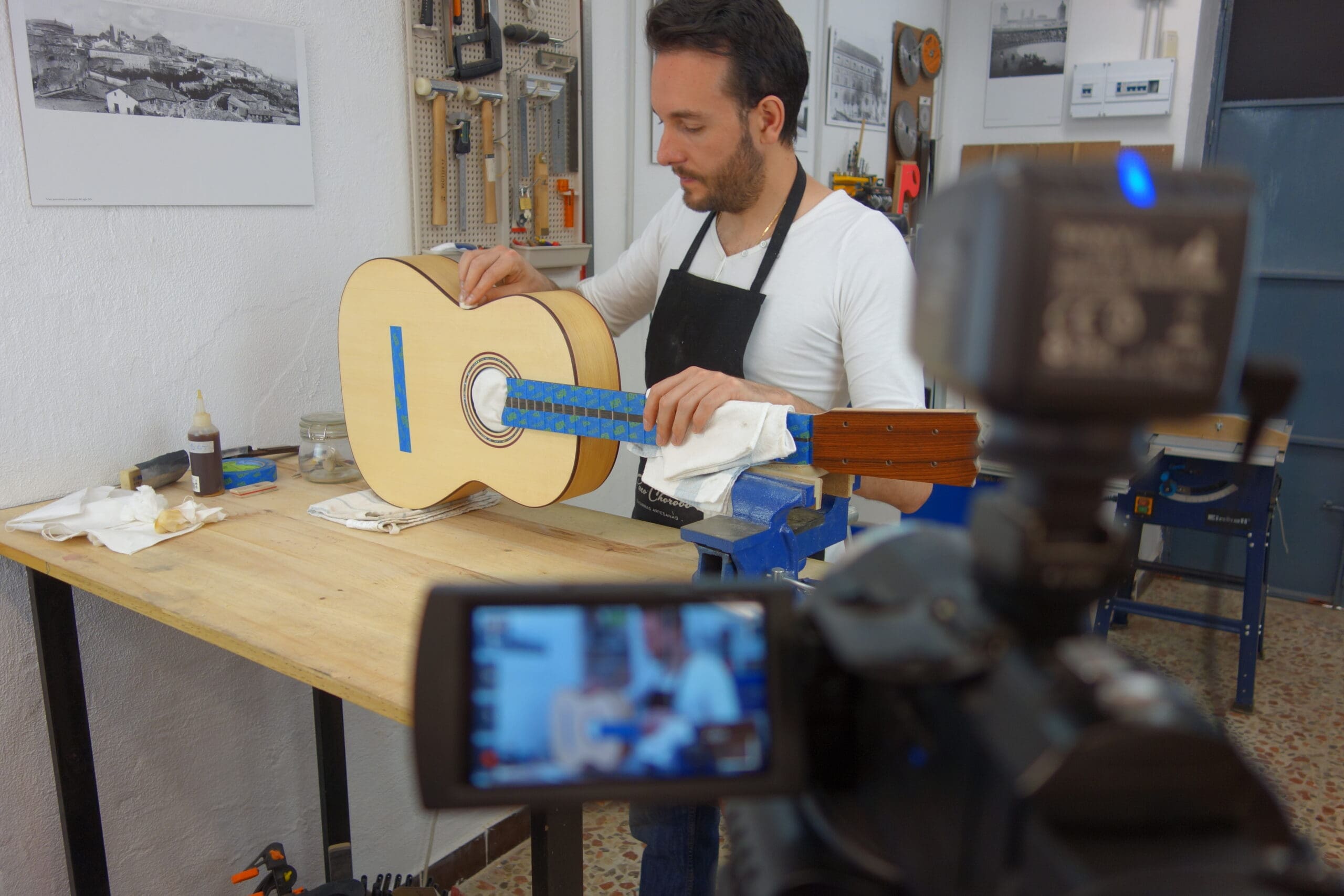
For episode 116, we’re joined by Spanish guitarmaker Paco Chorobo from Úbeda, Spain.
Paco shares his journey from telecommunications engineer to full-time luthier and discusses his approach to building both classical and flamenco guitars while blending traditional hand craftsmanship with modern technology. We also explore the cultural roots of flamenco guitars, the construction differences between flamenco and classical instruments, and his philosophy of building guitars around the individual player.
Link to Paco’s work: https://chorobo.com/home/
Luthier on Luthier is hosted by Michael Bashkin of Bashkin Guitars and brought to you by the Fretboard Journal. This episode is sponsored by the Looth Group, Dream Guitars and StewMac.
Want to support Luthier on Luthier? Join our Patreon to get access to exclusive photos and content from Michael and his builds.
The post Luthier on Luthier: Paco Chorobo first appeared on Fretboard Journal.
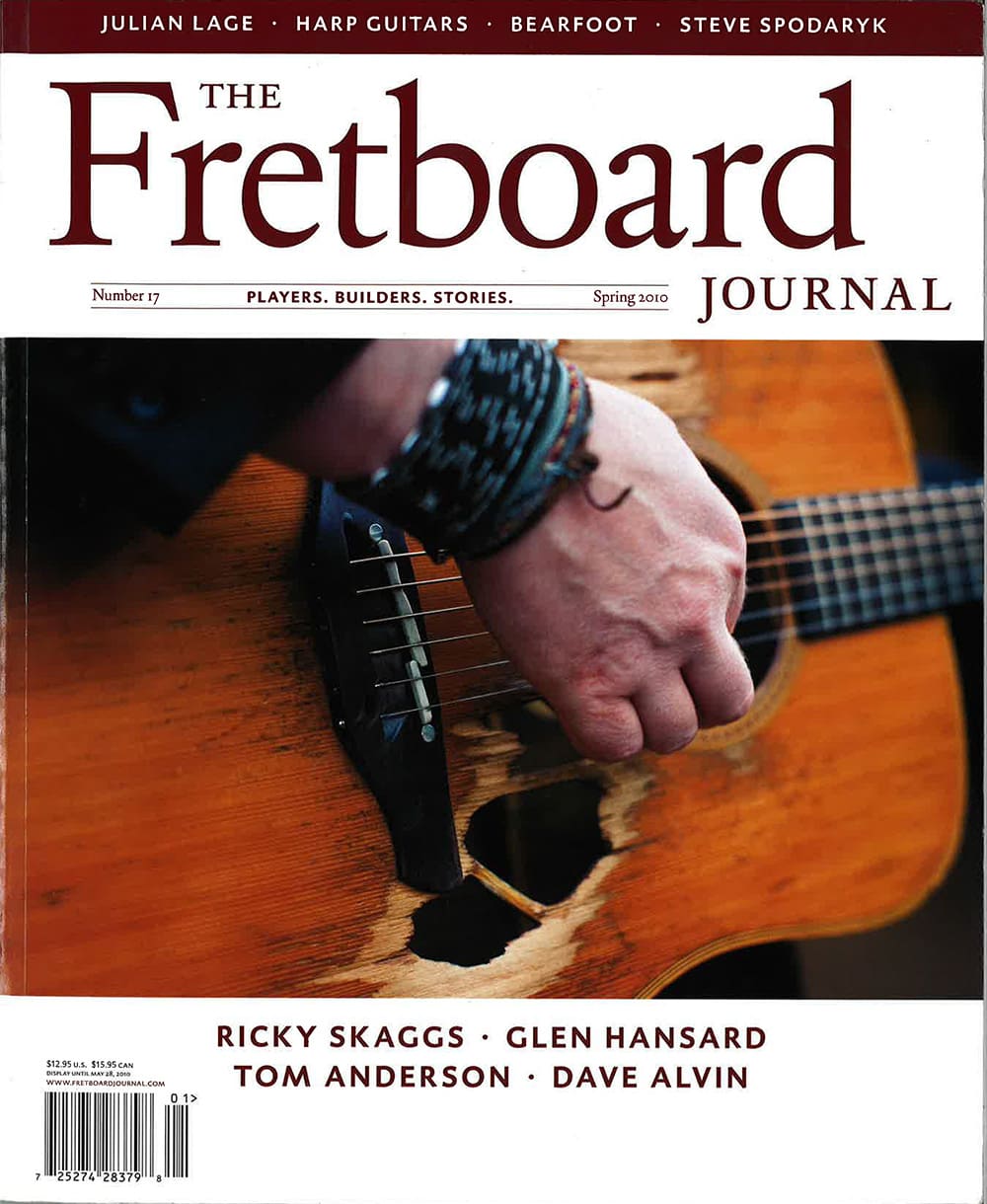
Tribute: Glen Hansard (1970-2026)
On the morning of July 29, 2026, singer-songwriter Glen Hansard tragically passed away after a motorcycle accident in Dublin.
In 2009, I interviewed the Frames and Swell Season frontman for the cover story of our magazine’s seventeenth issue. Back then, he was still touring with the original, worn-through Takamine NP15 as seen in the film Once. Before his Seattle soundcheck, we sat for over an hour at Kells – an Irish pub a short walk away from the famous Pike Place Market clock and fishmongers – with Hansard sharing stories about guitars, life, busking and songwriting. We also talked a lot about his heroes Van Morrison and Bob Dylan, who, in eerie hindsight, had his infamous motorcycle accident sixty years to the day before Hansard’s.
I nursed a beer, while Glen had tea. He was a natural storyteller, which made my job easy. Photographer Maxwell Balmain took pictures for the issue.
After our chat, all three of us walked over to the crowded Market to take some outside photos. Instantly, Hansard started performing with a local busker, who had no clue who he was. The footage launched the Fretboard Journal’s YouTube channel in 2010.
Readers and guitarist friends often ask me about my favorite interview. I’ve been a music journalist for three decades and I’ve been lucky enough to interview a few real rock stars, but I always say, “Glen Hansard.” During our chat, he was utterly present, thoughtful and charming. He spoke with ease, humor and earnestness like no one else. My experience wasn’t unique: Nearly everyone who met him felt like they just stumbled upon their new best friend.
Issue 17 sold out years ago. In light of Glen’s passing, I’m sharing that interview in its entirety below.
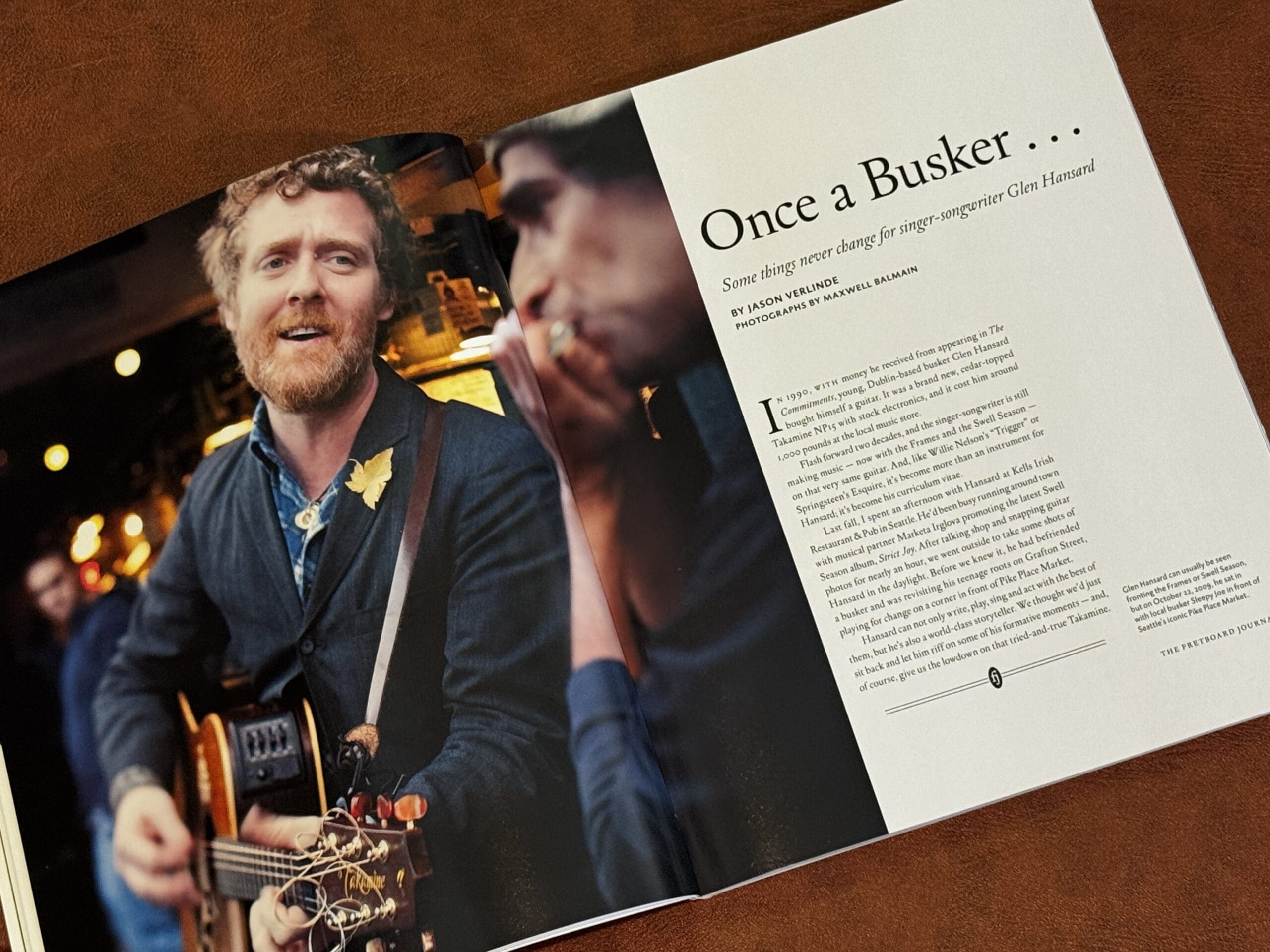
Once a Busker…
Some things never change for singer-songwriter Glen Hansard
By Jason Verlinde
In 1990, with money he received from appearing in The Commitments, young Dublin-based busker Glen Hansard bought himself a guitar. It was a brand new, cedar-topped Takamine NP15 with stock electronics. It cost him around 1000 pounds at the local music store. Flash forward two decades later and the singer-songwriter is still making music—now with the Frames and the Swell Season—on that very same guitar. And, like Willie Nelson’s “Trigger” or Springsteen’s Esquire, it’s become more than an instrument for Hansard, it’s become his curriculum vitae.
On October 22, 2009, I sat down with Hansard at Seattle’s Kell’s Irish Restaurant and Pub while he was busy running around town with musical partner Marketa Irglova promoting the Swell Season album, Strict Joy. After talking shop and snapping guitar photos for nearly an hour, we went outside to take some shots of Hansard in the daylight. Before we knew it, he had befriended a busker and was revisiting his teenage roots on Grafton Street, playing for change on a corner in front of Pike Place Market.
Hansard can not only write, play, sing and act with the best of them, he’s a world-class storyteller. We thought we’d let him riff on some of his formative moments … and give us the lowdown on that tried-and-true Takamine. –Jason Verlinde
First Guitar
When I was a kid, my uncle Paul was super cool. He was the good-looking younger brother of my mother. All the girls loved him. He was working at a theater; he played music in bars. And he was kind of like my father and hero. He taught me A and D chords when I was 8-years-old. He just loved to play, and he brought me to my first concert, the Police, in 1980. U2 opened up for them. They were all we talked about all day long.
He, unfortunately, took a job where he drove a car across Europe with some dodgy guys, and it turned out the car had stuff in it that shouldn’t have been in it. Classic story. He got locked up for a couple years in prison, in Turkey.
All of his stuff basically got left in Ireland, and I discovered his guitar. His instrument was—if I remember correctly, a Hummingbird—but it wasn’t a Gibson. I think it might have been like an Ibanez, some knock-off copy. Beautiful at the time; he adored it.
I discovered it, and learned some Bob Dylan songs on it. The first song I ever picked up was “Bob Dylan’s Dream.” I remember getting a harmonica and learning—picking up the chords … it was A, D and G.
And then I did something very ambitious. I listened to “Famous Blue Raincoat,” by Leonard Cohen, over and over and over until I figured out how to play it. I was going in pretty deep, it is a fingerpicking song. Amazingly, I took on this challenge and figured it out. A year ago, I saw Leonard play in Sydney, Australia, and I watched his hands. I was only wrong by two chords, but the rest I got right! B minor, B, A minor, F sharp minor.
So that was the beginning. Pretty soon after that, I started busking.
When he got out of prison, my uncle freaked out, because I’d knocked his guitar around. I didn’t realize! I was dragging it across the floor, and doing all the things you don’t do to a guitar. It’s only now I can appreciate that, but at the time I was like, “What is getting mad at me for?” I didn’t understand.
Guitar Heroes
As a kid, I was always interested in Angus Young. I grew up Catholic, and they make you take a confirmation, which is kind of like your bar mitzvah. You take on a new name—a saint’s name or whatever. At like 9-years-old, my confirmation name was Angus … he was my God! I guess, if I had guitar heroes, it would be him; Dylan, because his guitar playing is completely underrated; Dave Gilmore, the most amazing player; and maybe Peter Green … JJ Cale. These are all the people that I really adored.
The Takamine
It’s got a few knocks. It’s been played by many different people. I’m a big believer that your instrument is a tool; it’s no more. It shouldn’t be any more. If we identify too strongly with objects, I think we can get into an area where we get very precious.
Now, having said that, I’ve had this thing for so long, and it was always my workhorse. It was never my baby, or my “number one guitar,” or whatever. I’ve got a few guitars, but there are always two I use: a Fender Thinline Telecaster and this guitar. And I just used them both because they’re like an old pair of shoes. They work, they’re the most comfortable, and they sound the best plugged in.
But it became precious when we made Once, because then I noticed people were paying attention to the guitar. People were saying, “Oh, is that guitar you play in the film?” “Is that the guitar you’re playing on the tour?” “Is that the same guitar?” I was like, “Yeah, of course it is. It’s my guitar.” And because it’s gotten so delicate now, because the top of it is really in a pretty awful state, I realize that I’ve got a year or two—maybe three—left in it, in terms of its structure. But luthiers are pretty good at fixing stuff up, so who knows? I might have it for years and years.
I’ve become a little more precious. I bought this [Calton] case for it. I used to just check it in on a flight, in whatever case it was in. Nowadays, I’ll fight to try to get it on the plane with me. Sometimes, I’ll even buy a ticket to put it next to me!
I never thought I was that guy. You meet some people who treat their guitars better than they treat themselves. I don’t believe in this stuff, I believe the guitar is a tool—it’s an object, a piece of wood—it’s a beautiful piece of wood, but when it goes out of your life, it’s gone. And you get another one and you work with that tool.
Very, Very Lucky
I remember one night in Austria, I came out after a gig with my friend, Mic Christopher. Very drunk. I put the guitars down on the street—my electric guitar and my acoustic guitar—and got straight into a taxi, went to another part of town somewhere outside Vienna to this party. When it came time to sing a few songs at the party–two or three hours later–I’m looking for my guitar, and it’s not there! I panicked; I turned white. I ran back to the venue, and amazingly this guitar was still sitting there. There were kids going to school stepping over the guitar! And it was like late at night when we left the place! It was there on the street. My electric guitar was gone; someone picked it up and took it. I had it since I was 15.
But the electric guitar showed up two weeks later, standing against the venue wall. The venue owner came in to work one morning, found it, brought it into the place, and rang me, “Your guitar just showed up, completely untouched, still in tune.” So someone had picked it up, heard that this guy had lost it, and basically felt guilty and brought it back. It’s very, very lucky.
I think for other people this [Takamine] might just be a bit of a plank. But for me, it’s exactly what I need. For them, I don’t know. But it’s like a thousand people have played my guitar, because if we’re on a session and someone wants to sing a song, I just hand it over. I don’t think about. Maybe they’ll break it, and sometimes people do treat it more rough than I’d like them to—but that’s all a part of all my instruments; that’s what they’re for.
Busking for Dummies
I’m not a purest, but there’s something about guys who use a microphone (or amplifier) … not that they’re cheating, but they’re not going to learn as much doing it that way as they will by having to project raw.
That was the biggest lesson I learned: projecting raw. I remember I listened to Before the Flood, where Dylan sings “Just Like a Woman.” I remember making it my goal to be able to sing like that. On Grafton Street, like any street, learning how to project your voice to the point to where it bounces back at you was the goal. And it was all about learning how to play loud, and fast—in that way I noticed I had made more money.
The most lucrative day of the week was always Friday and Saturday night, when everyone was drunk, but that also meant you were going to face a lot of madness as well. It can be very tough, but an education. A baptism of fire.
That guy at the beginning of Once, who steals my money? There was a guy I knew that used to do that. On the street you meet everyone: you know who the pick-pockets are, you know where the whores are, you know who the drug squad are. You figure them all out. If you stand still on any street in the world for long enough, every person in that city will pass you by.
Into the Mystic
When I was busking, one of the people that I became very friendly with was Marina Guinness. She was of the brewing family and she knew I loved Van Morrison, because she heard me singing his tune. She said to me one day, “You know, Van is having this party—his 50th birthday party—at my house. Why don’t you come along?” I said, “What?” “Come along. Take it easy. Don’t make a big deal of it. Bring your girlfriend. Bring a bottle of Port. Treat him with respect, because we’d love for you to come.”
So, I was overjoyed with the opportunity. Her place is way outside the city. I drove out on my scooter with my girlfriend; it was late, and we got there, and we got in. And I thought it was going to be a party, but it wasn’t 20 people. It was Van sitting with just a few friends. And I was introduced to everybody, sat down, we ate some food … just being quiet and sort of being in the background.
It was amazing; I’m sitting here with Van Morrison! And a couple of drinks were had, and then someone came into the room we were in and said, “Everybody, come on into the kitchen… Van is singing some songs.” Van was there with Jerry Lee Lewis. And Jerry Lee and Van are standing at the fireplace, and they’re both singing beautiful old country songs—beautiful.
At one point Van says, “Anyone want to hear a song? Any requests?” I’m a huge fan, but I didn’t know whether I should say it, or whether I shouldn’t. No one else was shouting out, so I said, “Van… ‘I’m Hungry For Your Love’?”
“I’m Hungry For Your Love,” is a great song, but a fairly lesser-known song.
He looks at me, and he says, “You don’t know me!”
I was just like, ‘Jesus Christ!’ I turned away, and I walked outside. I kind of freaked out. The first thing I’d said to him, and I just got BAM!
So I went outside, and I was thinking about taking my head off, thinking I just shouldn’t have come here. And Marina came out, and said, “Glen, come on. Don’t let that get in the way. Come back in, have a good night. Relax!”
So I went back in and stayed at the back of the room, and just enjoyed listening to him. He said, “Anyone else want to sing a song?” And Marina said, “Glen … Glen will sing.” And I was like, “Oh, no!” Freaked out, you know?
I went up and he handed me the guitar, stood up and walked out of the room. I was like, “Oh, fuck!”
So I sang a song and there was nobody else to play, and people asked for another one, so I sang a second one. He comes back in, and sat down with his back to me. And I finished my second song, and he swung his chair around, and he said, “What did you want me to sing?” I said, “Hungry For Your Love.” And he says, “Do you know it?” I say, “Yeah.” He said, “Well, play it,” and he put me on the spot. And thank God I know his songs.
So I played it, and he’s listening to me, and about halfway through the song he starts going, yeah … yeah, and then sings a little harmony with me. I’m blown away. I’m flipping freaking out. I’m singing his song, and he’s singing harmony to me.
And then I finished that song, and he says, “All right. Come on.” I said, “Where?” “Just come on, follow me.” He brings me up the stairs of this beautiful old house, goes into one of the rooms, and sits me down on the couch. He was ready to sing. He sits down opposite me. He’s had a few drinks, and he should be downstairs mingling. And I start playing one of my songs.
He listens to it, he picks the guitar up. He says nothing. I say, “Well, will you play me ‘Hungry For Your Love’?”
He plays it, hands me the guitar. He plays a second song, takes the guitar. “What do you want to hear?” And we pass the guitar, and I’m not kidding you, for hours we passed the guitar. We ran out of songs after an hour-and-a-half.
The sun was coming up, and I remember his girlfriend at the time came into the room at the end, and said, “Come on, we have to go.” And he’s like, “Right.” And he stood up, comes over, pats me on the shoulder, and says, “Nice voice. Nice songs. Blah, blah, blah,” and walks out. And that was it. That was my encounter. That was all he said: “Nice voice. Nice songs. Blah, blah, blah.”
But what was amazing for me, the gift that I’d been given that night, was that I got to watch his hands. I got to watch his neck. I got to watch how he lifted his head into notes. I got to watch how his body leaned into chords.
I got to see Van the way no one probably gets to see him, except maybe his girlfriend, or his kids, or whoever. I got to see a master up close, and to digest every inflection—to use or not use—in my own palette all this experience. Do you know what I’m saying? I went to be being a proper apprentice that night. The education was profound because it was up close and personal with a master.
Meeting Dylan
I was busking and Dylan was in Dublin to do a gig, which, of course, I was going to because I’m a huge fan. He was number one. He was staying at this hotel, the Westbury Hotel. I was down the street and someone comes out and goes, “Bob-Fucking-Dylan just walked out—got out of the van around the corner!”
I just grabbed my guitar and ran … left the money in my case, everything there. I ran around the corner and Dylan was getting out of a truck. He was hanging out, going into the hotel. And I did this stupid thing: I just took a harmonica out of my pocket and I handed it to him. It was a stupid thing to do, give Bob Dylan a harmonica, but he took it, and he was like, “Hey, thanks.”
And that was it; he was gone. But the weird thing was maybe a year or two later … I was rehearsing with my band, and Dylan was rehearsing next door with his band in the rehearsal place we were in, because they were beginning a European tour. We finished our rehearsals, the drum and bass player had gone home, and I was running over one last song, and we didn’t know he was rehearsing next door, because all we were told was, “There’s someone famous next door. Don’t annoy them. Stay out of the way.” We didn’t care. We thought it might have been U2.
But at one point, Colin, our violin player, just looked at me like someone had died, and we turned around, and standing in our doorway was Bob with his foot up, and he’s smoking a cigarette, and he just says, “Sounds good.” And I walked up to him, and I just said, “Bob,” and I shook his hand, and was totally freaked out.
He shook my hand, and I said, “Bob, meeting you [for me] is what it must have been like when you met Woody.” And I think I must have said the right thing, ‘cause Bob was like, “Oh, Woody! Man, Woody was amazing!” He said, “I never got to hear Woody play.” And Bob starts talking … Bob Dylan started talking to me about Woody Guthrie! And I knew just enough about Woody—through Dylan—to hold a conversation with him.
We talked for a minute-and-a-half about Woody Guthrie, and he took off. And I shook his hand, and I ran home. I told my mother I’d shook Bob Dylan’s hand. It was unbelievable.
The next morning, a phone call came in to the rehearsal space. They gave Bob Dylan’s manager my number, and he rang up, and he said, “You must have impressed Bob. Do you want to come to London and open for him?”
It was amazing; he was like, “Can you get a flight? If you can get a flight, you can do the gig.” That was basically how he put it. We went out to the airport and explained our situation, and they canceled five people off the flight for us! We walked on stage, and I said, “Yesterday, I was rehearsing with my band to Dublin, and Bob Dylan appeared in the doorway, and we chatted for a few minutes, and here we are. This is amazing.”
Keeping It Road Worthy
A few months ago, a luthier contacted me via email about fixing my guitar for me. I really wasn’t sure how I felt about it. We were in L.A. and doing press, and he lives an hour’s drive south, and we went down, and we visited him. He asked me to leave the guitar with him for a couple of days, because he just wanted to observe the inside of it. He asked me how I felt about him reinforcing the part where it’s all damaged.
I took a risk, and I left it with him. I came back a couple of days later, and he had done this kind of amazing job, where he had basically put a very thin layer of wood underneath the holes, which basically means that the holes may not grow anymore.
But he didn’t change the aesthetic at all. He wanted to put lacquer—some sort of resin on the holes, which would have made the wood darker, and which would have meant I wouldn’t be able to wear the guitar down anymore.
But I didn’t let him do that, because I think there’s something very natural about the way the thing is. I didn’t want to change anything. But the reinforcement inside me was very happy with. He did an amazing job!
Marketa was amazing. I was kind of weird about [leaving my guitar with a stranger], but I wasn’t saying that. Mar just turned to him and said, “If you fuck up that guitar, I will kill you!” She really had my back.
The post Tribute: Glen Hansard (1970-2026) first appeared on Fretboard Journal.
Wintergrass Sessions: Missy Raines & Allegheny
At the 2026 Wintergrass festival in Bellevue, Washington, the Fretboard Journal teamed up with filmers I Know We Should to capture some of our favorite artists (and talk gear).
In this session, we hear from Missy Raines & Allegheny.
First, they perform, “Cold Wind” and “Cold Black Water.”
Then, we talk gear with the full band.
Register now for Wintergrass 2027. The lineup in 2027 will include Sierra Hull, Jerry Douglas Band, East Nash Grass and other bluegrass favorites.
Video by Brad Wagner, audio by Juan M Soria.
We’ll be sharing more highlights from Wintergrass 2026 on a weekly basis here and on our YouTube channel.
The post Wintergrass Sessions: Missy Raines & Allegheny first appeared on Fretboard Journal.
The Truth About Vintage Amps, Ep. 168
It’s the 167th episode of the Truth About Vintage Amps, the call-in show where amp tech Skip Simmons fields all of your tube amp and life questions.
Our sponsors: Grez Guitars; Emerald City Guitars; and Amplified Parts / Mod Electronics.
Some of the topics discussed this week:
:00 Special Guest: Sebastian Gruenberg of Vintage Inspired Pickups (link); molecular biology; winding pickups, making potentiometers; cryo-tuning magnets; Emerald City Guitars; Gibsonette input jack ground issues; and more!
30:57 What’s on Skip’s bench: Magnatones; a Sears 40XL Danelectro; Traynors
34:07 Jonathan Richman, charming singer-songwriter and stone mason
36:17 An early National Dobro amp for sale; where’s Larry Chung?
38:51 The Fretboard Summit, August 20-22 in Chicago (register here); this year @vintagetubeamplifiers is bringing out a bunch of old & rare amps along with various other contributors/listeners!
39:50 A kitchen cleaning tip, Dutch ovens, Skip’s typewriter repair
44:07 Optocoupler repair in a classic Fender
45:57 The BBC’s Shipping Forecast (link)
48:54 Rattlesnake Milk’s ‘Midnight Train’, quick Asian rice, and TAVA buzzwords
50:54 Output tubes for Skip’s Mega Champ amp build (Champ with Soursound transformers)
54:38 A demonic Ampeg B-18N
59:04 A new caster for my 1966 Fender Pro Reverb, ‘The Magnificent Charlie Parker’ compilation; homemade gumbo; Mike Watt
1:06:12 What should I do with this Masco A-10 project? Using a Hammond 166M12 as a Variac; do old black metal pre-amp tubes like the 6SJ7 have glass inside?
1:12:02 A tie story; how can I slow down the tremolo on my modded Silvertone 1484?
1:17:46 Gourmet dog treats
Want amp tech Skip Simmons’ advice on your DIY guitar amp projects? Want to share your top secret family recipe? Need relationship advice? Join us by sending your voice memo or written questions to podcast@fretboardjournal.com! Include a photo, too.
Want to support the show? Join our Patreon page to get to the front of the advice line, see exclusive pics, the occasional video and more.
Hosted by amp tech Skip Simmons and co-hosted/produced by Jason Verlinde of the Fretboard Journal.
Above: @patconnorbass‘ possibly haunted Ampeg bass rig, as discussed on this week’s episode.
The post The Truth About Vintage Amps, Ep. 168 first appeared on Fretboard Journal.