
Music is the universal language
“Glory to God in the highest heaven, and on earth peace to those on whom his favor rests.” - Luke 2:14
General Interest
The magic of partscasters – build your perfect guitar yourself

Ad feature with StewMac
We all know the myth of the ‘endgame guitar’ – it’s rare that one single instrument is the final piece of the puzzle for your rig. But there’s a good chance you’ve got some idea of what your perfect guitar might be, and there’s an equally good chance this perfect guitar isn’t just hanging on the wall of a guitar shop. Maybe it has some wild arrangement of specs and features that you’ve been hunting down for years – maybe it’s a more standard guitar with your own stamp on it. In any case, let’s explore how you can follow in the footsteps of Eddie Van Halen and Tom Morello and assemble that perfect guitar from parts.
Parts unknown
The two most important parts of a part guitar are, of course, the body and the neck. Making sure you’ve got a good match between the two, and the right sort of body for the kind of instrument you want to make, is crucial. There are a lot of options out there, either via the custom body route or official Fender parts – you could even salvage a body or neck from an existing instrument.
The most important thing a body defines is what kind of bridge you work with in the end. Broadly speaking each kind of bridge commonly found on Fender-style instruments presents a different level of challenge when it comes to getting assembly right. The least confounding is the straightforward hardtail setup – this includes Telecaster-style bodies with a full bridge plate, and bodies designed for shorter hardtail bridges, like the Telecaster Deluxe or Hardtail Stratocaster bodies. You can also find custom bodies in all sorts of shapes that accommodate various styles of hardtail bridges.
You then have the Stratocaster-style block vibrato – this requires a bit of finesse, but as long as the body you find has high-quality mounting holes already drilled (or you have a steady drilling hand), it’s not that bad. After this is the offset-style vibrato found on Jazzmasters and Jaguars, which requires a good deal of accuracy to get a well-performing string path, and of course is infamously fiddly even once it is assembled.
 The blank neck for the project.
Today I’m working with a Telecaster-style body and a Fender neck, both relic’d. The Tele platform is, as I mentioned, relatively straightforward, but it’s not without its own challenges – regardless, it’s a good place for a beginner to start thanks to the lack of a vibrato with moving parts and extra things to align.
Start with the Finish
 The body in question – without any shielding, electronics or hardware.
If it’s your first time assembling a parts guitar, then it’s probably a good idea to get a body and a neck that are already finished. The art of finishing is by no means inaccessible, but it can be a big hurdle for first-timers – there’s a lot that can go wrong, and depending on what kind of finish you opt for, the process itself can require a lot of practice and patience.
Getting pre-finished parts takes that worry out of the equation, but if you are keen to give it a go, StewMac has some excellent in-depth guides and info on the various finishing processes you can apply to get the right look for your guitar – just remember, don’t ever rush it!
Pickup some ideas
What kind of body you choose will define what kind of pickups you can go for – some bodies are more flexible than others, with swimming-pool routes that allow for any and all pickups, while some – like the more traditional Tele-style body we have today – won’t take non-standard pickups without serious modifications.
To help make the decision, it’s good to work backwards from the kinds of sounds that you want your perfect guitar to be capable of – do you want vintage PAFs? Full-throated Wide Range humbucker tones? Spanky single-coils? Thanks to the very wide world of aftermarket pickups, there are options that incorporate a wide range of sounds into all sorts and sizes of pickups. Getting a Tele doesn’t chain you to single-coils, for instance, as there are single-coil-sized humbuckers designed specifically for them.
If you need some inspiration, StewMac has a huge stock of various pickups, ranging from lovingly recreated PAF-style humbuckers to active EMGs, from vintage Tele single-coils to powerful blade pickups. For our purposes today we’re sticking with StewMac’s own vintage-style Tele single-coils.
Shields up
 The same body, shielded with copper tape. All of the separate cavities shielding parts have been joined with a wire or a strip of shielding tape.
If you’re keen to cut down on hum, you’ll want to shield the body cavities with conductive tape or paint. When the shielding is connected to ground, it works as a faraday cage, protecting the signal-generating parts of the guitar from external noise.
I opt for conductive tape. The Tele body in particular presents the fun challenge of getting all of the different cavities connected, and for that I use either a strip of tape between the two cavities that are hidden by the pickguard, and a jumper wire to connect these to the control cavity. Similarly the bridge plate is connected to the electronics’ ground via a stripped wire, sandwiched between it and the body.
Check the fit
Of course pickups are often fitted into pickguards, and one thing you quickly learn when assembling a parts guitar is that eventually, something just won’t fit, especially if you’re using a smorgasbord of parts from different brands.
Doing a dry fit is always a good idea, even if your body already has pickguard screw holes. If it doesn’t, it’s good to position the guard with everything installed before marking and drilling, just so you know that it’ll be properly aligned without any components crashing into cavity walls and so on. You may find you need to plug existing pickguard screw holes and re-drill them, or shave off a millimetre of pickguard to let a pickup through – just be careful, go slowly, and remember the age-old adage: measure twice, cut once.
And talking of things fitting – you’ll want to check that your neck is the right kind. If you’re building a Telecaster-style guitar, a traditional Tele pocket is designed for a square heel. Hence a Telecaster-style neck will fit in a Strat-style pocket (with a little gap), whereas a Strat-style neck’s rounded heel means it won’t fit in a Tele-style pocket!
 The neck, ready for mounting holes to be drilled. I’m using a cardboard caul to ensure the frets aren’t damaged by the pressing motion, and a concave curved piece of wood to keep the neck itself as vertical as possible.
The neck I’m using today also doesn’t have any mounting holes. And so I get the bridge installed, loosely string up an outer E to ensure alignment, and then clamp it in place, using a cardboard caul. Once I know the neck is aligned properly I mark the positions for the screw holes with the sharp end of a brad-point bit, and unclamp it all so I can drill them straight and true with a press – you’ll want to use a bit that’s the same diameter or very slightly larger than the shank of the neck pocket screw you’re using.
For more on what fit and alignment issues you might run into, check out StewMac’s full guide to assembling a parts guitar here. In fact, little like the measure twice, cut once adage, there’s not really too much reading you can do before embarking on a project like this!
Hardware and electronics
The body and neck we’re using today are relic’d, and so to complete the look of an aged guitar we can grab some aged hardware to match. StewMac has a veritable treasure-trove of ready-aged hardware, including a lovely Gotoh bridge that has a super vibey vintage aesthetic but also compensated saddles to keep things in tune. The Kluson tuners are an easy fit and also come pre-aged, so they don’t stick out like a sore thumb next to the aged Fender logo!
Of course, you may not like the relic vibe, or want to add a bit of modern panache to proceedings – that’s fine too, as of course this is your guitar that you’re making! There are lots of different modern options, each of which is suited for different aesthetic tastes and playstyles.
 The guitar’s control plate, all wired up. Here the pickguard screws are yet to be drilled, as I want to ensure the pickguard will key against the completed control plate before I commit to a location for it.
Once everything else is ready, I assemble the guitar’s electronics on the control plate – once it’s all wired up I give it the old screwdriver tap test to check that the switch and controls work. All this involves is plugging in and tapping the pickups with something metal, just to establish that the guitar makes the right signals in different switch positions, and the controls actually function – it’s good to check this before you get everything strung up and ready to go.
All together now
So that’s it all assembled – there are, as with all things guitar, a lot of improvements you can make to a simple parts instrument – once it’s working and making sound, there’ll be a long process of dialling in the action, neck relief, pickup height and so on to get it playing its best. It’s rarely a case of just bolting a body onto a neck and calling it a day, but the process is absolutely not beyond the average enthusiastic guitar-modder! Building a parts guitar is a great way of getting an instrument with your stamp on it, and when playing it you’ll feel even more connected to it knowing it was your handiwork that brought it into being.
For more on assembling parts guitars, check out StewMac’s full guide here.
The post The magic of partscasters – build your perfect guitar yourself appeared first on Guitar.com | All Things Guitar.
“Right away, your brain goes into survival mode” how having all his gear stolen led to Russian Circles’ Mike Sullivan reinventing his approach to guitar

Two Les Paul Customs, three cabinets, 12 pedals, 13 microphones and a bicycle. When Russian Circles opened their U-haul truck outside of a California hotel in 2021, they found that all these things and more had been stolen from them overnight. As if that weren’t calamitous enough, they were about to start the biggest tour of their lives, supporting System of a Down and Korn in stadiums, and were 2,100 miles away from their then-base of Chicago. The only thing that could have been worse was if someone had died.
“It was an ‘Oh, shit’ moment, obviously,” remembers guitarist Mike Sullivan, talking to me from his home in Los Angeles. “Right away, your brain goes into survival mode. We’re in fucking Bumblefuck, California! Who do we know around here? How do we get their gear? How do we reach out to these people? Despite being on a huge tour at the time, there weren’t many people looking to help us out in that world.”
The instru-metal trio took whatever they could to carry on. Chelsea Wolfe lent Sullivan her Dunable Gnarwahl guitar. Hiwatt, a company they’d never worked with before, let them borrow some amps. They overcame – playing the shows, crowd-sourcing $60,000 (£45,000) and getting some of their stuff back in 2024 – but the incident reinvented Sullivan’s rig. Five years later, Dunable and Hiwatt are his go-to manufacturers.
“I was desperate for anything that sounded like a Les Paul. Anything with humbuckers and a glued neck would have sufficed,” he recalls. “But the Gnarwahl was such a cool-looking instrument, which sounded and felt great, and I was hooked on it. It’s a fun guitar to play. You don’t feel weighed down: it’s so ergonomic for tapping.
“I was blown away by how good the Hiwatt sounded,” he adds. “It took pedals so well. All these pedals that I thought I needed no matter what, I started tossing them out of the pedal chain. Less is more. When your blueprint tone, your foundation, is that fucking good, then you don’t need as much garbage to polish the turd.”
 Image: Press
Cutting The Chaff
Hearing Sullivan talk about discarding pedals is like hearing Father Christmas talk about laying off elves. Since he co-founded Russian Circles in 2004, the guitarist’s penchant for pedals has become a cornerstone of the band’s identity. Many of their songs are centred around his loops, which help the three-man lineup, completed by drummer Dave Turncrantz and bassist Brian Cook, build bulletproof walls of noise.
Their approach is so ear-grabbingly loud, and Sullivan’s playing so immediately melodic, that they’ve transcended the insular post-rock scene which ensnares most modern instrumental rockers. As well as Korn and System of a Down, they’ve toured with Tool and Mastodon. Gojira’s Christian Andreu sports their merch onstage, ex-Killswitch Engage singer Howard Jones has touted them in interviews and Converge guitarist Kurt Ballou produced their four latest albums, including their brand-new ninth, aptly titled Nine. The soft-spoken Sullivan almost sounds uncomfortable with the elite company.
“After doing the System of a Down/Korn tour, I’ve never been more proud to be part of the underground,” he says. “Some of the stories are jaw-dropping. I have a lot of good things to say about Korn. System of a Down? Next question.”
Certain fans have talked about Nine as if it’s Russian Circle’s mainstream moment, pointing out the increased synths and electronics on the single Eluvial. But Sullivan only leaned further into his underground proclivities, such as on the punishing Empath and Seventh Seal. After being inspired by metal bands Pantera and At the Gates for 2022’s Gnosis, he went even deeper, turning to cult UK death metal luminaries Bolt Thrower.
“Death metal tremolo picking can be very vocal,” he explains. “It’s very minimal as far as melody. It’s a hummable, simple melody. It’s similar to black metal, where you can hold the chord shape and keep different voice lines interweaving in a cool way. You can rub an open string against a fretted string and create tension, a breathing pulse to the melodies.”
Unconventional Sources
Sullivan’s a metalhead at heart: he has a vinyl copy of Sabbath Bloody Sabbath on the table next to him and a 1981 Dean ML on his wall, in tribute to Dimebag Darrell. To understand the essence of his guitar playing, though, you need to know about obscure math-rockers Don Caballero. Like Russian Circles, they were an instrumental three-piece whose guitarist, Ian Williams, used tapping and loops. Sullivan saw them in Chicago after moving there to study and was floored.
“I came from the world of [punk legends] Fugazi, where many people were like, ‘Pedals? We don’t need pedals! Do it with your fingers!’” he says. “So the first pedal I ever had that I used in a band was a looper, and then a friend showed me, ‘Hey, you ever mess with a delay pedal?’ I’m like, ‘Not really. Let me try it out. Oh, this is fucking awesome! Alright, what does a tremolo pedal do? Oh, reverb’s great! Oh, the volume pedal!’”
He admits that his approach to distortion is pedal-first, “not out of preference, but utility”: “If I had my way, I’d probably draw upon a distorted amp channel and then boost it if need be. But I switch between gain stages so much. I want the decay of delay to bleed through. If I change channels on-amp from clean to dirty, the delay trails will be bumped up to a distorted signal, and I don’t want that. I want the delay to be after distortion, always.”
Seeing What’s Important
By the 2021 robbery, his fixation had become a bit much. “I had a bunch of tone sweeteners, like Klon clones and shit, and EQ sculpting devices that I just didn’t need,” he laughs. “Too many things were taking up space and compromising the tone.”
But Sullivan’s setup has always revolved around the looper. Be it a Les Paul or a Gnarwahl, he uses instruments with humbucker pickups so he’s not stacking layer upon layer of feedback. The Hiwatt amps have plenty of headroom so the loops don’t “collapse”. Unfortunately, other drawbacks can’t be circumvented. Mistimed loops force drummer Turncrantz to adjust or improvise.
“It’s all on me if it fucks up,” the guitarist admits. “It’s more about, do I know how to cheat to get the loop or the phrase sampled? If a loop’s awful, I’ll find a way to bury it and do some work-around.”
While making Nine, Sullivan was in his element. He recorded guitars at Ballou’s own studio God City in Salem, Massachusetts, where he experimented with so many models and bits of gear that he can’t remember what was used where. What he can say for certain is that he wrote some of the album with his favourite guitar, the 1985 Les Paul Custom that was stolen in 2021 then returned to him.
“All Les Pauls are a little bit different, and that one looks like it saw action in the Civil War,” he grins. “It’s falling apart, there are stress cracks everywhere, but it’s the most resonant guitar I’ve ever played. It just shakes for you and you can really feel it respond.”
He also dabbled in a variety of tunings. “I’ve always hovered around DADGAD tunings or that relative setup. The lowest [on this album] is DADGAD but tuned down to A. Other ones are that same shape of DADGAD but in B.”
Get Low
Across Russian Circles’ career, as the guitar influences have grown heavier, the tunings have got lower. Although Sullivan’s always imbued his riffs with a Sabbath-esque sludge, the early albums were much higher, in D or C-sharp. It’s a bit of a pickle for a man who tells me “I don’t like changing guitars during a set”.
“There’s enough changing pedals and settings, so to change guitars and all that takes so much time, and I end up getting gum in my hair or something like that while I’m doing it,” he elaborates. “It’s a fucking trainwreck.”
Then why do you use so many different guitars and tunings in the studio?!
“Oh, I fuck myself over at every opportunity. If you only knew. If there’s a fork in the road, I seem to always take the more difficult route.”
He may self-deprecate, but the more difficult route clearly pays off. You don’t get to support Korn and System of a Down by not knowing what you’re doing. As our conversation turns towards the future, Sullivan tips his hat to Mastodon for gradually getting bigger without compromising their musical vision. Given he’s still attached to his extreme metal and math-rock touchstones, even after getting a taste of stadiums, surely he wants the same thing?
“If it happens, that’d be awesome, and I’d be happy to go that course our own way,” he answers. “But we’re proud to be on an independent label. I’ve had endorsees turn me down because we’re not on late-night talk shows and tell me I’m ‘not pushing the brand hard enough’. We’re not going to be on a late-night talk show, and if we are, I don’t want that to matter if I get an endorsement or not. I’m fortunate that I have the ability to play, I get to play and people care enough to hear our records. That’s a good spot to be in.”
Nine is out on 28 August via Sargent House.
The post “Right away, your brain goes into survival mode” how having all his gear stolen led to Russian Circles’ Mike Sullivan reinventing his approach to guitar appeared first on Guitar.com | All Things Guitar.
DOWN To Release "Volume V" Full-Length November 20th
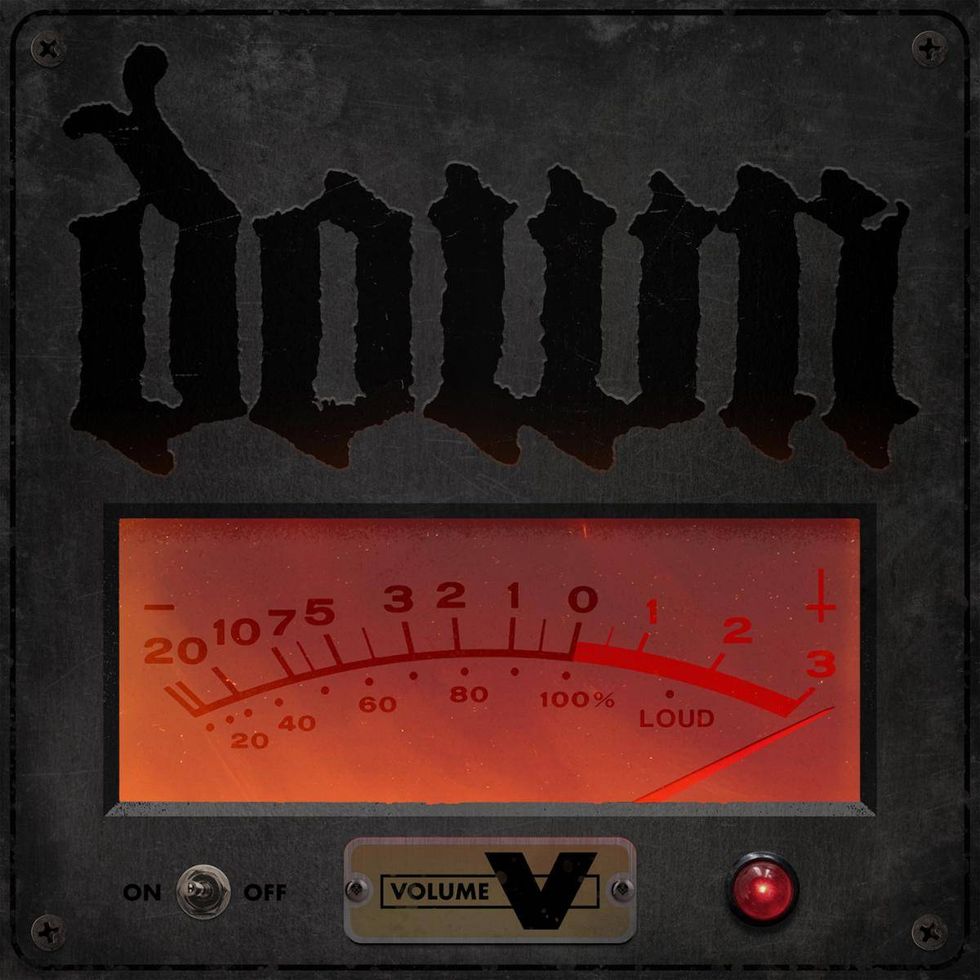
American heavy metal icons DOWN will unleash their long-awaited new studio album, Volume V, on November 20th via Nuclear Blast Records!
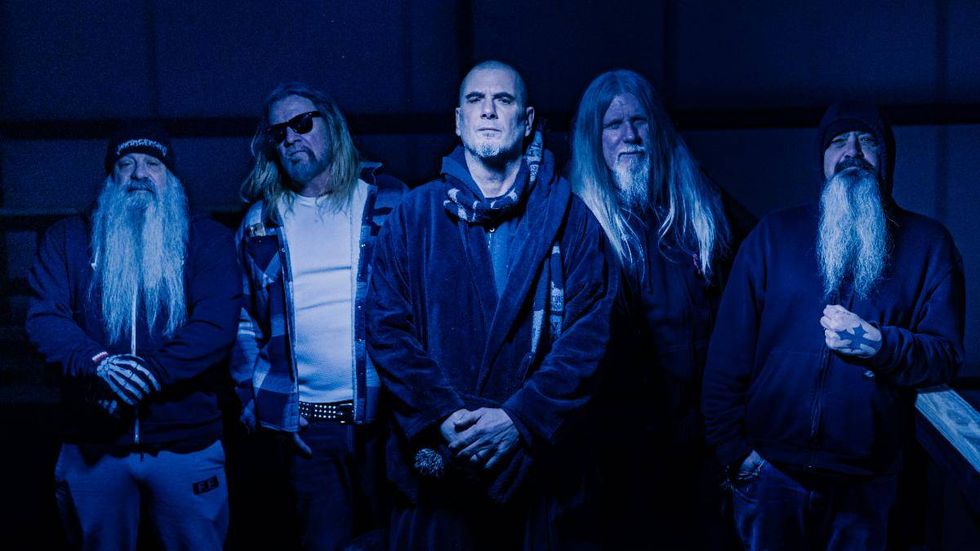
American heavy metal icons DOWN will unleash their long-awaited new studio album, Volume V, on November 20th via Nuclear Blast Records!
DOWN was never just a band. It’s a brotherhood rooted in childhood friendships that have endured for decades. It’s an homage to the city of New Orleans, Louisiana. It’s music meant for anybody who has ever headbanged, played air guitar, or worn a weathered tour t-shirt like armor. For over three decades, the quintet – Philip H. Anselmo, Pepper Keenan, Kirk Windstein, Jimmy Bower, and Pat Bruders – have quietly built a legacy like no other. When these individuals congregate, magic ensues, conjured by earthquaking grooves, bellowing straight from the soul, and riffing loud enough to awaken an ancient deity.

This Fall, DOWN begins another chapter with Volume V.
“We were all excited about this,” smiles Anselmo. “There was a sense of lightness in the air. Everyone’s attitude was positive. There was more focus than ever. It just felt fresh again. Each one of us was individually striving for something, and I believe we achieved what we wanted to achieve. The record is a journey. It’s classic DOWN, but it’s also unique.”
“Everybody played their asses off, wrote great riffs, and Philip is singing amazing,” adds Windstein. “There’s so much electricity when we get together. To me, it’s the same vibe as our debut NOLA, but we’ve got another 35 years of experience as songwriters.”
“The five of us are from the same era, grew up together, and accomplished a lot on our own,” Keenan observes. “We all sounded different, but we’re still from the same 20-block radius. As far as what makes DOWN special, we knew one another before any of us had done anything. There’s history.”
DOWN’s bond runs deep. The guys initially crossed paths as teens in various local bands throughout New Orleans. Over the years, each musician went off and made a name for himself with Anselmo notably fronting Pantera, Keenan holding down guitar and vocals for Corrosion Of Conformity, Windstein leading Crowbar, and Bower slinging guitar in Eyehategod.
Two writing sessions yielded the bulk of material on Volume V. Upholding a tradition dating back to Down II, the members retreated to Anselmo’s home studio and their de facto clubhouse, Nodferatu’s Lair. Songs originated on the spot as they jammed face-to-face. Throughout 2025, the music naturally took shape. Keenan and Windstein chose to simultaneously record guitar together, giving the album a timeless punch.
The album opens with a blistering barnburner “The Myth.” It sets the tone with a powerhouse vocal, pummeling rhythms, and precise down-picking. Then, there’s “Merciful Fate” featuring King Diamond. It reaches an apex with a vocal duel between Anselmo and King Diamond and fret-burning solos executed at a breakneck pace of 120bpm. King’s wife Livia Zita even blesses the track with dark accents of her own. Closer “Twice-Told Tales” caps the trip off with a heavy and hypnotic denouement. “It’s a conglomerate of tight riffs and blues rock mixed with the diligence of classic metal,” Anselmo reveals. “It’s an important song to us. I could feel Ozzy Osbourne’s influence on me in the strangest way.”
Lead single, “Blood Oath,” is anchored by an alternately hard-hitting and hummable riff, culminating on a clarion call chorus. With a sly tip of the hat to their stomping grounds, it practically bleeds old gold, black, and white. “Anybody who’s from New Orleans is going to get a kick out of the references to the city,” grins Anselmo. “Musically, it’s got a big hook. It’s a DOWN song, but it takes a turn.”
“You’ll know it’s DOWN right off the fucking bat,” adds Keenan. “It’s heavy in its attack.”
DOWN’s Volume V was produced by Eddie Mapp and DOWN, mixed by Dave Fortman, and mastered by Maor Appelbaum at Maor Appelbaum Mastering in California.
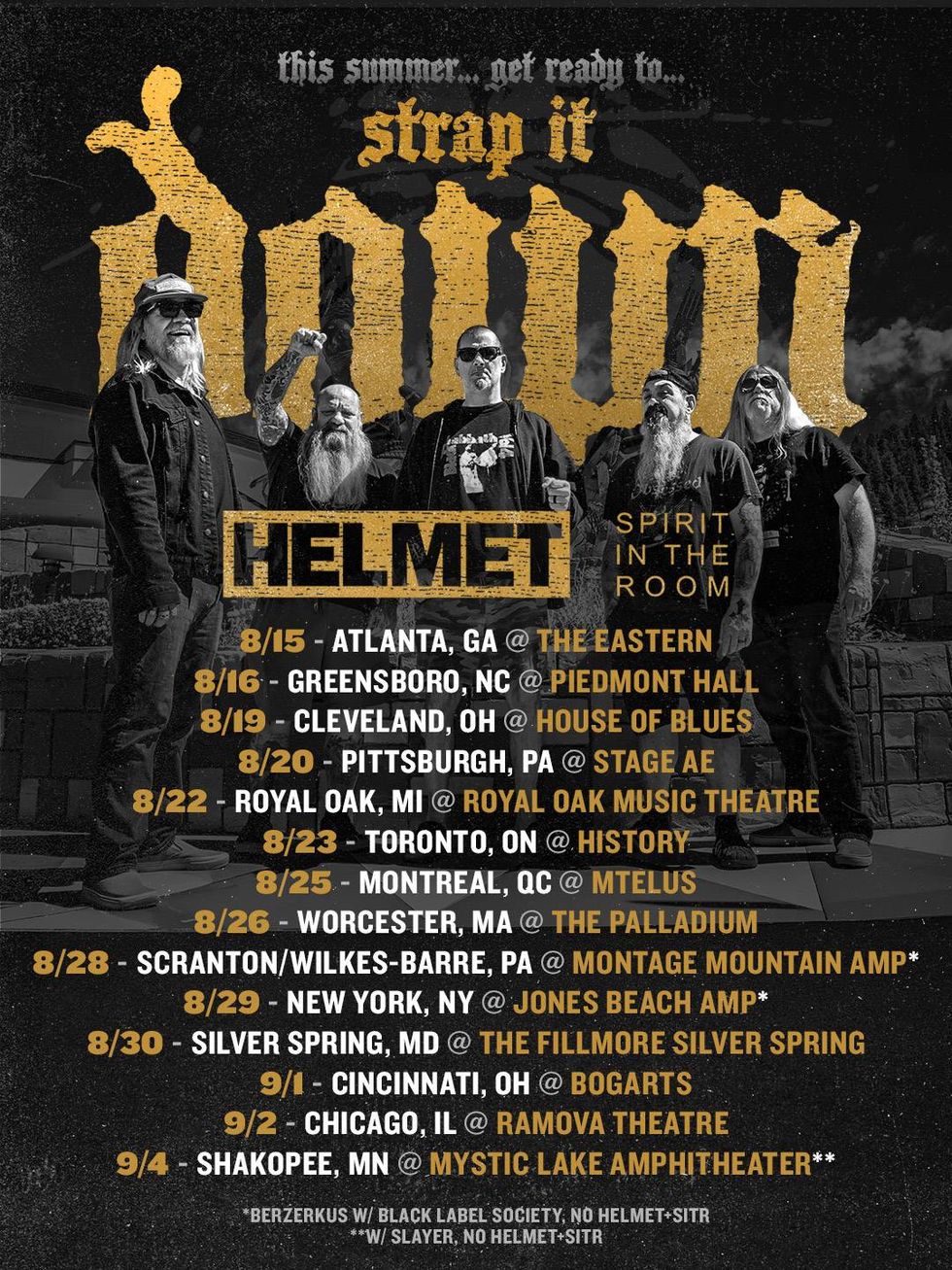
DOWN is amid their North American headlining tour with support provided by Helmet and Spirit In The Room. The Strap It Down tour commenced in Atlanta, Georgia on August 15th and will close in Shakopee, Minnesota on September 4th with a special performance as direct support to Slayer. The journey also includes slots on the 2026 installment of Zakk Wylde’s Berzerkus Festival featuring Lamb Of God, Black Label Society, and others on August 28th in Scranton, Pennsylvania and August 29th in Wantagh, New York.Limited DOWN VIP ticketless packages are available now, featuring a soundcheck experience, meet & greet, photo opportunity, signed poster, and exclusive merch item.
Visit down-nola.com/tour to secure yours.
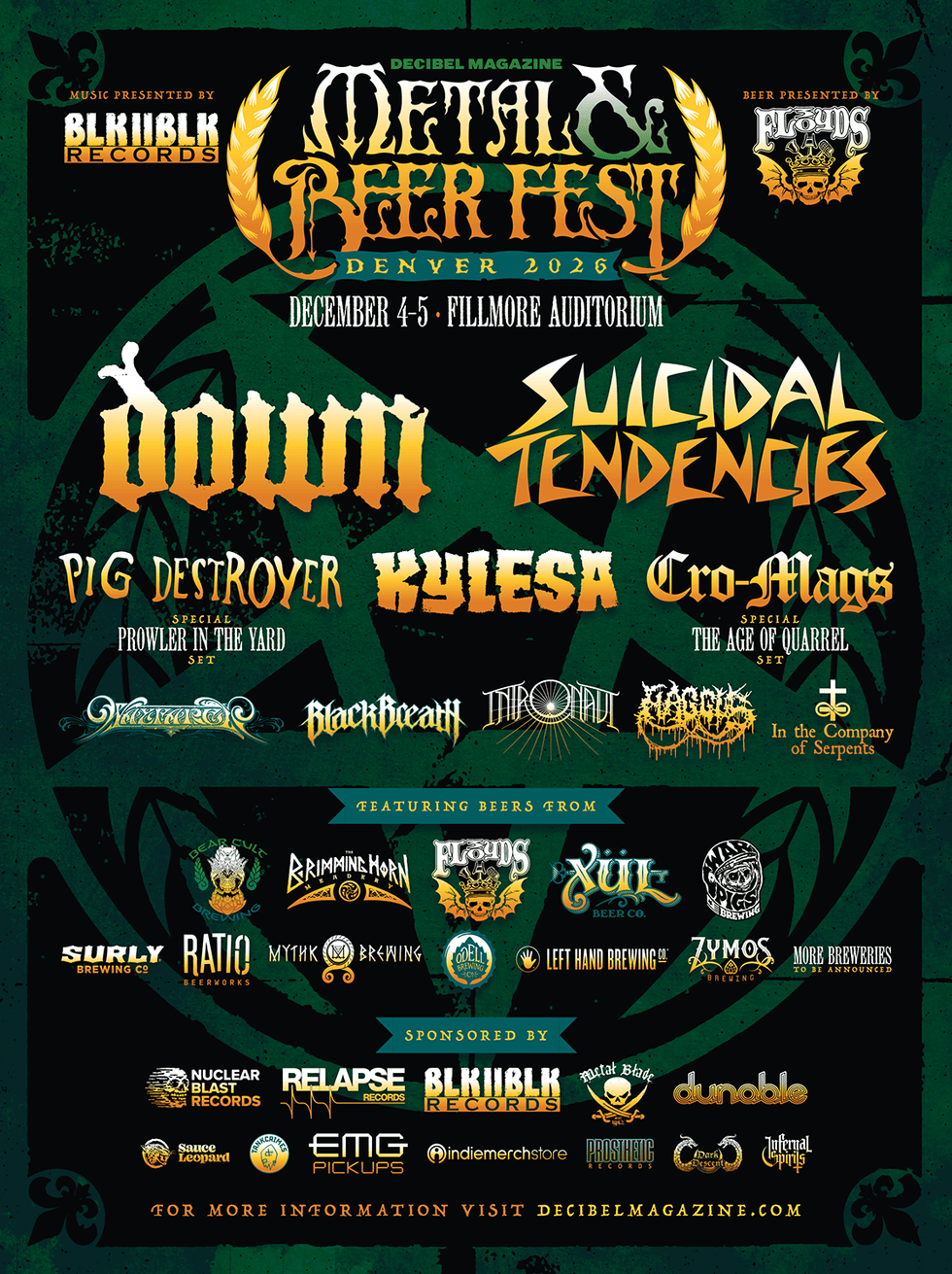
In October, DOWN will perform at both Aftershock and Sick New World Texas. In December the band will headline day two (December 5th) of this year’s edition of the Decibel Magazine Metal & Beer Fest Denver. The appearance marks the band’s first Denver appearance in over twelve years!
Tickets for all shows are on sale now. See confirmed dates below.
DOWN w/ Helmet, Spirit In The Room [remaining dates]:
8/19/2026 House Of Blues – Cleveland, OH
8/20/2026 Stage AE – Pittsburgh, PA
8/22/2026 Royal Oak Music Theatre – Royal Oak, MI
8/23/2026 HISTORY – Toronto, ON
8/25/2026 MTELUS – Montreal, QC
8/26/2026 The Palladium – Worcester, MA
8/28/2026 The Pavilion @ Montage Mountain – Scranton, PA ** Berzerkus Fest w/ Lamb Of God, Black Label Society, more…
8/29/2026 Northwell @ Jones Beach Theater – Wantagh, NY ** Berzerkus Fest w/ Lamb Of God, Black Label Society, more…
8/30/2026 The Fillmore Silver Spring – Silver Spring, MD
9/01/2026 Bogart’s – Cincinnati, OH
9/02/2026 Ramova Theatre – Chicago, IL
9/04/2026 Mystic Lake Amphitheater – Shakopee, MN ** w/ Slayer, Suicidal Tendencies, Hatebreed
US Festival Dates:
10/03/2026 Aftershock – Sacramento, CA
10/24/2026 Sick New World Texas – Fort Worth, TX
12/05/2026 Decibel Metal And Beer Fest – Denver, CO
** No Helmet, Spirit In The Room
Carl Martin Introduces the Dual Compressor Limiter
Carl Martin has introduced the Dual Compressor Limiter, an analog dynamics pedal that places two independently adjustable compression setups in one compact enclosure. Designed for guitarists who want consistent dynamics and longer sustain without sacrificing pick attack or clarity, it moves from subtle leveling to firm peak limiting at the press of a footswitch.
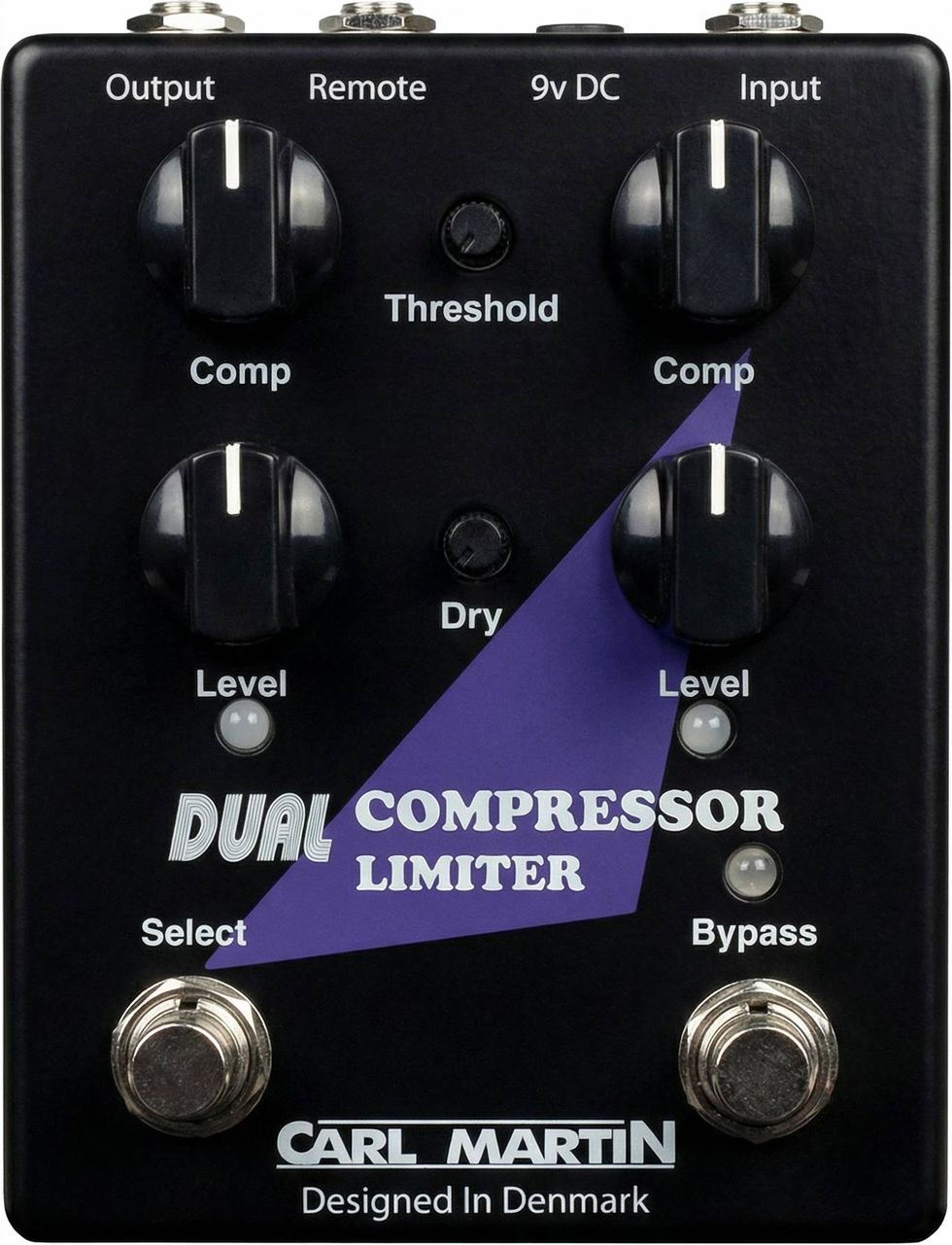
Each preset has its own COMP and LEVEL controls, while a shared THRESHOLD keeps the response consistent across both sides. Players can use one preset for transparent rhythm control and the other for stronger lead sustain, then switch between them using the onboard SELECT footswitch or the REMOTE input.
At the heart of the pedal's flexibility is the global DRY control, which adds parallel compression by blending the processed signal with the untouched instrument signal. Instead of choosing between compression and natural pick response, players can retain the original transient while adding body, consistency and sustain underneath it. This keeps the pedal responsive and natural-feeling even when more compression is applied. The pedal accepts a standard regulated 9V DC supply and generates +/-12V internally for increased headroom, clarity and stability.
Dual Compressor Limiter highlights include:
- Two independently adjustable compression presets in one analog pedal
- Dedicated DRY blend preserves the original attack while adding compressed body and sustain
- Individual COMP and LEVEL controls for each preset
- Shared 60 dB THRESHOLD range for consistent response
- Compression range from 1:1 to 30:1 for leveling, sustain or limiting
- Onboard SELECT footswitch plus REMOTE preset switching
- Internal +/-12V operation from a regulated 9V DC input
- True bypass, 105 dB signal-to-noise ratio and 0.05% THD
The Carl Martin Dual Compressor Limiter carries a street price of $199. For more information visit carlmartin.com.
EarthQuaker Scrolls Bass Odyssey Review
I thought I had everything a gigging bassist could possibly need. I usually get a pretty solid bass tone, the players and clients I engage with generally like it, and I tend to feel pretty good about my EQ choices. Some instruments I like to run direct, without much tonal color. Others I run through an amp, where I can get plenty of it. Between the two, I figured I had any session covered.
EarthQuaker’s Scrolls might have changed the standard for just fine, however. My P bass that sounds really good on its own? When I plugged it into the Scrolls it went from “just fine” to “sweet Mary!” EarthQuaker definitely ratcheted up the bar for what a DI’d bass can do onstage and in the studio.
Healthy Scrolling
Scrolls is a new bass DI box developed in collaboration with Japanese bassist Kentaro Nakao. Sometimes a pedal built for a specific player’s needs means essentials are overlooked. Not so with the Scrolls. Clearly, careful consideration was given to what the average bass player desires. But it also gave me things I didn’t know I wanted.
“When I turned it off, my bass suddenly sounded like a junior varsity team trying to compete with a professional squad.”
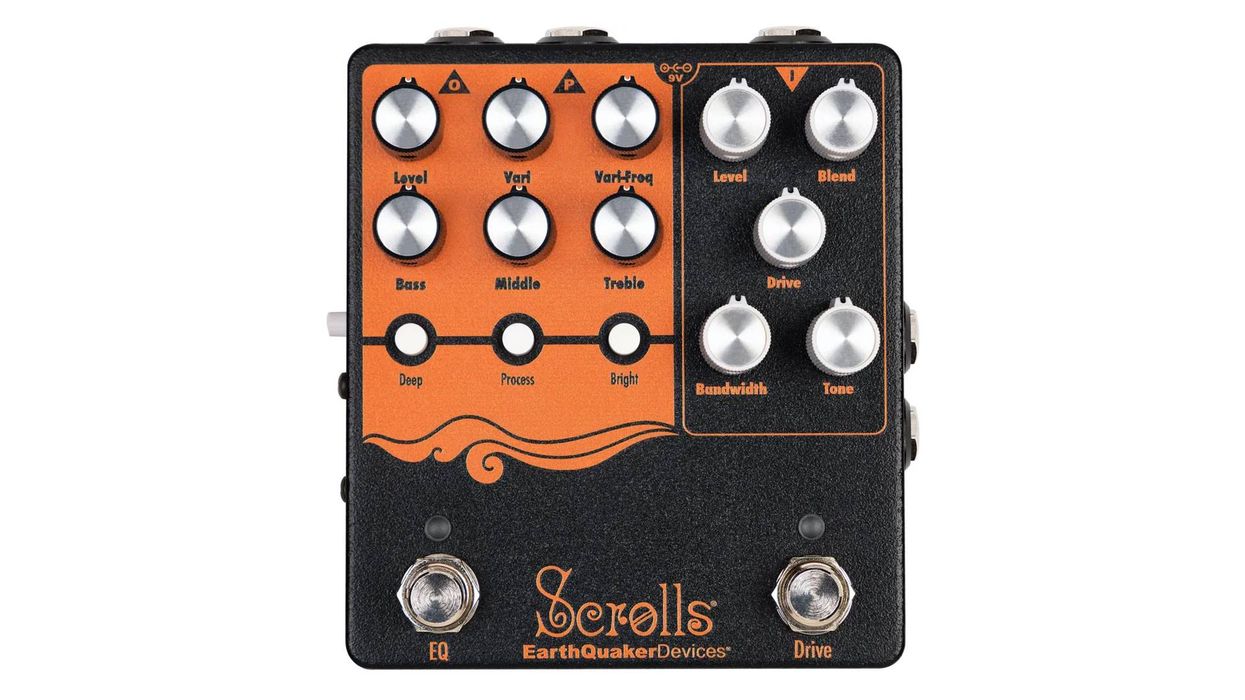
The pedal is divided into two robust sections, tied together by some common threads and some unusual ones. The first is a flexible drive section with wet/dry blend control, a clipping frequency knob (called “bandwidth” here,) and more. The second section is dedicated to EQ. Seems straightforward enough, right? Well, EarthQuaker decided to give players three output options: an XLR, a 1/4" out and a parallel buffered 1/4" out for a clean signal. In this configuration, a clean signal can go to an amp and/or front of house, where the signal can be manipulated and adjusted independent of the Scrolls. The effects loop lives between the drive and EQ sections, so if you add other effects, the loop will be after the drive but before EQ, leaving the EQ to shape the overall tone. Pretty clever, indeed.
Trust the Process
Scrolls’ EQ is the part of the pedal that sells the design. A DI’s job, after all, is to cover as many tones as possible for as many applications as possible, and Scrolls does that well enough that I can see it earning permanent real estate on a lot of pedalboards. The range comes down to how finely the EQ is divided—in the studio, it’s like having brushes from a fine liner up to a two-inch flat. Three push buttons—deep, process, and bright—provide a 80Hz boost, low-mid scoop, and 5kHz boost, respectively. Three corresponding tone knobs, which work with or without the pushbutton settings, cut or boost low, middle, and high frequencies. But the secret weapon might be the variable frequency control, which sweeps the emphasis anywhere from 20Hz to 10kHz and lets picky players slot their bass tone just so.
Though the numerous knobs look formidable, Scrolls is easy to use, too. I was able to take my bass from great to downright legendary in about 15 seconds. The pushbutton settings are excellent starting points, and activating all three adds up to a big, strong, and authoritative bass tone. The sweet spot for my P bass was a mix of boosts from the process and bright pushbuttons, and a little mid and treble boost from the corresponding EQ controls. I got used to this tone fast, and frankly, I didn’t want to box up the pedal again. When I turned it off, my bass suddenly sounded like a junior varsity team trying to compete with a professional squad.
The Verdict
EarthQuaker’s Scrolls is focused, smartly designed, and usable across just about any genre. The drive is the one section some players could find non-essential. It’s deeply tweakable—especially the wet/dry mix and the clipping frequency control—and harder-rocking players will love it. But I got what I needed from the EQ alone, and whether that's enough to justify the pedal comes down to your own tastes and objectives. As bass drives go, this is a flexible one, and in the right situation the two halves feed each other.
The Scrolls Bass Odyssey answers questions I hadn’t thought to ask. Can a great bass sound better going direct than it does through an amp? It can. Do I need three outputs on a bass DI? Turns out I do. Can I set this on my board, leave it there, and stop thinking about my bass tone? I think a lot of you will.
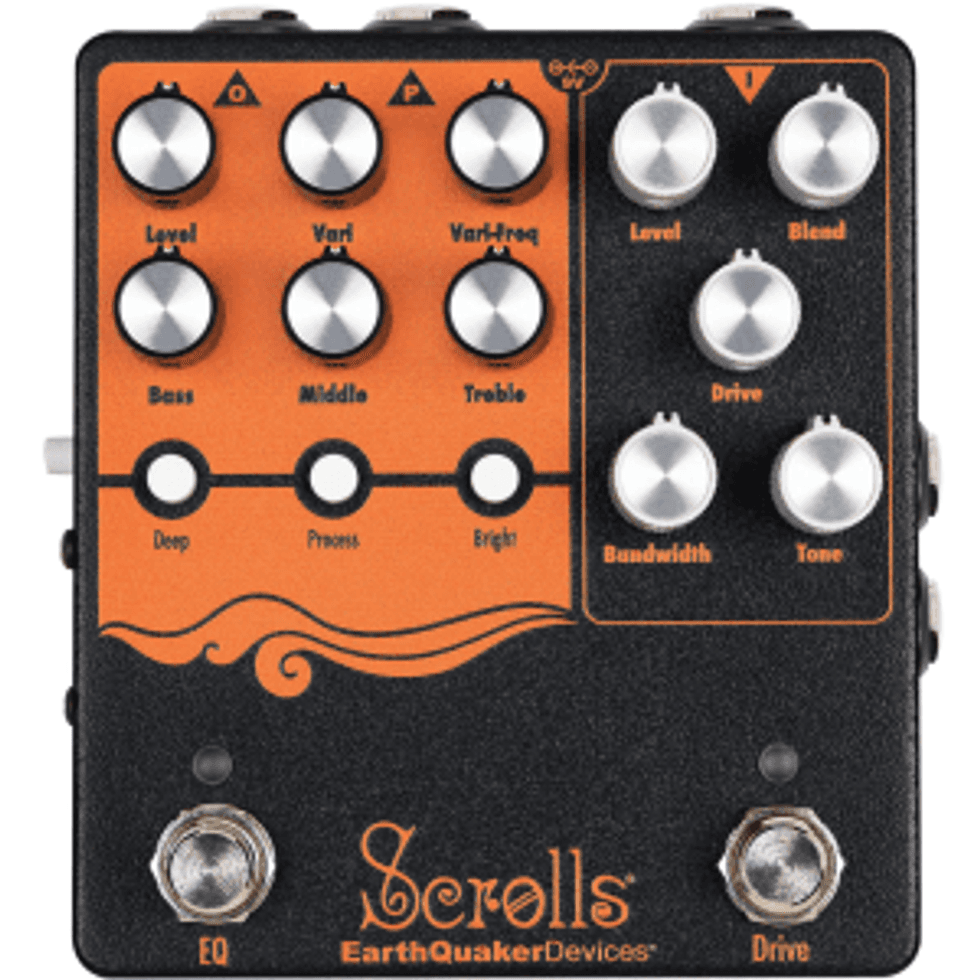
Scrolls Bass Preamp Pedal
Preamp Bass Guitar Pedal with EQ Channel, Drive Channel, FX Loop, XLR Direct Out, Parallel Out, and Ground Lift
Death By Audio and Rainger FX Announce the Amp Crash
Death By Audio and Rainger FX have joined forces to create Amp Crash, a completely new kind of effects pedal containing a real 3-watt amplifier, internal 2" speaker, and microphone.
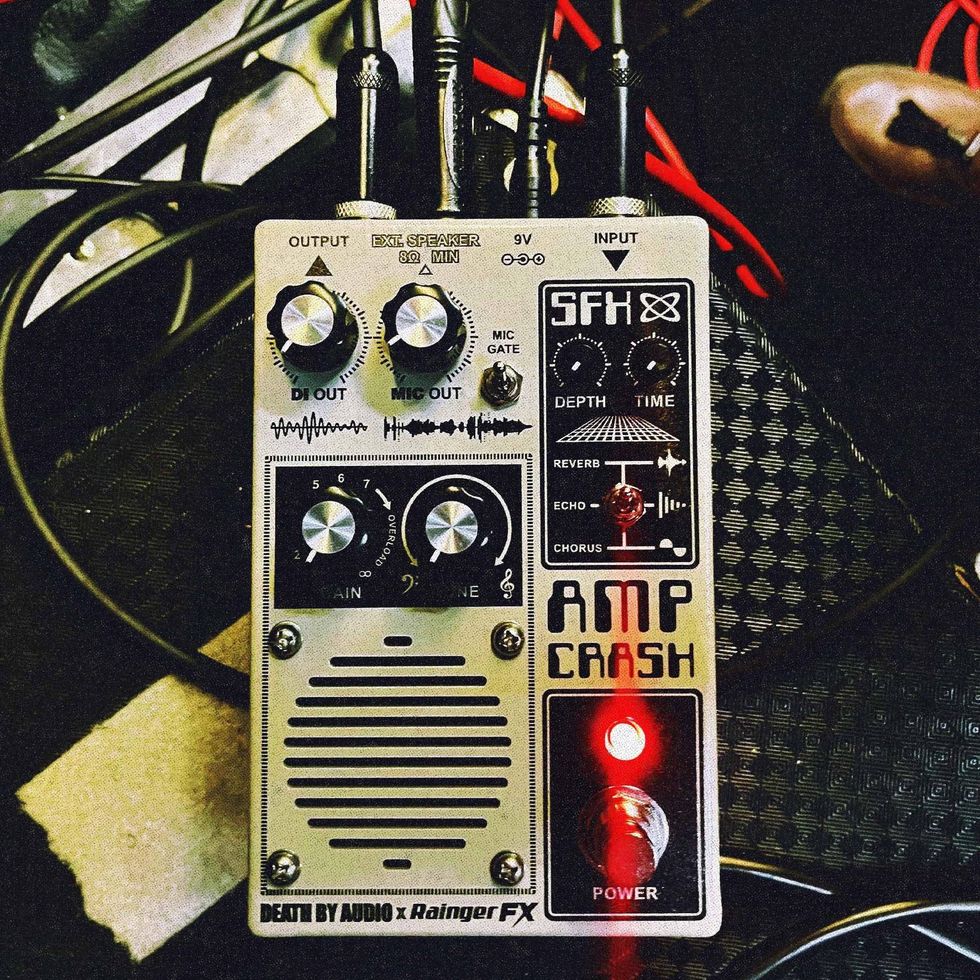
Amp Crash captures the sound and feel of a cranked amp inside a compact stompbox. A real amplifier drives a real speaker, while a built-in microphone captures what that speaker is actually doing. Players can then blend the direct amplifier signal with the mic'd sound, creating everything from rich, touch-sensitive overdrive to crushing fuzz, blooming harmonics, natural feedback, and completely unpredictable textures.
Unlike traditional distortion or amp simulation pedals, Amp Crash creates sound physically, not just electronically. As the amplifier, speaker, and microphone interact, they generate harmonics, feedback, compression, and textures that only exist because air is physically moving inside the pedal. The result is an instrument that breathes, responds, and sometimes even fights back.
The project began when David Rainger came to New York with an idea: put a microphone inside a pedal so ambient sound could blend with the guitar signal, creating new harmonics and unexpected overtones. Death By Audio took that idea and asked another question: what if the pedal contained its own speaker?
The internal speaker and microphone interacted like a real amp in a room, producing the sound and feel of small combo amps pushed to their limits. From there, Death By Audio built a complete multi-effects engine around the concept, adding Reverb, Echo, and Chorus to push the sounds even further.
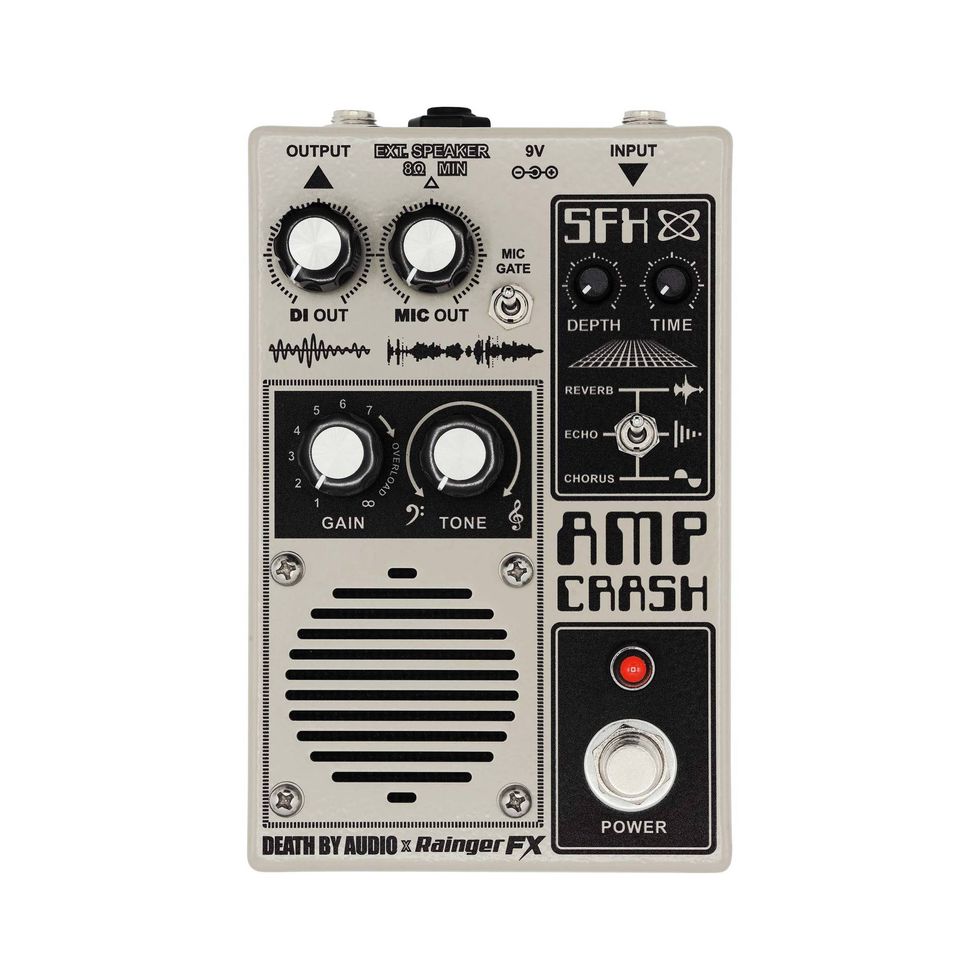
Amp Crash can be a real mic'd amp experience, a compact recording tool, a portable practice amp, an experimental effects platform, or an endlessly inspiring instrument capable of sounds that conventional pedals simply cannot create.
An external 8Ω speaker output also allows players to connect a speaker cabinet, transforming Amp Crash into a tiny but very real amplifier.
Key features:
- Real 3-watt amplifier, internal 2" speaker, and microphone built into the pedal
- Blend direct amplifier and internal microphone signals
- Real speaker interaction creates harmonics, feedback, compression, and unpredictable textures
- Built-in Reverb, Echo, and Chorus
- From edge-of-breakup overdrive to crushing fuzz and wild harmonic feedback
- External 8Ω speaker output for connecting a speaker cabinet
- Buffered bypass, lifetime warranty
- Power: 9V DC, 2.1mm center-negative, 300 mA
Amp Crash will be available directly and from participating retailers for a street price of $395 USD. For more information visit https://deathbyaudio.com/products/amp-crash or https://www.raingerfx.com/releases/p/amp-crash.
MXR Textures Can Make Your Guitar Sound Like Almost Anything
MXR Textures Granular Synth Engine uses granular synthesis, to slice and dice sound and experience your guitar in the fifth dimension.
- Transforms your signal into shimmering pads, glitched rhythms, and evolving textures
- Eight ready-to-play presets get you experimenting instantly, from regenerative octave loops to warbly polyphonic synth
- Three different modes—Delay, Auto-Freeze, and Layers—define how grains are sampled and replayed
- Size, Overlap, Pitch, Reverse, Delay, Regen, and Mix knobs allow you to sculpt every grain
- On-board reverb, filter, and vibrato FX add further depth and dimension • Deep parameter tweaks unlock randomization, effect fine-tuning, and tap tempo
- Full stereo I/O with mono, wet/dry, and true stereo output options, plus expression pedal and
- MXR Split + Tap compatibility
The MXR Textures Granular Synth Engine is available now at a $269.99 street price. For more information visit jimdunlop.com.
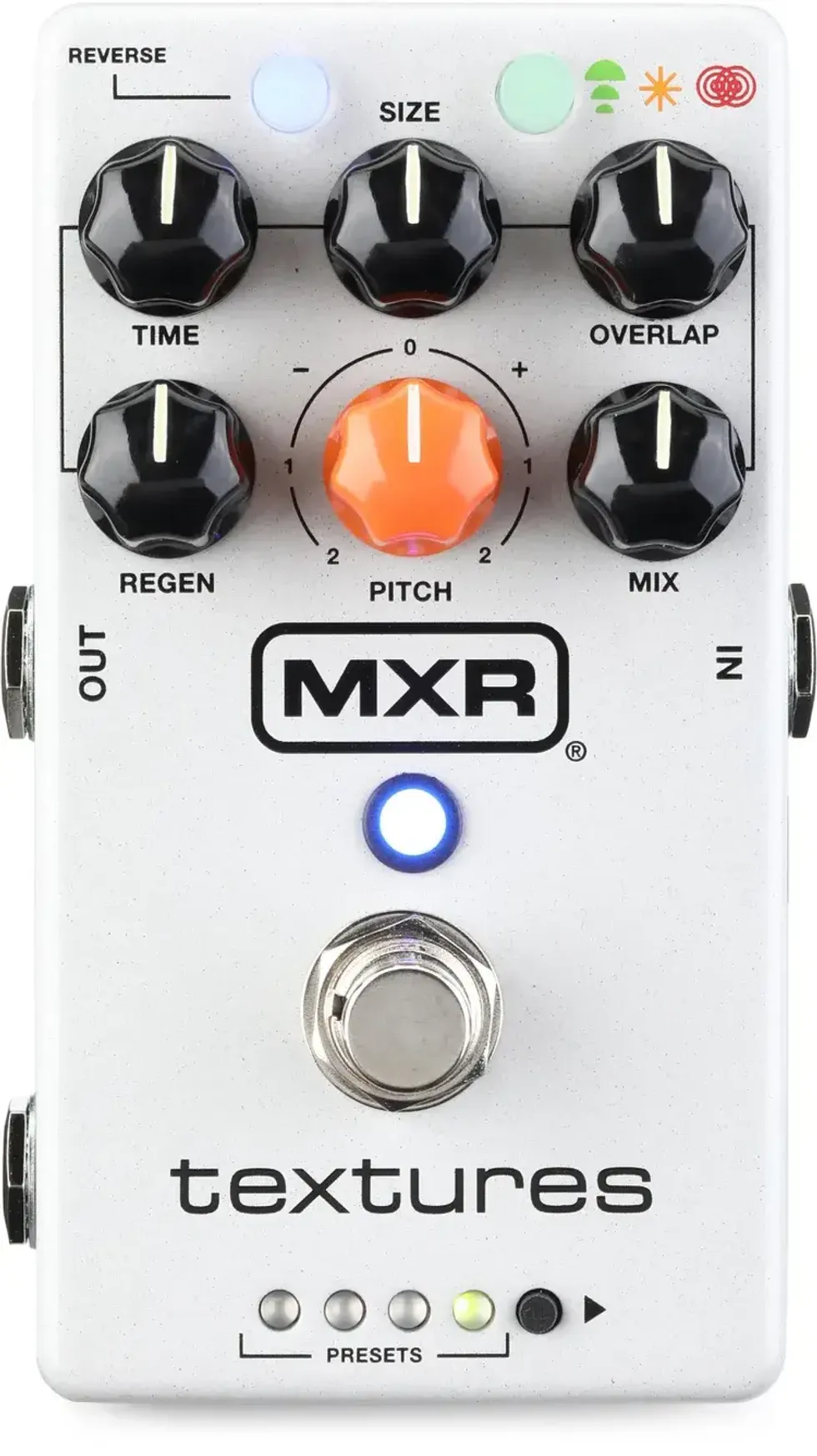
Textures Granular Synth Pedal
Stereo Granular Synth Guitar Pedal with 8 Presets, 3 Modes, Size, Overlap, Pitch, Reverse, Time, Mix, and Regen Controls, Second-layer Controls, Expression Input, and Split/Tap Compatibility
“There’s a difference between someone saying, ‘You’re in my thoughts and prayers’, versus somebody who goes into detail about his treatment”: The simple advice Bruce Dickinson gave Dave Mustaine as he faced cancer battle

Back in 2019, Dave Mustaine revealed that he had been diagnosed with throat cancer. In the limbo between his diagnosis and being declared cancer free in January of the following year, plenty of people reached out to the Megadeth frontman offering their support – but the wise words of fellow cancer survivor Bruce Dickinson were what really helped pull him through.
Just like Mustaine, the Iron Maiden frontman was also confronted with a throat cancer scare at the end of 2014. With Dickinson getting the all-clear in 2015, he was keen to share some advice with his heavy metal comrade. “Bruce had some fantastic stuff to say as a cancer survivor,” Mustaine explains to Metal Hammer in a new interview.
“There’s a big difference between someone saying, ‘You’re in my thoughts and prayers’, versus somebody who goes into detail about his treatment and tells you about the outcome,” he adds.
Considering Dickinson cam out the other side of his diagnosis, it felt like proof that Mustaine could come out the other side too. “I needed hope, and he gave me it,” he says. To keep spirits high, the Iron Maiden icon also encouraged Mustaine to “surround [himself] with good people” and to focus on “spending time with people who are upbeat and positive”.
Mustaine also reflected on Dickinson’s support in an interview with Forbes in 2020. As he puts it, Dickinson was one of the first people he wanted to talk to about his throat cancer experience. “After I was diagnosed, I thought, ‘I want to call Bruce,’” Mustaine said. “It’s not like I have a whole Rolodex of rock friends that sing heavy metal music that have throat cancer… so my choices were limited.”
“I was pretty proud of Bruce after speaking with him,” he added. “Although we’re not super close, I consider him to be someone I look up to… When you’re a frontman in one of the biggest bands in the galaxy, you don’t really have to tolerate the frontman of the other bands very much, but he’s always been super kind to me.”
With Megadeth releasing their final record and currently in the swing of a grand farewell tour, Mustaine is feeling reflective. In fact, he is set to drop a new memoir, In My Darkest Hour, later this year in September.
For news on Megadeth’s final tour, head to the band’s website. Mustaine’s upcoming memoir, In My Darkest Hour, will also drop on 24 September.
The post “There’s a difference between someone saying, ‘You’re in my thoughts and prayers’, versus somebody who goes into detail about his treatment”: The simple advice Bruce Dickinson gave Dave Mustaine as he faced cancer battle appeared first on Guitar.com | All Things Guitar.
Captured by a drama student who snuck onstage, new rare footage of Jimi Hendrix’s legendary 1969 Woodstock show has surfaced online

Nearly 60 years after his death, Jimi Hendrix remains one of the most iconic and influential guitarists to ever live. Over the course of a relatively short career – with his heyday lasting between his breakthrough in 1966 and death in 1970 – Hendrix performed hundreds of shows, notably including his Monterey Pop Festival set, which saw him famously set his Fender Stratocaster ablaze.
Indeed, there are a few Jimi Hendrix shows that make a claim for his most iconic, but perhaps the most legendary of all was his closing set at Woodstock on August 18, 1969.
The set included some of the guitarist’s biggest hits, including Purple Haze, Voodoo Child and Hear My Train a Comin’, as well as his landmark rendition of US national anthem The Star-Spangled Banner, which later became a defining symbol of the anti-war movement at the time the US was heavily involved in the Vietnam War.
Though one of the most iconic rock shows in history, good-quality extended footage of Hendrix’s Woodstock set is notoriously hard to find. But one of the best clips of the show yet has just surfaced…
It was captured by 22-year-old drama student Albert Goodman, who successfully snuck onstage shielded by a friend carrying a guitar, according to Guitar World. He managed to set up his camera just 15 feet across the stage where Hendrix was set to perform.
Now, the footage has been uploaded to the official Jimi Hendrix YouTube channel for all to see. In the footage, Hendrix can be seen playing his biggest hits – plus his fiery version of the US national anthem, alongside his newly formed Band of Gypsys.
The band’s lineup consisted of guitarist Larry Lee, bassist Billy Cox, Jimi Hendrix Experience drummer Mitch Mitchell, and percussionists Juma Sultan and Jerry Velez. Check out the footage below:
“Goodman was left alone, assumed to be just one member of the sprawling film crew who had surrounded the stage for the entire event,” reads the video’s description. “Armed with just two previously recorded, open reel videotapes, Goodman settled in behind percussionist Juma Sultan and prepared to document history.”
But that’s not the end of the story. After sneaking onstage to capture the awe-inspiring footage, as luck would have it, Albert Goodman was later given a ride by a driver who was friends with people working at the house Hendrix was renting nearby. One thing led to another, and legend has it Jimi Hendrix himself watched Goodman’s footage and approved.
The post Captured by a drama student who snuck onstage, new rare footage of Jimi Hendrix’s legendary 1969 Woodstock show has surfaced online appeared first on Guitar.com | All Things Guitar.
This D’Angelico could be your first semi-hollow – and it’s now just $500

[Editor’s note: Please note that this deal is only available to US customers. If you’re reading from outside the US, you’ll be shown similar deals.]
If you’ve never owned a semi-hollow before, D’Angelico’s Premier DC makes a pretty compelling case for being your first. It’s versatile, comfortable and built to handle everything from jazz and blues to rock – and right now, it’s priced at just $499.99.
That’s $250 off its usual $749.99 price, making this a particularly tempting way to dip your toes into the world of semi-hollows without blowing your entire guitar budget.
Semi-hollows are popular for good reason. You get that unmistakable warmth and resonance, but with the right pickups and some gain, they can also get surprisingly punchy and aggressive. That makes them a handy choice if you want one guitar that can cover a lot of ground.
That’s exactly what D’Angelico is going for with the Premier DC. It’s a double-cutaway semi-hollow with a 16-inch-wide laminated maple body and a solid centre block, giving it plenty of sustain while helping keep unwanted feedback under control when you turn things up.
The tonal flexibility continues with a pair of Seymour Duncan Designed humbuckers, which can cover everything from warm, jazzy cleans to searing distortion. They’re paired with a familiar two-volume, two-tone setup and three-way pickup selector, giving you plenty of control over your sound.
It’s a remarkably comfortable guitar to pick up, too. The Premier DC features a maple neck with a slim C profile, a 24.75-inch scale length and a 14-inch-radius Ovangkol fingerboard with 22 medium vintage nickel silver frets. The set-neck construction and smooth heel transition also make it easier to reach the higher frets.
Visually, it nails that classic D’Angelico vibe without looking over the top. The Sky Blue finish really pops against the Tortoise pickguard, while the pearloid block inlays and ebony knobs give it a clean, premium look up close.
Players also get a chrome Tune-o-Matic bridge, stopbar tailpiece and Grover tuners with Stairstep machine, rounding out a solid hardware package for the price.
At $499.99, the Premier DC is an appealing option if you’ve been curious about semi-hollows but don’t want to spend a fortune on your first one. If you’ve been waiting for the right time to give semi-hollows a try, this could be it.
Learn more at Sweetwater.
The post This D’Angelico could be your first semi-hollow – and it’s now just $500 appeared first on Guitar.com | All Things Guitar.
Session legend Chris Spedding – known for work with Elton John and Paul McCartney – diagnosed with lymphoma

Chris Spedding – a legendary session guitarist who has played alongside the likes of Elton John, Paul McCartney, Tom Waits and Roxy Music – has been diagnosed with lymphoma, it has been revealed.
The 82-year-old guitarist has now begun a nine-month process of chemotherapy, which will render him unable to work and tour, so his wife Jody and campaign organiser Eden Cale have set up a GoFundMe to cover his essential living and medical costs during this time.
At the time of writing, nearly £25,000 has been raised of the campaign’s £50,000 goal with 314 donations.
“For over six decades, Chris Spedding has been bringing magic to stages and studios across the world with his inimitable guitar work with Roxy Music, Bryan Ferry, Elton John, John Cale, Jack Bruce, Tom Waits, Paul McCartney and Robert Gordon,” the GoFundMe reads.
“Chris’s genius as a musician, session guitarist and producer has touched generations of music lovers. But to our family, he’s just been Uncle Chris.”
It continues: “Anyone who knows Chris knows he is a kind, generous soul who would step up for anyone in need. For decades, he has given us unforgettable music. Now, it is our turn to rally around him to show our appreciation of him during this challenging time.”
You can make a donation now at the official GoFundMe page.
The post Session legend Chris Spedding – known for work with Elton John and Paul McCartney – diagnosed with lymphoma appeared first on Guitar.com | All Things Guitar.
Right now you can save $300 on one of Ibanez’s best signature models – the seriously sleek Tim Henson TOD10

[Editor’s note: Please note this deal is only available for readers in the US. If you’re outside the US, you’ll be shown similar deals.]
If you’ve been thinking about adding a modern shred-focused guitar to your collection, Tim Henson’s Ibanez TOD10 is worth a look – especially now that it’s $300 off.
Over at Sweetwater, you can pick up the TOD10 for $1,299, down from the usual $1,599.99. That’s a saving of $300, or almost 20%, on one of Ibanez’s most distinctive signature models.
The TOD10 is Henson’s third signature model with Ibanez, following the TOD10N acoustic-electric and his earlier THBB10. Designed for modern technical playing, the guitar features an American basswood body paired with a roasted maple neck and Ibanez’s AZ Oval C profile.
The guitar’s neck is topped with a 24-fret ebony fingerboard and jumbo frets, giving you plenty of room for those higher-register runs. There’s also the distinctive Tree of Death inlay, carried over from the Polyphia guitarist’s TOD10N acoustic-electric signature model.
Soundwise, the TOD10 comes equipped with a pair of Fishman Fluence Tim Henson signature humbuckers. They’re wired to a five-way pickup selector, along with straightforward single volume and tone controls, giving you several pickup combinations without an overly complicated control layout.
The rest of the hardware is just as purpose-built. You get a T1502 two-point synchronised tremolo bridge, Graph Tech TUSQ nut and angled output jack, while Gotoh MG-T locking tuners use a thumb-wheel locking mechanism rather than the adjustable-height H.A.P.M locking tuners found on other AZ models.
And then there’s that Metallic Mauve finish, which adds a nice splash of colour to the otherwise sleek design of the TOD10.
At $1,299, it’s still a serious investment, but knocking $300 off the usual price makes the TOD10 a much easier guitar to consider – especially if you’ve had your eye on Henson’s signature model for a while.
Head over to Sweetwater to get yours today.
The post Right now you can save $300 on one of Ibanez’s best signature models – the seriously sleek Tim Henson TOD10 appeared first on Guitar.com | All Things Guitar.
Warm Audio Reamper review – the studio DI box to end all studio DI boxes?

$499/£431, warmaudio.com
Today we’re talking about a DI box – wait, where are you going? Come back! It’s interesting, I promise! The Warm Audio Reamper is not your average black box with a couple of transformers in it. It rolls a hell of a lot of functionality into its retro-styled enclosure, being at once a reamper, a variable-impedance DI box with a switchable preamp, a 50-watt load box capable of recording a direct power-amp signal from a tube amplifier, and a studio-ready conversion solution to go between instrument and line signals with ease. So can Warm Audio make a DI box sexy?
- READ MORE: Orange Outlowd ES3 review: is Ed Sheeran’s signature amp the best compact acoustic combo out there?
 Image: Press
Build quality
Warm Audio has a (not uncontroversial) history of replicating other makers’ vibey hardware designs. This has, apparently, meant that it’s extremely well-poised to come up with its own in a similarly cool vein – the Reamper looks like something that you might find sitting in the corner of an RBMK control room, quietly monitoring röntgens. Its retro look is bolstered by an abundance of clicky toggle switches, and the pair of unique Bakelite-esque knobs for the line and preamp levels. It’s very pleasing to the eyes and ears – all the jacks and controls are sensibly laid out, and are clearly premium parts, emanating reassuring clicks and clunks upon use.
Another design point that’s good to see: power is delivered by a standard kettle (IEC) lead, ideal for both neatness and replaceability. The quirky design includes a handle on top of the unit, meaning it won’t slot neatly into a rack setup – but it will look extremely at home on the top of a tube head, which is one of the places you’ll want to put it anyway. It is a remarkable thing to have a DI box look anything other than purely utilitarian, and so hats off to Warm for that.
 Image: Press
Usability
So, yes, this is ultimately a fancy two-way DI box that costs more than some amplifiers. Some of the price tag manifests in the above-described build quality and aesthetic beauty. The rest of it is evident in its extensive flexibility – the sheer number of actual ins and outs on the unit itself is a little overwhelming, so instead of just listing what every single jack does I’ll take you through a few use-cases that should hopefully demonstrate just how handy this thing is to have about.
First off – the titular reamping. This is done by using the line output to record a performance straight off your guitar’s pickups, with the variable impedance control ensuring the recorded signal stays bright and dynamic. The thru output lets you connect the rest of your rig as normal.
Switch a couple of cables around, and you can then send this dry audio back through amps and effects pedals to record the same performance, but with different tones. This allows you to get unique and layered sounds – but it’s also a good backup thing to have if your chosen tone doesn’t quite sit right in the mix, or anything else goes wrong. In essence – it gets you the flexibility of recording in-the-box, without having to lose the analogue joy of real, physical guitar amps.
 Image: Press
In Use
The other thing this configuration allows is sending basically any other audio through pedals and amps, as the Reamper can convert a line-level signal to the instrument-level signal guitar gear is designed around. This opens up some great recording possibilities – during my testing I lose an afternoon running vocals through distortion pedals, and synths through an array of delays and reverbs.
You can also do the inverse, in a way – using the instrument input to connect a guitar to any rack gear that’s expecting a line-level signal, and then either record direct or loop the output back to the line input of the Reamper, and then use the instrument output to continue on to an amplifier. This is, of course, something you can achieve with other gear – but it’s remarkable to see it all done so extensively in just one place.
The Reamper also works with the speaker output of your tube amp. You can connect a speaker or other loadbox to the amp-thru as normal, but if you just connect a tube head, the Reamper provides its own 50-watt load to stop anything going boom. It then routes the raw power-amp signal to its line output, allowing you to load your own IRs/virtual cabinets within your DAW for manipulation at a later date.
This is a very cool thing to see and do – a sort of “re-speaker” box. It is a bit of a shame the internal load for silent recording tops out at 50 watts, though, particularly for the heavier crowd who might want to push the power tubes of a 100-watter without stripping the paint off the walls. It’s also not an attenuator – you can either run through the Reamper and pass the full power onwards to your normal speaker (or other loadbox), or use the 50-watt load for silent recording, using software monitoring to hear your amp through a virtual speaker. You can’t use it to lower the level of the signal that gets passed on to the speaker.
The resultant sound and feel is good, perhaps not quite as freakishly accurate as something like the Ox Box – however in that instance, the Reamper is actually the much more affordable option.
 Image: Press
Should I buy one?
So the Reamper makes quick work of basically whatever routing trickery you might throw at it. Firstly and crucially, the sounds are all great, crackle-free and unmarred by any audible conversion losses. The optional preamp gain stage also sounds fantastic, and does a great job of adding a little life to your pure dry tone. Secondly, the actual process of reamping and/or doing any other routing is pleasing and tactile. While you might think the handled amp-top design would be annoying if you wanted to integrate it into a more permanent setup, it actually means that manipulating the Reamper as you re-route the required cables is a lot easier.
To answer the question of should you buy one – the answer is a resounding ‘probably’, unless you already have the pile of gear that the box itself replicates. Even then, having it integrated into this single package is still an undeniable quality of life improvement for home studio work. If you are a guitarist working out of a home studio with real, analogue pedals and amps – it’s more than worth its admittedly high price tag, given just how many things it can do. The dollar amount may be high, but the options-per-dollar make it far more appealing.
Alternatives
This is tricky – there aren’t really any single products that integrate quite as many routing functions as the Reamper. You could get something like the United Studio Technologies Replay Box ($299/£369) if you just wanted reamping, or explore the offerings from Two Notes and Universal Audio if you wanted the amp-loading capabilities – but to truly have an alternative, you’ll need a big pile of individual converters, preamps and loads.
The post Warm Audio Reamper review – the studio DI box to end all studio DI boxes? appeared first on Guitar.com | All Things Guitar.
Carr Trail Rider Review
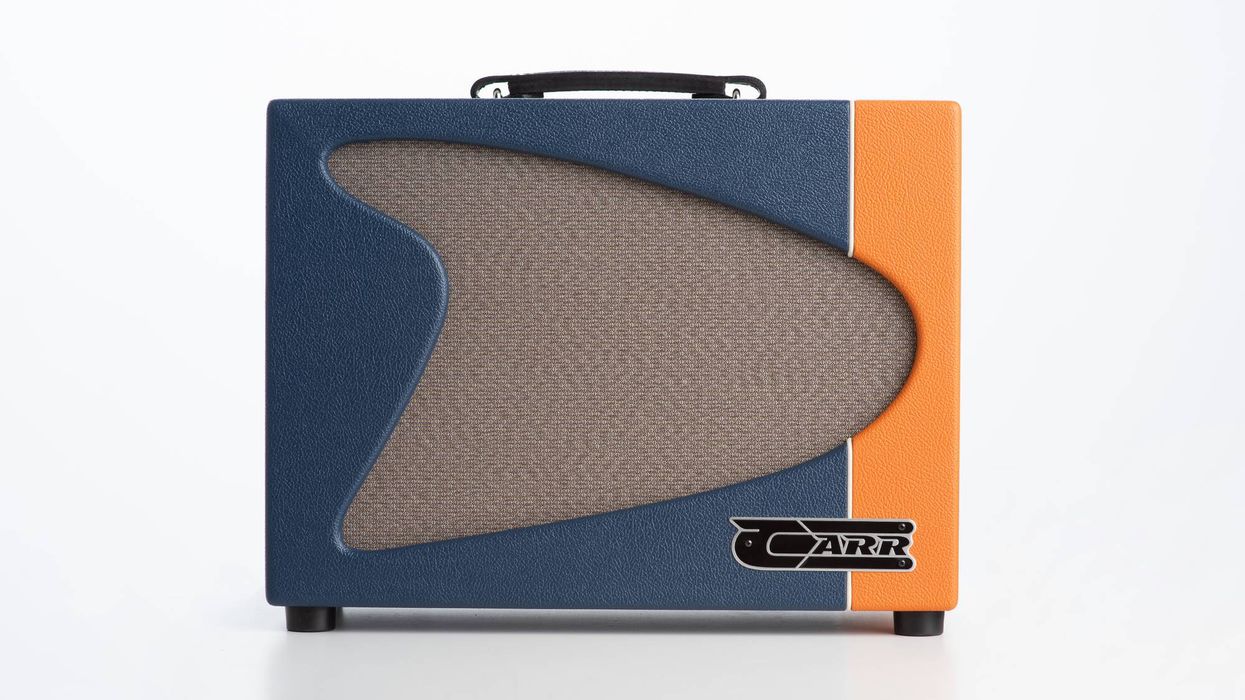
When one thinks about 5-watt amps, it’s often in terms of compromise—things like consideration for the neighbors downstairs, or the houseplant that would flourish in the space where your Hiwatt stack lives. On one hand, Carr’s 5-watt, 1xEL84-powered Trail Rider offers a viable path to such compromises. And with an excellent attenuator on board, it can sound alive and characterful at volumes no louder than your TV. But with the brakes off, the Trail Rider also has the potency to blast a whole city block. And with so many beautiful sounds and colors available at full power, restraint can be difficult.
Bermuda Triangle Address
When you think of a 5-watt amp, you probably envision something about the size of a Fender Champ or Vox AC4. But the Trail Rider, at roughly 20" wide, 15" tall and 9" deep, is almost the same size as Carr’s much more powerful Bel-Ray. The dimensions might be less than ideal for some 5-watt amp shoppers looking to maximize space. Thankfully, it looks smashing. But the ace visuals, the expertly crafted plywood cabinet has a practical benefit—it accommodates a 12", 50-watt Celestion A-type speaker, which plays a major role in the Trail Rider’s overachieving performance.
The Trail Rider’s tube complement—two 12AX7s and a single EL84 (along with a 12DW7 for reverb drive and return)—suggests fundamentally English inspirations. And the spirit of the Vox AC4 definitely dwells within the Trail Rider. But like most Carr amps of more recent vintage, the Trail Rider’s vocabulary transcends oceans, borders, and boundaries. Two switchable voices make up the basic tone foundations here. The Voxier of the two is called V67, the other is T57. You probably won’t need three tries to guess that the “T” is for tweed.
Deluxes and Bassmans define tweed tone for most. But tweediness can be a lot of things. Fender’s amp designs in the mid- to late-’50s evolved quickly, and when designing the Trail Rider, Steve Carr homed in on the point at which the tweed amps went from a single tone control that governed the high end, to a 2-knob EQ that controlled bass and treble independently. That simple enhancement opened up a lot of tone shaping range in tweeds like the Pro, Super, and Bassman, and Carr uses that simple but magical formula to fantastic effect in the Trail Rider. Its EQ section is a powerful tool that lends the amp an expansive vocabulary.
Trails Less Taken
One shouldn't be afraid to experiment with radical, unconventional, even uncomfortable shifts in EQ settings on the Trail Rider. In fact, messing with convention is half the fun. Situating the treble and bass at noon reveals the essence of the two voices, but also the basic flexibility of the amp. At these EQ settings—and in either V67 or T57 voices—the first 25 percent of the amp’s volume range offers sweet, lively clean tones that shine on their own, but sound dynamite with drive and distortion pedals. With amp volume in the 30-to-50 percent range, the Trail Rider starts to growl on its own. These textures can be accented with pedals to very cool ends, and the Trail Rider, in spite of its low power, won’t flinch at the addition of fuzz. But it's the Trail Rider’s own beautiful organic breakup that really highlights the EQ’s transformative power.
Treble-down/bass-up settings, for example, worked with the 12" Celestion to coax thick, burbling, jazzy tones from a Telecaster. Meanwhile, cranking the treble generates lead and chord tones that’ll rip, white hot, through the thickest, most muddled mix, and conjures focused, overtone-rich, and very unique distortion textures. These extreme EQ settings are often revelatory and inspiring. They’re also all genuinely useful. Even at its trebliest settings the Trail Rider’s output is never abrasive, and the interactivity of the bass and treble lends a painterly measure of control that is fun, satisfying, and, in a stage or studio setting, immensely practical.
These rules also apply when you wind up the Trail Rider and let it rip. When you get into the upper reaches of the volume, the details and differences that separate the tweed and Vox voices become less discernible amid the natural compression. But at full-blast, playing the Trail Rider is like being drenched in honey. There’s no grating stridency, and the distortion has a smoothness, dimension, and sense of size that’s reminiscent of a black-panel Fender Bassman.
“At full-blast, playing the Trail Rider is like being drenched in honey.”
The Trail Rider feels immediate, too. It’s very dynamic, and sensitive to variations in guitar volume and tone input, which puts even more color at your disposal. You get a sense of incredible efficiency in this circuit—as if your signal is running a flawless baton race, picking up some thickness here, some gain and top end there, and never breaking pace. Tone suck in this circuit simply feels nonexistent.
The Verdict
Steve Carr’s designs are always a treat. And his knack for spinning something new and imaginative from familiar touchstones never fails to surprise. Tweed- and Vox-like flavors are here in abundance, and in many shades. Yet the Trail Rider never feels like an imitation, and it tends to be so sweetly immersive that everything outside the sound you make with it becomes incidental. It pairs beautifully with any guitar (though Telecasters and the ES-335-style designs were especially tasty matches). And the onboard spring reverb meshes seamlessly into the overall tone picture—often feeling like the only effect you’ll ever need.
If there is any compromise or let down involved with playing the Trail Rider, it’s that its attenuated voices, however sweet, can’t match the electric thrill of experiencing the amp at full power. Another sobering factor is the price: $2,900 for a 5-watt amp. But what you hear and feel from the Trail Rider makes the power rating a poor measure of its value. The heirloom-level build quality goes a long way toward justifying the cost.
Above all else, the Trail Rider’s expansiveness, versatility, and shape-shifting capacity to range from clean to crushing could make more than a few amps in your collection redundant and ripe for sale. Viewed through that lens, the Trail Rider’s price could well add up to math that makes sense.
Vivian Campbell confirms his cancer is back – but he’s continuing treatments and is “certainly not slowing down”

Def Leppard guitarist Vivian Campbell has shared that his cancer has returned and that he is continuing treatment, but he’s staying resilient and “not slowing down”.
Campbell, who has also played for Dio, White Snake and Thin Lizzy, was diagnosed with Hodgkin’s lymphoma in 2013, and reported that he was in remission in June of last year after receiving a donor stem cell transplant.
Unfortunately, Campbell now reports that the transplant “didn’t stick” and that he may have to do another in a few years. In the meantime, he says he is doing as much with his life as possible, including his work with Def Leppard and his Last In Line supergroup.
Asked how he keeps a positive mindset during his health battles, he tells Francisco Sigüenza of El Salvador’s Radio YSKL FM [via Blabbermouth], “Unfortunately, I have met people in my life who, when they’ve gotten a cancer diagnosis, they’ve only focused on that. They think, ‘I can’t do anything. I need to stay in bed…’ I’ve never felt that way. I’ve always felt like I’m gonna continue to live my life as much as possible. In fact, even more so… I also consider myself very fortunate because I caught my cancer early.
“There’s only been one time that I felt it was gonna kill me; in the winter of 2023, I got really scared about what was happening and the pace at which it was happening. And I realised at that point that I had to do a donor transplant. It was my only hope to survive. And that’s what I did. I did that in January of ’25. Unfortunately, it didn’t stick. So the cancer has returned. And I’m continuing treatments to manage it.”
He goes on to add, “In the meantime, I’m certainly not slowing down. I’m doing as much with my life as possible, not just with Def Leppard and with Last In Line. I’m also rally driving, ’cause I always wanted to do that. So I’ve been doing that more and more, ’cause I love cars and I love driving.
“Life is for the living,” he says, “and I encourage everyone to look after their own health. And if you are unfortunate enough to get a cancer diagnosis to overcome the fear. Fear is inevitable when you’re first told those words. But once you get over that, you gotta realise just how to manage it and how to deal with it as best as possible, and just don’t give in.”
Def Leppard are on tour in October/November this year. You can find out more via the band’s official website.
The post Vivian Campbell confirms his cancer is back – but he’s continuing treatments and is “certainly not slowing down” appeared first on Guitar.com | All Things Guitar.
Maisy Owen’s Mesmerizing Songcraft | Acoustic Guitar Sessions

Lzzy Hale’s dazzling new Epiphone Explorer Custom is “purpose-built for heavy music”

Halestorm’s powerhouse vocalist and guitarist Lzzy Hale has launched a new signature model with Epiphone – a sparkling Explorer Custom model designed for heavy music with an aesthetic sure to steal the spotlight.
Finished in a Black Diamond Holographic Sparkle exterior, fans may recognise its shiny good looks from her signature Kramer Voyager model from 2023. Epiphone describes it as a “commanding new addition” to her series of Epiphone signature guitars; you may remember her limited-edition Explorer from 2019.
This new guitar has a classic mahogany body and 7-ply top binding, with a single-ply mirror pickguard that reflects and shines under stage lighting in keeping with its sparkling looks. Its mahogany neck is shaped to Epiphone’s SlimTaper 60s C profile, paired with an ebony fretboard, 22 medium jumbo frets, and pearloid block inlays.
At the top of the model, the Explorer “hockey stick” headstock has a raised Epiphone 3D nickel logo, a Graph Tech nut, and Grover Mini Rotomatic tuners. Custom artist details include a black two-ply truss rod cover engraved with Hale’s signature and a black stinger on the rear of the headstock.
Tonally, the guitar is powered by a matched set of Epiphone ProBucker Ignite pickups, with each wired to its own volume control, with a shared master tone control topped by a silver Speed knob for shaping. It’s also got a three-way pickup selector, a LockTone Tune-O-Matic bridge and LockTone Stop Bar tailpiece, and you also get a hardshell case included.
Due to its premium features, this is a higher-end Epiphone model that comes in at $999. Find out more about its story below:
Aljon Go, Product Manager at Epiphone, says: “Lzzy has always brought a rare combination of power, precision, and unmistakable style to the stage. The Lzzy Hale Explorer Custom captures that same energy in an instrument that looks unforgettable, plays fast, and delivers the clarity and punch players need to own the moment.”
To find out more, visit the Epiphone website. Lzzy Hale is offering fans on Halestorm’s autumn 2026 North American tour the opportunity to own an autographed Explorer Custom played live on stage through a VIP experience.
The post Lzzy Hale’s dazzling new Epiphone Explorer Custom is “purpose-built for heavy music” appeared first on Guitar.com | All Things Guitar.
How Chase Bliss’ Joel Korte Builds Effects That Push the Boundaries

If you type the name Chase Bliss into Google, the first thing that comes up—after the official website for the Minneapolis-based pedal maker—is a Reddit thread with a question: “What is special about Chase Bliss pedals?”
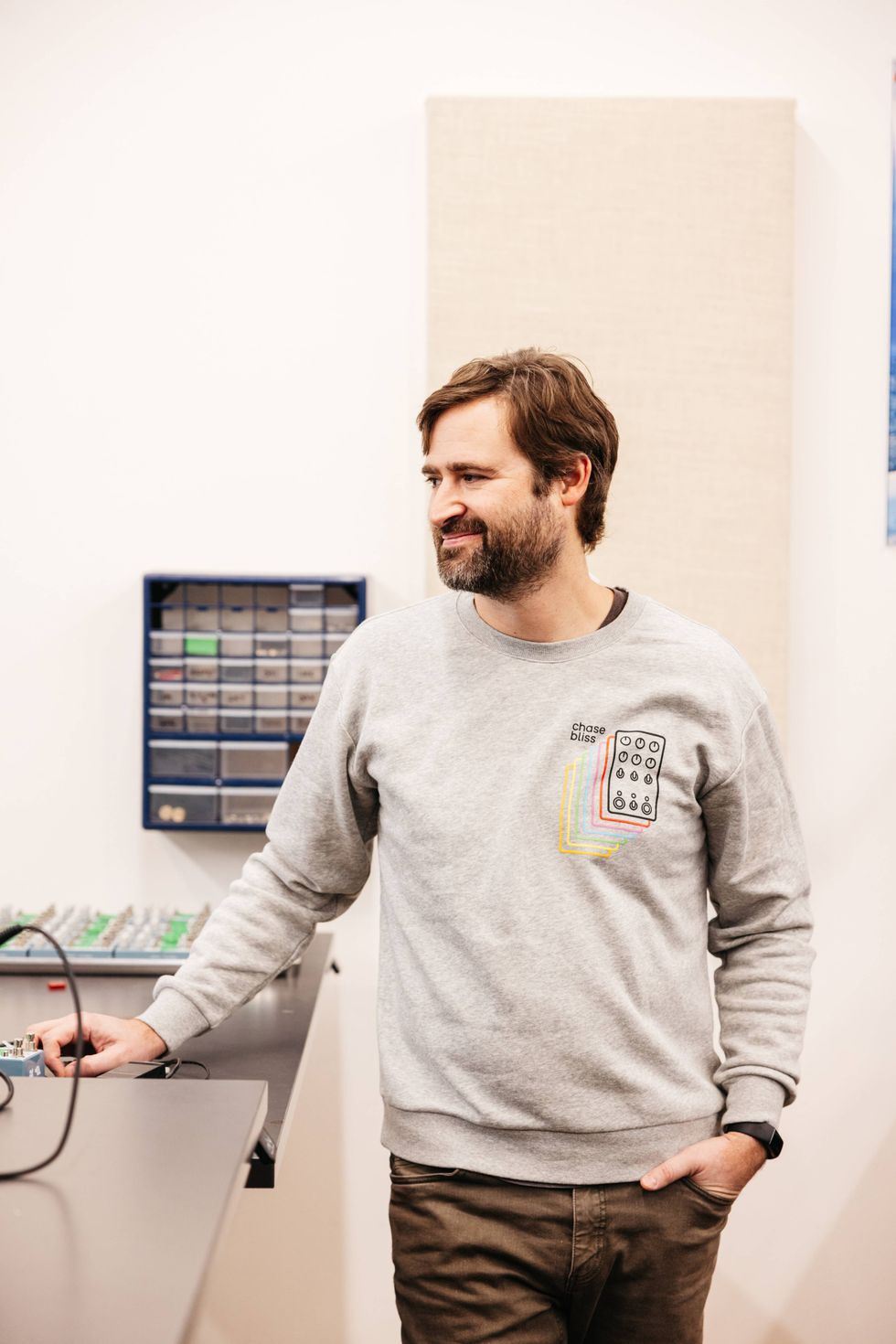
It’s a fair query. These days, Chase Bliss has an esteemed reputation among boutique guitar-pedal brands, lauded for their unique and innovative effects, high-end build quality, and tweakability that gives players virtually infinite possibilities.
At the same time, the brand can be polarizing. User experiences tend to vary. While Chase Bliss products are typically embraced by experimental players, studio geeks, and gearheads who spend hours dialing in a tone that’s just right, the sheer array of features stuffed into each stompbox can be overwhelming for some. Considering Chase Bliss pedals start at $399 and run up to $999, with some discontinued models going for well over a grand on the secondhand market, they’re not an especially easy sell.
So, what’s special about Chase Bliss? It depends what you mean.
There’s the ideology, described by founder Joel Korte as “digital brain, analog heart”—an electrical engineering concept that combines warm analog tones with digital control. There’s the novelty, with several one-of-a-kind pedals that do things that no other pedal does. And there’s the versatility, as Chase Bliss products are likely to reward users willing to make it over their steep learning curves.
“We make a huge effort to offer something new to the sonic landscape,” Korte tells Premier Guitar. “I never wanted to do just the same old thing. People who take a chance on us, they know they’re going on a bit of a journey. Hopefully they’ll be surprised and inspired.”
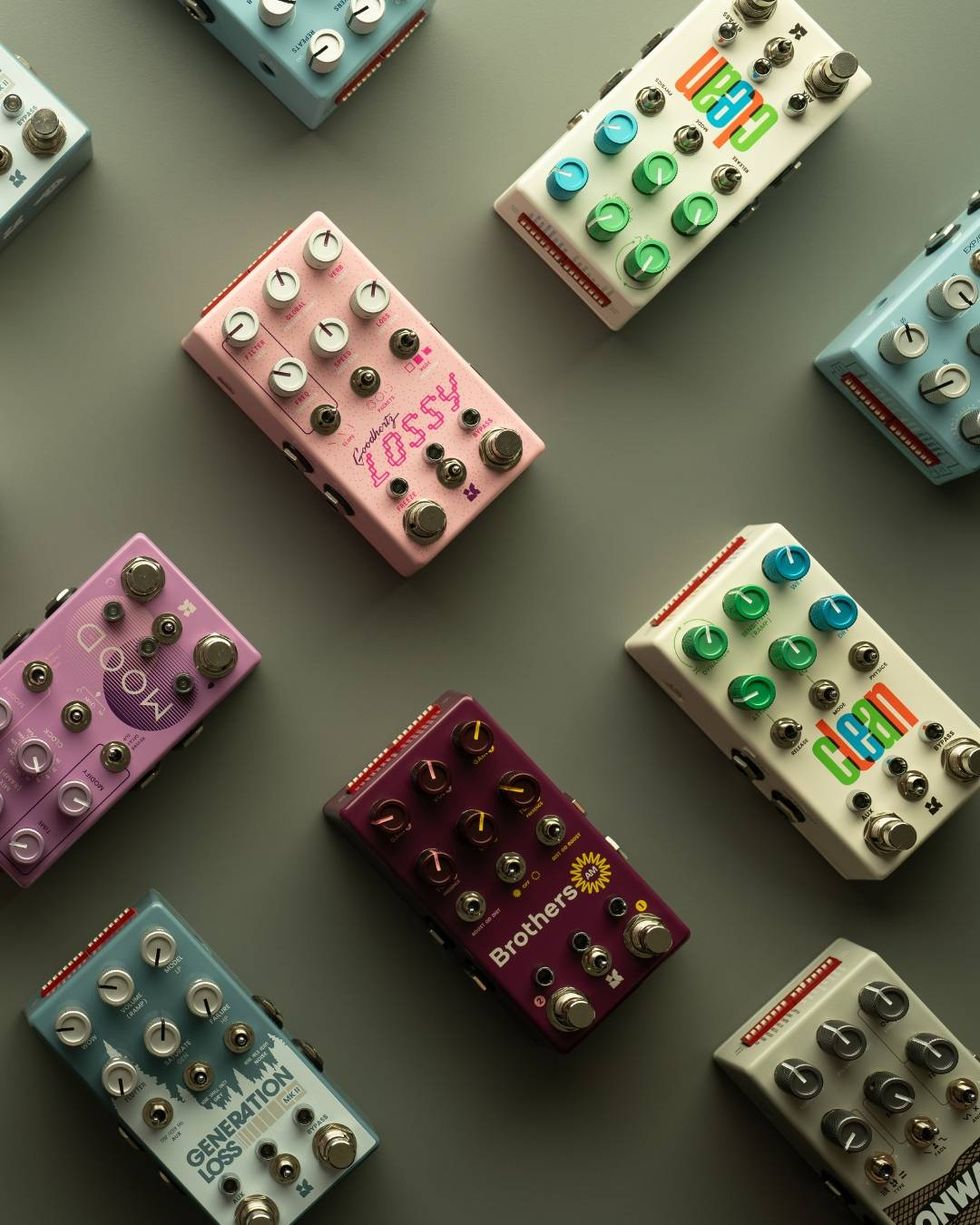
Passion for Pedals
In 2003, Joel Korte was a college freshman trying to decide what to declare as his major. He spent a lot of that year strumming his purple Stratocaster and fiddling with the on-board effects on his little practice amp, so he emailed some of his favorite gear manufacturers and asked what skills you needed to design audio equipment. They all said electrical engineering, so that's what he declared.
Five years later, though, things were going poorly. After graduating from college, Korte, then 24, settled for a corporate job that he hated, and lacked the motivation to pursue his real passion. A lifelong stutterer, he was going through a flare-up of the speech challenge that was making his life difficult. Above all, he was grieving the loss of his older brother Chase, who had been pursuing an acting career in California when he was killed by a drunk driver on Interstate 40 in early 2007. By his own admission, Joel Korte was headed toward an “unhappy life.”
“People who take a chance on us, they know they’re going on a bit of a journey.”
After taking a year and a half to mourn, Korte remembered how his brother’s approach to life was guided by American writer and philosopher Joseph Campbell’s mantra: “Follow your bliss.” That shook something in the young engineer, reigniting a fire that had been snuffed out.
Korte quit his job, enrolled in grad school, and doggedly pursued a new job at ZVEX Effects. After several emails and phone calls to founder Zack Vex, he landed a part-time gig at the Minneapolis-based workshop. At ZVEX, he learned everything he could about stompboxes—so much so that after four years, he left to start his own business. By 2013, he had developed the prototype for his first pedal and began operating out of the spare bedroom of his apartment in South Minneapolis. He named his new company in honour of his late brother and his ethos: Chase Bliss.
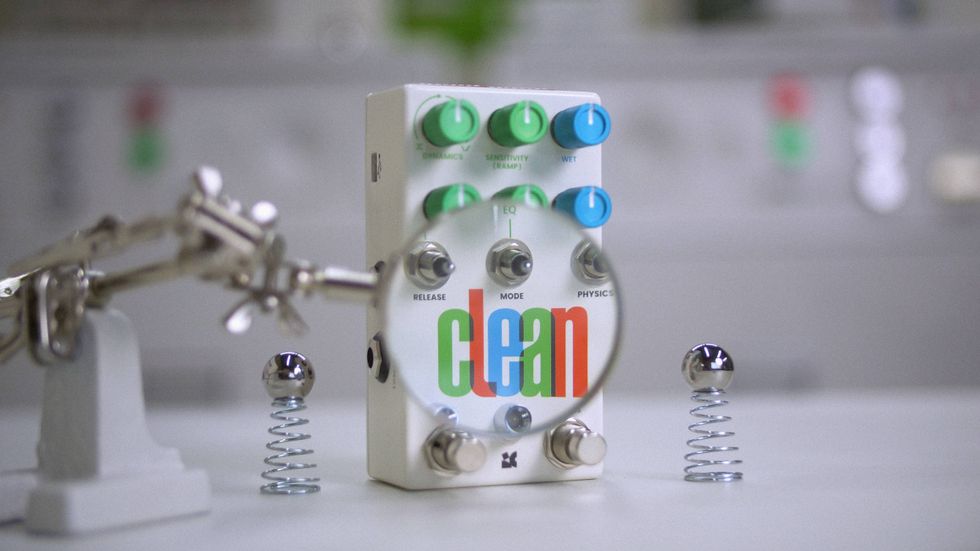
Infinite Possibilities
Whenever Korte played on his own or in bands, he found himself wishing the knobs on his effects pedals would go just a bit further, or for an extra switch that wasn’t there. “I wanted to be different,” he says. “There wasn’t that kitchen-sink approach [in other pedals] that I thought there could be. So, I just started to do things the way I wanted, as someone who loves guitar pedals. I wanted to create this blank canvas where someone could have infinite possibilities.”
Before leaving ZVEX, Korte had been put in charge of restructuring the Lo-Fi Loop Junky into a real-time version of the looper’s variable-voltage modulation and degradation. The result was the Instant Lo-Fi Junky, and it hooked Korte on the sound of lo-fi vibrato. By late 2013, he had developed the first Chase Bliss pedal, the Warped Vinyl, a vibrato-chorus hybrid designed to simulate the wavering, fluttering sound of a record that was left out in the sun for too long.
Korte wasn’t concerned with the Warped Vinyl’s marketability, but it was an immediate success, selling more than 500 within the first year. Encouraged by the critical and commercial response, Korte got back into the workshop and developed Chase Bliss’s second pedal, the Wombtone. Introduced eight months after the Warped Vinyl in August 2014, the Wombtone offered vintage, ’70s-style analog phaser tones with highly tweakable digital controls.
With the business taking off, Korte couldn’t keep up on his own (even with his parents’ help). In 2015, he hired his first employee, Zack Warpinski—who now serves as director of operations—and kept things rolling with two new products, the Gravitas tremolo and the Spectre flanger, along with updated MkII versions of the Warped Vinyl and Wombtone.
Over the next three years, Chase Bliss continued to expand its product lineup. The Tonal Recall arrived in 2016, giving players warm, sweet, vintage-style analog delay with digital-control amenities like tap tempo, expression/MIDI control, and patch saving, and tape-like saturation thanks to re-issued versions of the sought-after MN3005 bucket-brigade delay chips. Brothers was introduced in 2017, an overdrive pedal built with two independent JFET/IC analog channels that offered six unique boost, drive, or fuzz circuits in one package.
“I wanted to create this blank canvas where someone could have infinite possibilities.”
In 2018, Chase Bliss added Thermae, another delay that used the same MN3005s as the Tonal Recall but added pitch-shifting interval features so that players could create cascading, rhythmic harmonies. At the same time, they added their first overdrive pedal, the Condor, which also served as an EQ, filter, and preamp boost.
By that point, Chase Bliss had become one of the hottest names in guitar pedals. But that didn’t necessarily mean the business was on solid ground.

Turning Point
In 2019, Korte entered a long development cycle for two ambitious ideas. The first was a Kickstarter-funded collaboration with YouTuber Scott "Knobs" Harper that would eventually become the Blooper pedal, a multi-layer performance looper with a full suite of sound design. The second was a partnership with Benson Amps for a gain pedal called the Automatone Preamp MkII that would combine boost, EQ, overdrive, and fuzz.
As Chase Bliss and its collaborators started working on those pedals, Korte saw a big problem. It would take too long to push the new products through development and onto the market, and revenues from their existing lineup wouldn’t keep them afloat until then. One of the guitar world’s most critically acclaimed and sought-after pedalmakers was quickly running out of cash. “I was looking at the finances and I was like, ‘We're fucked,’” Korte recalls.
What he and his small team needed was something new that they could sell in the interim to fund the ongoing development of the Blooper and the Automatone. At the time, Chase Bliss had recently come out with its first fully digital effect, a reverb called the Dark World that was made in collaboration with Keeley Electronics and Cooper FX. Korte figured they could leverage the work they did on the Dark World into another all-digital offering that could generate interest—and money—while he worked on the Blooper and Automatone.
Chase Bliss linked up with Old Blood Noise Endeavors and Drolo Effects. Only six months later, they’d finalized the Mood pedal, a micro-looper and delay with two channels: one that samples and loops brief moments, and another that offers a full suite of spatial effects that let players stretch, slice, twist, and freeze those moments. The two channels pass audio back and forth to create otherworldly ambiences and weird, wonky soundscapes.
Korte summarizes the development: “You know how sometimes you’ll work so hard on a song and you’ll spend so much time on it? That was the Blooper and the Automatone. And then all of a sudden you’ll write a song in five minutes, and it just comes out of you. That was Mood.”
“The way that I loved to design, with the digital brain and analog heart … that was no longer feasible for us.”
Launched in June 2019, it was an instant hit and became the company’s best-selling pedal—a title it still holds to this day. By 2020, Chase Bliss had managed to push both the Blooper and Automatone to market, along with the CXM 1978 reverb, just in time to enjoy a massive sales boost brought on by pandemic lockdowns. “The direct orders from our website just exploded,” says Korte.
That allowed the company to not only secure its financial position but also expand significantly. In 2022, Tyler Devonald, who'd joined Chase Bliss five years earlier, opened an Amsterdam office with Liz Groshens to handle shipping, repairs, and distribution for European customers; it's since grown to three people. What used to be a one-man operation in a Minnesota basement is now a 23-person employer with a global presence. But the expansion hasn’t been without challenges, and it was Chase Bliss’ presence in Europe that forced Korte to change the way he had been making pedals for over a decade.
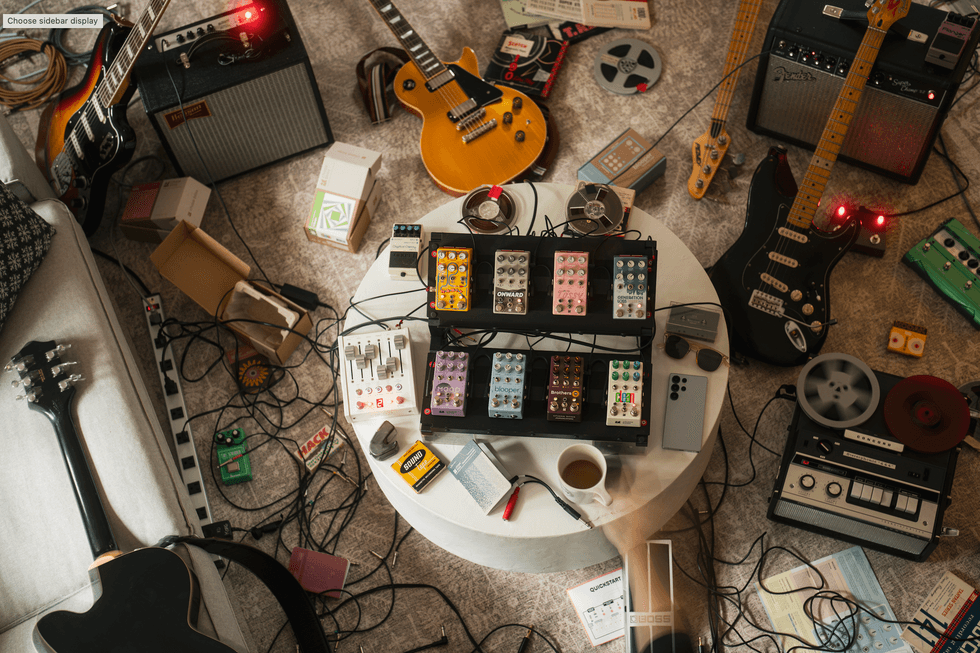
Digital Revolution
Two years ago, Chase Bliss arrived at another crossroads. A part used in several of its pedals made them noncompliant with sales regulations in the United Kingdom and European Union. The problem was with the light-dependent resistor, or LDR. A fairly common component in guitar effects, particularly modulators, it gets paired with an LED to form an opto-isolator that changes the level of resistance in an analog signal based on how much light is hitting it.
Since the beginning, that’s how Chase Bliss had achieved its “digital brain, analog heart” designs. By using a digital micro-processor to exert precise control over the LED, which then determined how much resistance the LDR would add to the clean signal, Chase Bliss could achieve smooth, organic-sounding analog tone with all of the versatility of digital mechanics. But the LDRs also contained cadmium sulfide, a toxic substance that’s not allowed to be sold in the UK or EU.
While Chase Bliss assured existing customers that any risk from the material was “incredibly low,” they were forced to discontinue five pedals: the Warped Vinyl, Condor, Thermae, Dark World, and Preamp MkII. For Korte, it meant that after more than 10 years of designing, he had to abandon his signature style. “The way that I loved to design, with the digital brain and analog heart … that was no longer feasible for us,” he says.
By then, Chase Bliss had already introduced a number of all-digital pedals that skipped the banned LDRs, and they quickly pivoted to working with digital potentiometers and voltage-controlled amplifiers (VCAs) to replace the troublesome resistors.
As of the writing of this article, Chase Bliss has a catalogue of nine pedals. That includes the Blooper, Generation Loss, the CXM 1978, the Mood MkII, and the Brothers AM, a collaboration with Analog Man that pays tribute to the latter’s King of Tone dual-circuit analog overdrive. It also features newer additions, among them: Lossy, an audio degradation emulator; Onward, a dynamic sampler pedal; Clean, a 2-stage stereo compressor; and Big Time, a stereo echo collaboration with Electronic Audio Experiments inspired by early-’80s rackmount delays.
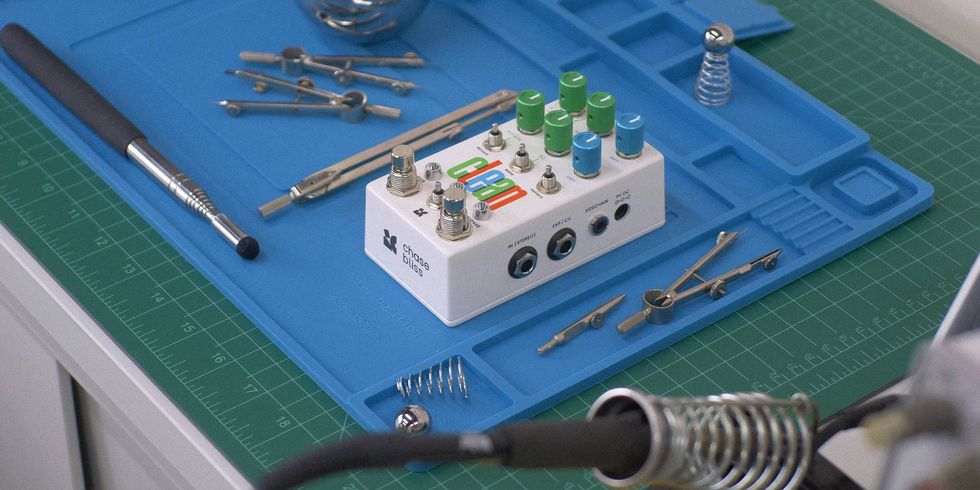
Leap of Faith
Thirteen years ago, Korte was headed for an unhappy life and decided to do something about it. Since then, he’s turned a solo venture into one of the most well-known and highly regarded guitar-pedal brands. All these years later, Korte’s eyes well up when he considers how Chase Bliss’ success—and his entire career—stand as a lasting, heartfelt tribute to his late brother.
“I attribute so much of what’s happened to him,” Korte says. “When I had the finite nature of life presented to me in the way that it was when he died, it made me take some risks that I don’t think I ever would have. Back in 2013, I bet the farm, and then I bet the farm again, and then the farm got bigger, and I just kept betting the farm … And it worked out.”
“My hope is that someone with a regular job will be able to afford it. They’re not all tens of thousands”: Johnny Marr on his upcoming Christie’s auction

Johnny Marr has shared his thoughts on the bidding estimates for the guitars he’s selling through Christie’s auction house.
Announced in June, the Marr’s Guitars auction will take place on 17 September and features nearly 100 pieces from his personal collection. Though these items are definitely not cheap, Marr believes his collection will sell for a lot less than that of other pivotal players, and hopes the items will go to fans.
Consisting of almost 80 instruments, as well as amps and other bits of gear, price estimates range from £1,000 to £80,000. However, one of the items could potentially go for up to £150,000 – his 1960 Cherry Red Gibson ES-355, which he used to write The Smiths’ Heaven Knows I’m Miserable Now.
Speaking to Guitarist, he explains, “Well, compared with other auctions, the prices don’t look too horrible. The people who follow me might not necessarily be the same people who follow Mark Knopfler or David Gilmour. Two people I’ve got the utmost respect for. My appeal as a guitar player is coming from a different place and a different time. That’s the main reason I put a lot of my Jags in there, precisely because they’re not heritage antiques.
“My hope is that someone who’s got a regular job in Glasgow, who fancies a good guitar but wants one of mine, will be able to afford it. They’re not all tens of thousands,” Marr states.
“In the past, I’ve never regretted selling, like, one of the Playland guitars or something I used on The Messenger. Because I know it’s someone who really cares about [what I’ve done in] my career overall. It’s not just someone who wants to buy the How Soon Is Now guitar and stick it in a glass case. I want a fan to buy these guitars.”
He goes on to add, “It’s not really for me to control if someone wants to hang it up in a collection, but something tells me that isn’t going to be the case. Precisely because I come from a different culture from Jeff Beck and David Gilmour. And not to say that their fans aren’t [guitar fanatics]. But y’know, I’m an indie-rock musician and I’ve got a feeling it’s going to be an indie-rock fan who buys my guitars.”
It’s fair to say that these prices are still very high for the regular player, but Marr raises a fair point regarding the value of Gilmour’s instruments. The Pink Floyd guitarist’s famous Black Strat holds the title of the most expensive guitar ever sold at auction, nearly tripling the previous record by selling for $14,550,000 including fees.
The guitar was sold as part of the Jim Irsay Collection auction, also via Christie’s. It originally had an estimated price of $2-4,000,000.
Marr has promised to donate 100 percent of the profits from 10 lots of his auction to a pair of charities: The Guide Dogs for the Blind Association and The National Autistic Society.
Find out more about the Marr’s Guitars auction via Christie’s auction house.
The post “My hope is that someone with a regular job will be able to afford it. They’re not all tens of thousands”: Johnny Marr on his upcoming Christie’s auction appeared first on Guitar.com | All Things Guitar.
“I was the f**kin’ guy, okay?”: Sebastian Bach says he was the reason for a spike in popularity of the name ‘Sebastian’ in 1989

If you happen to be named Sebastian, well it seems you might have Sebastian Bach to thank – or at least that’s what he thinks.
The Twisted Sister singer believes there was a spike in popularity for his name in the late 1980s, but prior to his music career taking off, he recalls never hearing of anyone else with the same name as his. He even says fans have approached him over the years to tell him that their parents named them after him.
- READ MORE: “They play too many notes”: Twisted Sister’s Jay Jay French on the problem with young guitarists
Speaking to Loudwire, he says, “There’s a lot of times people come up to me and say, ‘I was named after you, my parents named me after you.’ ’cause when I was a kid, I was born in 1968, so I was in grade school in 1975/76. Let me tell you something. There was no other kid named Sebastian in the ’70s.
“I would come home almost crying to my mom, ‘Why did you name me this name? Why couldn’t you name me Joe?’ I remember saying that. My mom’s like, ‘Listen, honey, you’re gonna like it [one day].’ When I got to be like 13 getting in bands, then it was a great name!” He shares.
“Back in 1989, some fan said, ‘Sebastian, do you know about this?’ And it was [one of] these polls of popular names for boys and girls. They showed me in ’89 the in the newspaper it had the most popular names and it said Sebastian, but the year before it wasn’t even in the chart! I was the fuckin’ guy, okay? Because ’88, nothing. ’89, Sebastian was one of the top names that people were naming their kids. You’re welcome!”
You can watch the interview below:
Bach joined Twisted Sister in 2023 in place of Dee Snider. Their guitarist, Jay Jay French, has been pretty outspoken in recent years about his thoughts on rock music and its future. In fact, he’d go as far as to say it’s “dead”.
Speaking with Sean P. McKenna on Rimshots With Sean for Barstools & Bandtalk earlier this year, French said: “People say to me, ‘What makes you say rock is dead?’ Well, here’s my take on that. When I was 17 years old back in 1969, all my heroes – Beatles, Stones, Who, Zep, Floyd, Hendrix, Dylan, Grateful Dead, Jefferson Airplane; you name it, you name ‘em all – none of them were older than 27.
“Now think about this for a second. The greatest rock artists in the history of the world, when I was 17, were no older than 10 years [older] than me. Most of them were 25 to 27. Well, I say, name me a 27-year-old rock star right now. And nobody can name one.”
He went on to add, “I’m not saying that there are no rock bands. I’m just saying that the collective psyche that dictates current music trends and sociological impact of music, it’s not showing up in the rock world in terms of mass acceptance.”
The post “I was the f**kin’ guy, okay?”: Sebastian Bach says he was the reason for a spike in popularity of the name ‘Sebastian’ in 1989 appeared first on Guitar.com | All Things Guitar.
Pages
