
Music is the universal language
“Glory to God in the highest heaven, and on earth peace to those on whom his favor rests.” - Luke 2:14
General Interest
Electro-Harmonix Brings to Lifethe Big Muff PI 2
The Electro-Harmonix story is long and complex with more untold stories beneath the surface than most could imagine. Part of that untold story is all of the pedal ideas that never got made for one reason or another. EHX aficionados Josh Scott and Daniel Danger had been digging through all of the EHX’s history when they came upon an old schematic at the home of original Big Muff Pi designer, Bob Myer. Initially passed over by EHX Founder, Mike Matthews, for what would become the Op-Amp Big Muff Pi back in the late 70’s, this schematic serves as a window into that untold story of forgotten pedals, so Josh went to work to bring this circuit to life in collaboration with Electro-Harmonix. The result, a Dual Op-Amp fuzz that’s very much Big Muff with its own character dubbed the Big Muff Pi 2.
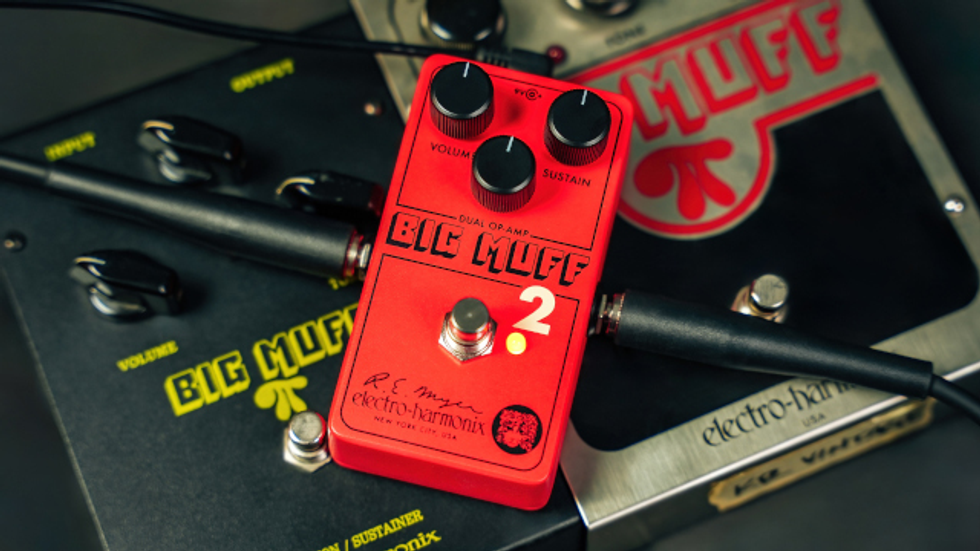
The Big Muff Pi 2 is a slight detour from the usual Big Muff tone. Slightly lower gain, slightly less refined edges with a unique feel, but with the signature sustain and full-bodied BMP tone known and loved by countless players. Housed in EHX’s Nano-sized chassis in a vibrant refinish with graphics by Daniel Danger, the pedal features the familiar SUSTAIN, TONE, and VOL controls. SUSTAIN controls the amount of distortion from heavy crunch to full speaker pounding saturation. The TONE knob is a classic BMP-style tone control, boosting treble and cutting bass as it’s turned up, from wooly to searing. VOL adjusts the overall output of the effects.
This lost piece of the pi ships a 9 Volt battery (power supply optional), is available now and has a U.S. Street Price of $122.00.
J. Rockett Audio Designs Releases New Aqueous Chorus
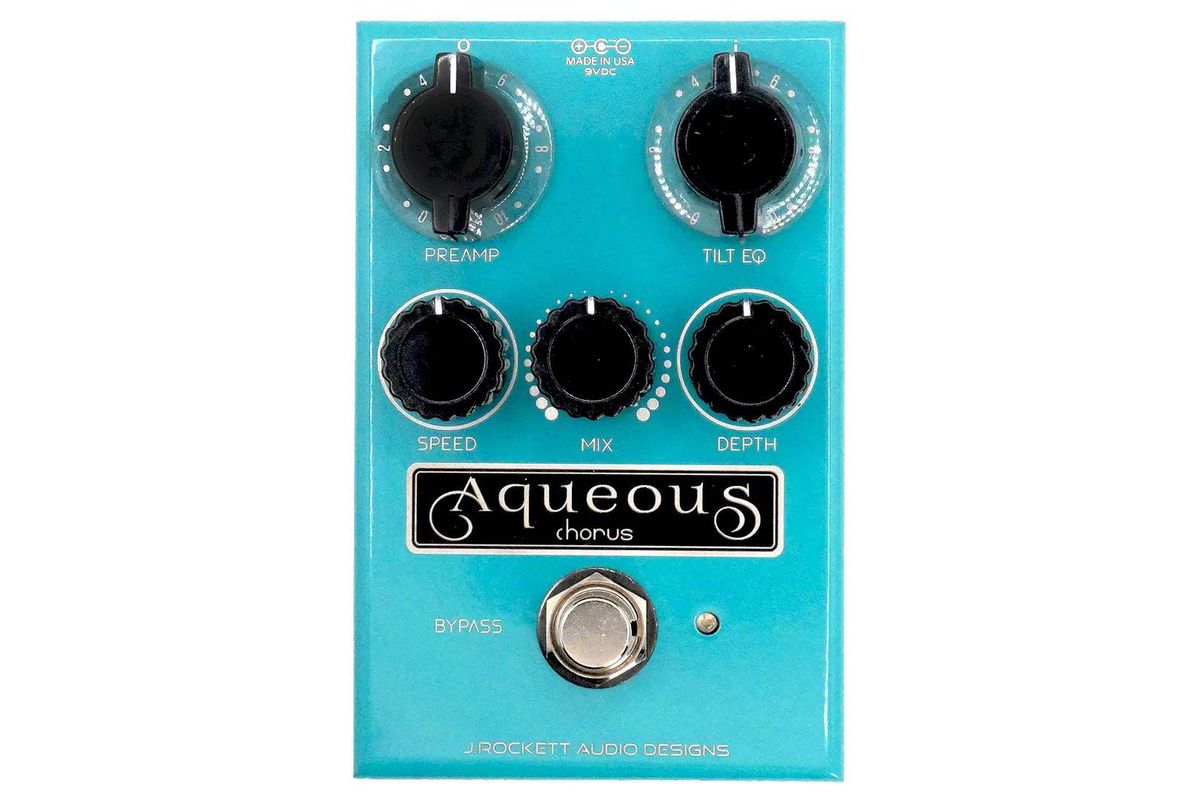
J Rockett Audio Designs announces the release of the Aqueous Chorus, a versatile chorus pedalthat can live in both the vintage era and the modern era with its unique features.
“The Aqueous Chorus is our take on the best of both worlds — vintage bucket brigade character andmodern watery tones” says Chris Van Tassel. Chris continues, “We wanted a chorus that didn’t just soundgood, but felt good to play. With added controls for EQ and gain makeup, it gives players a huge palette ofsounds from subtle vibe textures to full-on rotating speaker effects, vintage and modern chorus soundsthanks to its tilt EQ.”
Aqueous Chorus Features:
- Vintage to modern chorus tones with Tilt EQ shaping (wet signal only)
- Pre-amp section for gain makeup and added feel not typically found in modulation pedals
- Mix control blends chorus and vibe modes, with vibe-only in the last 1/4 rotation
- Depth and Speed controls for subtle movement to extreme modulation
- Rotary-style sounds and lush modulation effects are available with creative settings
- Built with rugged construction and vintage-inspired looks
Specifications:
- 9VDC Negative Tip Power (no internal battery option)
- 28mA Current Draw
The Aqueous Chorus will be available November 6th, 2025 via select dealers for $229.99
One of the most iconic pedals ever for under 50 quid? Grab this incredible Thomann deal while you can

Still looking for last-minute Christmas gifts? You’re in luck, because Thomann is offering one of the most treasured Electro-Harmonix pedals for less than £50.
The EHX Bad Stone was originally launched in the late 1970s and was reissued by the brand in 2015. It remains faithful to the original circuit design and three-knob control layout, but features up-to-date enhancements for today’s players, and can now be yours for just £47.
The Bad Stone delivers six stages of phase shifting, and also hosts a manual mode that lets players freeze the phase. Its Rate knob controls the phase shifting speed – which goes from very slow to a rapid, oscillating warble – while its Feedback knob determines the depth of the phase effect. A toggle switch is also onboard for selecting Auto or Manual modes.
All controls are super simple to use, and the pedal is housed in a compact, rugged die-cast package that shrinks down the original Bad Stone to a more typical modern pedal size. To hear how it sounds and find out more, you can watch the video below:
In other EHX news, the brand has teamed up with JHS Pedals to revive Bob Myer’s long-lost dual Op-Amp Big Muff design as the EHX Big Muff 2, described as “a sharper, louder, more aggressive take on the classic Big Muff voice.”
But that’s not all from the EHX camp, as it also recently informed the subscribers of its email newsletter that the company has a plan to solve an AI-induced energy crisis by harvesting a near-infinite supply of energy that’s hiding out in the planet’s magnetosphere.
To shop this deal on the EHX Bad Stone, head over to Thomann.
The post One of the most iconic pedals ever for under 50 quid? Grab this incredible Thomann deal while you can appeared first on Guitar.com | All Things Guitar.
We said this Guild “reminds you exactly why you fell in love” with guitar – and you can get an incredible 20% off it at Reverb
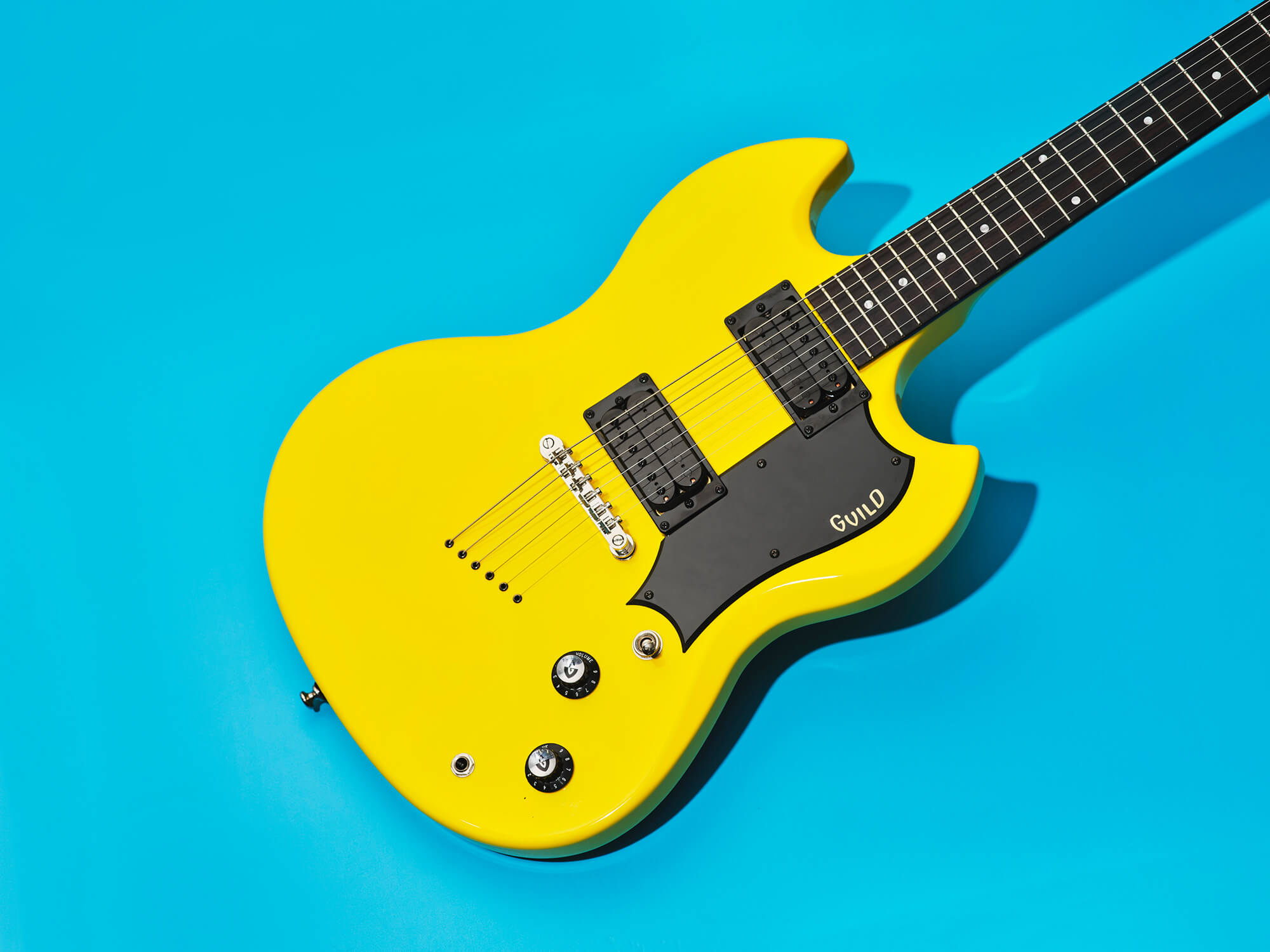
The Guild Polara is an ultra-light, rock-ready machine with simple yet effective controls, and you can now get your hands on it for less than $500.
Launched at NAMM in 2024, this Polara range followed on from the success of Guild’s 2023 collaboration with Kim Thayil. This standard version is the most affordable of the lot – among the Deluxe, Artist Signature, and USA versions – and you can now get a further 20 percent off it via the zZounds Reverb shop, knocking it down to $439.95.
We reviewed the Polara shortly after its launch, and awarded it a glowing 8/10. While its no frills layout means it’s not the most versatile guitar, we loved its striking aesthetics and described it as a “tone-packed rock machine” that will “remind you exactly why you fell in love” with guitar in the first place.
A brilliantly accessible model, the standard Polara offers uncovered HB-2+ pickups, described as “modern extensions” of the coveted Guild HB-1 oversized humbuckers built in a traditional size with Alnico V magnets. A diagonal string layout matches Guild’s compensated stop bar design first introduced in the early 1970s, and its string-through body design delivers glorious sustain.
This double cut dream offers plenty of access to the upper frets for soloing and classic rock shredding. It has an ultra-light ergonomic Mahogany body, making it an ideal workhorse guitar, and a mahogany U-shaped neck hosting a rosewood fingerboard. Its uber sleek and simple design is completed with basic controls for master volume and tone.
Infallible for players of all abilities, this standard Polara is sold brand-new through Reverb and comes in a vibrant Voltage Yellow colour. Hear it in-play in the video below:
You can shop this deal now via Reverb.
The post We said this Guild “reminds you exactly why you fell in love” with guitar – and you can get an incredible 20% off it at Reverb appeared first on Guitar.com | All Things Guitar.
The Circle Guitar is the most revolutionary new guitar in half a century – and artists are queuing up to be part of it

As much as we love it, and while guitarists themselves have continued to evolve, there’s no escaping the truth. The electric guitar is an instrument rooted in technology from the early 20th century, with a playing technique that predates the printing press.
But what if we took all the technological innovation the last seven decades have afforded us, and approached this wonderful thing of ours with fresh eyes? The Circle Guitar is one answer.
 The Circle Guitar on the Guitar.com Cover. Image: Andy Ford for Guitar.com
If you’ve seen it, you will no doubt have an abiding memory: the disc. The spinning wheel that gives the guitar its name, covered in tiny plectrums, strums the strings in a way that no human could – freeing both hands up to create sounds, effects and textures that even the greatest guitarist couldn’t create on their own with a conventional instrument. With the rhythm aspect controlled by the guitar (the rhythm and pattern of which is determined by MIDI), you can interact with the guitar in new ways: create impossible chord shapes, experiment with new types of string muting and string bending, work the onboard volume faders to precisely bring in each note at the right moment.
Creator Anthony Dickens describes the circle as “an electro-mechanical guitar that uses a MIDI-enabled physical sequencer to strum the strings”. Sounds straightforward, right? But to see it, to hear it, to play it is like nothing else you’ve ever experienced with six strings. It’s dizzying, confronting and exhilarating all at once.
 Image: Andy Ford for Guitar.com
Pushing The Envelope
The man who designed this guitar from a cyberpunk future is an unassuming, down-to-earth chap from the South West of England. Anthony Dickens’ first experience of the instrument was some rapidly aborted classical guitar lessons at school. He didn’t give the guitar much more thought until he was flicking through his dad’s record collection a few years later. The 12-year-old happened upon a cellophane-wrapped sample single given away with Smash Hits magazine, celebrating some artist he’d never heard of by the name of Jimi Hendrix.
“For two years, I listened to nothing else apart from every single thing Jimi Hendrix did,” Dickens explains today. “I was just obsessed from that moment on with music and guitars.”
“The thought was a simple one really – what if I could strum a guitar, but that strum never ends?”
Dickens’ obsession expanded: Led Zeppelin, Metallica, Rage Against The Machine. Rave music was also everywhere in the UK in that period, but Dickens struggled to really connect with it until he heard the uniquely experimental sounds of Aphex Twin – it was like a light had been turned on.
“When I discovered Aphex Twin, the first thing about it was that he was sort of an enigma,” Dickens says. He adds, tellingly: “And then I heard that he made his own instruments, and I was like, fucking hell, that is cool! That is the ultimate freedom, isn’t it?”
Dickens’ cousin taught him the basics of sampling on his Atari ST, and he was off making his own ‘esoteric’ electronic music. The logic went: “I’m not in a band, so I’m gonna try and do it myself!”
 Image: Andy Ford for Guitar.com
Design For Life
Dickens also had a passion for making things, and went to university to study furniture design. That said, he planned to pursue music as a career once he was done with his degree. But a final-year exhibit in London complicated matters.
“I ended up winning these awards!” Dickens explains. “Instead of going to Brighton with my three other mates, to go head first into writing music and probably set up a label, I had to ring them up and go, ‘I’ve won this design award. I’ve got to stay in London and I’m going to work.’ It’s a sliding doors moment because it started me on a design career… but the tension has always remained.”
As a designer, Dickens has since worked with everyone from Red Bull to Audi – but he never stopped thinking about ways his two passions could combine. Around 1996, he started to seriously contemplate how music could influence design and vice versa.
“For me, it’s always about: how can I find a new way of expressing myself that nobody else has done before? It’s about people exploring new ways of communicating, and progressing that historical lineage of creativity.”
“It’s almost like the guitar has been left behind. Look at the evolution of music technology – and yet the guitar is the way that it is, and that’s all it should be”
After considering and discarding various ideas over the years, true inspiration struck in 2018. “I was trying to think about how I could change the way that I interacted with a guitar,” Dickens recalls. “The thought was a simple one really: ‘What if I could strum a guitar, but that strum never ends?’ No matter how fast your hand is, there has to be a moment where your downstroke ends and you have to bring it back up for the next one. But I thought, ‘What if it never ended?’”
Dickens landed on the idea of sticking a wheel onto a guitar, putting a load of plectrums onto it, and spinning it by hand. So he made his first prototype – using a cheap acoustic guitar with a hole drilled into it, skateboard ball bearings, a laser-cut piece of plastic, the cheapest, thinnest plectrums he could find, and a doorknob off a kitchen cabinet.
“I started spinning it around, and it sounded amazing – you could make it sound like a swarm of bees, this incessant, endless thing. Immediately I thought, all right, there’s something there.”
 Image: Andy Ford for Guitar.com
On Your Ed
Dickens began pursuing the Circle Guitar project in earnest shortly before the pandemic. At Somerset House’s Makerversity space, he connected with people who could fill in expertise gaps, such as the coders and engineers who helped develop the motorised spinning wheel and the MIDI control that could accurately and consistently keep time. Dickens eventually also added a hex pickup to enable each string to be treated as an independent signal, with onboard volume faders for each one.
As he continued to tinker, Dickens needed some validation that he was on track. “I thought I had to put some videos on social media. Just to see: are we being absolutely mad? If I’m finally going to put my love of design and music together into something, I need to find out if it’s really worth pursuing.”
Some thought the Circle Guitar was madness, while others thought it was genius. But one particular cosign pushed the project forward.
Dickens had watched a That Pedal Show episode with Ed O’Brien, where the Radiohead guitarist insisted that searching for new sounds and textures was more important than any kind of technical virtuosity. It struck a chord, and so he dropped O’Brien an Instagram message about the Circle Guitar. “Within an hour, he got back to me going, ‘Wow, this is amazing. I’d love to come and play it,’” Dickens remembers. “And a week later he was in my house!”
“Every single guitar hero was an agitator, because they were doing something that hadn’t been done before”
O’Brien would later characterise the Circle Guitar as “extraordinary”, telling Reuters it was “almost like playing a different instrument”. “It’s like learning a new language, really. I want to spend a lot of time with it.”
Chances are your first encounter with the Circle Guitar was a direct result of that meeting in August 2020. While at Dickens’ house O’Brien recorded a short phone video of him using the Circle Guitar to create some otherworldly sonic textures, and shared it on Instagram. It quickly went viral, and before long Dickens was fielding queries from artists and producers keen to try it for themselves.
In the five years since that video, the Circle Guitar has changed dramatically both inside and out – and Dickens is ready to share his vision with the world. The first batch of production instruments have been completed, each one custom-tailored to the requirements of the artists and innovators who ordered them.
 Image: Andy Ford for Guitar.com
O’Brien will take delivery of one of them, Phish bassist Mike Gordon another, as will A-list producers Paul Epworth and John Congleton. True innovation doesn’t come cheap – the Circle Guitar costs £7,995 – but guitarists as diverse as Muse’s Matt Bellamy and Idles’ Lee Kiernan have been wowed by the Circle Guitar’s potential.
The faith these artists have placed in Dickens has empowered him to assemble a small team of investors and collaborators to help him achieve the Circle Guitar dream. US-based software engineer David Ashman is responsible for coding the guitar’s firmware and designing the internal electronics, while respected UK luthier Manson Guitar Works – which is owned by Bellamy – produced the necks and bodies for the first batch. [Editor’s Note: Meng Ru Kuok, Founder & CEO of Caldecott Music Group is a part owner of Manson Guitar Works. Guitar.com is part of Caldecott Music Group.]
Another key figure in helping the project move forward is Freddie Cowan, former guitarist in indie-rockers The Vaccines. When Dickens moved to the quiet Somerset village of Frome to work on Circle in earnest, he discovered that Cowan was his neighbour, and he became a hugely important voice in the development – if you’ve seen a Circle Guitar demo online in recent months, Cowan is likely the man playing it.
 Image: Andy Ford for Guitar.com
The Future of Guitar
Even with a formidable team behind him, Dickens still toils away in his workshop to assemble each and every Circle Guitar. There are some who see his brainchild as some sort of technological interloper, transgressing on the pure and good world of electric guitars. It’s a position he understands, even if he hasn’t got much patience for it.
“It’s almost like the guitar has been left behind,” he argues. “Look how the evolution of music technology has exploded – and yet for some reason the guitar is the way that it is, and that’s all it should be. Some people get annoyed because they see the Circle as cheating, because you don’t have to play it like a normal guitar – but you can still buy the old ones! And the intention was never to create something to shortcut learning; it was about exploring new ways to play the guitar. But,” he adds with a wry smile, “it’s also quite fun winding people up as well.”
The unique venn diagram of Dickens’ interests made him the perfect man to conceive of the Circle Guitar. But it still comes back to that maverick creativity and expression that Jimi Hendrix captivated him with all those years ago.
“The beauty of innovation is that it’s deep within us – we’re compelled to find something new”
“For the purists out there, every single one of their guitar heroes was an agitator when they first came out,” Dickens explains. “Because they were doing something that hadn’t been done before, and it probably pissed off a load of other musicians too! This is what humans do. We are always pushing things. The beauty of innovation is that it’s deep within us – we’re compelled to find something new.”
With batch one completed and deposits for the second batch now being taken, Dickens is ambitious about the future of the Circle Guitar. He has plans for new devices, and intends to use feedback from batch one’s owners to refine the concept and better cater to the needs of artists – something that remains at the heart of the Circle ethos.
“The thing that [guitarists] always tell me is that Circle forces you to think differently,” Dickens says. “And for a musician, that’s their job – they’re constantly trying to reinvent themselves. They’re trying to find different ways of responding to their instrument. So that’s what I’m hoping that Circle as a brand is going to keep doing – giving these tools that allow them to open new doors of sonic exploration.”
Words: Josh Gardner
Photography: Andy Ford
Location: Distillery II Studios, Bristol
The post The Circle Guitar is the most revolutionary new guitar in half a century – and artists are queuing up to be part of it appeared first on Guitar.com | All Things Guitar.
EHX Launches A Previously Unheard Big Muff
Keeley Nocturne Stereo Reverb with 3 Modes!
Andy Timmons' own one-stop reverb shop gets expansive with spring, plate, and more ethereal sounds.
Developed in collaboration with Andy Timmons, the NOCTURNE showcases a brand new reverb space based on our unique Halo delay algorithm. From subtle ambience to cinematic space, the NOCTURNE allows players to create that same expressive, touch-sensitive bloom that trails effortlessly behind every note, without the cross-talk rom echoes.
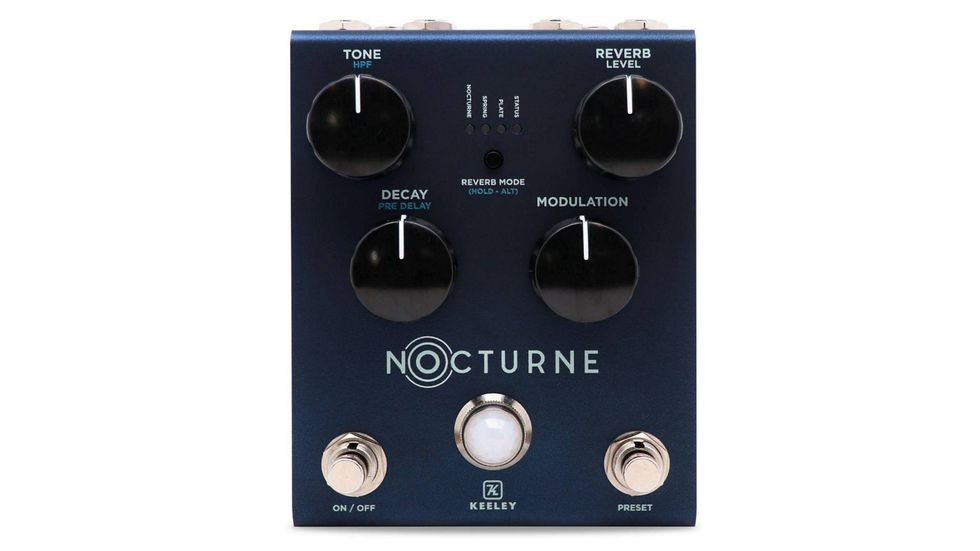
The NOCTURNE pedal gives you three new reverb modes — Nocturne, Spring, and Plate — each designed to be the guitar and amp’s perfect companion. The Plate reverb is based on our extensive analysis and modeling of the stereo tube plate reverb that was in Austin City Limits studio since the mid-1970s. The Nocturne’s Spring reverb features our finest sounds based on both stand alone reverb tanks and tube amplifier combos. The simple four-knob layout of Tone, Level, Decay, and Modulation makes it easy to shape each gorgeous reverb space. Each reverb mode can be made a preset so you can store your favorite sounds. Alt features include our first pre-delay time control, allowing you to create slapback echo effects.
The NOCTURNE offers a flexible signal path with True or Buffered Bypass, Expression Pedal control, Remote Switching, and MIDI compatibility for up to 72 presets. Whether you’re running mono or stereo, wet/dry, or full wet for parallel rigs, the NOCTURNE adapts easily to any setup. Built on Keeley’s award-winning Core architecture, every component and line of code is tuned to make this reverb feel musical and alive. Operation is easy with the Nocturne – if the indicator LED is blue then it's 'wysiwyg'; the knobs set the tone or level of each reverb mode. If the LED is red, each reverb is a favorite or preset, where you can save the settings for each reverb mode.
Nocturne Reverb Pedal
The Keeley Nocturne reverb pedal introduces a new chapter in the collection of effects developed alongside legendary guitarist Andy Timmons. This versatile reverb pedal provides a wide range of sonic ambience, operating in three modes: Keeley-famous Spring reverb, studio-inspired Plate, and, of course, the immersive Nocturne reverb, derived from Keeley’s unique HALO delay algorithm. Featuring four main control knobs for extensive sonic shaping — Tone, Decay, Level, and Modulation — Nocturne is also equipped with HPF and Pre-Delay alt controls, mono/stereo capabilities, and a host of control jacks for expression pedal control, remote switching, and MIDI compatibility for accessing up to 72 recallable presets. Whether you're seeking the springy bounce of standalone tanks, a vintage sound inspired by the world-famous Austin City Limits Studio stereo tube plate, or the ethereal wash that inspired the pedal's name, the Nocturne delivers pure reverb bliss.
Keeley’s Nocturne: Three Killer Reverbs in A Single Pedal
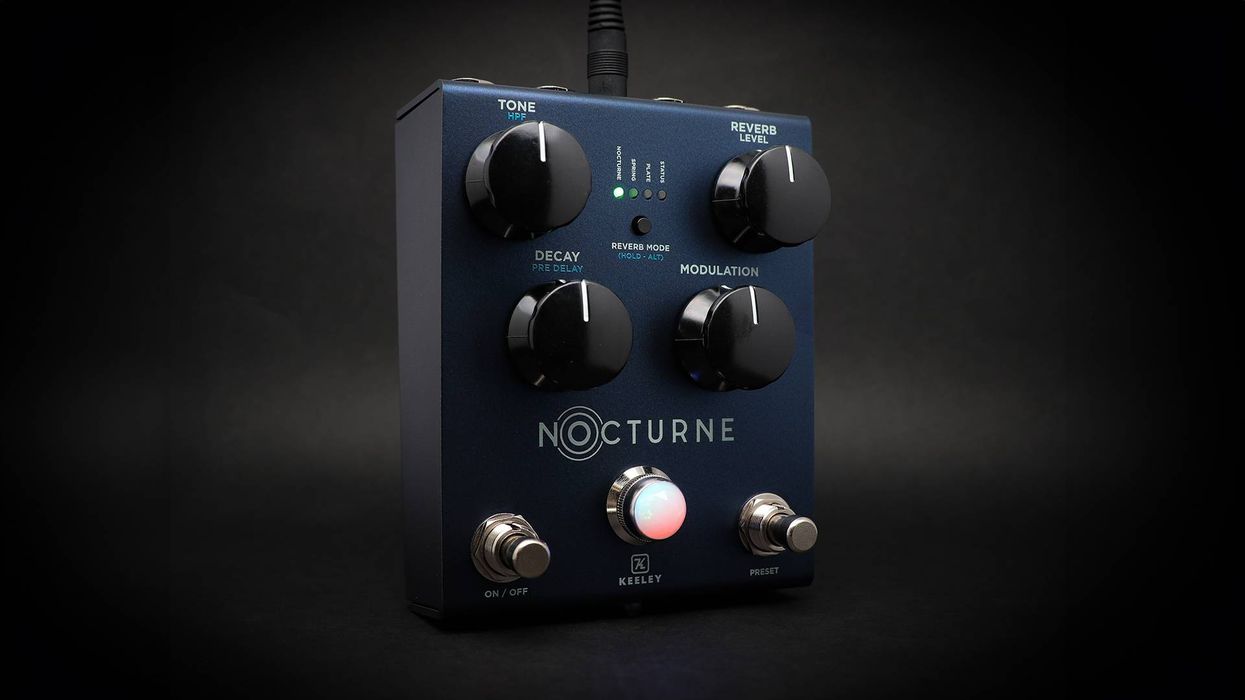
Effects pioneer Robert Keeley and guitar adventurer Andy Timmons reveal their newest collaboration.
Keeley Electronics’ new Nocturne reverb marks the latest chapter in an ongoing and expanding partnership between Andy Timmons, Robert Keeley, and the Keeley Electronics design group. They first teamed up in 2020 and have since developed effects such as the HALO Dual Echo (which captured Timmons' dual delay sound in a compact pedal) and Timmons’ signature Mk3 Drive. The new Nocturne reverb represents a fascinating new direction in the collaboration.
At its core, the Nocturne offers three distinct reverb modes in a single unit. Its Plate and Spring reverbs are based on bona fide classic sounds, while its titular Nocturne mode takes a fresh approach to reverb and delivers an otherworldly playing experience. It’s incredibly user-friendly, with a simple four-knob control set—Tone, Level, Decay, and Modulation—that makes it easy to shape your reverb space. Each reverb mode can be saved as a preset, so you can store your favorite sounds.
It’s an approachable, powerful pedal that offers instant gratification for just about any guitarist… even players who don’t normally use reverb. And that’s the biggest plot twist in the Nocturne story.
You see, Timmons doesn’t even consider himself a “reverb guy.”
“I've always used echo and delay instead of reverb. That's my ambience, that's my space,” Timmons admits. “Until now, there was never really a reverb that worked for me. I would use delays and try to curate them in the right way. But I had a different sound in my head, and I approached Robert to see if we could make it a reality. Now, my wall has come down for reverb. I just had to wait for the ‘Mr. Right reverb’ I guess,” he laughs.
Timmons’ “Mr. Right” reverb has arrived, and its calling card is the Nocturne reverb mode.
Knock, Knock, Knockin’ on Heaven’s Door

Amid the pedal’s offerings, many players will view the Nocturne mode as the belle of the ball. It’s an immersive, almost heavenly reverb that sounds great when used sparingly—and sounds even better when it’s generously applied to clean, arpeggiated phrases or textural chords.
The brand-new reverb space is based on Keeley’s unique Halo delay algorithm. From subtle ambience to cinematic space, the Nocturne allows players to create that same expressive, touch-sensitive bloom that trails effortlessly behind every note, without the cross talk from echoes. It features a pre-delay echo that transforms into an expansive and engulfing reverb space. It’s difficult to describe—it simply sounds like it’s from another planet.
As Timmons says, “it creates a reverb from a different perspective. It’s not a usual reverb algorithm. It’s a fresh and different angle. I just want to sit and play in this dreamlike sound all day.”
Not surprisingly, Timmons has immediately put the pedal to creative use: “I've got a collection of songs that I've written—solo pieces called ‘The Outlier Nocturnes’—so I was basically waiting for this pedal. I'm already using it in the studio now that I have the right sound.”
Spring Fever
In designing the Nocturne, Robert Keeley and his team were determined to create a pedal that could satisfy a broad range of tastes. And for many guitarists, the first thing that comes to mind when they think of reverb is the classic reverb-drenched amp tones of the 1960s.
That includes Andy Timmons himself. “I’ll admit that I'm a closet surf guitarist,” he laughs. “I even have a surf record that's been in the can for years… I just haven't released it.When I run the Nocturne in spring mode into my dual showman and a 2x15 Fender cab, it’s just got that sound, man. It’s Dick Dale incarnate.”
Timmons’ personal passion for spring reverb and surf music helped spur the design process—but spring reverbs are fickle beasts, and notoriously difficult to replicate. To fine-tune the pedal’s Spring mode, Keeley worked closely with Aaron Pierce, a key partner in Robert’s design team at Keeley Electronics, and relied on modern technology to capture the vintage spring reverb mojo. “Aaron and I purchased a spring reverb or two and we put them through our audio analyzer. We worked hard to make it sound realistic and very drippy, just like the originals. When it comes to the iconic reverb sounds that we were searching for, I wasn’t sure I was going to be able to make it happen. But we finally got some awesome drip going with one, and that's the one I'm most in love with.”

Having harnessed the elusive, authentic spring reverb sound he had been seeking, Keeley and his team were determined to capture another essential reverb flavor for the Nocturne’s third mode: vintage tube-driven plate reverb.
The chase led them to Austin, Texas….
Keeley Electronics Nocturne Reverb with Robert Keeley and Andy Timmons | A REVERB YOU’VE NEVER HEARD BEFORE!
Join Robert Keeley, Andy Timmons, and Aaron Pierce for a deep dive into the creation of the Keeley Electronics Nocturne Reverb—a design shaped by collaboration, experimentation, and a completely new approach to ambient space. In this panel-style conversation, the team breaks down the ideas, sounds, and engineering choices that led to a reverb unlike anything in the Keeley lineup.
Hear the stories, explore the process, and discover why the Nocturne truly is a reverb you’ve never heard before.
A Plateful of History
Tube-driven plate reverb is one of the defining sonic characteristics of classic recordings from the 1950s, 1960s and 1970s. Beginning with the 1957 introduction of the EMT 140 by the German company Elektromesstechnik (EMT), plate reverb quickly became ubiquitous in popular music. Each individual plate reverb has its own subtle flavor—a unique sonic fingerprint. If you’re going to create a modern digital effect based on a vintage unit, it’s crucial to find a great-sounding original specimen.
“The plate is a really exciting part of the story for me,” Keeley admits. “My plate is (based on) the one that they used at Austin City Limits since the mid-’70s. About 10 years ago (Mike Daane) got a hold of it. They (ACL) decided to stop using it to go to a digital system and it was at that point in time where we got to go down with our audio analyzer, the APX 515B, and we could study its frequency response and measure the reverb trails. We modified the frequency response of our reverb so it more closely matched the Austin City Limits plate reverb. Reverbs have a certain resonance. And if you play something percussive like a tom or a snare, you can hear the resonance in the Austin City Limits reverb—it’s a lower frequency than typical.”
This particular plate reverb boasts its own historic provenance. Beginning with an October 1974 performance by Willie Nelson, the Austin City Limits TV program has hosted the crème-de-la-crème of blues, rock and country music artists for decades. Stevie Ray Vaughan, B.B. King, Johnny Cash, Lyle Lovett, George Strait, Emmylou Harris, Wilco, Los Lobos, and Dolly Parton are just a few of the artists whose performances were channeled through this very reverb unit.
Timmons was enthused that the Austin City Limits reverb provided the basis for the Nocturne’s plate mode. “Every stereo tube plate reverb is gonna sound a little different, and it’s such an amazing opportunity to have the specific plate that was used on all the Austin City Limits shows for so many years. The design team could do a molecular level study of it with the amazing gear that Robert's got. I think that’s the one that took the most effort and revisions. But once Aaron [Tackett] figured out how to approach the plate, it was really exciting to hear how it turned out.”
HALO AND NOCTURNE—TOGETHER
For all of the technology and analysis that went into creating the pedal, the Nocturne is dead-simple to use: just three easily selectable reverb modes, four control knobs, plus some alt functions if you’re inclined to use them.
“And I'm not one of those that's inclined to do much tweaking,” Timmons admits. “I just want to turn something on and have it inspire me really quickly. That's what this format does so eloquently. It's encouraging, not daunting, and you feel it as soon as you plug in.”
Even though it’s an outgrowth of the Halo delay that Timmons and Keeley collaborated on earlier, Timmons says the Nocturne is designed to be used in conjunction with the Halo. “It's not meant to replace my Halo, but they work incredibly well together. I basically keep the Nocturne always on and I'm blending in the Halo occasionally. I was in the studio three days ago: I’m playing through my Keeley Mark 3 drive, the Halo, then the Nocturne into 2 vintage Marshalls. All the effects are being printed, and I'm listening back to the monitors and thinking, this is the best sound I've ever had! It's such a wonderful place to be, to be that happy with what's happening sonically. So now all I have to do is try to play to the level that the sound is allowing me to play. It's a dreamscape that I have never heard before.”
DIVE DEEPER IF YOU WANT TO
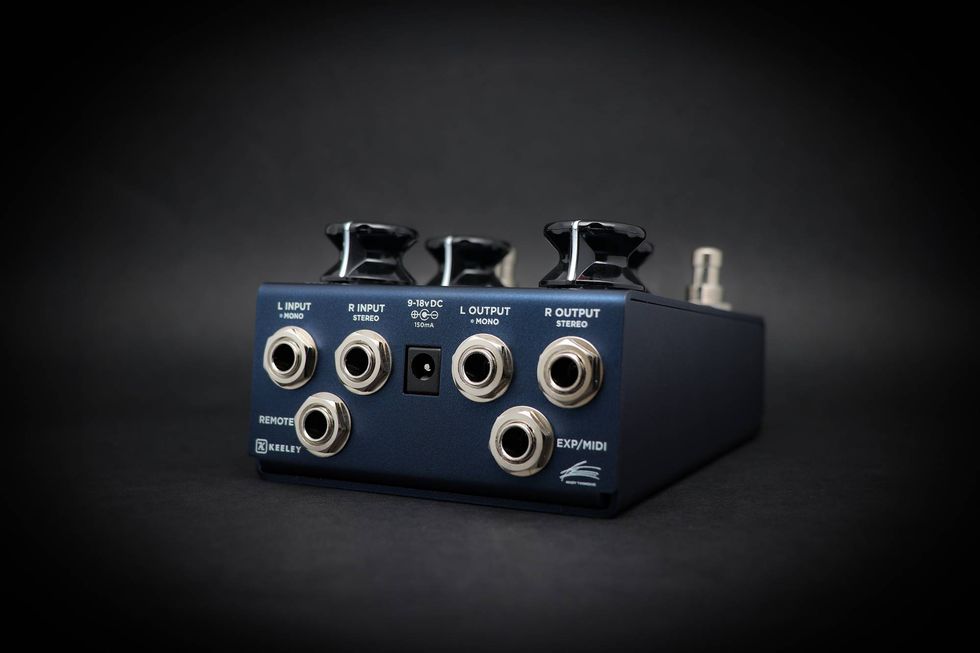
For players that do enjoy tweaking their settings, the Nocturne offers a flexible signal path with True or Buffered Bypass, Expression Pedal control, Remote Switching, and MIDI compatibility for up to 72 presets. Whether you’re running mono or stereo outputs, wet/dry, or full wet for parallel rigs, the Nocturne adapts easily to any setup.
Operation is intuitive with the Nocturne. If the indicator LED is blue then it's “wysiwyg”; the knobs set the tone or level of each reverb mode. If the LED is red, each reverb is a favorite or preset, where you can save the settings for each reverb mode. You can store and recall presets with a dedicated footswitch, and turn trails on/off.
Ultimately, Keeley and his team get the greatest satisfaction from seeing a player focus on playing, rather than tweaking. “These pedals are really near and dear to my heart,” he notes, “especially when it becomes a new platform like the Nocturne. We put a lot of time and effort into making sure that you could just walk up to this unit and not feel intimidated. just go out and have fun making music.”
With the arrival of Keeley’s Nocturne, you might have finally found your own “Mr. Right” reverb. Hear it and feel it for yourself. Plug into a Nocturne, turn up your amp and get inspired.
Keeley Electronics ‘NOCTURNE’ Featuring Andy Timmons’ Signature Reverb
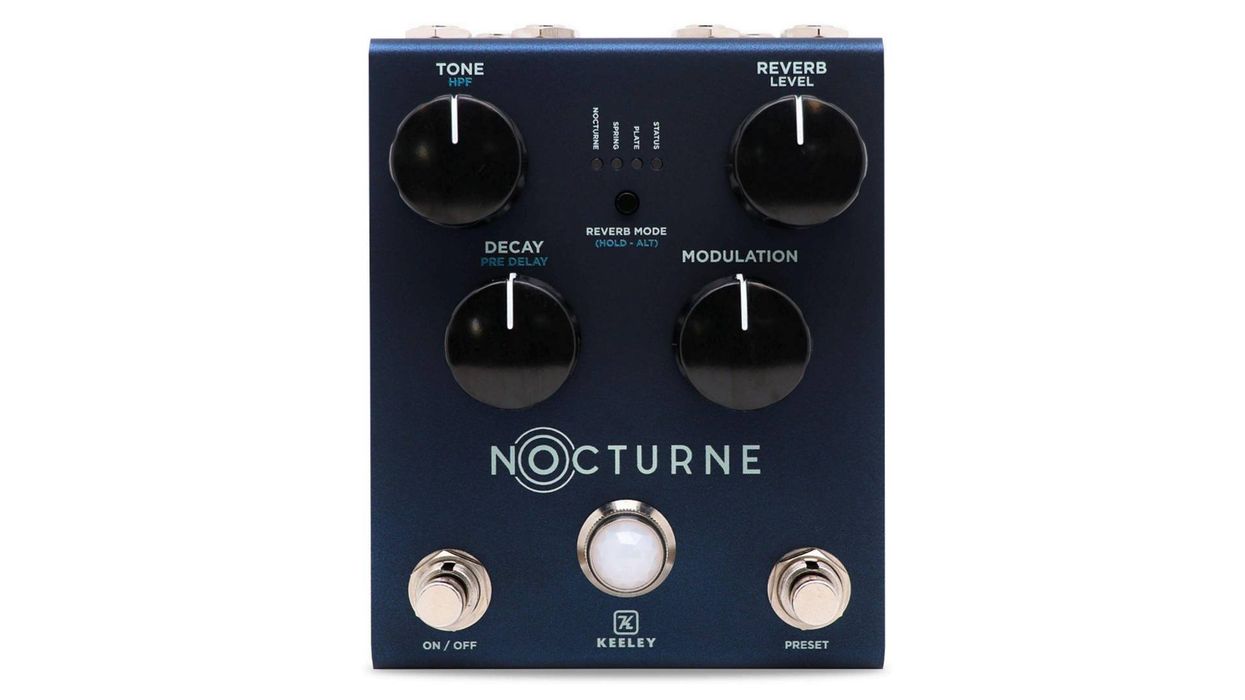
Keeley Electronics NOCTURNE Reverb Developed in collaboration with Andy Timmons, the NOCTURNE showcases a brand new reverb space based on our unique Halo delay algorithm. From subtle ambience to cinematic space, the NOCTURNE allows players to create that same expressive, touch-sensitive bloom that trails effortlessly behind every note, without the cross-talk from echoes.
The NOCTURNE pedal gives you three new reverb modes — Nocturne, Spring, and Plate — each designed to be the guitar and amp’s perfect companion. The Plate reverb is based on our extensive analysis and modeling of the stereo tube plate reverb that was in Austin City Limits studio since the mid-1970s. The Nocturne’s Spring reverb features our finest sounds based on both stand alone reverb tanks and tube amplifier combos. The simple four-knob layout of Tone, Level, Decay, and Modulation makes it easy to shape each gorgeous reverb space. Each reverb mode can be made a preset so you can store your favorite sounds. Alt features include our first pre-delay time control, allowing you to create slapback echo effects.
- YouTube
The NOCTURNE offers a flexible signal path with True or Buffered Bypass, Expression Pedal control, Remote Switching, and MIDI compatibility for up to 72 presets. Whether you’re running mono or stereo, wet/dry, or full wet for parallel rigs, the NOCTURNE adapts easily to any setup. Built on Keeley’s award-winning Core architecture, every component and line of code is tuned to make this reverb feel musical and alive.
Operation is easy with the Nocturne – if the indicator LED is blue then it's 'wysiwyg'; the knobs set the tone or level of each reverb mode. If the LED is red, each reverb is a favorite or preset, where you can save the settings for each reverb mode.
Like every Keeley pedal, the NOCTURNE Andy Timmons Reverb is designed and manufactured in Oklahoma, USA. Engineered for the working musician, and voiced for inspiration.
Features
- A Brand New Reverb -’Nocturne’ based on the Andy Timmons’ signature HALO sound
- Three reverb modes: Nocturne, Spring, Plate
- Intuitive four-knob control layout: Tone, Level, Decay, Modulation
- Store and recall presets with dedicated footswitch
- Trails on/off, True or Buffered Bypass selectable
- Expression and MIDI control with up to 72 preset locations
- Stereo outputs with Wet+Dry or Wet-only operation
- Made in the USA
- $269 USD
Dealer Contact:
Danny Black, Sales Director • Phone: 1-405-341-2025 • Email: dealer@rkfx.com Visit the Keeley Electronics website, on YouTube and on Facebook and Instagram.
Keith Urban says this is the best way to tell if you should buy a guitar: “I get very excited about that particularly”

What makes you want to buy a guitar? It could be a visual aspect like shape or colour, or maybe it’s the electronics or wood. For Keith Urban, it needs to pull an unusual riff out of him.
Urban, who has just launched his first ever live album, High And A(live), has been sharing his best tips for buying guitars, including what is most important to him. It doesn’t matter if a guitar is expensive or cheap, if he manages to play something entirely brand new on it, he’ll likely buy it.
He tells Guitarist in its new print issue, “I think maybe it’s about bonding with something. That’s all it is for me. l usually base it on if I pick it up and play it, and a riff or something comes out of the guitar that I’ve never played before, I get very excited about that particularly.
“It happens on really cheap guitars, too. I’ve walked into stores and found fairly cheap guitars, you know, for a couple hundred bucks, and kind of gone, ‘Wow, l’ve never played that riff before.’ Then maybe another riff comes out of it, and I go, ‘This guitar’s got some stuff in it.’ So l’ve bought guitars based on that,” he explains.
Asked if he’d rather buy a cheap guitar and an expensive amp, or vice versa, Urban responds, “The guitar comes first, but… Man, that’s a great question. I was going to try to give an answer, and I was like, ‘You don’t believe that, Keith’ [laughs]. Because, really, either one works.
“To me, ‘good’ is something that pulls something out of me that feels and sounds really good. Regardless of how much it is, what brand it is or anything about it, to me, that’s a good guitar. That beats tone,” he concludes. “Because the tone could be shitty and that’s actually part of the character of the guitar you just played.”
Keith Urban will go on tour in 2026. You can find out more via his official website.
The post Keith Urban says this is the best way to tell if you should buy a guitar: “I get very excited about that particularly” appeared first on Guitar.com | All Things Guitar.
Steve Stevens claims 80s guitar music suffered due to the obsession with finding “clones” of Eddie Van Halen: “Record labels were signing anyone who could tap and shred”

Steve Stevens has recalled how Eddie Van Halen “shook up the world” when he rose to success, as shredding became an obsession – but with some unintended consequences for the rest of the guitar scene.
Stevens kicked off his own career in the 1980s, just as Van Halen were soaring, and remembers how record labels were looking to sing players who could tap and shred in the same style.
- READ MORE: The Guitar Influences of Eddie Van Halen
Stevens has worked with artists like Michael Jackson, Vince Neil, and prominently Billy Idol, as well as having worked on his own solo music. In an interview with Guitarist, he says he never gave into the pressure of shred-sanity, and still prefers “having a dialogue” with other band members on stage.
“I wasn’t from LA. I didn’t grow up watching Van Halen thinking, ‘Oh shit, what do we do now?’ A lot of guys did. Eddie shook up the world, no doubt. I became friends with him later, but I never wanted to play like him.
“Record labels were signing anyone who could tap and shred. The good ones, like Warren DeMartini and George Lynch, found their own voices, unlike guys that were just Eddie clones. But, really, my true love is collaborating on a good song.”
He continues, “I’m definitely not looking for my moment of glory three minutes into a song, waiting for the guitar solo. I enjoy being part of the band more than anything and having that dialogue with the guys on stage, playing and locking in with the drummer.”
Another guitarist who has recently reflected on the impact of Eddie Van Halen’s work is Steve Lukather, who was also a good friend of his. Speaking to Forbes, he said that Ed “changed the world”, but not everybody understood what he was about.
“People mistook him for a parlour trick because he did the tapping thing. He actually stumbled upon it by accident. It had been around for a while. He was in a trio, and filling up the sound is hard. Think Cream [with Eric Clapton],” Lukather said.
“Ed’s rhythm-playing and solos were like one fluid movement. I don’t think he ever played the same thing twice, and that used to drive the guys in the band crazy.”
You can find out more about Steve Stevens’ work via his official website.
The post Steve Stevens claims 80s guitar music suffered due to the obsession with finding “clones” of Eddie Van Halen: “Record labels were signing anyone who could tap and shred” appeared first on Guitar.com | All Things Guitar.
Guitar.com Deals Of The Week: pre-Christmas savings to stuff your stockings with

We’ve entered into December proper. And, so, the herds of savings that stampeded around us across Black Friday and Cyber Week have completed their yearly migration, disappearing over the horizon as quickly as they came. But, deal hunters that we are, we move onto new pastures to find fresh savings to throw spears at and chase over cliffs. Metaphorically. And those new pastures are the pre-Christmas build-up sales, which are now in full swing at retailers like Sweetwater and zZounds. There are some awesome deals to be had on everything from stocking-stuffing pedals to dream guitars to reliable Boss classics – here are just a few.
Save $50 on the IK Multimedia ToneX One
[deals ids=”55Lo7ELi4kX2vnXWA5zWSV”]
A pocket-sized pedal this may be, but there’s a whole universe of amplifier simulations within its miniscule enclosure. This bite-size pedal features 20 onboard Tone Model slots, allowing you to pick and choose from over 200 Premium Tone Models and more than 25,000 user-generated Tone Models via IK’s TONEX Librarian and ToneNET – that’s an unbelievable amount of flexibility, all for less ahead of the holidays.
Save $30 on the Boss RC-5
[deals ids=”2iMpWKulea7KLxmzvOZSvh”]
This is my personal looper of choice – it’s a great balance between size and featureset, as it’s got an extensive set of on-board beats, storage options, and other nifty quality of life features, but it still functions just fine as a straight-ahead looper!
Save $310 on the PRS SE Hollowbody Standard Piezo Electric Guitar
[deals ids=”4izu1sQ7V1fRK6OT8tv4Hg”]
This innovative semi-hollow from PRS comes in the rather intriguing dog hair finish, which is a lot prettier to look at than you might think – with the accentuated, tight grain of the top providing an almost glittery effect. The guitar comes with all of the player-friendly ergonomics that you might expect from PRS, alongside a versatile set of sounds thanks to that unique piezo setup.
Save $30 on the Boss TU-3
[deals ids=”4LjwlcMcAqUpOw4yYG5TiS”]
We don’t need to tell you why the TU-3 is great, and even greater at just under $80. It’s a fast, accurate, reliable tuner that’s housed in Boss’ ever-beloved compact series enclosure, and therefore will survive a direct hit from a nuclear missile, probably. No wonder it’s on so many professional and non-professional pedalboards alike!
Save $50 on the Boss Katana
[deals ids=”6p5ZFu8SQuchpClOioLc3H”]
$299 for the Katana 50 Gen 3 is an extremely appealing deal. The Katana Gen 3 has excellent direct sounds, with a customisable signal path and effects chain thanks to robust software control. What’s more, it’s also more than capable of being used as a regular combo amplifier – the 50-watt version balances between power and portability, as it’s more than capable of all kinds of gigs thanks to its headroom and its direct capabilities, but it’s also a one-hand lift!
The post Guitar.com Deals Of The Week: pre-Christmas savings to stuff your stockings with appeared first on Guitar.com | All Things Guitar.
Guitarist Steve Morse: “I'm a Student of Everything"

If you were reading guitar magazines in the ’90s, you’re familiar with Steve Morse’s “Open Ear” column. Running for many years in Guitar (née Guitar for the Practicing Musician), Morse shared his thoughts on session work, practice routines, practical tips for guitarists, and various other parts of his life. For years before I’d ever heard a note of his playing, I read his wisdom monthly.
With every column was a short bio that began, “Steve Morse is one of the busiest guitarists in the industry.” At the time, that busy-ness played out in his writing—Steve was very active. Eventually digging into his background, I learned just how prolific he really was.
Morse first caught ears with the Dixie Dregs—whose origin story reached back to their time as students at the University of Miami (alongside luminaries like Pat Metheny, Jaco Pastorius, and Hiram Bullock), where wunderkind headed after leaving high school early. Together, they assembled a barn-burning blend of ’70s Southern rock, jazz, and bluegrass.
When the Dregs ran their course, Morse joined Kansas. And after that, he joined Deep Purple. (By the time they parted ways in 2022, he was Purple’s longest-running guitarist.) In 1985, he introduced the Steve Morse Band, along the way racking up a list of collabs and guest spots that’ll make your head spin.
Offstage and amidst musical globetrotting, his drive has kept him working well beyond the fretboard, and he has, at times, pursued a career as a commercial airline pilot—he still flies to this day—and he currently owns and oversees the daily operations of a small Florida hay farm.
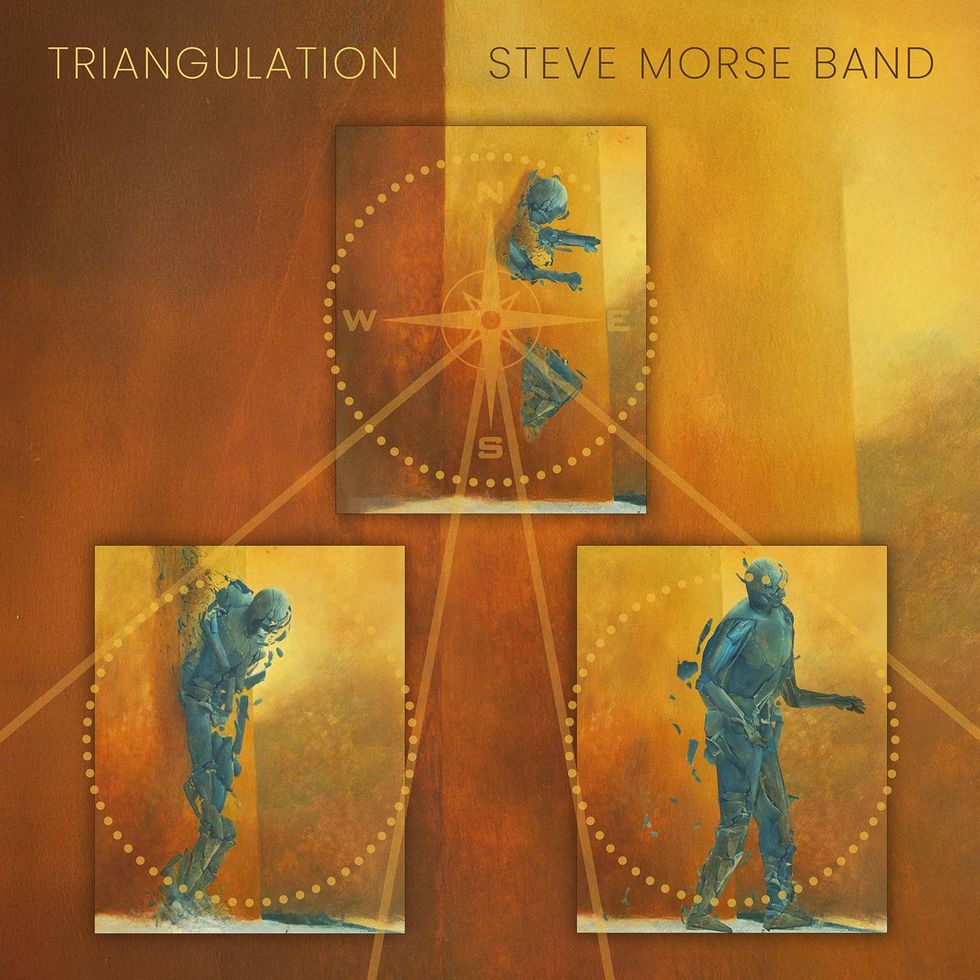
All the while, the music never stopped. His latest Steve Morse Band release, Triangulation, featuring bassist Dave LaRue and drummer Van Romaine, is a high-flying shredathon that treats glorious rock melody and proggy twists and turns with equally explosive abandon. Below the surface, there’s a heavier backstory, the album’s origin tracing back to the passing of Morse’s wife Janine in 2024, and Morse in a physical battle with arthritis that has been slowly deteriorating his technique. So it is, then, that his first solo record since 2009’s Out Standing in Their Field stands as a testament to the power of music, of the human spirit, and, ultimately, of Morse’s hard work and perseverance. It’s also a coming together of sorts for the band as well as for the friends the guitarist has gathered as guests, which include Eric Johnson, John Petrucci, and Morse’s son, Kevin.
We caught up with Morse while he was on tour in New Jersey to have an inspiring talk about Triangulation, his guitar habits, and the importance of hard work.

Steve Morse’s Gear
Guitars
- Ernie Ball Music Man Steve Morse Signature
- Buscarino custom classical guitar
Amps
- Engl Steve Morse Signature E656 100-watt head
- Engl Steve Morse Signature 20 E658 20-watt combo
Strings and Picks
- Ernie Ball Paradigm Slinky strings (.009–.042)
- Ernie Ball Heavy Nylon picks
Effects
- TC Electronic Polytune
- Keeley Compressor
- TC Electronic Flashback (x3) with Steve Morse Delay TonePrint
- GigRig Wetter Box
- Ernie Ball volume pedal
- Roland GK-3 pickup
- Roland GR-55 Guitar Synthesizer
So this is the first new music you put your name on since 2009. You’re back with Dave LaRue and Van Romaine, and then you have a couple collaborators on here. And let’s start by talking about the collabs. You’ve got Eric Johnson, John Petrucci, and, of course, your son, Kevin. How did those collaborators end up on the record?
Steve Morse: It was kind of late in the game. We’d already been recording the album. I felt like, at this rate of putting out one every 16 years, that I was going to be pretty old by the time the next one rolls around, so that could be it. I have some old friends that’re just amazing guitar players, and I hate to ask them for favors, but I finally broke down and did. When it comes to favors from friends, even if it’s not convenient for them, they will probably say yes, so I felt guilty about doing it. But it turned out everybody, I think, had a good time.
The Eric Johnson tune, “TexUS,” I wrote in the style of that late-’70s sound that I heard him playing—melodic rock, not jazzy at all, just straight down the middle but with a lot of melody.
“Triangulation,” the John Petrucci tune, was also arranged for him, like “you play this part, I’ll play this part.” John doesn’t do anything halfway. He was playing the song super perfect, as usual, right in the middle of just being as busy as he’s ever been with Portnoy back in the band.
The third tune with my son, Kevin, we played at my wife's memorial. He, on his own, volunteered to make a recording of it. It grew organically. It starts off real lonely and minor key, I was imitating an oboe with the electric guitar and playing classical at the very beginning, and then Kevin comes in and it keeps slowly growing from there.
Obviously there’s a much greater significance on that song, but this isn't the first time you collaborated with Kevin. What’s it like to have your son as part of your records? How did he get involved?
Morse: Well, it’s the biggest deal. I’ve been one of those people that never pushed music on him. Of course, if I owned a 7-Eleven, I would have him come in and learn by working here. Yes, you’re my son, but you still have to work, you know? That’s what dads do.
I think it really pushed him to have his own identity. But we’re planning on doing more music in the future.
Why was now the time to make a new record?
Morse: I always have ideas, and I’m always working on ideas. After my wife died, there was no big project coming up. There was nothing. I was stuck in this sort of limbo. I just decided to start working on an album. Dave [LaRue] lives in the same town as I do. He would come over and be the guinea pig for the new bass and guitar parts.
We made a template of each song by working on the parts, sitting next to each other in the studio, and making fine adjustments and constant editing. Everybody had the same template and tempo to work on their parts.
When you were on Rick Beato’s podcast, something that caught my attention was you were talking about coping with arthritis. When did that first start affecting you?
Morse: I was in Purple, and it was killing me then, probably eight or 10 years ago. It just got to the point where I’ve tried every cure there is. In fact, I just did a bunch of radiation treatments; it’s supposed to help the inflammation and pain.
I just have a genetic predisposition, but I’m doing more things. I’m eating better and concentrating on an anti-inflammatory diet and all these cures, plasma injections and cortisone injections, the radiation, every supplement known to man. Obviously, you can’t cure it.
“Imagine writing, and they say, ‘You’ve got a six-year-old’s vocabulary.’ How do you do it? With music, it involves making artful placement of things.”
On the record, you sound like you have full control of your technique. I think it’s great that you talk about it because it’s something that so many players deal with.
Morse: It reduces my vocabulary, and I hate that, but there’s nothing I can do. Imagine writing, and they say, “You’ve got a six-year-old’s vocabulary.” How do you do it? With music, it involves making artful placement of things. So there’s a lot of time spent finding the ideal phrase.
Something that’s really interested me about your career is that you’ve had other professional trajectories. You were a commercial airline pilot. Is that something you still do?
Morse: Yeah, I fly all the time. I’ve never stopped flying.
And you also own a farm, right? Is that an active business?
Morse: Yeah, it’s small, like 56 acres. It’s open grass hayfields. I also have a little runway for the airplanes.
I had helpers when I first took this over, but it just didn’t go well, so I just do everything myself. I’ve scaled down to a manageable level of hay production. I cut the hay first, then ted it with a fluffer, then rake it into rows, and then bail it into square bales and round bales. I have to pick up the bales and put them all in my hay barn to keep them from spoiling when the rains come. And then I deliver them over the winter to my customers that are nearby using my tractor and big wagons. The people on my road hate me because I go slow—I can’t go fast.
How do these parts of your life—flying and running your farm—influence your art? And how important is it to have a life outside of music?
Morse: That’s cool that you’re touching on that. I think it’s very important, because you have more to say with the music if you have a life outside of it.
The biggest part of my extracurricular thing is fixing stuff because I’ve got old hay equipment, old machines—like my lifts that I use to cut the trees, it puts me 70 feet in the air and it’s got a whole level of maintenance that it needs—and I have to learn the systems for each one. So, a lot of my life is spent looking for manuals and looking for sources of parts and learning hydraulics and learning the way that electrical systems work, so that I can basically fix everything.
Every once in a while, I have to ask for help. Like, if I’m rebuilding a cylinder, a hydraulic cylinder is really big, I can’t do it. I have to take it to the shop, and that bugs me.
But my main thing is just that I’m known as the handyman. I’ve fixed stuff all around the farm. Two other families live there—my wife’s mother and my stepdaughter—and they live in the other two houses on the farm, so I have to keep those up and then cut the grass for everybody.
“A lot of my life is spent looking for manuals and looking for sources of parts.”
So I work all day, basically. I don’t wake up early, but when I do wake up, I just go straight outside and start working until dark. Then I’ll work on music after dinner.
I think it’s super important, because when I’m doing laps in the tractor, cutting weeds or whatever, I’m thinking about stuff. And I’m always experimenting with things in my mind. Melodies and parts come to mind that I've been working on recently, and I just kick it around.
I’ve never been bored. I remember it as a kid. When I was trapped somewhere, in school or something, I remember that it was a horrible, horrible feeling.
When I’m at a gig and I walk by and see a guy welding something in back, I stop and ask questions: How are you doing that? Did you preheat that? Does that make it crack? I’m a student of everything.

Have you always been into fixing things?
Morse: Well, it’s necessity. I’d see my dad doing his thing in the workshop, and part of me paying off my guitar and amplifier was to paint the house and do manual labor outside—cutting the lawn and shoveling snow. So there was always stuff to do that gets you familiar with the real world.
But I wasn’t good at mechanic-ing until it became a matter of necessity. My first car, the radiator hose blew and I was out on the interstate and I hiked over to a store. I bought a radiator return hose, and I was like, “Wow, I fixed my car and made it home.”
“Everything that breaks gives you an opportunity to learn.”
After that, it was me pulling the band trailer with my station wagon forever and never having a trip without a mechanical problem, so I got more and more used to that and more and more interested in the science of things. And as an airplane pilot, I think the safest way to fly is to understand every system on the aircraft. Part of me getting ready for my airline career involved getting my mechanic’s license for working on aircrafts—that made me more employable, just one of the things you had to put in your resume back then.
Everything that breaks gives you an opportunity to learn. But man it feels good when it works right.
With all this work on your plate everyday, it makes me very curious about your daily guitar habits.
Morse: It depends on the day. I try to rotate things. People that are in training, they might do cardio one day and heavy lifting the next day and cross training another day. I do a mix between technique, discovery and writing—discovery could be transcribing if you’re not into composing—and, of course, playing for gratification, which means playing along with something and exercising what you’re doing. But the technical part is probably what I concentrate the most on, because it gets harder and harder to make things work. And now I have to keep up a technique where I pick with two fingers and a thumb and flex a little bit of my wrist, and a technique holding the pick the same way with a stiff wrist when that starts to really hurt. And when I can’t grasp the pick any more, I hold it with the side of my thumb using a stiff wrist also. There’s a lot of challenges, but I have a strong desire to keep playing as long as possible.
The Lutefish Stream is a remote jamming solution that actually works

Ad feature with Lutefish
Remote jamming is a phrase that incites a certain degree of scepticism – with a lot of solutions, the latency is inevitably too high thanks to lengthy processing delays. But the Lutefish stream is a new solution that aims to get around the normal roadblocks and offer a super low-latency experience while you jam with musicians hundreds of miles away.
What is the Lutefish Stream?
The Lutefish Stream is a pretty straightforward unit. To some degree it resembles an audio interface, but it is by no means a traditional one. Each bandmate requires a Stream, and can easily connect their instrument either direct or via microphones – there are two mono combo XLR/¼” inputs with individual gain controls, two headphone outputs for your preferred connector size, an overall master volume and finally a talkback mic to communicate with your bandmates.
So, why a hardware solution as opposed to software that uses your own interface? Rather working like a traditional interface, the Lutefish Stream instead uses a direct ethernet connection, straight into your router – which is what lets it achieve such low latency. Going direct via ethernet means the minimum possible delay in sending the digitised audio stream – no lag is added by unstable WiFi connections or your computer’s audio processing path.
With a good connection, the Stream’s latency can be around 3ms. Sound travels through air at roughly one metre per millisecond – and so a 3ms delay is about what you’d get from just standing on the other side of the room to the rest of your band.
All of the audio is routed through this connection, including the talkback mic. This allows for seamless, lag-free chats alongside your practice session. The video call for a session is sent separately through your laptop or phone’s own connection, which keeps as much bandwidth as possible available for the audio stream.
To the test
I put the Lutefish Stream to the test with the help of my band Epimetheus. Gathered in different practice spaces, we connected everything up and joined the session. I was worried that remote jamming of any kind would be pretty obstructive to our music – we play downtuned shoegaze that occasionally veers totally off-piste, or at least I do, while the rhythm section keeps things grounded. We don’t play to a click or backing tracks, and we often rely on cueing each other back in for different sections – so we really need to be in sync!
However the Lutefish Stream handled it all with aplomb! Remote jamming is never going to feel exactly like you’re in the same room, mainly because you’re hearing everything through headphones – but the latency was so low it felt really great playing with my bandmates. Check out the video to see for yourself!
The benefits of a solution like this really speak for themselves – there are lots of reasons why you might not be able to all get into the same room and practice as often as you’d like. And thanks to Lutefish’s network of musicians, once you have a stream you can also start connecting with a load of other players and expand your musical horizons.
The Lutefish Stream is by no means a complete replacement for playing in a room together, however it’s a great solution for those of us who find life getting in the way of music. It lets you work to a more flexible schedule, and spend more time playing – and less time lugging gear across your city.
Find out more about Lutefish at lutefish.com.
The post The Lutefish Stream is a remote jamming solution that actually works appeared first on Guitar.com | All Things Guitar.
Mateus Asato doesn’t mind you imagining vocals on his instrumental music, but this is why he’s not going to do it

Mateus Asato has been thinking about suggestions to add vocals to his instrumental pieces, and has concluded that the music alone is “enough”.
Asato rose to fame by sharing videos of himself playing online, and has toured with artists like Bruno Mars and Tori Kelly. This year, he began releasing music of his own with singles Cryin’ and The Breakup Song. Both tracks form part of his debut album, which is due for release in 2026.
Neither song features any lyrical content, and fans of Asato have been suggesting different vocalists that should collaborate with him on his music. In a Story post on Instagram, he says he’s not offended by these suggestions, but plans to keep his music purely instrumental.
“If there’s a person who’s considered having vocals and lyrics on my songs, that person was definitely me,” he begins. “Now that I have been releasing my own music these days, it’s been a common thing to read something like, ‘I can picture [this artist] singing over this’. I don’t feel offended – actually, most of the time, I agree or even thought the same thing.
“But… let me explain this. I’m aware of how a human voice and words could be the closest bridge from a creator to the listener. The message doesn’t get any more clear than that. I am not a singer – and never wanted to be one. The only reason I make music today is because I fell in love with the sound of the electric guitar one day.”
Asato goes on to explain how for a number of years, he felt there was something missing from the music he was making, which he now puts down to external pressures from others: “That never started from myself, always from others. Former managers, family members and so on.
“After hearing their words, I’d come home and started to re-shape in my head the creation that made me proud and alive. Until the day I realised that I truly like these guitar pieces how they are. It’s meant to sound that way and it’s enough. For me, at least. And that’s what matters,” he says.
“The coolest thing of instrumentals is how SUBJECTIVE it could be. Like a painting with no description. And I’ve been enjoying the effect of it at this season of my life. It’s grown on me at a point that I finally decided to release these songs in an album that will be out soon. The time with songs with vocals and melodies might come, if my identity as a creator understands it needs some extensions. Right now there’s a lot of satisfaction where it is.”
Hear his latest single below:
You can learn more about Asato and find tabs for his new music via his official website.
The post Mateus Asato doesn’t mind you imagining vocals on his instrumental music, but this is why he’s not going to do it appeared first on Guitar.com | All Things Guitar.
John 5 explains why he doesn’t improvise when playing other people’s songs: “I show respect by playing the songs just as they were written”

John 5 has played for some huge rock artists, and unlike some guitarists, he doesn’t believe in putting his own spin on other artists’ songs.
John joined Mötley Crüe in 2022 after Mick Mars stepped down due to health reasons. As well as his own solo career, he’s played for David Lee Roth, Rob Zombie, and more, and says he only plays for artists whose music he enjoys so that he’s a better fit for the job.
There are lots of guitarists out there who are set on putting their own spin on things when filling in the shoes of another player, with some arguing they want to leave that artist’s work and legacy alone out of respect, but John feels that nailing the parts as intended is more honourable.
Speaking to Metal Hammer for its new print issue, he explains, “[For every band I’ve played with], I have such respect for the music and the artist, and the person that I’m stepping in for. Be it Eddie Van Halen [with David Lee Roth], Mick Mars [with Mötley Crüe], or anyone like that, I have such respect for them.
“I show respect by playing the songs just as they were written. I’m not trying to do my own thing. As long as you play the parts directly and do a good job at it, everything will be OK, because that’s what people want. They love these bands that they’ve seen their whole lives.”
He goes on to add, “I do only join musicians that I’ve loved most of my life as well. It makes it easier on me. It’s easier for the audience, too, because there have been a lot of people who joined certain bands, and were like, ‘Oh, I never really even listened to them before’, and that idea is just so foreign to me.”
In other John 5 news, the guitarist was honoured with a birthday cake that replicated his Boss-heavy pedalboard earlier this year. After turning 55 in July, a fan named Merredith Mooth commissioned the cake, which was made by Angie Martinez Hrndz (Cakes from the Crypt). All six of his pedals were expertly recreated, from his CE-2W Chorus to his NS-2 Noise Suppressor, to his DD-8 Digital and DM-2W Delay pedals.
Find out more about John 5, or view the full list of dates for Mötley Crüe’s 2026 Carnival Of Sins anniversary tour.
The post John 5 explains why he doesn’t improvise when playing other people’s songs: “I show respect by playing the songs just as they were written” appeared first on Guitar.com | All Things Guitar.
Gamechanger Audio Motor Pedal review – a radical synth pedal for sonic extremists

€329/£299/$399, gamechangeraudio.com
I’m going to be very careful to avoid hyperbole here. The Gamechanger Audio Motor Pedal is almost certainly the wildest, hairiest, scariest stompbox I have ever used. Now imagine what that sentence would have been like with the hyperbole left in…
To be clear, while the Latvian mavericks’ latest concoction very much comes under the ‘synth’ category, we’re not dealing with boops, bleeps, moving filters or emulated organ sounds here. This is a whole different kettle of piranhas.
 Image: Adam Gasson
Gamechanger Audio Motor Pedal – what is it?
Okay, here’s the easy part: it’s a monophonic synthesizer pedal for guitar. More specifically, according to the manual, this is “the world’s first electromechanical synth engine in pedal format”. It’s built around a spinning motor oscillator with three rotating coils and a fixed electromagnetic pickup, driven by a pitch-tracking engine.
For anyone thinking that might as well be written in Greek, you’re not far off – it’s written in geek. And here’s what it means in basic English: the higher the note you play, the faster the motor spins, and that’s what generates the output signal. It’s an idea taken from the desktop Motor Synth, but now offered in much-simplified (and guitarified) form.
 Image: Adam Gasson
Gamechanger Audio Motor Pedal – is it easy to use?
Ten knobs looks like a lot, especially when they’re crowded around a bamboozling display of multicoloured lights, but they’re ripe for picking off one at a time.
Begin with the ones at bottom left and right, which aren’t really knobs at all but five-way rotary switches: one for selecting the synth mode, and one for assigning the function of the built-in expression pedal. Between those two you’ve got plenty of housemate-horrifying power on tap even with everything else parked at halfway.
Let’s not forget the other controls, though. There’s a seven-way switch for setting a pitch-shift interval between one octave down and one octave up, dials for dry and wet volume plus tone and drive, and three more for tweaking the synthesized signal.
And then, of course, you’ve got the expression pedal. This looks and feels like a car’s accelerator, and I don’t think that’s a decision Gamechanger has made just to fit in with the automotive theme: push it down and it will spring back up when you let go, which is useful, and you can also squeeze it down harder to push through into ‘floor-it’ mode. Intriguing, no? Better buckle up…
 Image: Adam Gasson
Gamechanger Audio Motor Pedal – sounds
Sure, the vroomy-vroom concept is cute and all – it’s even got racing stripes! – but if you pop it in the first mode and note-bend your way along the low E string, the Motor Pedal can sound uncannily like an F1 car going through the gears. It’s a ‘synth’ sound, yes, but with a grindingly atonal thickness that’s distinctive and exhilarating, if not exactly musical in any familiar sense of the word.
Some of the other sounds are more traditionally synthy – throw away your keyboards now, Gary Numan fans! – but you always have the feeling that unpredictable overtones are just waiting to grab the wheel and drag you into the crash barriers. The knob marked ‘mod’ can make this even more pronounced, while you also have the option of cranking the drive for maximum furiousness.
There’s a wonderfully wobbly vibrato on board, as well as adjustable sustain for softening the in-built gating effect – which is helpful, but can’t always stop it cutting off a hanging note when you really don’t want it to. This can be absolutely maddening, and will make you envy those key-prodders with their un-decaying notes.
For the real high-octane thrills, though, you need to step on the expression pedal. It can be set to go up or down an octave, engage infinite sustain, add momentary vibrato or serve as a volume pedal. Push down extra-hard in vibrato mode and it increases the speed; in either of the octave modes it will soar beyond its range like a satanically possessed Whammy. All of this happens without any distracting latency or tracking issues, and with the entertaining visual bonus of a spinning chequered wheel to distract you from all your mistakes.
 Image: Adam Gasson
Gamechanger Audio Motor Pedal – should I buy one?
The Motor Pedal pushes at the boundaries of what a guitar stompbox can do before it becomes simply a generator of unpleasant noises. Its practical uses, unless you’re in some sort of neo-industrial electro-goth dada-brutalist ensemble, are limited. It’s large, heavy and somewhat expensive. Worst of all, it sounds better with keyboards than it does with guitars. Still with me after all that? Then yes, you probably should buy it.
Gamechanger Audio Motor Pedal – alternatives
Nothing else will take you anywhere quite like this, but other unapologetically rebellious stompboxes for noisemongers include the Noise Engineering Dystorpia ($299/£299), Electro-Harmonix POG3 ($645/£599) and Mantic Flex Pro ($269/£230).
The post Gamechanger Audio Motor Pedal review – a radical synth pedal for sonic extremists appeared first on Guitar.com | All Things Guitar.
Pages
