
Music is the universal language
“Glory to God in the highest heaven, and on earth peace to those on whom his favor rests.” - Luke 2:14
Premier Guitar


Recording Dojo: How Samplers and Loopers Create Beautiful Chaos
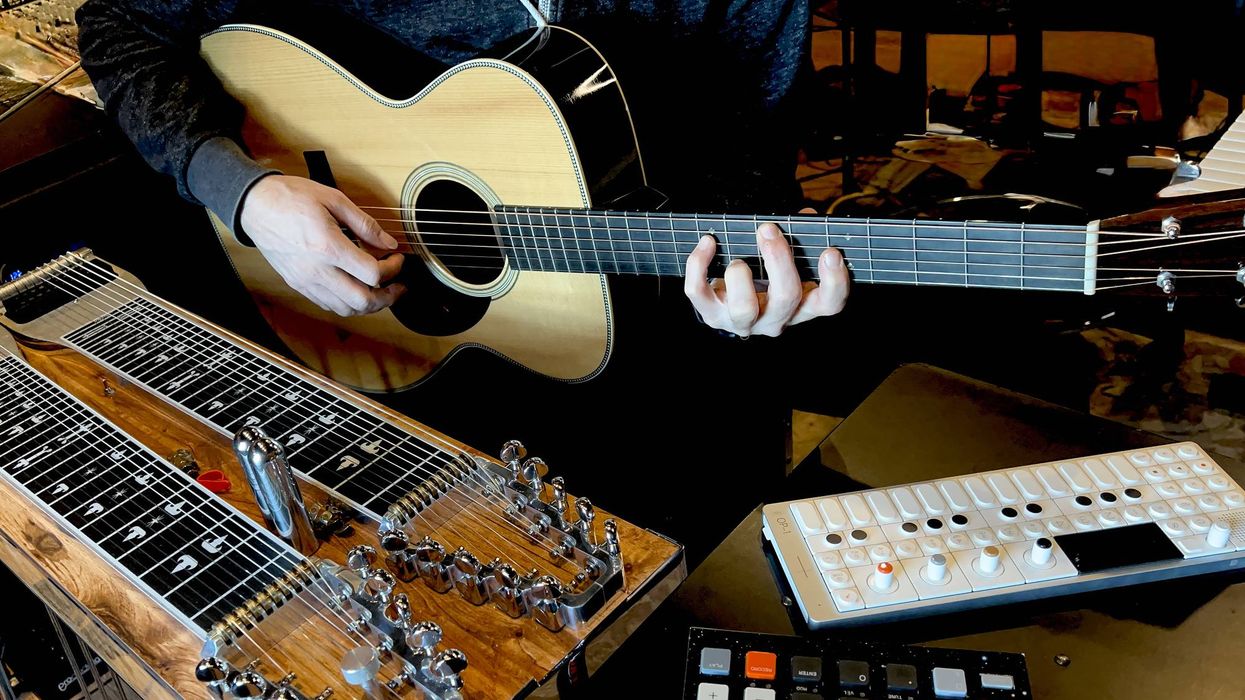
Most people think of samplers as drum machines with delusions of grandeur—four-bar loops, predictable patterns, and neatly sliced bits living forever in the prison of the grid. But for me, samplers and loopers are something completely different. They’re instruments of disruption. They’re creative accelerants. They’re circuit breakers designed to shock me out of my comfort zone and force my compositions, productions, and performances into strange, exhilarating new shapes.
One of my favorite studio practices—and something I encourage my Recording Dojo readers to experiment with—is to sample your performances. Not a preset library, not a pack from somebody else, but use your own melodic lines, motifs, rhythms, textures, and half-formed ideas. There’s something magical about hearing your own musical DNA come back to you in an unfamiliar, mutated form. It’s like collaborating with a version of yourself from an alternate timeline.
The real thrill isn’t about capturing pristine performances. In fact, it’s often the opposite: I’ll grab a phrase that’s imperfect, or mid-gesture, or harmonically unresolved, and drop it into a sampler purely to see what it becomes. When you do this, your musical habits—your well-worn licks, default rhythms, and predictable choices—don’t stand a chance. The sampler shreds them, recontextualizes them, and hands them back as raw material for re-writing, re-arranging, or composing something that never would have emerged in a linear workflow.
Sometimes the transformation is subtle—a lick becomes a rhythmic ostinato, a sustain becomes a pad, a passing tone becomes a focal point. Other times the sampler just mangles it, spits it out sideways, and you think, ‘Oh… now that’s interesting.’ Either way, it becomes a tool for breaking patterns, both musically and psychologically.
My Process: Mutations, Not Replications
My approach to sampling isn’t any more complicated than anyone else’s. I’m not using some secret, elite technique. I’m simply collecting fragments—little melodic cells, rhythmic quirks, harmonic gestures—and giving them permission to misbehave.
I’ll chop up key licks into uneven slices, or isolate just the back half of a phrase, or extract a rhythmic hiccup that wouldn’t survive in a normal editing session. Then I reassemble these bits with the expectation that they won’t behave. I want mutations. I want the musical equivalent of genetic drift. I’m not trying to color within the lines; I’m trying to see what happens when I throw the coloring book across the room.
Once the sampler gives me something intriguing, I run these new creatures through chains of further processing: glitch delays that stutter and fold the sound into origami-like shapes, micro-loopers feeding into overdrives or fuzz pedals, shimmering reverbs that stretch a 200-millisecond blip into a widescreen texture. The result can be anything from a ghostly sustained pad to a snarling, percussive accent, to a completely alien harmonic bed.
You can use these elements as alternate melodic lines, counterpoint, ambient beds, transitions, ear candy, or even structural material for entire songs. And because the source is you, the end result stays connected to your musical identity—just bent, twisted, and refracted into something fresh.
Outcome Independence: The Spirit Behind the Process
If there’s one thing that makes this approach powerful, it’s letting go of the expectation that what you sample must “work.” This is pure experimentation, not product-driven crafting.
I’m outcome-independent when I do this. I’m not looking for a result so much as engaging in the joy of the unknown. Some days nothing meaningful emerges. Other days I strike gold. But either way, the process sharpens my creative instincts. It keeps me curious.
“There's something magical about hearing your own musical DNA come back to you in an unfamiliar, mutated form.”
I use this same strategy when producing artists or working on film and soundtrack material. Recently, I applied it to pedal steel—an instrument known for its lyrical beauty—and the resulting textures were … well, not beautiful in the traditional sense. They were fractured, shadowy, almost Jekyll-and-Hyde. Perfect for a track built around the duality of personality. The clients absolutely loved the unpredictable, emotive soundscape those mutated pedal steel lines created.
Some Favorite Tools for Sonic Mutation
You don’t need a million pieces of gear to do this. A single sampler and a single effects chain can take you far. But here are a few of my favorite “chaos engines,” all of which I own and use regularly:
• Teenage Engineering OP-1 Field – A sampler, synth, tape machine, and chaos generator disguised as a minimalist art object. Its sampling engine and tape modes are perfect for tonal mutations.
• Teenage Engineering EP-133 K.O. II – A quick, dirty, wonderfully immediate sampler for slicing, punching, and recombining your ideas without overthinking.
• Omnisphere 3 – The granular engine alone is a goldmine for turning simple samples into cinematic, evolving textures.
• NI Maschine – Still one of the fastest environments for grabbing a sound, flipping it, and building an idea around the unexpected.
• …and whatever else you have lying around. The point is exploration, not allegiance to any one workflow.
Final Thoughts
Sampling your own voice as an instrumentalist—and then breaking it—reminds you that creativity doesn’t live in the safe, predictable spaces. It lives in the moments where you lose control just enough to discover something new. Give your sampler permission to surprise you, confuse you, and sometimes even challenge your sense of what you sound like. That’s where the good stuff begins.
Listening and Looking with Steve Tibbetts

There is a specific thread of experimental musician whose real motive is to deal in mystery and wonder. Think conceptualists like Brian Eno and David Bowie, sonic conjurers Sunn O))), transcendent improvisers as varied as Alice Coltrane and Loren Connors, song mystic Annette Peacock—each artist’s work is tied to something that happens beyond the notes, something bigger than just the sounds we hear. And for the listener, there are no easy answers. You can research and dissect compositional and production methods, know all of the gear that was used inside and out, break down all of the influences. But you’re always left with something to chase, to try and understand more deeply. For some, that’s the thrill.
Steve Tibbetts works with these ineffable parts of music, and he has ever since his 1977 self-titled debut. His albums create experiences that, at times, approach definability, but remain elusive: He’s a guitarist, but his music isn’t necessarily “guitar music”; his work is rooted in traditions, but it’s not traditional. So, what is it?
Since the beginning of the 1980s, Tibbetts’ records have been released primarily on the ECM label—the longstanding preeminent home of meditative and ambient jazz and jazz-adjacent sounds. On his earlier releases, you may hear grooves assembled around percussion from various global cultures mixed with suspended 12-string acoustic strumming, soaring evocative melodies, and, at times, blazing electric guitar solos. The cover images on his albums are striking, and often created by the composer himself, capturing some moment in a similarly un-pinnable land—check out the rock formations on either 1980’s Yr or 1986’s Exploded View, for example. The whole blissed-out package is conceptually inspired by place and tradition, yet totally untethered and fresh.
“If I just sat around and played guitar all day long, I don’t know how that would go.”
On more recent releases, and especially on his latest, Close, Tibbetts’ sound has evolved toward something else—more big-picture, but also more personal. Raw and organic sounds mix with a futuristic sonic landscape (and yet, he uses antiquated technology to create those sounds). Close feels like a universal meditation, a grand vision that pulls sounds from across the globe and reaches beyond, toward some distant sonic horizon, overcoming instrument and process. Basically, it sounds like nothing else.
Enigmatic as that is, over the course of an hour or so on our video call, Tibbetts himself proved to be anything but. Speaking from his wood-paneled Minnesota studio, where he’s made much of his music since 1985, he revealed his process and the philosophy behind it—a methodology deeply tied to his own experience of the world.
For Tibbetts, creation starts simply. “You have to sit down and put your hands on the instrument,” he explains. And it’s all about vibe. “Sometimes, it's a matter of getting the guitar warmed up. Hoping for the right humidity in the room.”
In order to keep things moving, his studio is always ready to go—his mics in position and DAW loaded up. “The process is to come to the studio, make a cup of coffee, begin to play, and see if we get to that point,” he says. He starts solo, bringing in other players further down the line. “Nobody cares how loud I get here. I’ve got a couple of Marshall JCM 800s, a younger Marshall, and as long as I wear adequate ear protection, I’m fine. I can get the sound that I need.”

Steve Tibbetts’ Gear
Guitars
Martin D-35 12-string
Martin DM-12
(Fishman TriplePlay pickup for acoustics)
1971 Fender Stratocaster
Amps
Marshall JCM 800 combo
Matchless Lightning 15 watt
Strings
John Pearse custom 12-string sets with double courses instead of octaves
GHS Boomers (Medium)
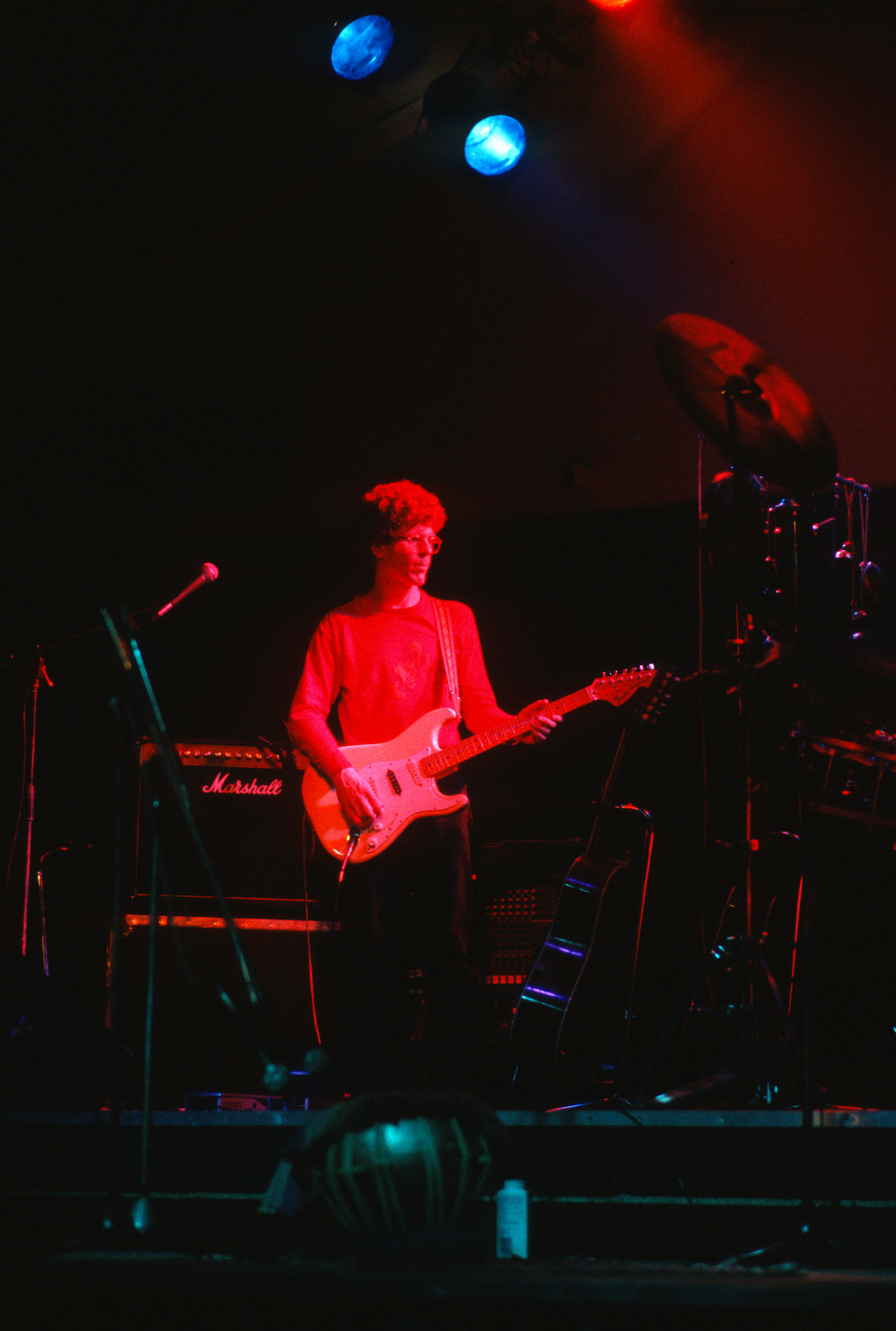
The days slowly add up. “Do you know what it’s like when you wake up in the night and your fingers are throbbing?” he asks. For him, “that usually means it’s been a good, productive day at the studio. Then you come back the next day. Is there anything worthwhile? Probably not. But after five or six years, you’ve got something—30 minutes, 40 minutes worth of pieces.”
As the music takes form, at some point, he brings in collaborators. On Close, Tibbetts is accompanied by percussionist Marc Anderson, his longest-running musical partner, and drummer JT Bates.
“It begins to sort of assemble itself,” he continues. “It is a little bit of a cliché, but at a certain point, you are in service to the music that you've created and you just need to do a good job with it.”
He quickly balances that thought with a dose of reality: “Mostly, the process is one of tedium, boredom, failure, and actually figuring out what I need to do when I've started the car and am on the way home.”
“What a good thing to do, to listen and look at stuff.”
Tibbetts’ music isn’t purely an in-the-studio creation, though. The world outside his walls plays a major role. “If I just sat around and played guitar all day long, I don’t know how that would go. Maybe there are some guitar players who can do it,” he muses. “Sometimes, the process is to give up entirely and go someplace a long ways away and listen to some loops or little lines that you have as you’re walking around.”
That’s the specific method Tibbetts followed on 2018’s Life Of. He explains: “There’s an area in northern Nepal, close to Tibet, called Lhasa. Difficult to get to, but a friend of mine, a professional clown, named Marian, said, ‘We’re going to Lhasa, do you want to come?’ And I thought, I’ll go there, and I’ll make little mp3s, 60 minutes or so, to listen to while we're walking. That’s what I did. When I came back, I had a good idea of what I wanted to do to put things together.”
For those who can’t travel quite so far, he recommends just getting out of your surroundings. “What a good thing to do,” he enthuses, “to listen and look at stuff. Even mixing. I’m looking at the same paneling here all the time. It doesn’t work. You can take your little laptop now and go to a coffee shop and say, ‘This song is gonna be about this couple over here, or that guy drinking coffee by himself.’ Just mess with your mind a little bit.”
“If it’s not fun, I’m not interested.”
Travel has inspired Tibbetts work throughout his career, thanks especially to his early experience working for study-abroad programs in Bali and Nepal. “That was hard work,” he explains, “but I got to live in cultures where there was different music. Balinese gamelan, if I hear it in Minnesota, it’s just annoying. But over there, it sounds like it fits. The double drumming technique, I had to be in it and study it to bring it back.”
Across the globe, Tibbetts has collected the recordings to incorporate in his music. The idea goes back to his 1997 album, Chö, a collaboration with Tibetan singer Choying Drolma. “We made that record in Kathmandu, Nepal,” he says. “Her singing was incredible. I didn’t want to just strum along on guitar, I wanted to use some of the sounds of Tibetan longhorns, some of my own sounds like bowed hammered dulcimer, my wife’s wine glasses….”
Tibbetts continues, “I did that. And then we got an offer to go out on the road. Desperation takes hold. How am I gonna do this? There’s gotta be a way.”
He devised a setup to trigger samples with his guitar using a Roland MIDI pickup that “had a cable that was about as thick as a stalk of corn that went to another box that would jack into a sampler, probably with a SCSI port.” Inconvenient, but, Tibbetts says, “it did work and we did take that on the road, and then I thought, this will be a good composing tool, this will be fun.” He pauses, and adds, “If it’s not fun, I’m not interested.”
More recently, Tibbetts switched to a Fishman wireless system to trigger the samples. But the samples themselves come from an old version of MOTU’s Digital Performer, which requires him to keep his computer “probably 15 operating systems behind what’s current now.” (He jokingly explains: “I’m working with antiquated technology. I’ve got buggy whips and wooden wheels here.”)
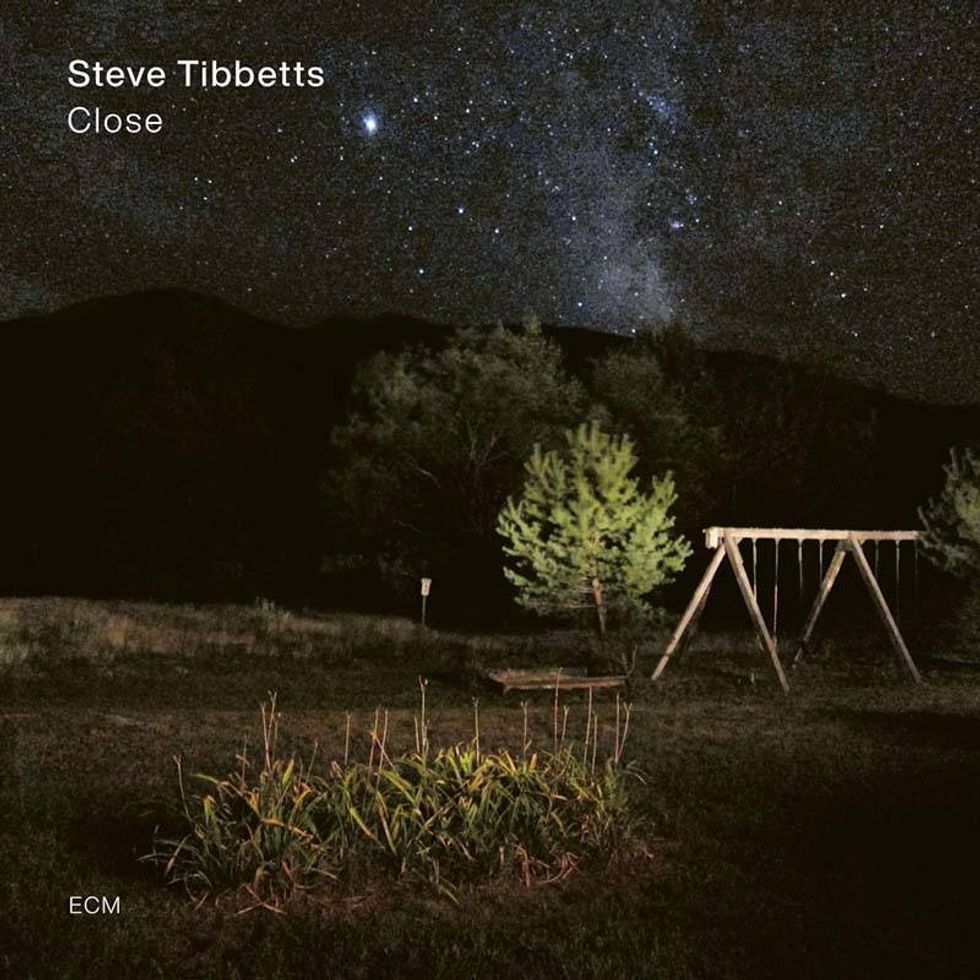
The result is otherworldly. Global sounds enmesh with Tibbetts’ strings, opening up the possibilities of his guitar—a sum-is-greater-than-the-parts experience where you might not realize what exactly is being played or where it’s coming from.
Knowing the sources, however, enriches the experience. Because though some of Tibbetts’ samples are created at home in his studio, many have a story. “I can still hear the chicken in the gong,” he says, launching into a story that goes back to his time working for a study-abroad program in Candi Dasa, Bali. He took the class to visit “a guy that did two things: made sacred knives that they use for ritual activities and had a gong shop.” He explains that gongs for gamelans are all made at the same time to coordinate the orchestra’s tuning, and they visited on a day where new bronze would be poured. “This was a once-in-a-lifetime thing. We went down there and spent a day watching these guys beat the shit out of these things to get them in their own tune, which is still a good 30 or 40 cents off what we would call in tune, but together it sounds good.
He continues: “I spent an extra day there sampling these gongs. I would hit the gong softly. I’d mute it. I would hit it hard.” The gong-maker was curious. “He said, ‘Let me listen to it.’ He listened to it on the headphones and said, ‘I’m sorry my chicken is squawking.’ I said, ‘It’s okay.’ And then the next thing I heard was no chicken squawking. He invited me for dinner. I declined.”
On Close, focused listening reveals another sonic element—the sound from Tibbetts’ acoustic guitar. Often more polished, it’s more raw this time around than on his other records—sometimes you’ll hear buzzing, fretting, and breath sounds. It gives his playing an intimacy, a warmth that stands out. It feels close.
Early in the creation process, Tibbetts wasn’t confident this was a direction he wanted to pursue. So he had Anderson listen to some takes. “People who work alone a lot tend to become a little inbred with themselves, start not understanding what direction they’re going in, or if they’re going in the right direction, or if anything is any good at all,” he muses. “Marc and I have been working together since 1979. His ears are very good. He made me understand that I already knew that this was okay. I just needed confirmation from him.”
He continues, “I am going for the feeling. I guess we’re always going for the feeling, but I just didn’t want to ditch a take because I happened to make a sound, a bad fret sound, a new string sound….”
With Closenow out in the world, don’t hold your breath to catch Tibbetts live—his performances are rare. When asked about this, it’s clear his days of getting in the van are long gone, adding that one-off gigs are also “not that great. It usually takes a few gigs on the road before you get your chops together, lighting, sound, loading in, loading out, your pedals, whatever you have….” But he says there are those occasional gigs that afford the travel, rehearsal time to get it together, and make a compelling enough offer. “If the gig is weird enough and far away enough,” he says, “we'll do it.”Courtney Cox Breaks Down Burning Witches Guitars, Tone, and Touring Gear
Burning Witches guitarist Courtney Cox joins the Axe Lords to talk technique, tone, and the realities of life as a modern touring guitarist. She breaks down how the band writes and records across borders, works under brutally short studio timelines, and balances locked-in rhythm playing with expressive lead work. Cox also explains why learning by ear—not regimented practice—has always driven her playing, and how ADHD shapes both her focus and creativity.

The conversation traces her path from early touring as a teenage prodigy through her years with Iron Maidens, to designing multiple signature guitars built for extended range, lower tunings, and long tours. Along the way, she gets specific about gear and discusses the realities of being a working guitarist, from social media burnout and Patreon economics to perfectionism onstage—and knowing when to stop forcing it and just play.
Follow Courtney @ccshred
Axe Lords is presented in partnership with Premier Guitar. Hosted by Dave Hill, Cindy Hulej and Tom Beaujour. Produced by Studio Kairos. Executive Producer is Kirsten Cluthe. Edited by Justin Thomas (Revoice Media). Engineered by Patrick Samaha. Recorded at Kensaltown East. Artwork by Mark Dowd. Theme music by Valley Lodge.
Follow @axelordspod for updates, news, and cool stuff.
The Lowdown: Why Do We Never Take Lessons as Professional Musicians?

In late 2015, I basically quit playing bass and spent a year traveling with the Bryan Brothers as their fitness coach. For those not familiar with the tennis world, they’re the most successful doubles team of all time, with 119 titles as a team, 16 Grand Slams, an Olympic gold medal, and a record 438 weeks (including 139 consecutive) at number one in the world.
Much like I’m an amateur tennis player, they’re amateur musicians. We met through music, specifically through our mutual friend James Valentine from Maroon 5, who is also way into tennis.
I was going through a divorce and needed a change of scenery. They had just lost early in the US Open and were back in California, so we started training together. They asked if I wanted to come out on tour with them—initially to make a bit of a documentary, as their career was going to wind down in the not-too-distant future. As we trained more, that morphed into going to the world tour finals in London, me becoming part of the team, working the off-season with them at the end of 2015, and then getting on a plane to Australia to start the 2016 season.
“I realized very early on that any serious tennis player on the modern tour doesn’t step foot on a court or into a gym without a coach or trainer. Ever.”
Early in the season, I woke up to my phone melting down in Australia because Bob had given an interview with The New York Times and mentioned me joining the team: “…Janek Gwizdala, an accomplished jazz musician turned fitness guru.” I didn’t realize how many of my music friends were into tennis until that moment, but they sure let me know about it double-quick. Most didn’t believe I was actually on the tour until I was getting them tickets to come see our matches.
All this is to say, I got to see the real day-to-day workings of professional athletes—not just at the top of their field, but at a historically important and legendary point in their careers. We practiced alongside Nadal and Federer regularly, did cryotherapy with Djokovic, and shot the shit in the physio room with Andy Murray. As a tennis fan, it was off the charts.
But when I eventually returned to being a musician and got back into the swing of my musical career, I carried a lot of priceless information with me from my time running around the world on the ATP Tour.
Most importantly, I realized very early on that any serious tennis player on the modern tour doesn’t step foot on a court or into a gym without a coach or trainer. Ever.
And what do we do as musicians? If—and that’s a big if—we go to some sort of music school between 18 and 22, we leave, we’re flat broke because it cost a fortune, and we might never take another lesson for the rest of our careers.
Not once in my 20s, having quit Berklee and moved to New York City, did I have anyone consistently guiding my playing, my mental capacity to deal with what it takes to break into the New York scene, my choices of gigs, sessions, tours—anything. I had friends, sure. We’d talk and commiserate over certain things. But they had no more experience than I did, for the most part.
Sometimes you’d be lucky enough to make friends with a far more senior musician in the scene, and you’d hang on every word and story like a kid getting to stay up late watching TV you shouldn’t see that young. But as amazing as those stories were, they were stories from a bygone era that bore little relevance to where I was at.
What I’ve made a conscious effort to do over the past decade—since that incredible experience of being in a completely different, intense professional scenario—is seek out advice, mentorship, lessons, and coaching whenever possible. Sometimes that’s been for my music, sometimes for business, other times for health or fitness when I’m trying to add something to my routine and want to get the most out of it.
If you’re a beginner or a pro—especially a pro—get a local teacher. Find someone you trust, someone you respect, and take a lesson once in a while. It’s amazing to have someone to talk to, to gain confidence from, and to help you remember you’re not alone in so many of the things we struggle with as musicians.
Top 10 Rig Rundowns of 2025
This year was a big one for the Rig Rundown crew! John, Perry & Chris traveled to Boston, Cincinnati, Chicago, Milwaukee, and even a cave in Tennessee, while of course foraging in their home base Music City, to gather the biggest, brightest (and loudest) setups touring the world. Find out the most-popular episodes and behind-the-scenes adventures the tres amigos encountered in 2025.
Rig Rundowns supported by D'Addario
HONORABLE MENTIONS:
Rig Rundown: Jeff Tweedy

The Wilco frontman’s ’90s pawn shop raids are paying off decades later.
Rig Rundown: Marty Stuart & His Fabulous Superlatives

The legendary country musician and his right-hand man, guitarist Kenny Vaughan, prove that Fender guitars through Fender amps can still take you a long way in this world.
THE TOP 10:
10. Marty Friedman Rig Rundown
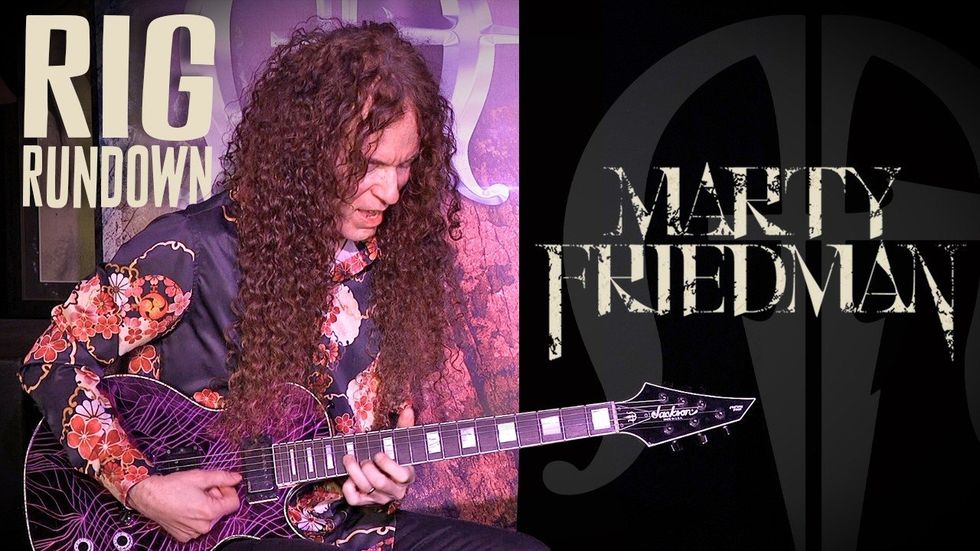
Marty Friedman and his trusted tech, Alan Sosa, who handles all effects switching manually during the show, showed us the goods.
9. The Who Rig Rundown

The Who need no introduction, so let’s get to the good stuff: PG’s John Bohlinger caught up with the band’s farewell tour at Fenway Park in Boston, where guitarist Pete Townshend’s tech Simon Law and bassist Jon Button’s tech Joel Ashton gave him a look at the gear that the infamous British rockers are trusting for their goodbye gigs celebrating 60-plus years together.
8. Fontaines D.C. Rig Rundown [2025]

The Irish post-punk band’s three guitarists go for Fairlane, Fenders, and a fake on their spring American tour.
7. Steve Stevens Rig Rundown

The Billy Idol guitarist rides his Knaggs into Nashville.
6. Dann Huff Rig Rundown
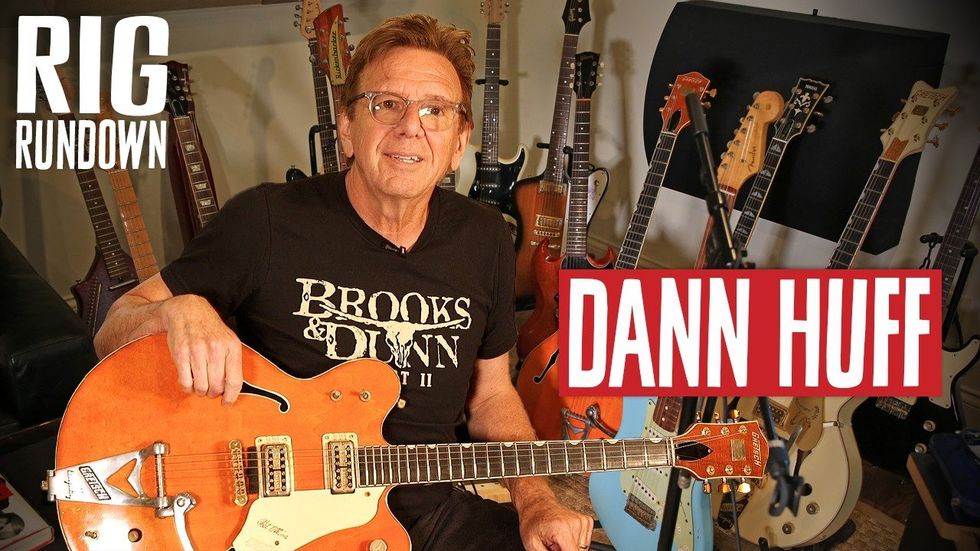
The all-star producer invites John Bohlinger to his home studio for a glimpse of his most treasured gear.
5. Queens of the Stone Age Rig Rundown with Troy Van Leeuwen

Fresh off a substantial break and a live acoustic recording from Paris’ infamous catacombs, hard-rock titans Queens of the Stone Age stormed back to life this spring with an American tour, including back-to-back nights in Boston at Fenway’s MGM Music Hall.
PG’s Chris Kies snuck onstage before soundcheck to meet with guitarist Troy Van Leeuwen and get an in-depth look at the guitars, amps, and effects he’s using this summer.
4. Keith Urban Rig Rundown for High and Alive Tour 2025

Down Under’s number one country guitar export—and November 2024 Premier Guitar cover model—Keith Urban rolled into Cincinnati’s Riverbend Music Center last month, so John Bohlinger and the Rig Rundown team drove up to meet him. Urban travels with a friendly crew of vintage guitars, so there was much to see and play. In fact, so much that they ran out of time after getting through the axes! Later, Bohli and Co. met up with Urban tech Chris Miller to wrap their heads around the rest of the straightforward pedal-free rig he’s rockin’ this summer.
3. System of a Down's Daron Malakian Rig Rundown
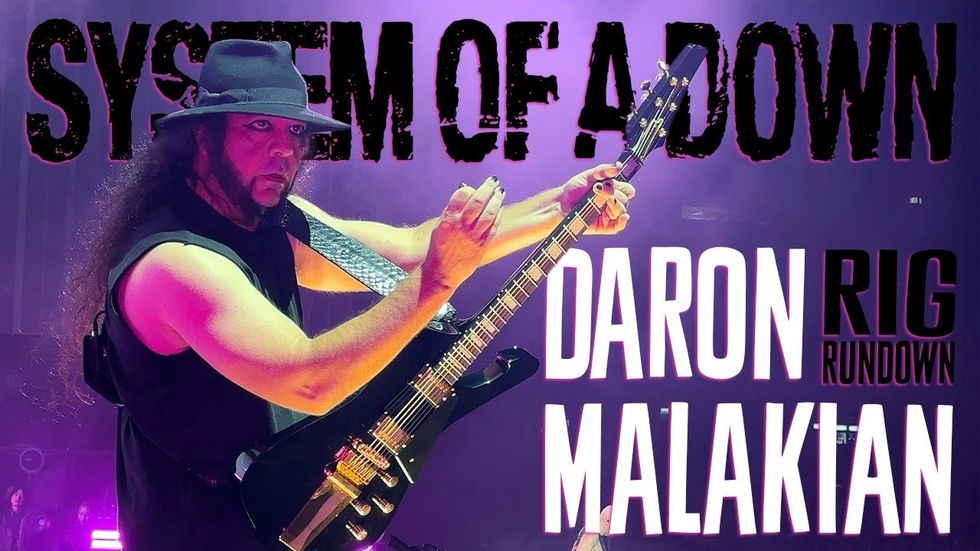
The metal giants return to the stage with a show powered by gold-and-black axes and pure tube power.
Except for two new singles in 2020, alt-metal icons System of a Down haven’t released new music in 20 years. But luckily for their fans, System—vocalist Serj Tankian, guitarist/vocalist Daron Malakian, bassist Shavo Odadjian, and drummer John Dolmayan—took their catalog of era-defining, genre-changing hard-rock haymakers on tour this year across South and North America.
2. Linkin Park Rig Rundown

Linkin Park went on hiatus for seven years after lead vocalist Chester Bennington’s death in 2017, but last September, the band announced that they were returning with new music and a new lineup—including vocalist Emily Armstrong and drummer Colin Brittain. A new album, From Zero, was released in November 2024, followed by the single “Up From the Bottom” earlier this year, and this summer, the band tore off on an international arena and stadium comeback tour. Founding lead guitarist Brad Delson is still a creative member of the band, but has elected to step back from touring. And so on the road, Alex Feder takes his place alongside founding guitarist/vocalist/keyboardist Mike Shinoda, DJ Joe Hahn, and bassist Dave Farrell.
1. Deftones' Stephen Carpenter Rig Rundown

California metal giants Deftones returned this year with Private Music, their first album in five years. In support of it, they ripped across North America on a string of headline shows and support slots with System of a Down.
We linked with Deftones guitarist Stef Carpenter for a Rig Rundown back in 2013, but a lot has changed since then (and as Carpenter reveals in this new interview, he basically disowns that 2013 rig). Back in August, PG’s Chris Kies caught up with Carpenter again ahead of the band’s gig in Milwaukee, Wisconsin, where the guitarist gave us an all-access walkthrough of his current road rig.
Acoustic Soundboard: The Ethics and Practice of Revoicing Flat-Top Guitars
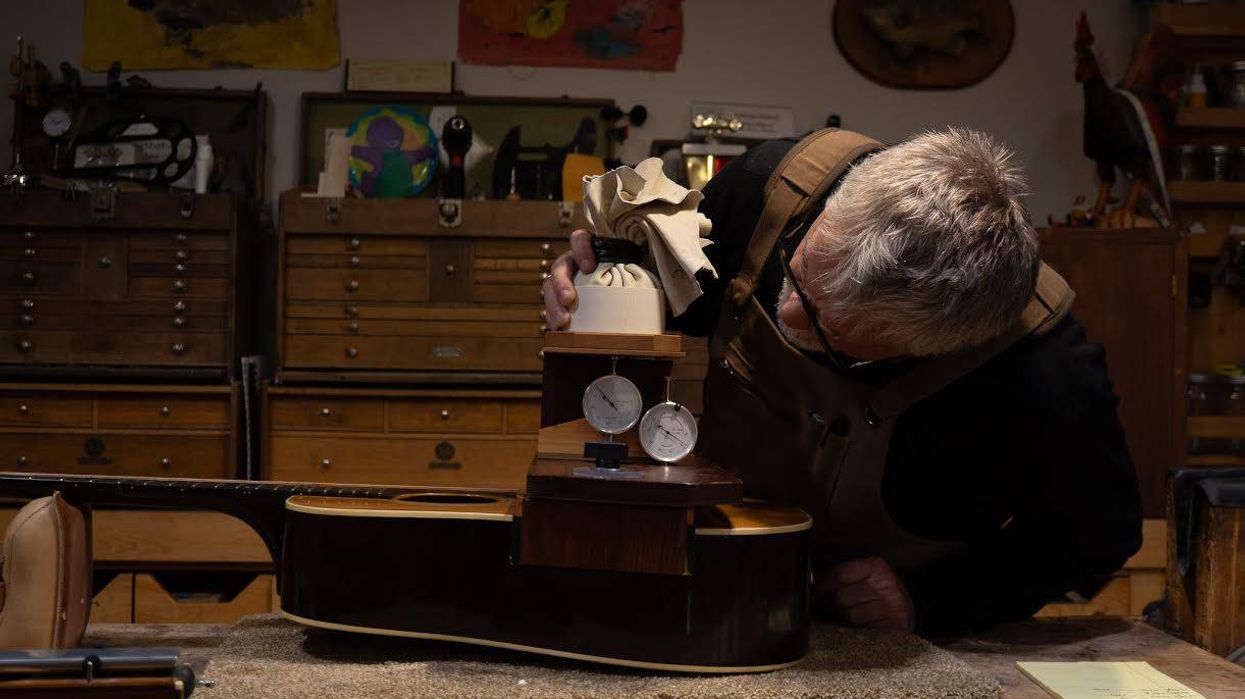
Revoicing flat-top steel-string guitars is something I’ve practiced for decades. In the early days, once I discovered what scalloping was and how it affected tone, I began reaching inside instruments and carving braces in hopes of improving their sound. The problem was that I had no real idea what I was doing, no sense of targets, and certainly no clear understanding of purpose. Fortunately, I didn’t attempt this on many guitars, and never on anything of real value.
As time went on and I began building my own instruments, I developed the ability to tune tops through scalloping or tapering braces. This gave me valuable insight into what to look for when approaching revoicing later in my career. The process became more disciplined; it included setting air resonance, balancing top and back frequencies, and measuring deflections.
But the question remains: Should we even be revoicing guitars at all?
In the violin world, revoicing is standard practice. Instruments are designed to be disassembled and worked on, and re-graduating tops is one of the most common procedures performed on vintage violins, violas, and cellos. These repairs are done routinely, even on valuable vintage instruments, and often multiple times across their lifespans. This tradition also extends to historical pitch change, such as the move from A=340 Hz to A=440 Hz, where instruments had to be physically altered to remain functional. Violin makers are trained from the very beginning to understand instrument revoicing and the practice is widely accepted.
“For those with the training and experience, revoicing can transform a lifeless guitar into something inspiring and enjoyable to play.”
Flat-top steel-strings are different. We now have guitars, pre-war Martins in particular, that are considered the Stradivari of the flat-top world. These instruments already sound extraordinary, and carving on their braces would not only be unnecessary, but destructive. Still, not all guitars share this level of excellence even within vintage Martin examples. Over the years I’ve encountered many instruments that simply missed the mark, where the relationships between air, top, and back resonances were poorly balanced.
Take, for example, a Guild D-40 from the 1980s that recently came into my shop. Guilds of that era were well-built, sometimes even overbuilt. This particular guitar measured an air resonance of 101 Hz, a top resonance of 200 Hz, and a back resonance of 207 Hz. The problem was obvious: The top was so tight at 200 Hz it had restricted musicality, and its frequency nearly sat on top of the back, only separated by 7 Hz. Worse, the air resonance, at 101 Hz, was far too high for a large-body guitar, which typically falls around 95 Hz or lower.
This guitar was crying out for a revoice. My plan was simple: reshape and scallop the accessible braces on the top, drop the top resonance into the 170 Hz range, and allow the air resonance to settle near 95 Hz. Step by step, I carved, restrung, measured, and repeated until the targets were met. The top gradually dropped: first to 190 Hz, then 180 Hz, and finally 173 Hz. The air resonance followed, landing at 95 Hz. The results were dramatic. The instrument opened up, resonances began to couple, and its musicality increased significantly.
Of course, there are caveats. Any revoicing work voids a warranty, and on a new instrument that can be a serious consideration. In this case, the Guild was decades old, had changed hands multiple times, and carried no warranty concerns. More importantly, the guitar was so overbuilt that there was little danger in loosening the top.
So, what are the ethics of revoicing? Should you attempt it? The answer is clear: Unless you thoroughly understand resonance, frequency targets, deflection values, and how they interact, you should not. For those with the training and experience, however, revoicing can transform a lifeless guitar into something inspiring and enjoyable to play.
In restoration, the golden rule is to enter and exit an instrument without leaving a trace. But sometimes, as with this Guild, the only way forward is to make meaningful change. Done carefully, with respect for the instrument and for the physics of sound, revoicing is not only ethical; it can be a gift to both the guitar and its player.
Mayones Duvell DT-7 Giveaway!

Win a Maynoes Duvell Dt-7, a 7-string built around clarity, control, and directed tone. Enter by January 30 ,2026.
Mayones Duvell DT 7 String Giveaway
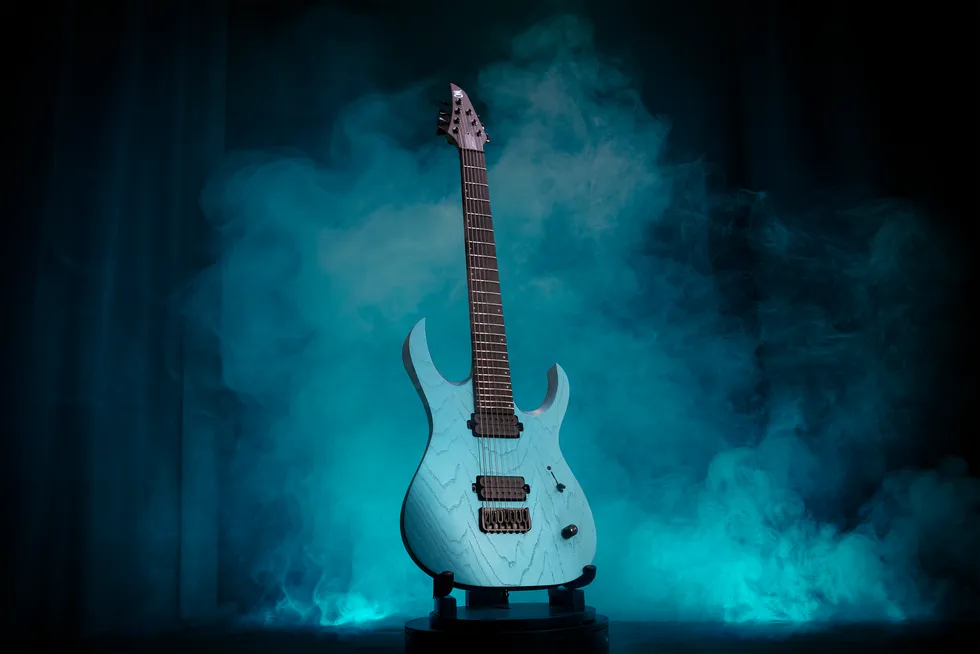
Duvell DT-7
Duvell DT was created with the “Directed Tone” concept in mind. It’s about mastering simplicity and letting the core of the music resonate deeply with both the performer and the audience.
Question of the Month: Is the Vintage Juice Worth the Squeeze?

Question: Is expensive vintage gear really worth the price?
Guest Picker
Iyad Moussa Ben Abderahmane, a.k.a. Sadam (Imarhan)
A: In terms of music gear, I’m not a big collector. But I’ll always pick vintage over newer stuff. I’m a fan of old Gibson guitars—I actually own an SG from the late ’70s, either ’78 or ’79. It sounds amazing and is really easy to play.
Obsession: My current obsession is figuring out how I can help keep the Tamasheq language alive. I’m thinking about writing a book so my kids can learn it, and maybe even finding a way to connect the language to tourism in southern Algeria. I believe we need to develop tourism around Tamanrasset—it could play an important role in safeguarding our culture.

Reader of the Month
Derek Rader
A: My answer … maybe. What motivates you to play and perform is worth the money within a person’s means. If a vintage guitar price isn’t unobtanium, and it has the feel, sound, and mojo, then it’s an emphatic yes! However, a myriad of luthiers and custom shops can provide a similar experience with modern production methods, materials, and electronics, at a lower cost, and the comfort of a warranty. There isn’t a wrong choice if the purchase is motivated by what drives you to play and write music that created the spark to pick up your first guitar.
Obsession: Music theory! A definite area for improvement, and I’m working with the talented Mr. Cris Eaves to improve as a player. Amazing journey!
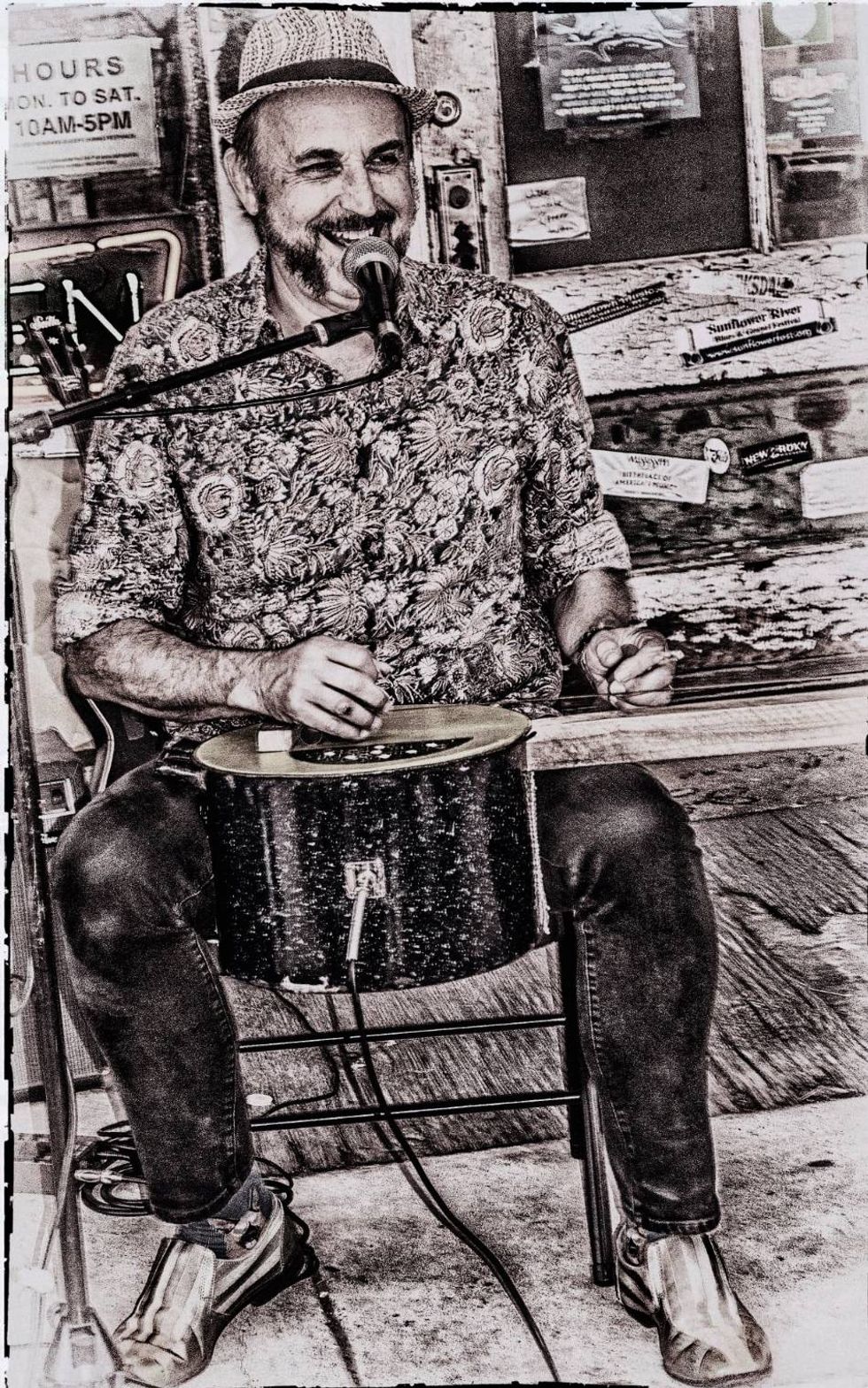
Contributing Editor
Ted Drozdowski
A: I used to be dismissive about vintage gear until Ronnie Earl let me play his ’64 Strat years ago. I instantly sounded and played better. Now, I treasure my vintage instruments: a ’68 Les Paul, a ’58 Special, a ’72 Super Lead, a ’64 Supro Tremo-Verb, and an original Maestro Fuzz-Tone. Nothing sounds quite like these originals. That said, I can’t imagine spending six digits on a guitar—even if I had that much cake—unless I was also giving a lot to charity.
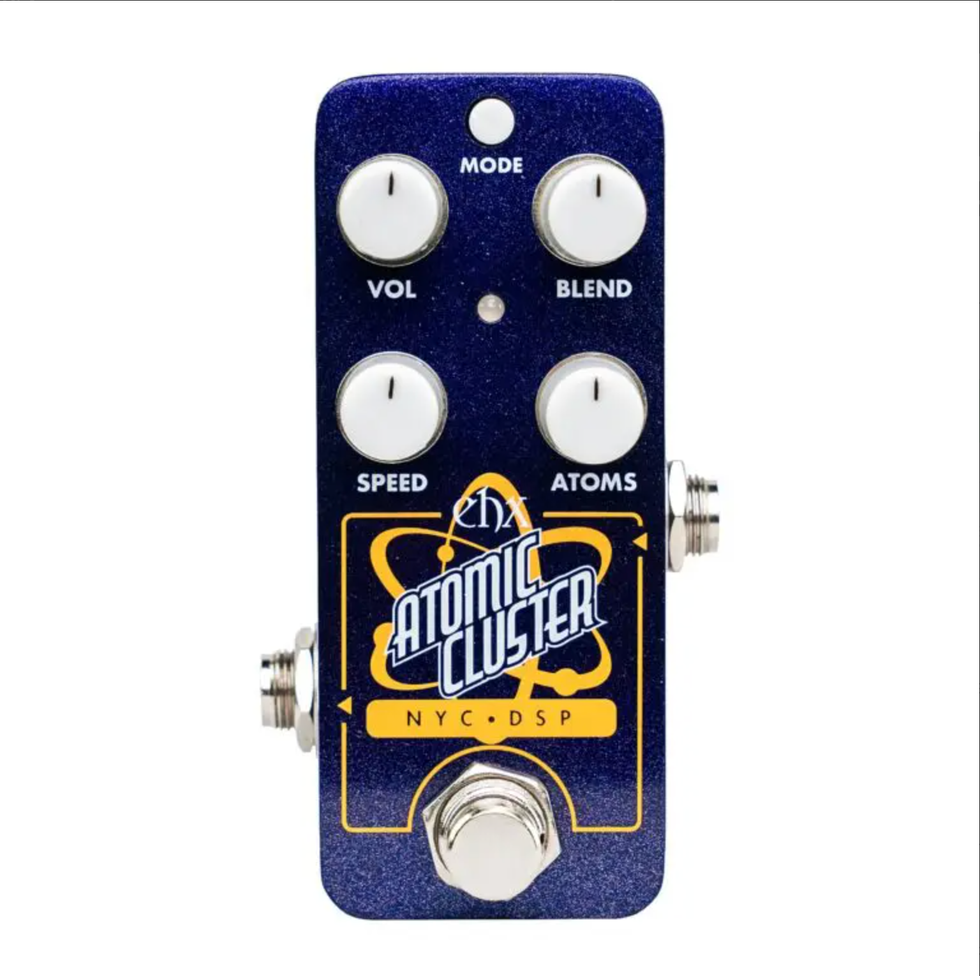
Obsession: EHX’s new Pico Atomic Cluster Spectral Decomposer. It’s full of sounds I’ve been looking for!

Gear Editor
Charlie Saufley
A: Vintage-or-not is a completely case-by-case thing, and there is no one criteria by which to judge the worth of an old instrument. Depending on your musical needs and manner of expression, some old things that have since been digitized don’t cut it in compact form. For instance, I’m tired of paying to fix my Echoplex EP-3, but I haven’t found a digital alternative that I can physically manipulate in the same way. Three little clustered dials just aren’t going to work or feel like the EP-3’s record-head slider/lever and the perfectly spaced sustain and volume knobs—not to mention the tape irregularities.
Vibes are a real thing too, though. I’m no less psyched when I play something I like on a brand-new Squier. But I also know that engaging with my old guitars and amps is a different kind of fun. It’s just like driving a car from the 1950s or 1960s. The right ones—in addition to feeling as comfortable as old, worn baseball gloves—exude a sense of history and travel and secret stories that appeal to a sentimentalist like myself, and those sensations spark my imagination in ways I can’t put a price on.
Obsession:
Inventing a melody, slowing it down—way down—and fitting a new melody in the spaces in between.
Home Front’s Post-Punk Call to Arms

When he was 10 years old, Graeme McKinnon walked into a pawn shop near his home in Edmonton, Alberta, and bought his first guitar for $50. It was a sharp-angled, all-black axe made by the Japanese company Profile as a low-cost imitation of a Jackson, with a knife-like headstock that jutted curiously upward.
“It looked like a reaper’s scythe,” McKinnon says, recalling the way he’d carry it around town in an awkwardly shaped gig bag. “Everyone thought I had a hunting rifle.”
It was the early ’90s, in the thick of the Seattle grunge movement, and McKinnon’s older cousin would often come over and play him Pearl Jam songs, which he didn’t really like. But when his guitar teacher showed him the Ramones, something unlocked in the youngster. As he improved his chops, McKinnon and his older brother, a bassist, would jam Dead Kennedys and Beastie Boys songs together. McKinnon was hooked on punk rock. “That’s how I cut my teeth,” he says. “The downstrokes from the Ramones stuck with me forever. I always practiced my right hand.”
Fast forward 30 years, and today McKinnon is one half of the post-punk duo Home Front, one of the most hyped-up bands to emerge from Canada in recent years. And the outfit’s new album Watch It Die should earn them a spot on the Mount Rushmore of the current post-punk revival, alongside other breakouts like Fontaines D.C., Idles, and Viagra Boys.
In 2021, McKinnon’s hardcore punk band No Problem was on hiatus and he was looking for a new outlet. That’s when his childhood friend Clint Frazier, previously a member of the electro dance-punk outfit Shout Out Out Out Out, asked him to start a synth-driven band.
“The downstrokes from the Ramones stuck with me forever. I always practiced my right hand.”—Graeme McKinnon
The style that they created combines the jangly sheen of synth-pop, the sneering attitude of old-school punk rock, and the hard-stomping force of oi! and hardcore. The band nicknamed it “bootwave,” a reference to the distinct sound of winter boots marching on ice-crusted snow or the cold concrete of the streets of Edmonton. “Our sound has this duality,” McKinnon says. “There’s the punk side, there’s the synth side, and it’s always these two forces.”
“We’re just trying to find enough space in the songs to do both of them well,” adds Frazier. “I’ve been trying to do that for over 20 years.”
Graeme McKinnon’s Gear
Guitars
Fender Classic Series ’72 Telecaster Deluxe (with new humbucker and graphite saddles)
1979 Gibson Marauder (with P-90 pickup and kill switch)
Hagstrom Viking
Basses
Fender Steve Harris Precision Bass
Fender Bass VI
Guitar Amps
1979 Marshall JMP
Hiwatt Custom 50
Marshall 4x12 cabinet
Bass Amps
Peavey Super Festival Series F-800B
Peavey Roadmaster Vintage Tube Series
Ampeg 6x10 cabinet
Effects
Roland SDE-3000
MXR Carbon Copy
EHX Holy Grail
Van Hall fuzz
MXR Analog Chorus
Various Pro Co RAT models
MXR Blue Box
Strings & Picks
Ernie Ball Regular Slinky (.010–.046) (Telecaster)
Ernie Ball Power Slinky (.011–.048) (Marauder)
Ernie Ball Regular Slinky (.045–.130), unchanged since 2019 (bass)
Dunlop .73mm picks

Watch It Die follows Home Front’s full-length debut, 2023’s Games of Power. That album earned them positive press from some of the indie-rock scene’s key tastemakers, and it was longlisted for the Polaris Music Prize. The band hit the road hard to support it, embarking on multiple tours of the U.S., the U.K., and mainland Europe, including dates with punk veterans like Dillinger Four and Cock Sparrer, as well as fellow newcomers the Chisel and High Vis.
Like its predecessor, Watch It Die is a record that posits that life is hard, the world is cruel, and it’s easy to feel powerless to make any difference. It’s a headspace that stops just a few yards short of nihilism. But this time around, McKinnon and Frazier are channeling something else, too: hope.
“Our sound has this duality. There’s the punk side, there’s the synth side, and it’s always these two forces.”—McKinnon
“I was using a metaphor of a flower being picked and becoming an ornament in someone’s place, and it’s slowly dying,” McKinnon says. “The secret, the bit that brings a little bit of hope, is that the seed is still in the ground. They can’t see it and they can’t steal it. You watched this part die, but underneath, there’s something else.”
With his previous bands, McKinnon had approached his instrument in much the same way he had since he was a kid: Ramones-style power chords and fast-and-furious downstrokes on his trusty Fender ’72 Telecaster Deluxe. With Home Front, McKinnon had to rethink his playing so that it could coexist with Frazier’s ordnance of analog synths and drum machines.

He looked for inspiration from bands he had always loved but hadn’t previously channeled: England’s ’80s post-punk and new wave exports like New Order, Joy Division, Depeche Mode, the Cure, A Flock of Seagulls, and Blitz. But he wasn’t just looking to do what they did; instead, he wanted to bring his hard-nosed punk style to the mix. “If the electronics are covered, then maybe the play is to bring that punk attack to the guitar to accent the synths,” he says.
On Watch It Die, McKinnon played almost everything through a 1979 Marshall JMP, giving him bright, saturated power chords that tracked well whether he was palm muting or fully strumming. The main exception was a cigar box amp made by a friend who works at an auto shop. It was miked close and cranked, giving them the trashy ’70s punk sound on “Young Offender.”
McKinnon used his Telecaster for most of the record, but he also brought out a 1979 Gibson Marauder with a swapped-in P-90 pickup, which he coupled with a German-made Van Hall fuzz pedal to find the nasty, scooped-out tone that appears on some of the record’s more straight-ahead punk songs like “Young Offender” and “For the Children (F*ck All).” On the new wave jams “Kiss the Sky” and “Between the Waves,” he pulled out a Hagstrom Viking that engineer Nik Kozub recorded by miking the semi-hollow body itself, giving the songs a thin, percussive jangle without having the low end of a proper acoustic muddying the mix.
For McKinnon, it was important to get his palm mutes sounding clean and punchy, and to have them perfectly aligned with the synth arpeggiators—even when he’d add swirls of reverb and delay in his chain. Enter his secret weapon: an old Roland SDE-3000 digital delay that he got from the TV studio where he works. McKinnon and Frazier used its BPM-sync function to dial it in to precisely match the tempo of the drum machines.
McKinnon also records all of the bass lines for Home Front. That, of course, comes with its own military-grade arsenal. On “Empire,” he pulled out all the stops. For the grand finale, he chained the Van Hall into a fully cranked Pro Co RAT, into the MXR Blue Box octave fuzz, and finally into a dimed-out Peavey Super Festival F-800B. It was “the nastiest fuzz bass I’ve ever played,” he says, creating a wall of sound inspired by My Bloody Valentine. Frazier accentuated that enormous gain-fest with eighth-note Roland 808s that he painstakingly tuned, note by note, so that each kick would follow the bass line, creating a pulsating effect that makes rhythmic sense of McKinnon’s fuzzed-out chaos.
That is, fittingly enough, the thematic throughline of Watch It Die: making sense of the madness. “Our lives are chaos all the time,” says McKinnon. “We have jobs that are going to end at any moment. The rent is too high, the groceries are too expensive, all these stresses, and then every time you open up your phone, there’s atrocities in the world. There’s shit your government’s doing, police breaking families apart, this is stuff you’re constantly thinking about, and it’s always hitting you.”
But Home Front aren’t just going to wallow in their sorrows. “On this record, I didn’t want to sound like, ‘Shit’s bad. I’m just gonna be kicking rocks,’” McKinnon continues. “It’s more like, ‘Shit’s bad, but this is how we’re gonna work through this, by having outlets that allow us to form like Voltron to terrorize the oppressors.’” PG
Source Audio Encounter Review
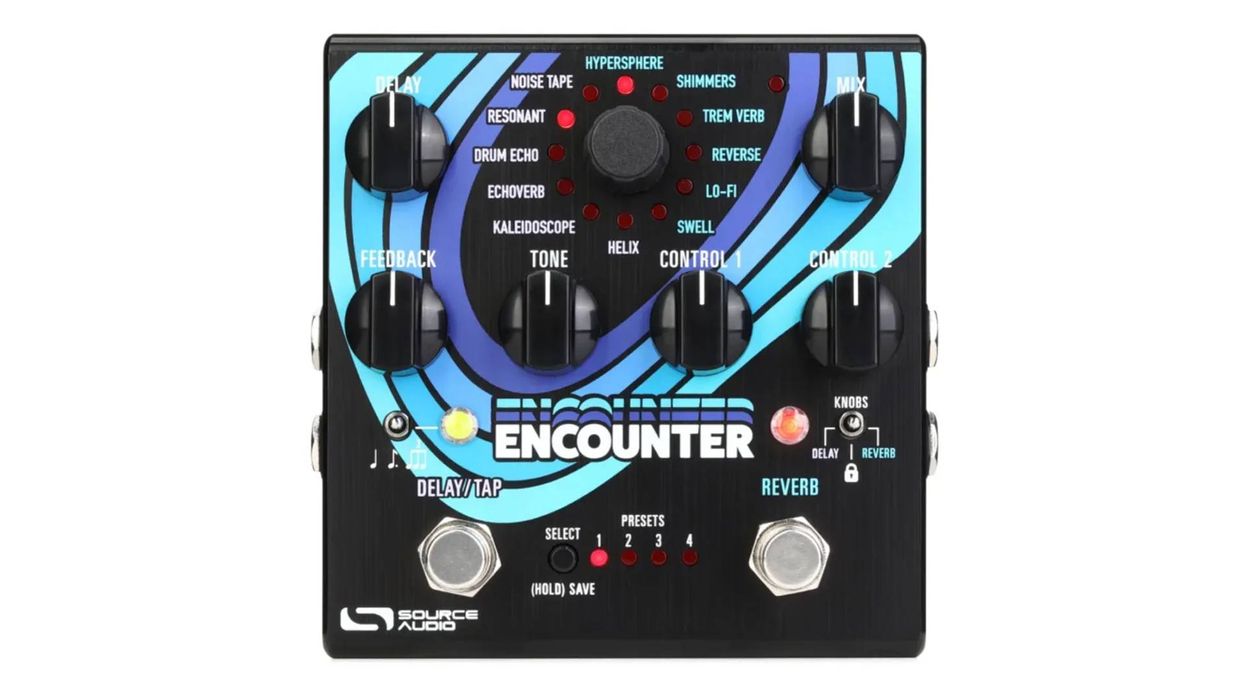
Reverb and delay. What two effects are better suited to live side-by-side in one pedal? Source Audio’s new Encounter reverb and delay is a mirror image of the company’s Collider, which explores the reverb/delay combo via a vintage lens. The mirror by which Encounter reflects the Collider, however, is more like the funhouse variety. There are many psychedelic, cosmic, and wildly refracted echoes to utilize in the Encounter. There are lots of practical ones that can be tuned to subtle ends, too. But Encounter’s realm-of-the-extra-real extras make it a companion for players that ply dreamy musical seas. It’s incredibly fun, a great spark for creativity, and, most certainly, a place to lose oneself.
Exponentially Unfolding
Of Encounter’s six reverb modes and six delay modes, four of them—the hypersphere, shimmers, and trem verb reverbs, and the kaleidoscope delay—are entirely new. Hypersphere, fundamentally, makes reverberations more particulate. Source Audio says it’s a reverb without direct reflections. In their most naked state, these reverberations can still sound a touch angular and perhaps not quite as ghostly and fluid as “no direct reflections” suggests. But they are still complex, appealing, immersive sounds. Odd reverberation clusters can conjure a confused sense of space and highlight different overtones and frequency peaks in random ways. At settings where you can hear this level of detail, hypersphere shines, particularly in spacious solo phrases. Hypersphere also features phase rate and pitch modulation depth functions via the control 1 and control 2 knobs, and they can further accent and enhance those frequency peaks, creating intoxicating, deep fractal reflection systems.
“Blends of the delay and reverb are the kind of places where you can lose track of a rainy day.”
The new trem verb mode can be practical or insane. The two effects together are a pillar of vintage electric guitar atmospherics. But the Encounter’s trem verb explodes those templates. As with the hypersphere mode, trem verb can zest simple chord melodies by using extreme effect settings at low mixes, where chaotic, half-hidden patterns dip in and out of the shadows, sometimes creating eerie counterpoint. But I loved trem verb most at extremes—mostly high mix, feedback, and decay settings with really slow modulation. Sounds here can be intense and vague—like strobe flashes piercing drifting fog. It might not be an ideal place to indulge fast, technical fretwork, but it’s a wonderland for exploring overtones, drone, and melodic possibilities.
Incidentally, the trem verb is a great match for the six delays, and the new kaleidoscope delay in particular, which fractures and scatters repeats in a million possible directions and spaces. Blends of the delay and reverb are the kind of places where you can lose track of a rainy day. The sound permutations often seem endless, and finding magic can take some attention and patience. But you can strike gold fast, too. You have to take care to save settings you really love (you can store as many as eight presets on board, and 128 total via midi) because it’s hard to resist the urge to meander through— and meditate on—hours of sound without stopping. Not all of the Encounter’s sounds are perfectly pleasing. Some combinations reveal peaky little chirps that betray digital origins—the merits of which are subjective and contextual. For the most part, though, the combined sounds are liquid and vividly complex, and can be especially enveloping at high mix and feedback.
Extended Reach
If the onboard controls don’t get you in enough trouble, downloading the Neuro 3 app, which unlocks deep control and functionality, is a minor wormhole. Take the case of trem verb—you can use Neuro 3 to change the wave shape or set up the reverb to affect the wet signal only, just the dry signal, or both of them. All of these changes open up a new system of tone caves as the sound evolves. If you’re deep in the nuance of a mix or arrangement, this functionality can be invaluable. And it’s a boon if you have nothing but time on your hands. In a state of engaged, intuitive workflow, I like to avoid these kinds of app dives. But having that much extended power on your phone or computer is impressive.
Neuro 3 extends the capability of the Encounter in other ways, too. The SoundCheck tool within Encounter is home to prerecorded loops of various instruments that you can then route through a virtual Encounter pedal. That means you can explore Encounter’s potential while stuck in a train station. It’s a real asset if you want to understand the pedal as completely as possible, and certainly a way to extract the most value from the unit’s considerable $399 price.The Verdict
About that price. It looks steep. For most of us, it’s a significant investment. But when I consider how many sounds I found in the Encounter, how compact it is, and the possibilities that it opens up in performance and portable production (especially when you factor in the stereo ins and outs), that investment seems pretty sound. I must qualify all this by saying I was happiest with the Encounter when exploring its spaciest places—the kind of atmospheric layer where Spacemen 3, ambient producers, 1969 Pink Floyd, and slow-soul balladeers all hang. But there is room to roam for precision pickers that background radical effects, too.
Still looking to justify the cash outlay? Consider the Encounter as a portable outboard post-production and mixing asset. If you’re creating music built on big, shape-shifting ambience, it’s a cool thing to have in your bag of tricks. Different artists will mine more from the Encounter than others, so you should consider our ratings scores on a sliding scale. But as you contemplate the Encounter, be sure to factor in mystery paths that will beckon when you dive in. There’s lots of fuel for creation along most of them.
On the Bench: 1959 Fender 5F1 Champ
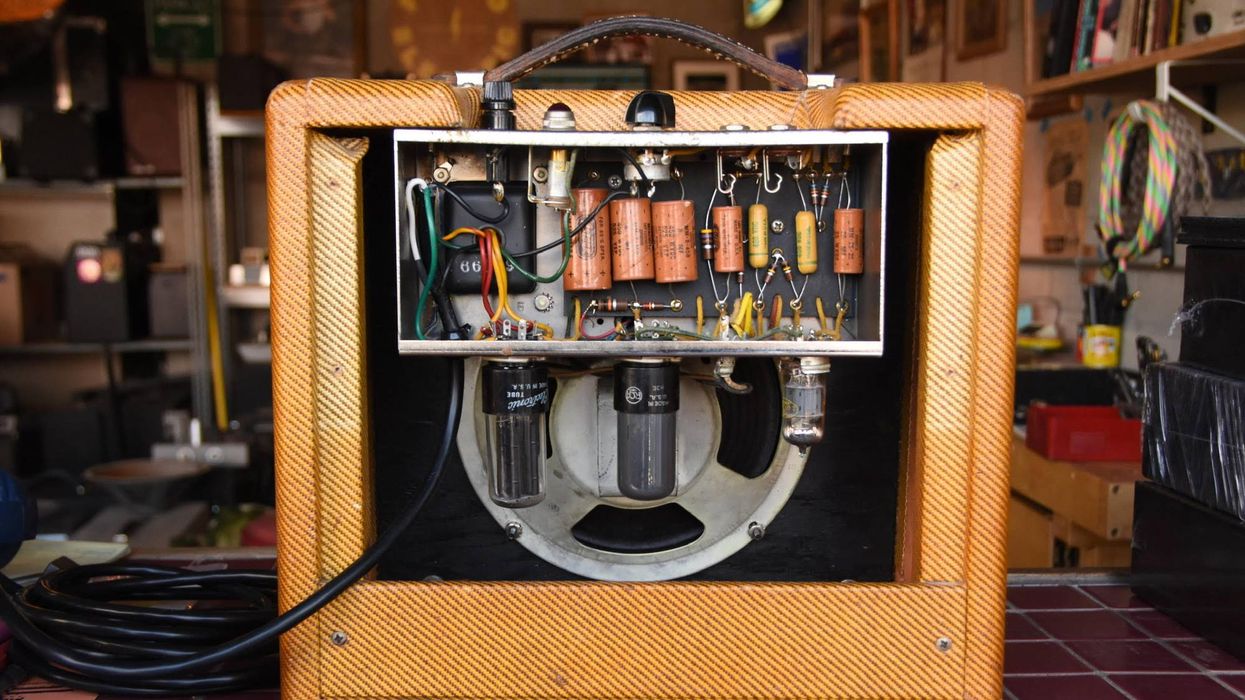
There is an element of time travel in opening up an amp to find original circuitry from decades prior. As an amp repair technician, there are few things better than finding that circuit untouched. And that feeling is enhanced when the amp has sentimental value.
In this case, I received a 1959 Fender 5F1 Champ that belonged to my client’s grandfather, who used it along with his Fender Champion lap steel guitar. He was a Polish immigrant who worked in the coal mines of Pennsylvania and enjoyed teaching himself a range of subjects from mathematics to music.
The 5F1 “narrow-panel” Champ was produced from 1956-1964. All of the tweed-era amps were special, but the 5F1 is a quintessential amp of that period. It’s a simple circuit, with only one volume control. This is as pure as it gets, allowing the unfiltered guitar signal to really breathe through the speaker and into our ears.
When you think about early rock ’n’ roll, and that warm and crunchy guitar tone, you’re hearing a tweed Champ. Eric Clapton, Joe Walsh, and Keith Richards were all known to use a 5F1 in the studio. At low volumes, a guitar sounds smooth and rich. As the amp’s volume gets cranked, it starts to growl, filling the room with pure grit.
“It was customary for the amp’s builder to sign their name on this piece of tape, and in many cases during this time, the builder was a woman.”
At first glance, I was impressed with the overall condition of the amp. The tweed and grill cloth are in beautiful shape, with barely any flaws. Opening up the amp only entails the removal of 4 screws. I held my breath as I placed the asbestos-lined panel—which was meant to act as a heat shield—outside. I then sealed it with a clear lacquer, to avoid disturbing the material.
Immediately, my eye was drawn to the tiny piece of masking tape that had been placed inside the chassis. It was customary for the amp’s builder to sign their name on this piece of tape, and in many cases during this time, the builder was a woman. Sometimes that piece of tape is missing or illegible, but I was happy to see the name “Lily” clearly visible in this amp.
This Champ still has its original speaker, an 8" Oxford, which is dated the 3rd week of 1959. Sadly, but not surprisingly, the speaker did need a re-cone. Over time, it’s common for the paper cone to crack or tear, which was visually obvious in this case. If we were to put a signal through the speaker as it was, it would sound horribly blown.
The circuit itself is pristine, sporting all of the original components that had kept the amp alive for the last 66 years. The orange Astron filter and cathode bypass capacitors caught my attention as soon as I saw them.The filter capacitors are an important part of the amp, as they smooth or “filter” noise out of the power supply. Eventually, these capacitors dry out and can cause loud humming or other issues. The cathode resistor sets the bias for each cathode-biased tube, which, in the 5F1, includes the output tube. The cathode bypass capacitor works in parallel with this resistor to resurrect the gain and tonal color that tends to flatten out through this process. When these capacitors start to drift from factory specification, they can cause strange tone or signal issues.
It’s disappointing to have to replace parts on such an original specimen, but in order to make the amp usable and reliable, the leaky and drifted capacitors need to go. Thankfully, there is a way to preserve the aesthetic beauty of the orange Astrons and keep the amp appearing as original as possible. I carefully opened up each capacitor, removed the outer orange cardboard, and pulled out the capacitor itself, which is typically silver in color. I then installed the new, quality F&T filter capacitors inside of the original cardboard covering. I did the same with the bypass capacitors, using Sprague as a replacement.
This process takes a bit of finesse, but the results are worth it. There is nothing like seeing that orange color inside of a tweed Fender amp.
Safety standards have changed significantly since the 1950s. Instead of the original 2-prong power cord, I will always install a grounded 3-prong power cord. I will also remove the “death cap,” which is a capacitor connected from the AC power line to ground. These were originally used to reduce noise, but are completely obsolete with a grounded power cord. If this capacitor shorts, the chassis could become electrified, resulting in an unpleasant shock hazard. With the installation of a modern power cord and the removal of the “death cap,” the amp is safe to use.
After a basic service and tube install, I was finally able to hear the amp in its full glory. The owner and I agreed that NOS tubes would suit this beauty well. I happily tested the amp for a while, buttoned it up, and sent it on its way to thrive for another 65 years.
A Famous Drum Company’s First Electric Guitar
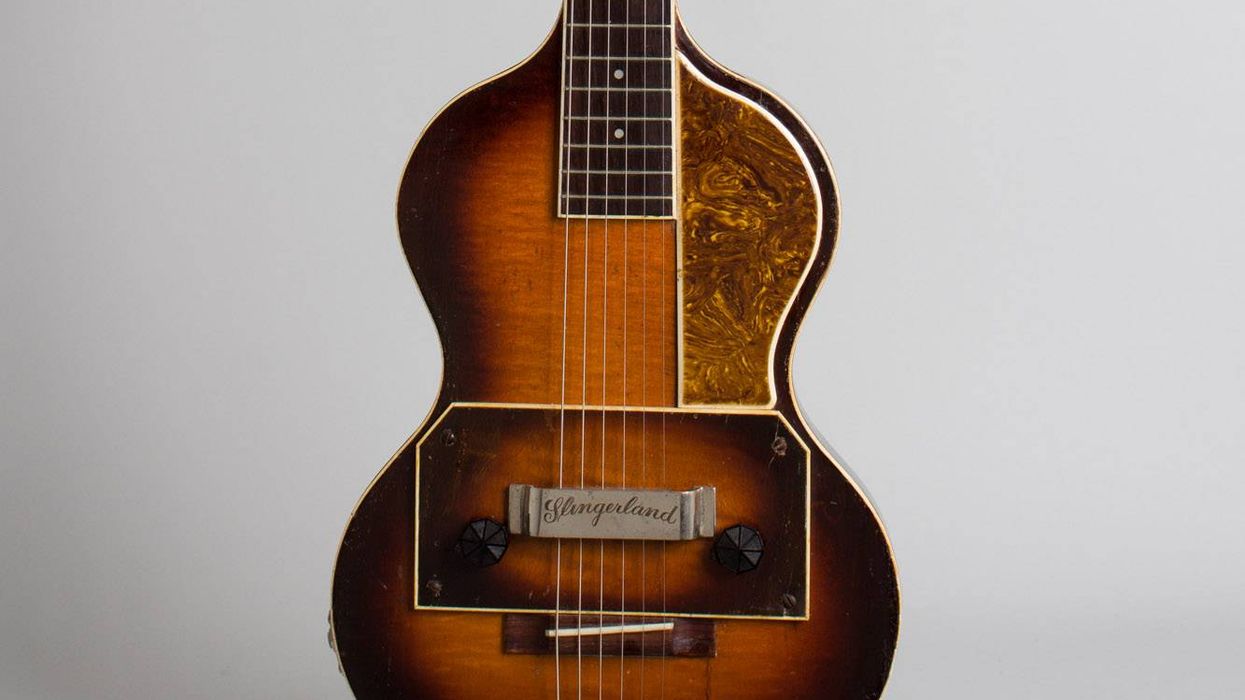
When you get into the history of the development of the electric guitar, you encounter a lot of famous names: Les Paul creating his “Log” from a 4x4 block and a Gibson neck, Paul Bigsby fashioning his ultra-modern solidbody for country legend Merle Travis.
Go deeper and you’ll read about pioneering brands like Rickenbacker, Epiphone, Vega, Volu-Tone, and Vivi-Tone, all of which helped bring the dream of the electric guitar to life. But one name you seldom see? Slingerland.
Yes, Slingerland.
Although best known these days as a drum brand (thanks to the success of its 1930s Radio King set), back in the 1920s Slingerland was actually the king of cheap banjos. It was only after the success of the banjos that it moved into drums, then acoustic guitars, and soon thereafter, a giant leap forward for electric guitars.
The Slingerland Songster Model 401, created in 1936, was in many ways the first solidbody electric guitar that most of us would recognize as a modern instrument. Serial #132, up for sale now on Reverb via Retrofret Vintage Guitars, is our featured pick for this edition of Vintage Vault.
That’s not to say this model was the first. By ’36, there were many companies affixing pickups to otherwise acoustic archtops and flattops. Rickenbacker had made its frying pan lap steel way back in ’31, and had issued a solid, plastic-bodied Bakelite Electro Spanish guitar in 1935.
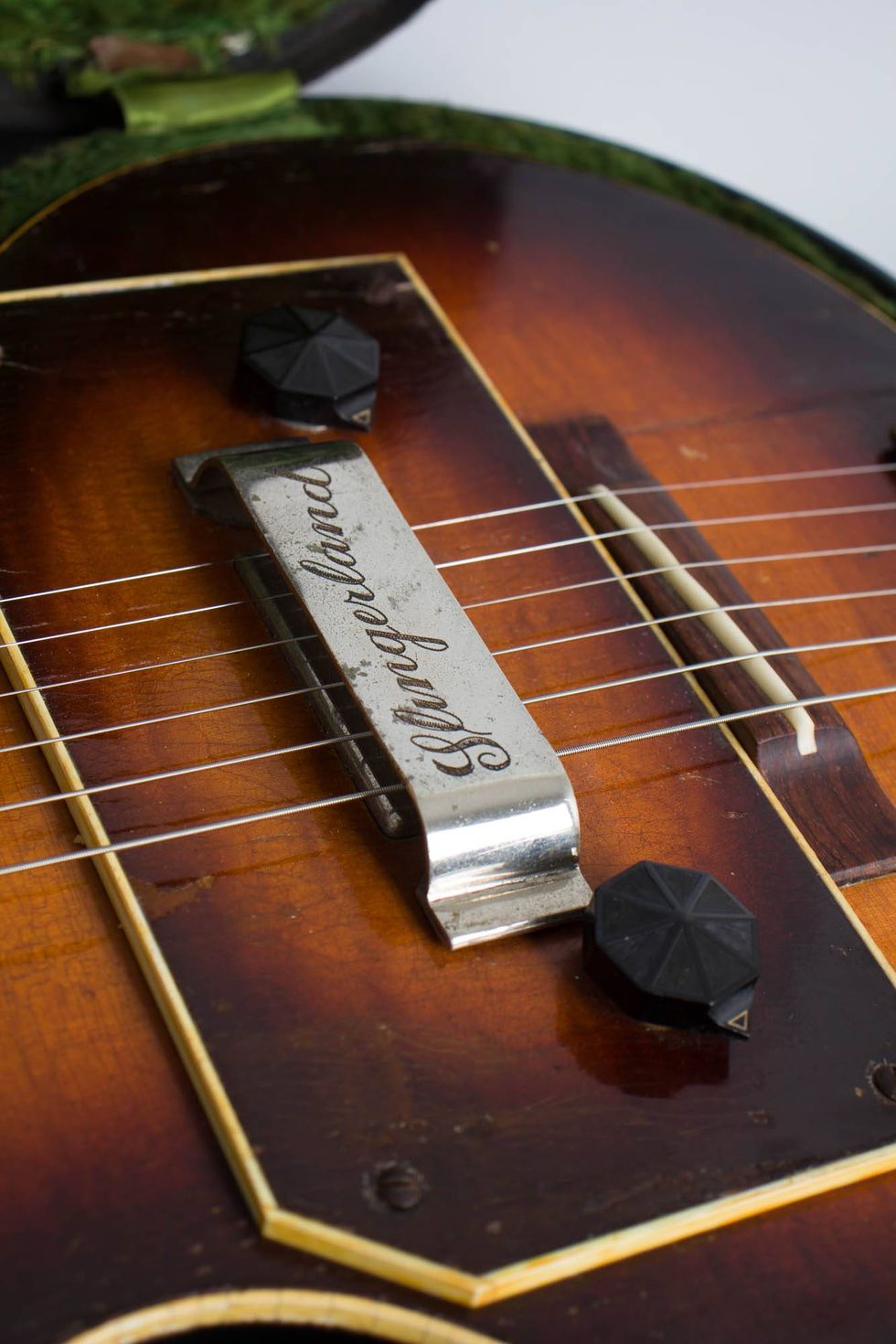
But the Songster Model 401 was the first solidbody electric guitar to be made out of solid wood, which is a fairly important distinction. In an era of electrified archtops, aluminum Hawaiian steels, or Rickenbacker’s plastic Electro Spanish, the Model 401 was a beautiful, slightly hefty instrument, one that would look right at home on a wall hook next to a Les Paul.
Built via neck-through construction, the round, D-shaped neck and the body itself were both made out of poplar, with a gorgeous flamed maple veneer on top with a sunburst finish. The rosewood fretboard has a comfortably fast 12" radius, and a 25" scale length.
Its body—15.25" long, and 11.5" wide at the lower bout—was revolutionarily small compared to the large archtops that dominated the guitar market, and is even svelte compared to a Les Paul. But at over 7 pounds and 6 ounces of solid wood in weight, it would’ve felt closer to a light Tele than any of its mid-’30s peers … if the Tele had been invented in time to compare.
“…the Model 401 was a beautiful, slightly hefty instrument, one that would look right at home on a wall hook next to a Les Paul.”
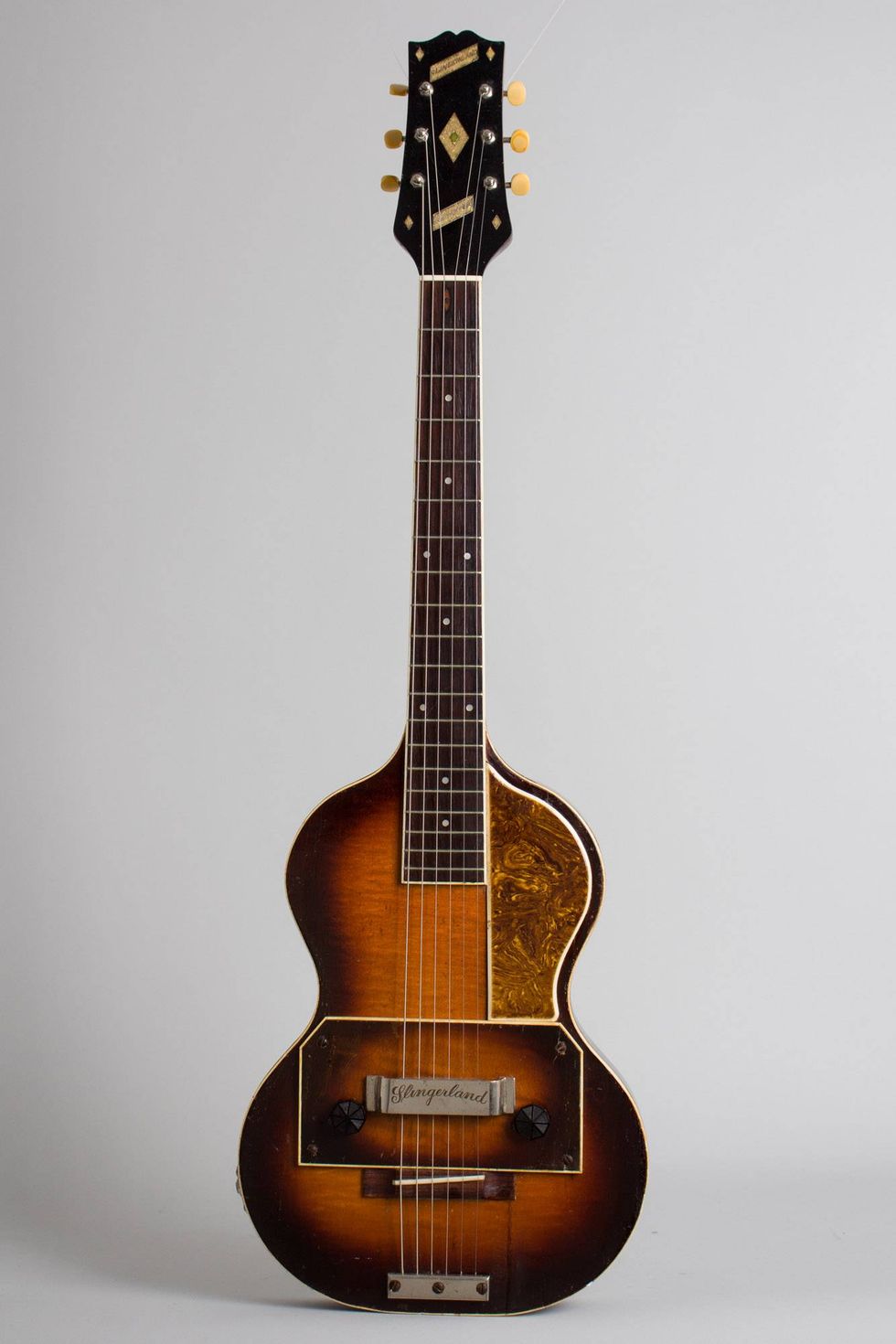
The Model 401’s pickup situation looks quite unique, but what you’re looking at is something akin to the Stratocaster’s pickguard: the Songster’s pickup, volume, and tone control all mounted onto one plate that is then secured to the body.
In The Pinecaster Collection, Lynn Wheelwright explains what’s happening under the hood: “The original Songster pickup had a unique design; it used six individual pole pieces—one for each string. Each elongated coil was divided into two sections of three coils with the coils connected in series.” These were energized by a horseshoe magnet. While not constructed the same, the effect was similar to a modern humbucker.
The 401, with its matching amplifier, was $135 at the time of its release, in line with other electrics of the era and a little more than $3,000 today if adjusting for inflation. Its solid wood construction, flamed maple top, and small body made it thoroughly modern, and it was, perhaps, too advanced for its time. By 1940, it had ceased production in its original form, only ever numbering in the dozens of units.
Today, you might expect them to be priceless. But you can actually find them for anywhere between its original inflation-adjusted price of about $3,000 to $9,000. Our Vintage Vault pick, listed at $5,950 at the time of writing, is not even the only one currently for sale on Reverb.
So if you want a piece of true guitar history, why not start with an early electric solidbody that won’t even feel that early in your hands?
Sources: The Pinecaster Volume 1: The Pioneers by Lynn Wheelwright, jayrosen.com, Reverb listings
Treasure Hunt: Inside Gibson's Certified Vintage Program
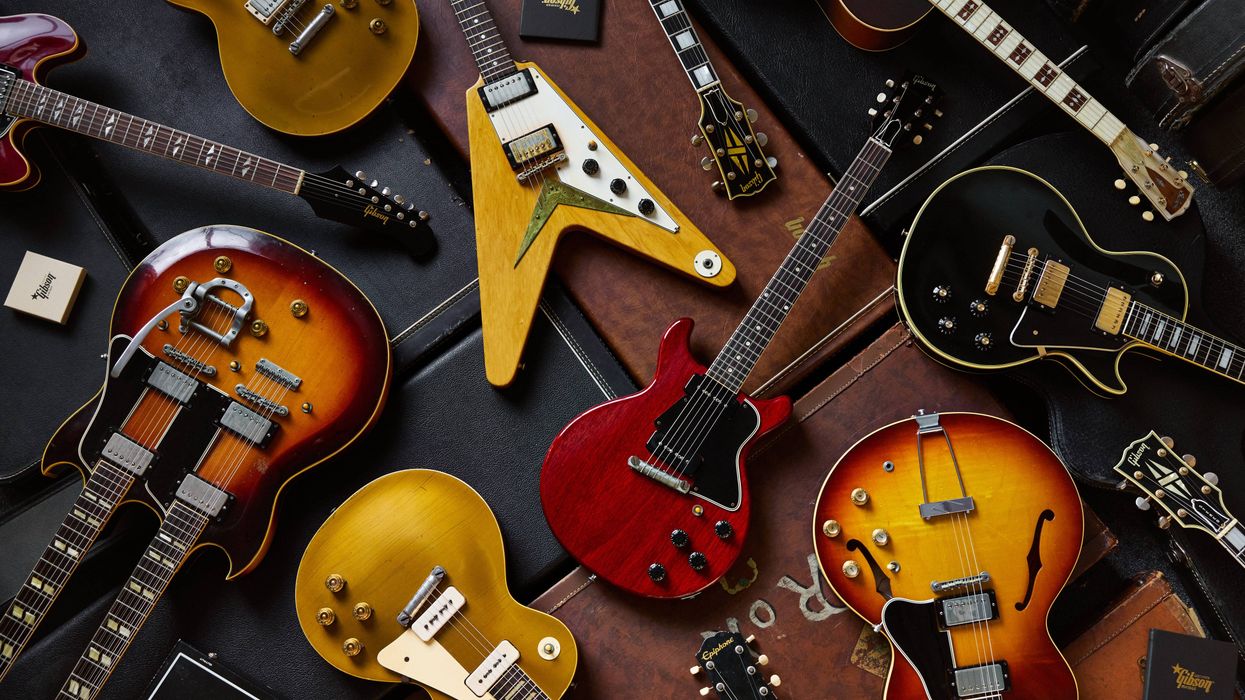
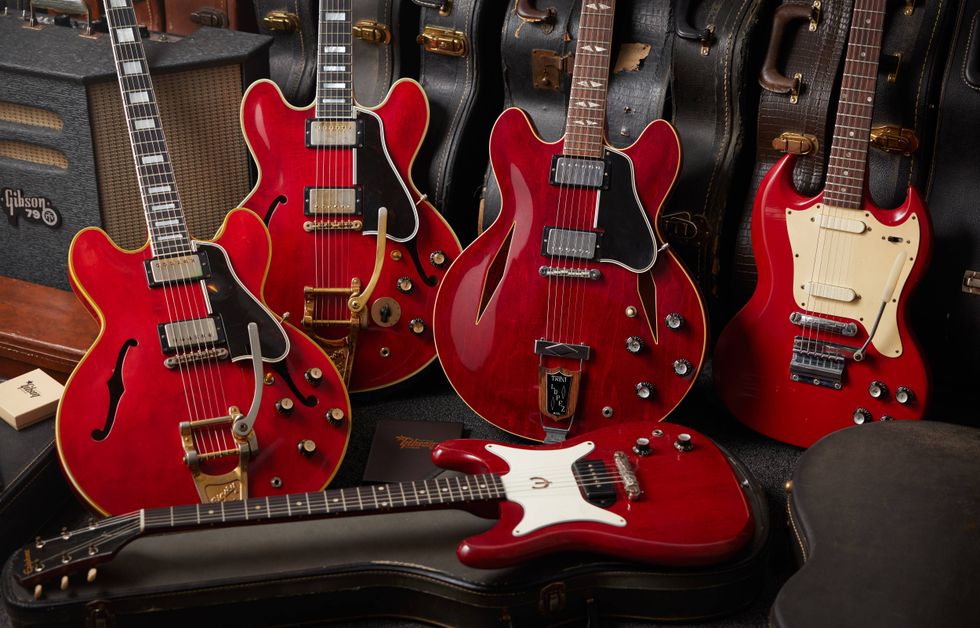
Gibson Certified Vintage isn’t just a place for the lucky few to buy a vintage guitar; it's a portal into the DNA of some of the most important instruments in history. Every level of the program is composed of people obsessed with acoustics, electrics, and basses. For a guitar to earn its Certified Vintage certificate, it has to be truly extraordinary.
Thankfully, the whole program is curated by someone who grew up with Gibson woven into the landscape and relationships around him.
“I grew up in St Joe [Joseph], Michigan, about an hour southwest of Kalamazoo,” explains Mitch Conrad, Gibson’s Certified Vintage Manager. “And when my grandfather was in the military, a guy swapped his late ’40s blonde Gibson L-7 with him. That Gibson was permanently entrenched in my brain, and I was very fortunate for my grandfather to gift that guitar to me for my 18th birthday.”
This history set Conrad on a path that mixed curiosity, hustle, and deep respect for the past. After meeting Gibson VP of Product Mat Koehler while running a photography studio, the pair bonded over their shared passion for all things vintage. That connection led Conrad to Nashville and, eventually, to his current role.
"These guitars are built to last lifetimes, and being part of that journey really matters to us."
Today, he is responsible for finding, authenticating, restoring, and documenting the guitars that have shaped the company’s legacy. For Conrad and the Certified Vintage team, it’s all about honoring both the guitars and the people who play them. And from his process for unearthing hidden gems to his candid transparency around pricing, he didn’t hold anything back.
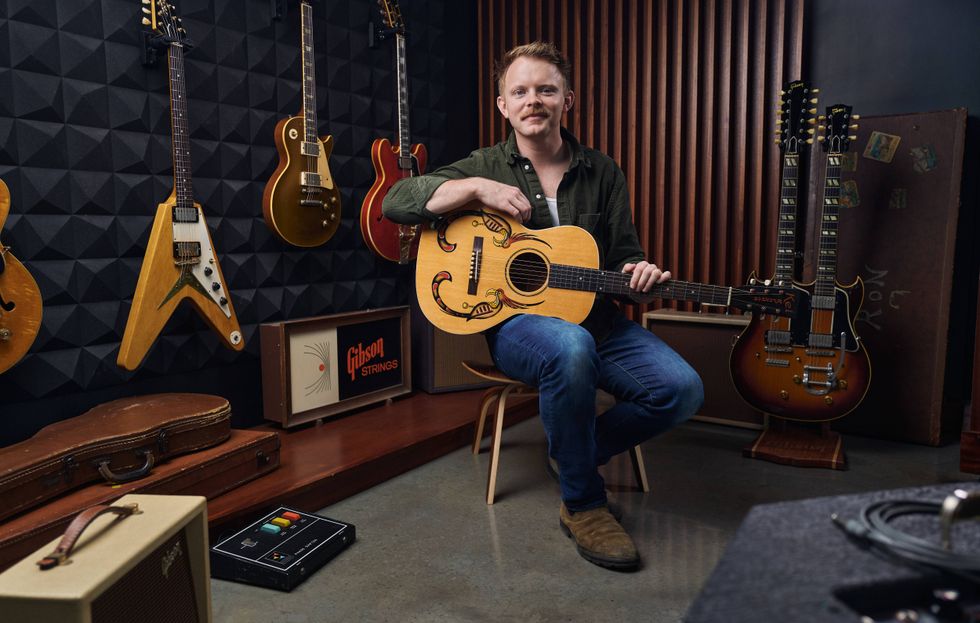
Recognizing that there are various outlets for vintage gear these days, what drove Gibson to create the Certified Vintage program?
Mitch Conrad: The vintage world can be a murky place to navigate. It can be hard for people to feel confident about what it is they’re adding to their collection. We really wanted to provide the best possible experience when buying a vintage Gibson or a Gibson-made instrument.
When we sell one of our Certified Vintage instruments, it comes with a certificate of authenticity. It comes with the letter of appraisal documenting anything and everything that we know about the instrument, in terms of its history and its provenance. It also includes a deep dive into all the bits and pieces. Even if the mounting screws that were originally on it corroded and rusted out, we’ll source a vintage-correct set and put them on. We’ll call that out.
And, as far as I’m aware, we’re the only ones [offering] a new, limited lifetime warranty. We want to send them back out with that same level of confidence that these instruments will make it another lifetime in the hands of their next caretaker.
Are you specific about the guitars you’re looking for?
Conrad: We want to find the best examples of these instruments. If you’re out on the hunt for a nice mid-’60s ES-335, there’s confidence in knowing that the model Certified Vintage has is a really great one.
But "best" is a little bit of a flexible term. For instance, we try to stay away from things that have been broken. Still, we’ll make an exception. We sold a killer 1958 Goldtop that had a headstock repair. But this guitar was incredible. It was not in museum-grade condition, but it was one of the best ’50s Goldtop, darkback, PAF-equipped Les Pauls that we’ve had around.
That one actually went to Slash. When I took it down for him to try out, he told me, “I really don’t need any more of these.” And then he plugged it in. He was like, “All right, I think I’ll take this one.” [laughs]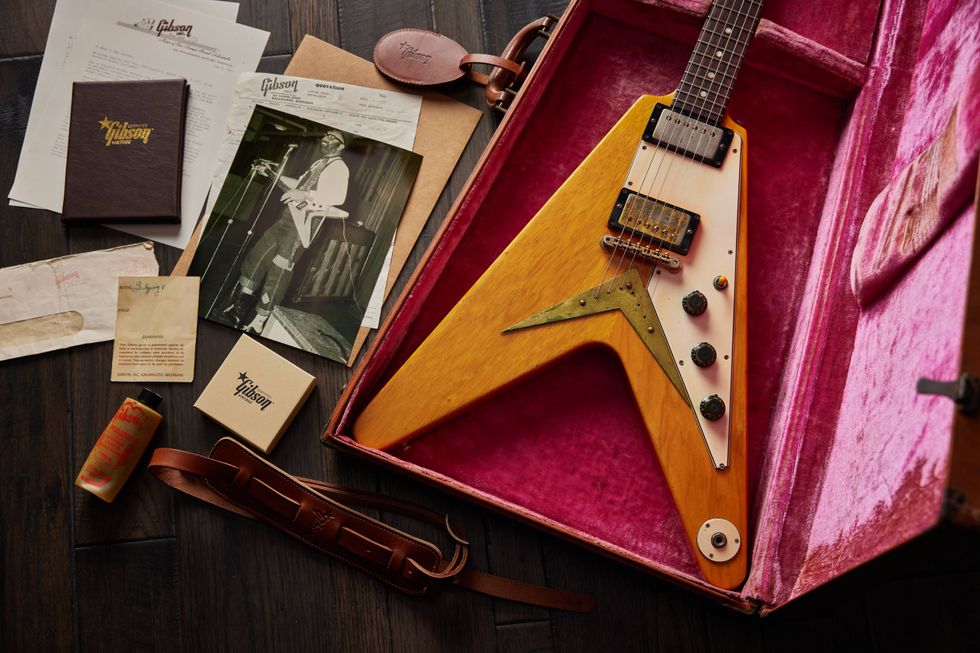
How do you find the guitars to bring into the program?
Mitch Conrad: A lot of folks reach out directly. We’re really fortunate that the name on the headstock of the guitars we’re looking for is also the name on the website.
But there’s a lot of digging around as well. It’s stopping into shops on a long drive and asking, “Do you have anything else?” And then somebody pulls out an old black rectangle case, and it’s a 1969 Les Paul Custom. There’s also Facebook Marketplace, Craigslist, all those spaces. So, not every story has the romantic “found it at a garage sale” start to it.
It sounds like there’s a real personal touch to this.
Conrad: We work really hard to make this feel like a boutique offering inside a global company, and we’re intentional about keeping that human connection at the center.
There was one really sweet woman whose mother had a beautiful ’57 Southern Jumbo. She said, “I can’t play—I don’t have a musical bone in my body—but I remember my mom playing that guitar every week.” As much as she loved having it around, she knew she couldn’t make music with it, and that’s what the guitar had spent its whole life doing. She wanted it to continue doing that.
When instruments like that come in, we’re just a temporary stop as they move from one caretaker to the next. These guitars are built to last lifetimes, and being part of that journey really matters to us.
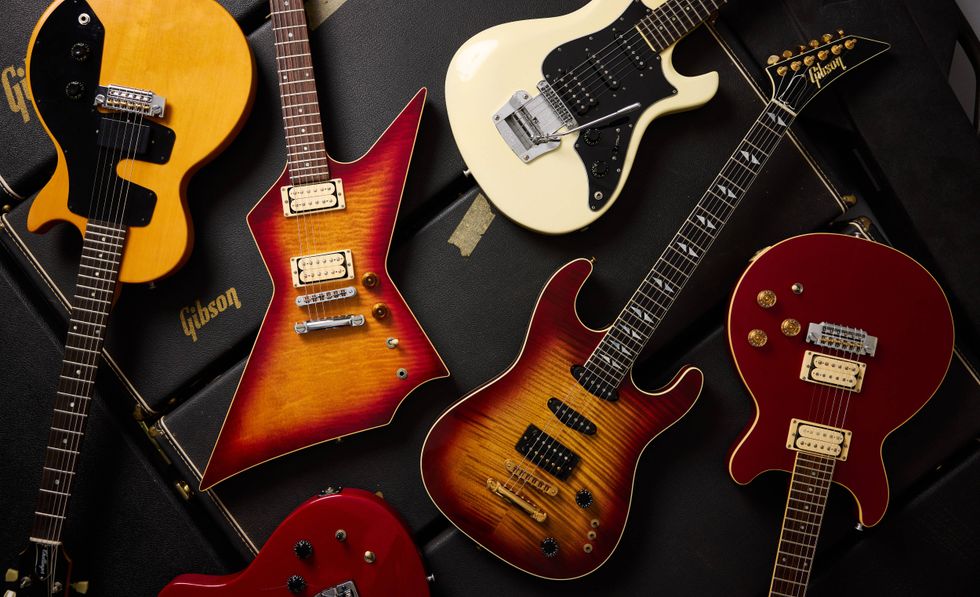
For people just expecting to see a lot of ’50s- and ’60s-era Les Pauls, the collection has real surprises. For instance, tell us about the 1980s prototypes and other “vault” pieces you’re offering.
Conrad: When you’re developing a new product that ultimately doesn’t move forward, there isn’t really a pathway for those instruments to make it out into the world. So you end up with these great prototype pieces that, for one reason or another, just stayed behind.
It’s really fun to dig these things out. A lot of the ’80s stuff, it really scratches an itch for a group of people. These guitars don’t always get the limelight: the Q Series or Corvus, or Explorer XPLs. To be able to buy—directly from Gibson—an original prototype that’s never been offered to the public before is a unique thing.
Whether it’s a one-off prototype or a vintage Gibson classic, what does a guitar need to qualify for Certified Vintage authentication?
Conrad: Step one is identifying exactly what the instrument is. Step two is playing it—we check that it feels right and sounds right, or shows the potential to do so. The biggest part comes down to originality. “Let’s make sure that everything that’s here is what’s supposed to be here.”
"Every day brings a strange mix of vintage guitar joy and chaos."
Again, there may be times when that’s not a deal breaker for a specific instrument, but we want them to be as representative of what they were originally intended to be as possible. We’re looking at clean solder joints. We’re saying, “Have these covers been off and back on? Are the caps what they should be?” We’re digging into the finish extensively. We’re looking at every screw and every saddle and asking, “Are all these things the things that should be on this guitar?”
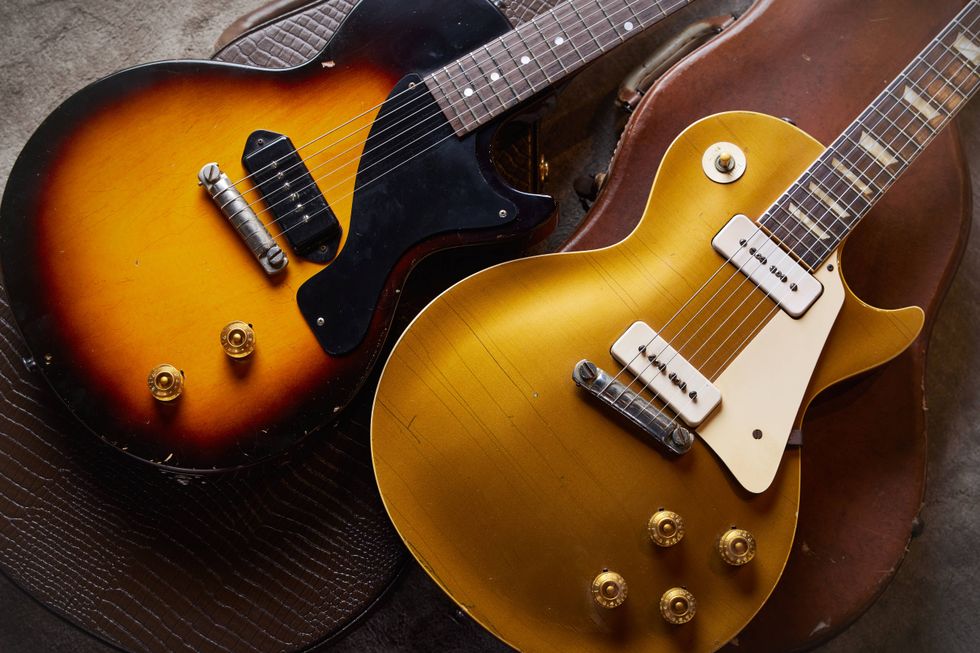
Sometimes, ensuring authenticity and playability—or tone—can be at odds. How do you strike that balance?
Conrad: We approach each guitar individually. If there’s an artist instrument that has caps from the ’80s, but it’s a ’50s Les Paul, those are now part of its legacy. That’s worth hanging on to. If we get a guitar that’s in excellent condition, where someone replaced a few parts but everything else is original, we want to restore that back to how it ought to be. And we’ll call that out. We’re not going to try and hide that work.
Do you still have access to a lot of the original records and notes for these older instruments?
Conrad: Yes. A lot of our records are still very intact. I have this super beautiful 1965 ES-335 that we’ll be making available in the next few weeks. I was able to find [it] in the shipping ledger, and I can say that it left the factory in Kalamazoo on November 18, 1965. That doesn’t change what the guitar is, but for someone, it gives the instrument a birthday. They get to know exactly when it left the factory and connect with a bit more of its story.
We’re still on the hunt for our ’59 shipping ledger, and I feel confident we’re going to find it! I feel it in my bones. I have to believe it’s out there and it will make its way home someday.
Your pricing sometimes differs from what’s seen on sites like Reverb.com. How do you explain that, and what feedback have you received from buyers?
Conrad: I’m really grateful for all the positive testimonials from folks who have purchased instruments from us—they’ve been good ambassadors for the program. It’s a reminder that we’re guitar people here. We’re excited about bringing these instruments back home to Gibson, and the program gives us a chance to celebrate these beautiful guitars we’ve made in the past.
"We work really hard to make this feel like a boutique offering inside a global company."
I also work hard to make sure that what we’re bringing to market is staying in the ballpark of what else is out there. I don’t want to find ourselves trying to tack on a higher percentage because of who we are. That said, when we bring a guitar in, we pay a little more because we want it to be an excellent example. And there might be times when a guitar [we’re offering] has more that’s gone into it. Vintage acoustics, for instance, are one of those things where they need work.
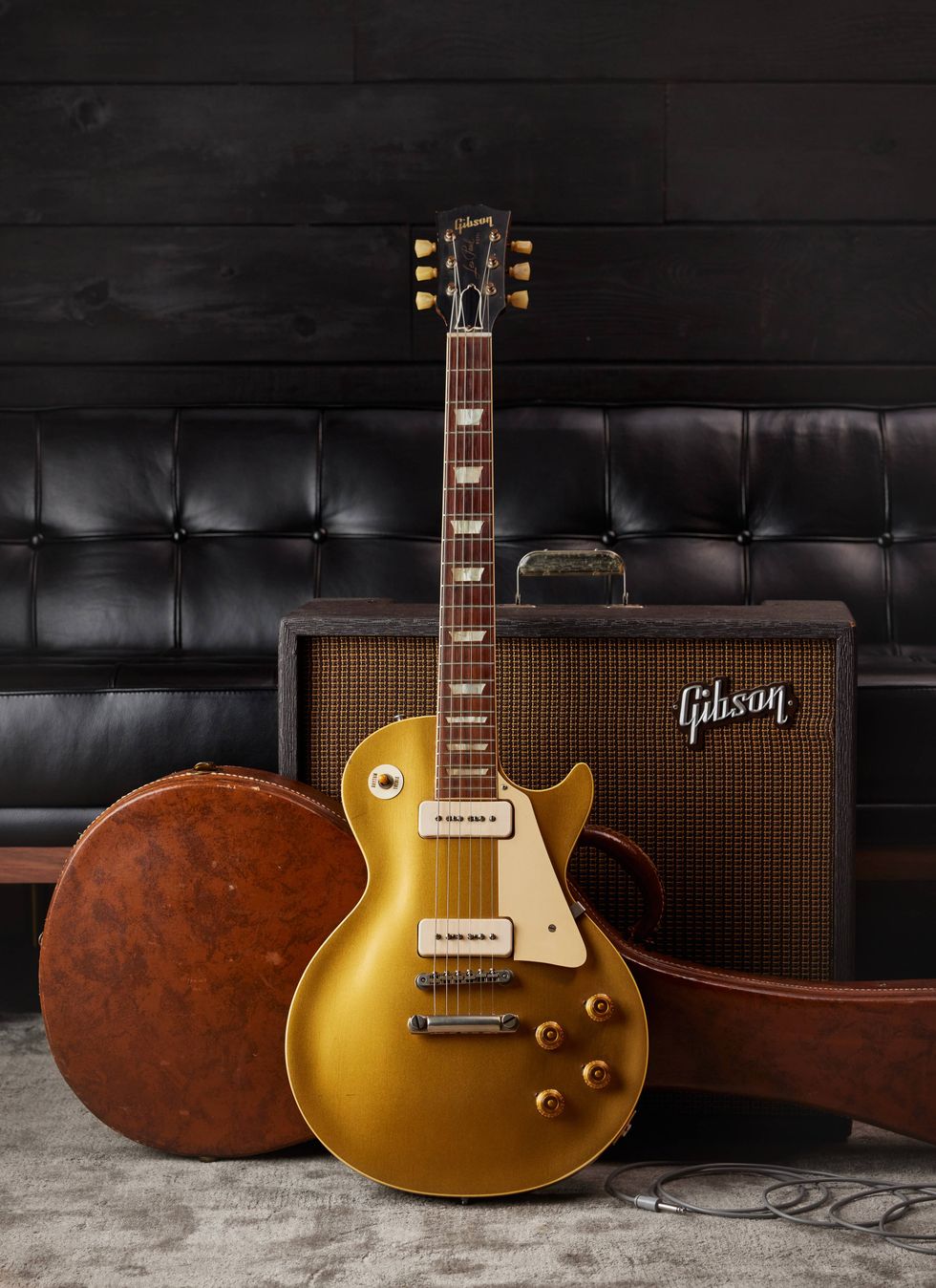
From road trips and online marketplaces to restorations and authentications, your job definitely keeps you busy.
Conrad: Every day is a new adventure. I’m out on the road a fair amount, going out and finding these guitars and purchasing them from all sorts of folks. And we’re working with high-value items, so you’re making sure they make it safely to their new homes and new caretakers.
But my day-to-day also may involve re-adhering the green felt lining of a late ’40s Lifton case. I have to get some new buttons installed on a set of No-Line Kluson 3-On-a-Plate tuners. Every day brings a strange mix of vintage guitar joy and chaos.
Clearly, working in the Certified Vintage program requires more than just guitar skills—it takes deep knowledge and a keen instinct for spotting truly special instruments.
Conrad: [That’s why] it’s important to me that we preserve this aspect of our history, and give the team a chance to see these original instruments. The [1959] Korina V that we brought to market earlier this year was a huge one. Sharing that guitar internally with our teams is really exciting.
Folks across all levels of things, from customer service and the crafters to product development and the aging team in Murphy Lab, are so passionate about our history and legacy. I feel a very personal connection to that.
To see the latest releases from Gibson Certified Vintage, follow the program on Instagram at @gibsoncertifiedvintage and on Facebook at Gibson Certified Vintage. If you have a vintage Gibson you’re looking to sell, you can contact the team directly at gibsoncertifiedvintage@gibson.com.
StewMac Valve Factory 18 Review
Most amp kits are Fender flavored, typically recreating historic 5F1 Champ, 5F2-A Princeton, or 5E3 Deluxe tweed-style circuits. And since an actual late-’50s Princeton, for example, costs about $3,000, at well less than a third of that price a DIY kit is an affordable alternative for any guitarist with soldering skills and the patience to follow instructions. But what if Fender isn’t exclusively the taste you’re looking for? What if Valco, Ampeg, Marshall, or modern takes on classic tones also float your rubber raft?
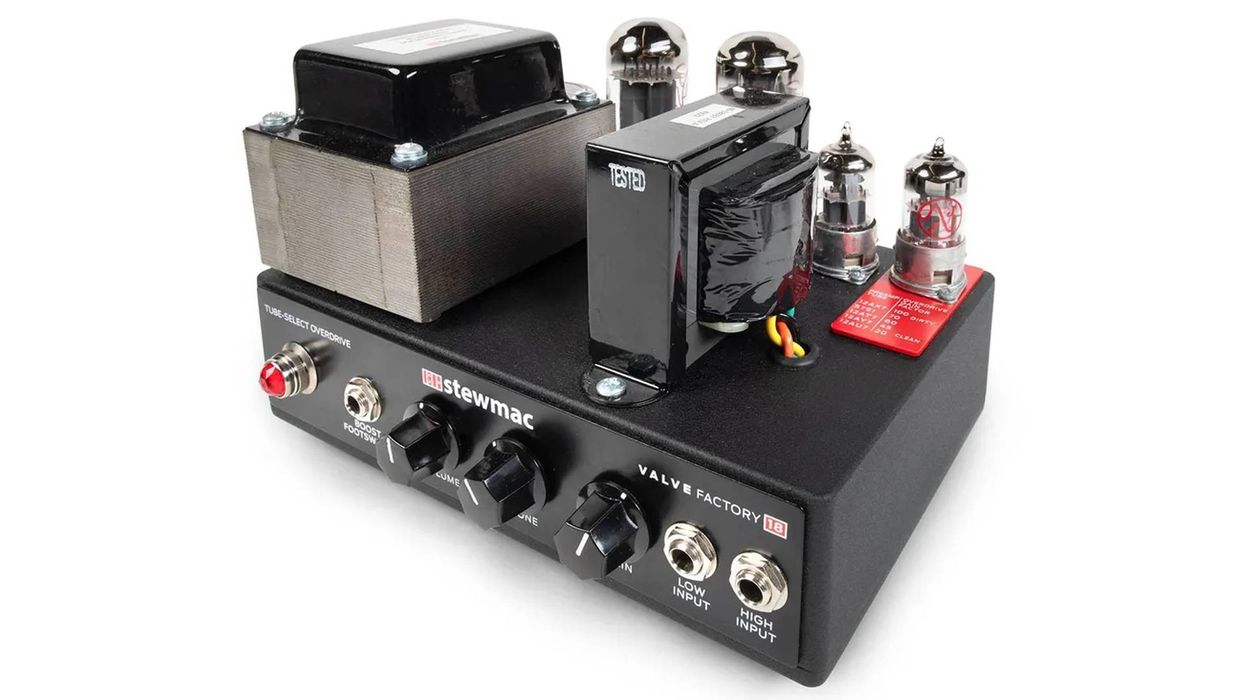
Enter StewMac’s mighty little Valve Factory 18 head kit, a 12-pound beast that punches above its weight class, offers a variety of classic-inspired sounds, and hints at modern boutique amp voices.
Flexible Fryer
Part of the Valve Factory 18’s versatility is due to the two preamp tube options provided in the kit: a 12AX7 or a 12AY7. But it’s mostly the result of a concise-but-flexible set of controls. On the front panel, there are volume, gain, and tone dials, but the way they shape sound depends on whether your guitar is plugged into the low- or high-input jack. The low input is the clearer of the two and hews close to Fender tweed world. But the high input offers gentle breakup that, to my ears, gets into gnarlier old amp voices. Both channels offer plenty of headroom and work well with pedals, but if your primary sources of tone color are stompboxes, the low input may be best for you. Both also benefit from a clean boost footswitch that pumps up the volume without altering the tones in play too much.
On the back, there’s an impedance switch with 4-, 8-, and 16-ohm settings, so the Valve Factory 18 can be used with most cabinets. There’s a single speaker-out jack, and on/off and standby toggles. And as its name implies, the amp delivers 18 watts, and it’s a loud 18 watts at that—fitting for today’s small-amp sweepstakes.
Brick By Brick
Confession: StewMac sent me an immaculate, pre-assembled review model rather than a kit. But I still settled into a meticulous reading of the highly detailed and lavishly illustrated instruction book. It begins with a menu of the included parts, which are metal film and metal oxide resistors, plus a single wire-wound resistor, two 1N5408 diodes, nine various capacitors, a pair of custom-built Pacific Trans transformers (power and output, naturally), wire, heat-shrink tubing, sockets and tubes (more on the tubes later), the fuse and fuse holder, the pilot lamp, screws and locknuts, input jacks, control pots, front and rear faceplates, the fully assembled footswitch for the boost, and a very solid anodized metal chassis.
Point-to-point assembly begins with the filter cap and works through the sockets on up to populating the circuit board, and so on. It’s advisable to have a digital multimeter handy to check each resistor before installation. Our test Valve Factory 18 arrived ready to go save for installing the tubes, which was easy, since this amp does not have a cabinet, so, it's merely a matter of plugging the tubes into the slots on the top of the chassis. Two JJ 6V6s live atop the amp’s crown next to the filter cap, which is also adjacent to the 18-watt power amp. I inserted the provided 12AT7 phase inverter tube and then decided whether to plug the 12AX7 or 12AY7 into the preamp slot.
Totally Tubular
Those aren't the only tubes that can be swapped in the preamp slot. The amp will function happily with 7025, 5751, 12AT7, and 12AU7 valves. But I stuck to the provided 12AX7 and 12AY7. Both performed true to their tendencies. I used the Valve Factory 18 to power a Sam Hill Custom 1x12 cab with a 50-watt Eminence Private Jack and plugged in a two-humbucker Les Paul, a PRS SE Silver Sky, a Dean electric resonator with a lipstick pickup and a piezo, and a Steinberger Spirit. In all these combinations the 12AY7 yielded a little more headroom than the 12AX7, little breakup when pushed, and a cleaner sound profile overall. That is not to say the 12AX7, my favorite of the two, lacks headroom—especially when I plugged into the low-input jack. But playing through the high-input side, the 12AX7 gave me exactly what I want from an amp: enough clean tone to stay articulate along with a gritty patina that speaks the language of rock and blues.
For me, that sound sings best with the tone between 10 and 2 o’clock and the gain between 10 and 12 o’clock which generates genuine old-school breakup. The tone control has great range. Turned hard to the left, it creates a booming, bass dominated voice; hard right, it’s bright and cutting, but never piercing. I did not find an unsatisfying sound within its scope. Dialing the gain to the top and the tone to about 8 o’clock, visions of doom rock danced in my head. With the tone at noon and higher, and the gain all the way up, I could hear the hard rock and metal applications, though the Valve Factory 18 isn’t a 5150 by any means. The volume dial simply makes things louder without significantly impacting the tone, which is ideal.
The Verdict
Short story: I dig this amp in all its sonic variations. Although the Valve Factory 18 is simple to use—and seems relatively easy to build—it is cleverly designed too. Playing it is a joy. So much so that I am disappointed that it’s not gig-ready. Without a cabinet or some cover to protect the tubes, transformers, and filter cap, it’s easily damaged. That said, the power, versatility, tonal range, and sense of accomplishment in building a point-to-point packed with character seems well worth $599.
Orangewood Del Sol Baritone Review
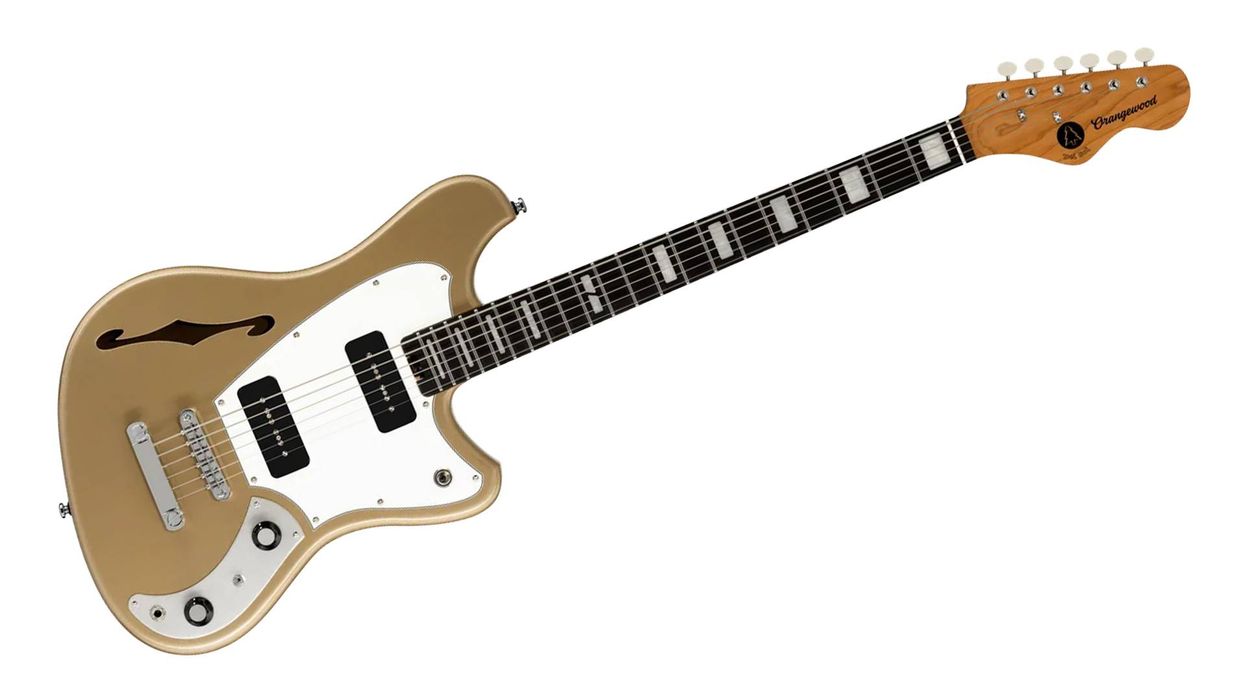
Connecticut builder Josh Forest’s TreeTone Guitars specializes in retro-inspired designs with hip offset bodies, classic inspired color combos, and an array of electronic options. He’s teamed up with Orangewood to offer an imported version of his Del Sol model—which he produces in a standard-tuning version under his own name—as a baritone. Although the Orangewood Del Sol Baritone hits a price point well below a domestic build, it’s a solidly crafted, handsome guitar that punches well above its $795 tag.
Comfy Feels
The Del Sol Baritone’s slick, unique offset mahogany body evokes retro Fender vibes, but on its own terms. It’s a sleek look, and thanks to its chambered design—with a bass-side f-hole—it’s lightweight.
Playing while seated, the bari has a nice weight distribution and offers a comfortable playing experience. Its 27 1/2" scale length is close enough to a standard scale to feel familiar, giving it a more guitar-like feel than, say, a Danelectro’s 29 3/4" scale or a Bass VI’s 30", which makes it easy to get acquainted with.
Without checking price data first, I guessed it was priced a few hundred bucks above its $795 cost direct from Orangewood.”
A pair of P-90s sit nicely in the 3-ply parchment pickguard. Controls include a master volume and tone with pickup selector, plus a phase switch. Characteristically, the P-90s tend toward warmth more than clarity, but together they have a wide range, from bridge-position twang to thick neck tones. They certainly lean dark, and digging in will push their output enough to drive the amp if you’re already heading in that direction. That’s particularly the case with the neck pickup, though tamping down the bass control on my Deluxe Reverb helped keep it cleaner longer. But the P-90s performed great once overdriven, whether from the amp or with the help of a dirt box, with plenty of sonic space for well-articulated arpeggios and dynamic strumming. I preferred the middle position most, and the phase switch—located on a brushed aluminum control plate between the volume and tone knobs—opens up the possibilities. It’s a helpful control, especially for navigating bass response and finding the line between heaviness and twang.
Jack of All Trades
The Del Sol’s roasted maple neck has a smooth satin finish and a soft C profile. Combined with the 12" radius on its rosewood fretboard, the neck feels great. A rounded heel offers easy access to the upper frets, and has a spoke wheel for truss rod adjustment, which I always find to be a thoughtful and welcome feature. The 43 mm nut width feels naturally spaced for the .013–.072 strings that come stock.
As far as build quality goes, my demo model arrived set up and ready to go. The frets are even and nicely dressed across the neck, and seem to have received a fine level of attention. In fact, from top to bottom, the Del Sol’s build is flawless. Without checking price data first, I guessed it was priced a few hundred bucks above its $795 cost direct from Orangewood.
Though its offset aesthetic gives a bit of a surfy vibe, the Del Sol Baritone is more of a rocker—though I suspect replacing the Tune-o-matic-style bridge with a JM-style vibrato could push it in the former direction. It’s definitely capable of heavier sounds and plays well with distortion. The resonance of the chambered body lends some sustain across its range, and that helps this bari sing. The easy playability of the neck and fretboard open it up to all styles, and knotty, technical passages are easy to execute. That makes the Del Sol a specifically versatile instrument. The other side of versatility, though, is that if you’re looking for specialized sounds—let’s say a Dano-with-lipstick-pickup kind of thing, or a tic tac bass sound—you might not find it. But as a do-it-all baritone under $1,000, the Del Sol is one to consider.
The Verdict
The Orangewood brand model delivers attention to detail in cool aesthetic packages at easy-to-reach prices. Yes, there are less expensive baritones than the Del Sol on the market. But many of those cater toward more specific, if not a bit quirky, tastes. Instead, the Del Sol Baritone can cover a breadth of stylistic ground both sonically and, thanks to its easy playability, from a technical perspective. With a build quality that’s more consistent with a higher price point, it delivers both musical and financial value. If you want a well-rounded bari, this may be all you’ll ever need.
Rig Rundown: Marc Ford and Doug Pettibone (The Lucinda Williams Band)
The country legend’s bandmates bring a range of low- to high-end gear to Nashville’s Basement East.
Ahead of Lucinda Williams’ fundraiser show on December 15 at Nashville’s Basement East, PG’s John Bohlinger spent some time with guitarists Marc Ford and Doug Pettibone, and bassist David Sutton, at the venue for this special holiday Rig Rundown. Tune in for all the goods, and check out the highlights below!
Brought to you by D’Addario.
Gretschy Guild
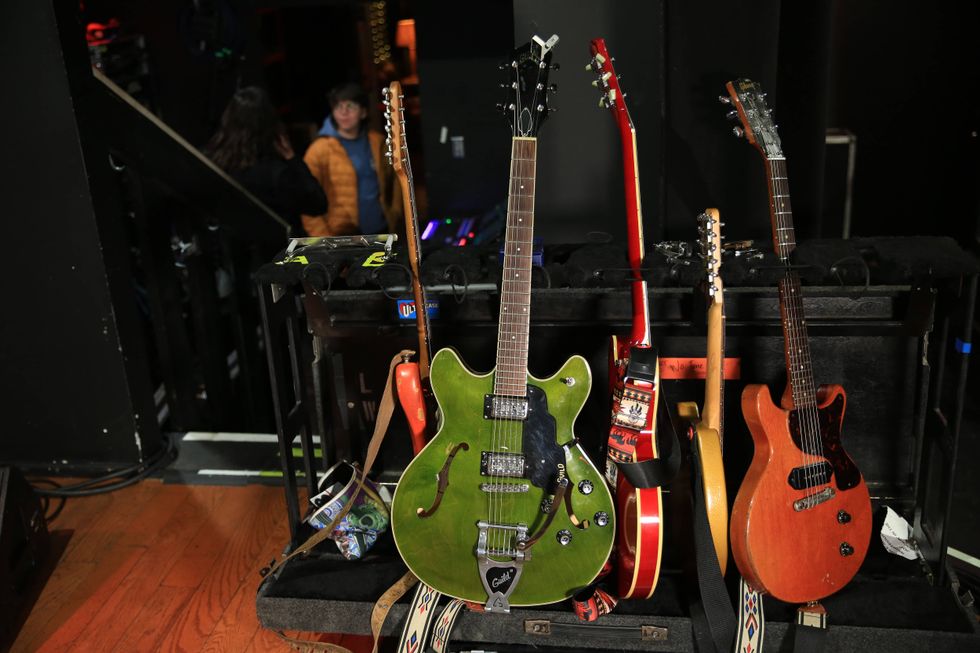
Pettibone plucked this off the wall of a guitar shop in Philly to demo an amp and ended up walking out with it. Its Seymour Duncan pickups are coil-split, and Pettibone gets some good, old-timey Gretsch tones out of it. Plus, after having a load of gear stolen on tour a while back, Pettibone prefers to bring out less precious instruments.
Tok-ibson
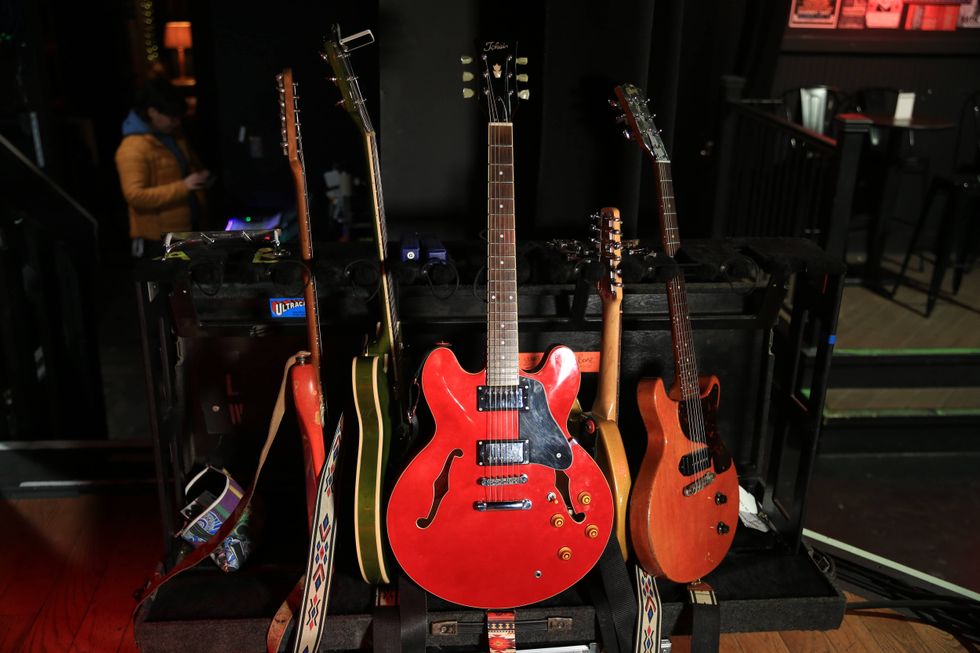
Pettibone snagged this Japan-made ES-335 knockoff, built by Tokai, while touring Australia earlier this year.
A Jewel of a Pedal Steel
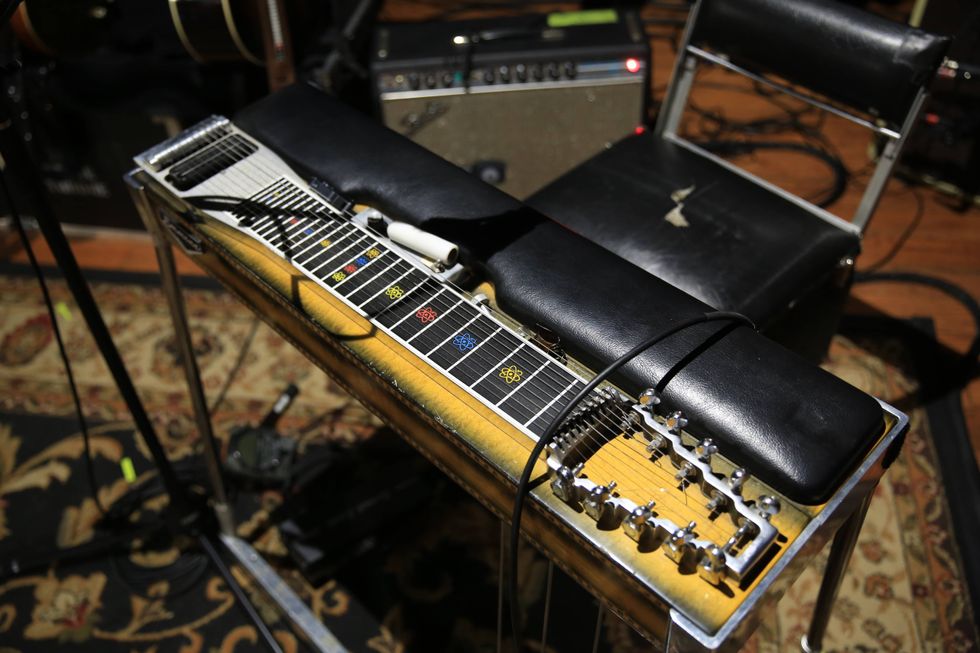
Pettibone’s main pedal steel is this 1999 Emmons, which he ordered brand-new when he was playing with Jewel.
Fender Friends

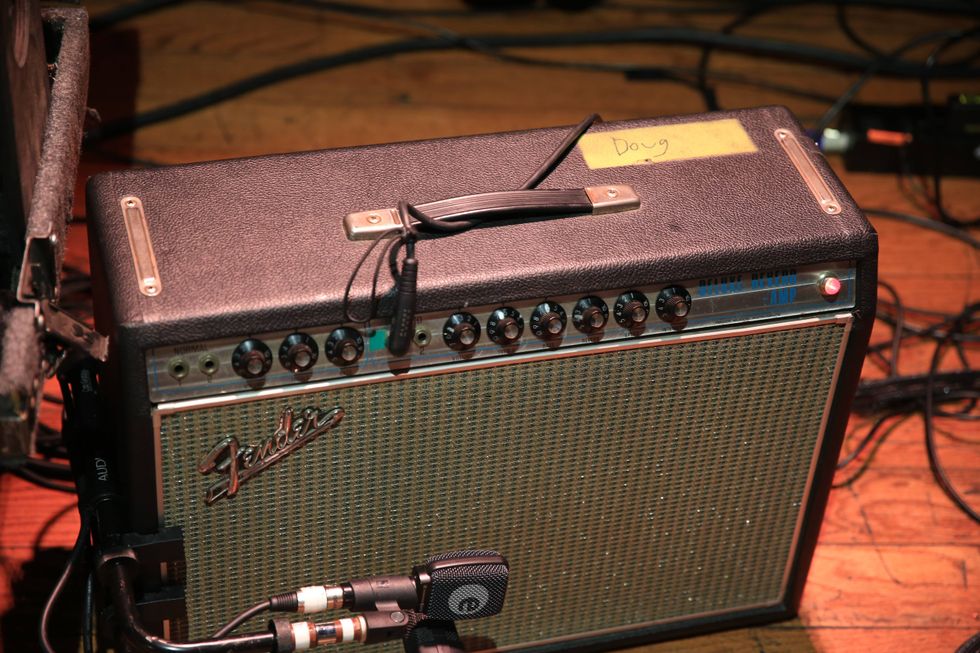
Pettibone runs the Emmons pedal steel through a ’64 Fender Twin Reverb, with a ’70s JBL 15" speaker. A Strymon El Capistan adds delay, if desired. His 6-strings run into a ’68 Fender Deluxe Reverb, loaded with a Celestion Greenback speaker.
Doug Pettibone’s Pedalboard

Pettibone runs a Sarno Earth Drive, Durham Electronics Crazy Horse, Keeley-modded Boss BD-2, Boss TR-2, Mad Professor Silver Spring Reverb, and a Catalinbread Belle Epoch. A Strymon Zuma powers them.
Thou Shalt Not Covet
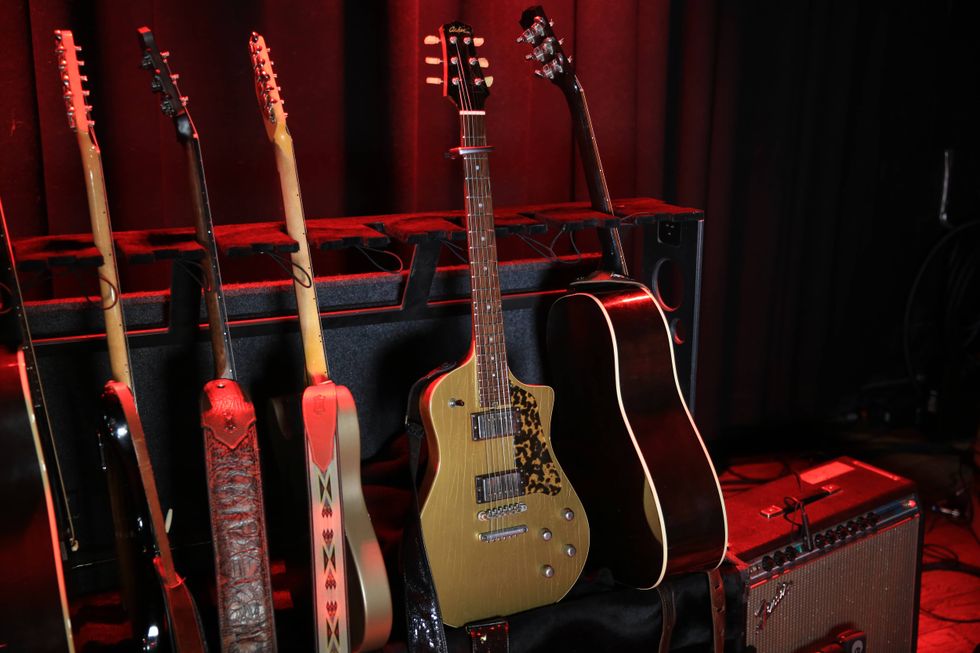
After “coveting” it for a long while, Ford borrowed this humbucker-equipped 6-string from Bill Asher, and after a bit of time with it, decided that he couldn’t give it back—even though he has an Asher signature model.
Nashing of Teeth
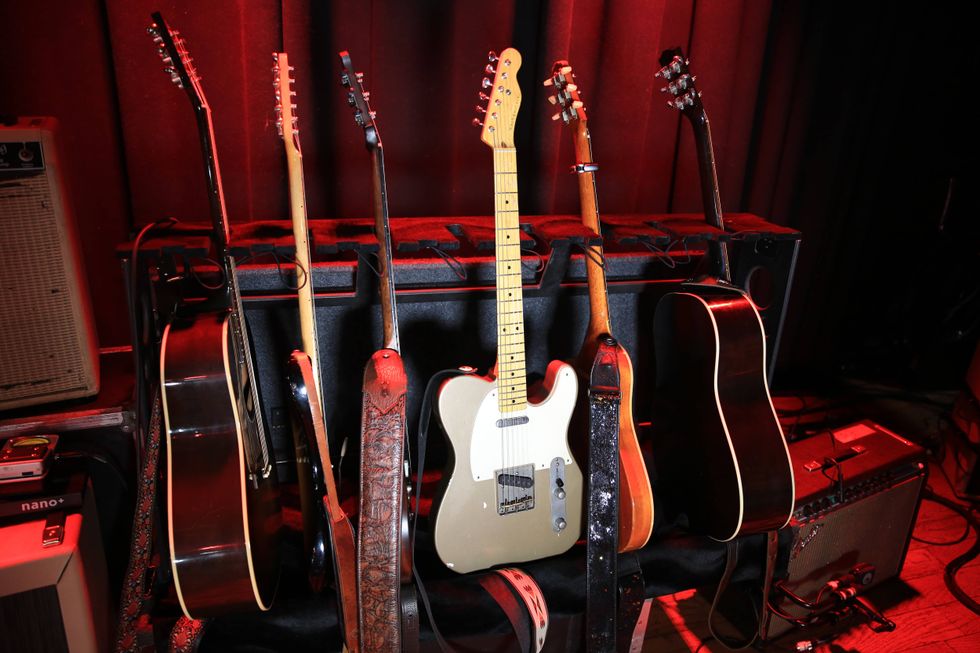
Ford was on the hunt for a Telecaster with a maple neck, and snagged this Nash T-style just a few weeks before this Rundown.
Hurtling Through Space

This custom Satellite amp has two 10" speakers and pumps out roughly 20 to 25 watts.
Marc Ford’s Pedalboard
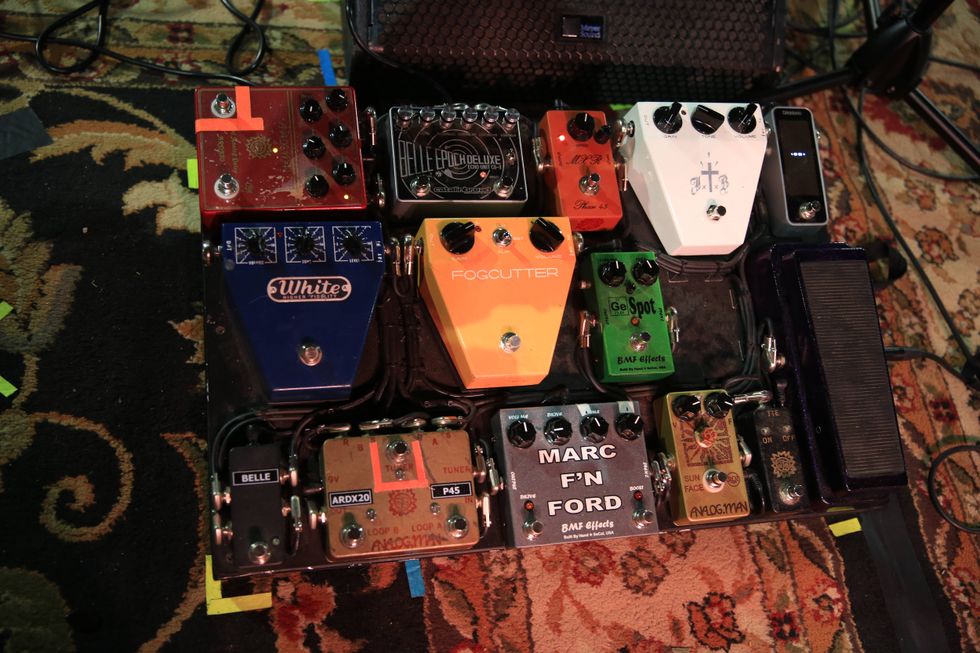
On his board, Ford runs a D’Addario tuner, BMF Effects Marc F’n Ford and Ge Spot, Analog Man Sun Face, Satellite Fogcutter, White Amp Emulator, and Jonny Two Bags, a Catalinbread Belle Epoch Deluxe, MXR Phase 45, and Analog Man ARDX20.
Ghost of Christmas Past
There’s a lot of history in this picture. The P-bass on the right was a gift that Sutton received on Christmas morning when he was 16. The body is the only original part left, and he strings it with La Bella flatwounds. On the left is an old Kay/Kraftsman bass, which he plays with old roundwounds strings. Sutton has owned the Ampeg SVT and cab, at rear, since he was 18.
David Sutton’s Pedalboard

At his feet, Sutton runs a TC Electronic PolyTune, Radial Loopbone Master Loop Controller, Boss TR-2, SansAmp Bass Driver DI, and ACT Entertainment Panic Button, all powered by a Voodoo Lab Pedal Power 2 Plus.

Tech 21 SansAmp Bass Driver DI
Mod Garage Tonewood Teardown: Chasing the “Closet-Classic” Look
Hello! Welcome back to Mod Garage, and our “Tonewood Teardown” series. After finishing our work on the body of our Telecaster, let’s move on to the hardware and electronics, starting with the pickguard.
The factory-stock pickguard on this guitar is a 3-ply mint green one, and as they say, there’s no accounting for taste! In my book, a greenish pickguard on a green body isn’t an appealing look, so it had to go. Because I want to transform the guitar to Esquire specs, I had to replace it anyway, and this is a perfect field to let creativity flow and create a custom look: There are countless choices when it comes to materials, from plastic to metal to wood to acrylic glass to leather and beyond. Find the color and pattern you like best, or simply leave the original pickguard with the neck pickup removed for a serious DIY aesthetic. You can cover the hole for the neck pickup with some tape (maybe in a third green color, like neon green!) or simply remove the pickguard for the ultimate outlaw look, exposing the neck pickup routing.
I decided for a classic vintage look, with a twist. After comparing several different pickguard colors, I decided to use a 1-ply nicotine-white guard, which perfectly matches the now-matte look of the surf-green body. The color is also often referred to as parchment, offset white, eggshell white, or vintage white—not white, not cream, but somewhere in between. (Wow, an accidental rhyme!)
You can buy replacement pickguards from plenty of companies, but if you want to keep it strictly DIY, you can purchase an uncut sheet of the material. I already had some nicotine-white blanks in my storage room, so I used the old pickguard as my pattern and a simple jigsaw with different saw blades to carve out the new one. For the curvatures, I like to use a superfine round saw blade, and a standard straight one for even lines. Put some self-adhesive foil on the surface to keep you safe from any accidents.
An Esquire pickguard without the neck pickup opening is easy to fashion, and a perfect beginners’ project for pickguard-making—so be brave! It took me about 20 minutes, plus a few more minutes to drill and countersink the holes for the pickguard screws. After another 10 minutes with some sandpaper and files, the new pickguard was ready, and it looked so much better on the surf green body compared to the stock mint green.
To give the new pickguard a custom-shop twist, I decided to break the shine and make it matte like the body, which was done in just a few minutes by using some fine 0000-grit steel wool and abrasive cloth. This easy step makes it look slightly used, and by applying different grades of steel wool and pressure, you can decide on your own exactly how “used” it will look. I decided for a moderate used look that Fender would call “closet classic.”
“Do yourself a favor and replace the tiny screws with heavier ones—better safe than sorry!”
To take it the extra mile, I decided to round all the edges to give it a rolled-edge feeling—very smooth and a pleasure to touch. I thought this would be done in no time, but I was mistaken; it took me almost an hour to look and feel great! That said, rounding the edges isn’t a complicated task, since all you need is some sandpaper wrapped around a wooden rod. The hard part is getting all of the edges totally even, so if you decide to give it a try, prepare some strong coffee and take your time. It was absolutely worth the time, effort … and swearing. I found that the trick was to always get the same angle with the sandpaper, and to stay away from rotating tools like a Dremel.
Now, for the rest of the body. In general, I have a problem with all the screws used on this guitar. The diameter is always smaller compared to the standard, and the material is very soft, which is flirting with stripped-screw-head disaster. Besides this, the chromed surface is super shiny, so I decided to replace all screws with stainless-steel screws in standard sizes. I really like the typical matte look of most stainless-steel screws; they appear a little bit worn right out of the box and are easy to work with. All you need to do to give them the “closet-classic” look is rub the head of the screws with some sandpaper to produce artificial scratches. You can buy matching stainless-steel screws in any guitar or hardware store.
Next, let’s take a look at the factory-stock strap buttons. They’re chromed and standard Fender-sized, so no need to replace them if you want to keep the classic ’50s look. The stock screws are tiny, so I’ll replace them with thicker stainless steel ones. Here, too, you have plenty of options to customize your guitar by using the strap buttons you like best, or, alternatively, removing them. You can use smaller Gibson-style ones made of aluminium, locking buttons, custom buttons made out of wood, graphite, etc ... it’s your guitar, and you decide what to use. But do yourself a favor and replace the tiny screws with heavier ones at this spot—better safe than sorry! The stock strap buttons came with a small ring of black felt to protect the body from any imprints, so it’s your call whether you reinstall or remove them. For a more classic look, I decided to remove them.
To break the shiny chromed surface of the stock strap buttons, you can again use some steel wool, abrasive cloth, or go the chemical route. Here are two other easy techniques you can use on chrome or nickel guitar hardware.
1. Alternative mechanical methods
Collect a nice mixture of nails, metal parts, broken glass, gravel, sand, little stones, etc., and put this mixture into a small box or a bucket with a lid. Put the hardware inside, close the lid, and shake the hell out of it for a couple minutes to create some nice random scratches, dings, and bumps on the metal parts. The longer you shake, the more weathered it will look. Check the result after a few minutes, and if you want more scratches, keep on shaking.
If you don’t want to shake by hand or plan to do this regularly, I recommend a small stone tumbler like we have in the shop. Usually, they’re used for polishing, which is exactly the opposite of what we want to do, but loading it with our mixture from above will work perfectly for relic’ing metal hardware. When you’re pleased with the result, take the hardware out of the box or tumbler tube, and use a soft brush to clean off any dust.
2. Alternative chemical method
Place the hardware on some old newspapers, put on some gloves and goggles, and put iron (III) oxide (ferric oxide) liquid on the hardware with a Q-tip. Watch carefully, and if you like what you see, stop the process by wiping the liquid off the object with a wet cloth or paper towel, or run it under cold water.
Next month, we’ll work on the rest of our Telecaster’s hardware. I calculated $25 for a new pickguard and another $10 for the stainless-steel screws, so our budget is down to $305 for future investments. Stay tuned, and until then ... keep on modding!
Why Is Rhythm Guitar So Hard?
Rhythm guitar is arguably the most important aspect of guitar playing, and it’s also one of the most challenging skills to develop. The discouragement many players feel when working on rhythms forces too many of them to oversimplify the nuances, and this can reduce a performance from exceptional to fine. In this lesson, we’ll investigate why rhythm guitar can be so puzzling and look at a few ways to keep yourself motivated enough to persevere and improve.
Why So Hard?
In my many years of teaching I have found that students can learn the basic open-position chord shapes relatively quickly. The same goes for the pentatonic and major scale patterns. Even riffs and hooks like “Smoke on the Water,” “Crazy Train,” and “Oh, Pretty Woman” come relatively quickly to beginners. The biggest challenge for most guitar players is mastering rhythm guitar.
I’m not referring to the basics, such as four down strums in a measure of 4/4, a down and up eighth-note strum, or even the slightly syncopated strum of Ex. 1.
Ex. 1
Rather, I’m talking about the rhythms in countless classic rock, folk, and pop songs, which are the mainstays—for better or worse—of every oldies station, cover band’s setlist, and many aspiring beginners’ guitar dreams. Why are these rhythms so challenging for most players?
Dictionary.com defines idiosyncratic as “something peculiar to an individual.” Well, there’s your answer. Many of our favorite songs and guitarists, such as Neil Young, Malcolm and Angus Young, Joni Mitchell, David Gilmour, Jimi Hendrix, and Prince, possess idiosyncratic strums. How can something peculiar to an individual be easily reproduced? It can’t. Imitation takes hard work, hours of practice and refinement, and highly developed listening skills. That is not to say that idiosyncratic strums can’t be reproduced, only that they can’t be imitated easily.
What Can Guitar Players do to Improve Their Rhythm?
The first priority is to confirm that you genuinely know how the rhythm was originally performed. In this day and age, with reliable, professionally created guitar transcriptions and instructional videos (as well as an abundance of isolated rhythm guitar tracks on YouTube), there is ample opportunity to both hear and see accurate rhythms. This doesn’t make the rhythm immediately easier to play. It will help you avoid practicing it incorrectly and allow you to generate modifications based on the original, rather than through guesswork.
Play the Part Correctly and Slowly
The second step I recommend is to endeavor to play the part correctly and slowly. This requires playing the rhythms with slower tempos and one measure at a time rather than the more common four-measure patterns. This second aspect is important as many idiosyncratic strums vary from measure to measure. Such a lack of uniformity adds to the artistry of the music, but it can be frustrating to imitate.
For instance, look at Ex. 2, which is similar to Pink Floyd’s “Wish You Were Here.” While the chords themselves, G–C–D–Am, are easy enough to fret, the strum pattern is a nightmare of mixed rhythms, with each measure not only containing a different pattern, but different string choices as well. (To make it even more tricky, David Gilmour continues to vary his rhythms throughout the song.) Let’s consider just the first measure. There’s only one chord, but three different rhythmic figures. It gets even worse than that. Sometimes the strum includes all six strings, other times one note, two notes, or three notes. Maddening! This is one of the most challenging aspects of idiosyncratic rhythm. And these types of variations show up over and over again in accurate portfolio transcriptions. Yes, it is correct, but it’s an ordeal to decipher.
Ex. 2
Here’s a tip. First work on the strum, not the individually plucked notes and strings. Strum the entire G chord (Ex. 3). Next, isolate the lowest note in the chord (Ex. 4). If you can play this correctly then you can begin mixing it up with a combination of full chords, single bass notes, and partial chords. Trust me, Gilmour wasn’t thinking, “Gotta play just the top three strings on the 16th-note upbeat of beat two and the two bottom strings on the ‘and’ of beat four.” It’s idiosyncratic! Once you have measure one correct, move on to measure two, which is slightly different. Measures three and four are also marginally altered.
Ex. 3
Ex. 4
Hopefully you’ll find that one new rhythmic pattern on its own is relatively manageable. Having to generate four different patterns in the space of four measures? In that situation, strums become exponentially more complex. As this lesson moves forward, all the examples will be variations on this theme, in different contexts, and citing different specific artists. The idea here is to demonstrate the vast complexity idiosyncratic playing can generate.
Neil Young's Strumming Patterns
In my experience, Neil Young has some of the most seemingly random strums one can find. He’ll play a song with only four chords but there will be 16 different strum patterns. It’s both inspiring and infuriating. Ex. 5 is an example of such an exasperating figure, based on “Heart of Gold.” There are four chords in two measures, each with a different strum, followed by variations on the same four chords! Brilliant and unbearable.
Ex. 5
Ex. 5
To make mastering this a bit more tolerable, as with the previous Gilmour-esque pattern, break it down into smaller parts. You’ll also want to add full chord strums on the Em and C. Ex. 6. and Ex. 7 demonstrate measures three and four of Ex. 5, isolated and repeated. Do this for the first two measures as well.
Ex. 6
Ex. 6
Ex. 7
Joni Mitchell's "Big Yellow Taxi"
Another icon of individuality is Joni Mitchell, who deserves a lesson all to herself. For now, Ex. 8 will suffice. In this example, based on “Big Yellow Taxi” (although the original is performed in open-E tuning), there is the added complication of muted strums.
Ex. 8
If these muted strums are new to you, I recommend you focus on the mutes, as shown in Ex. 9. Once that is comfortable, return to Ex. 8 and incorporate the barre chords into the pattern. As with all our examples thus far, break them down, making sure each measure is solid before moving on to the next. At the risk of belaboring the point, these strums are demanding—there is no instant gratification here. “Practice and refine” should be your mantra.
Ex. 9
Let's Talk About Jimi Hendrix
It would be impossible to write about either guitar icons or 6-string idiosyncrasy without mentioning Jimi Hendrix. Jimi’s use of his thumb to fret chords is alone worthy of attention. For now, let’s stick with his eccentric strumming patterns. A good place to start is probably Hendrix’s version of “Hey Joe.” It consists of a three-and-a-half-minute loop of the circle of fourths chord progression C–G–D–A–E, yet Jimi finds a new way to play the pattern every time. Ex. 10 offers one of countless variations you can attempt. Ex. 11 demonstrates how to break it down.
Ex. 10
Ex. 11
While it’s true that most AC/DC songs feature the same riff or chord pattern played repetitively, you’ll also find that many of those patterns are four measures long, with multiple, highly syncopated rhythms found within each measure. “You Shook Me All Night Long,” “Bad Boy Boogie,” and “Highway to Hell” are all excellent examples of this. Ex. 12 demonstrates Malcolm and Angus Young’s penchants for such patterns by imitating the rhythms of “For Those About to Rock (We Salute You).” As you can hear, there are four measures with an immense amount of space in them and four different rhythmic figures. The key to perfecting this sort of rhythm is to not rush. Either tap your foot or use a metronome to keep your tempo steady.
Ex. 12
Our final example isn’t exactly idiosyncratic, though the referenced artist is. While Prince’s music and personal style is incredibly diverse, he often wears his influences on his sleeves, whether those be James Brown, Jimi Hendrix, or Joni Mitchell. Nevertheless, he habitually put his own spin on the source inspiration.
Ex. 13 provides you with a funky rhythm that will improve your playing, no matter what genre you specialize in, as it features muted strings (similar to those in our Joni Mitchell example), a fast syncopated 16th-note strum, and a four-measure pattern that requires you to focus on the subtle variations found in the pattern. Once again, I’ll remind you to practice such patterns one measure at a time. Goodness, any one of these measures is funky enough on its own and would satisfy most funk musicians: It’s the idiosyncratic nature of Prince to go beyond.
Ex. 13
Ex. 14 is measure three of Ex. 13 isolated and repeated. I’ve chosen this measure because for me it’s the easiest to play (always start with what’s easiest for you). Note that in Ex. 14, I removed the muted strums. We know they’re in the original and we can add them in soon enough, as demonstrated in Ex. 15.
Ex. 14
Ex. 15
Finally, let’s play all four measures without the mutes, as demonstrated in Ex. 16. It is this sort of compartmentalized, methodical, attention-to-detail practice that will improve your playing.
Ex. 16
Words of Encouragement
Ironically, one of the best things I can tell you about practicing the guitar is, “Learning to play guitar is hard!” I don’t say this to discourage, but to give perspective. If it’s taking you a week to learn a certain rhythmic pattern, guess what? It might take you a month to really get it down. Still, the rewards are worth the effort. Good luck with your rhythms!
Get Slash Tones Without Breaking The Bank
Slash’s tone is often regarded in gear circles like buried treasure—elusive, highly coveted, and shrouded in the mystique of modified vintage Marshalls and “Holy Grail” '59 Les Pauls. For most aspiring players, achieving that sound feels unattainable due to the specificity of the gear and the level of precision required to capture his Appetite for Destruction-era tone. In the first installment of a new video series, Blueprints, PG contributor Tom Butwin demonstrates that the "blueprint" isn't a locked vault; it’s a set of principles you can follow using modern, accessible tools.
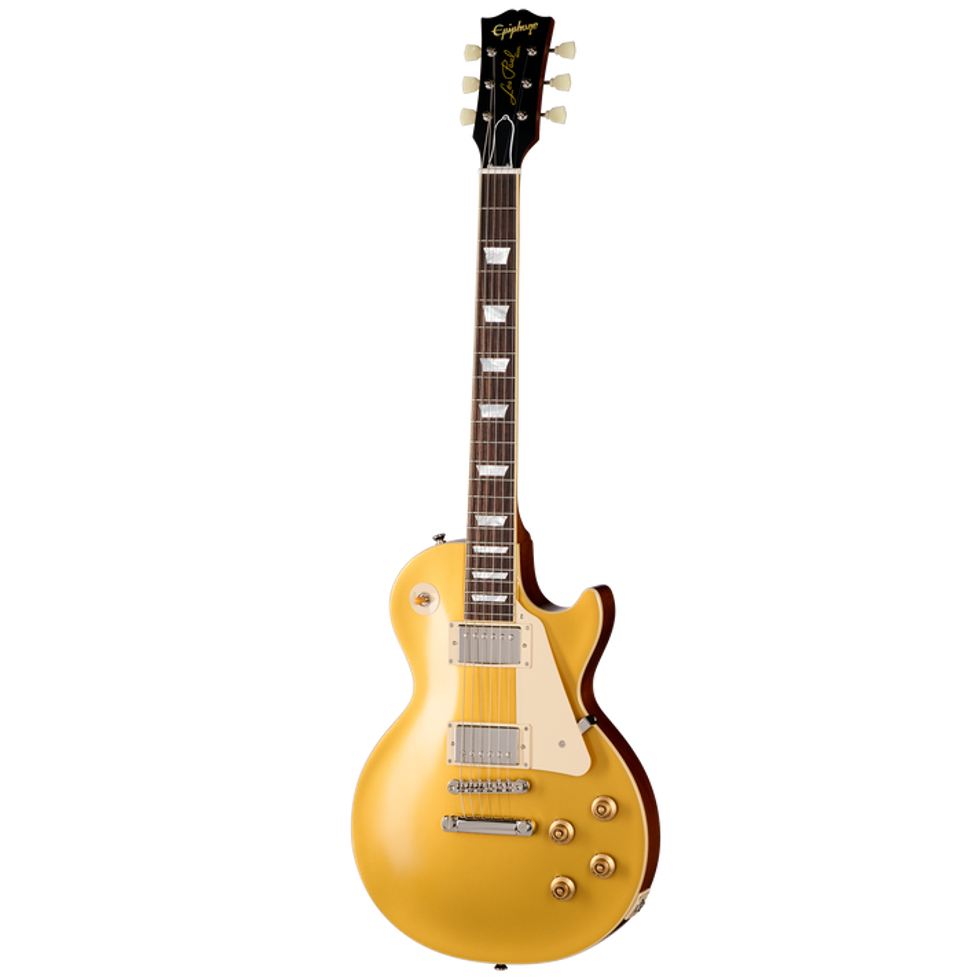
IGC 1957 Les Paul Goldtop Reissue, Double Gold
An Inspired by Gibson Custom reissue of the classic humbucker-equipped ’57 Goldtop –
1957 was the year that the Les Paul™, as most players think of it today, truly came into its own. It was the first full year that it had Patent Applied For humbucker™ pickups installed. The humbuckers, along with the ABR-1 Tune-O-Matic™ bridge and Stop Bar tailpiece that first appeared on a Les Paul with the introduction of the Les Paul Custom in late 1953 and on the Goldtop in late 1955, were defining features that many players still prefer over the earlier models that had a wraparound bridge/tailpiece and P-90 pickups and made the Les Paul into a true fire-breathing rock icon. Now, Epiphone, in collaboration with Gibson Custom, is very proud to introduce the 1957 Les Paul Goldtop Reissue, a stunningly authentic Inspired by Gibson Custom reissue of those early humbucker-equipped Les Paul Goldtops that delivers vintage Les Paul looks and performance at an accessible price. The 1957 Les Paul Goldtop Reissue isn’t just a guitar; it’s a bridge to a symphony of possibilities, willing and ready to help you make your own mark on music history.
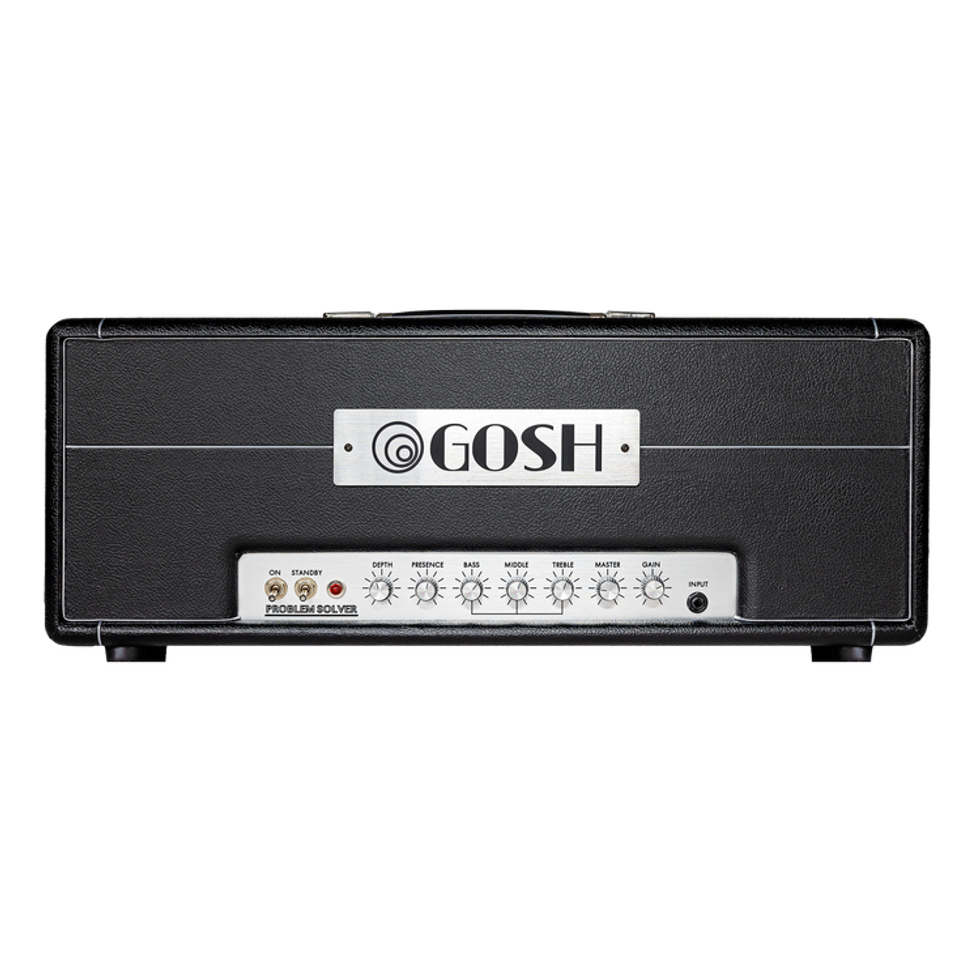
Problem Solver 50
What sets the Problem Solver apart is its thoughtful array of features, carefully curated to empower your creativity. The AGE switch lets you tailor your tone stack to different eras – whether you crave the cutting-edge brilliance of 1963, the aggressive bite of 1966, the mid-heavy roar of 1981, or the warmth of 2023, it's all at your fingertips.
The Mid Boost switch elevates your highs and mids, ensuring your solos cut through the mix with unparalleled clarity. The Depth control allows you sculpt the low-end frequencies. And the revamped EQ controls provide a logical, intuitive layout, ensuring that you can sculpt your sound effortlessly, straight out of the box.
In the end, the Problem Solver Amplifier isn't just an homage to the past—it's a celebration of timeless tone, reimagined for the demands of today's musicians. Join us on this journey and discover a new era of sonic possibilities. Plug in, play, and let the music do the talking – the Problem Solver has arrived.
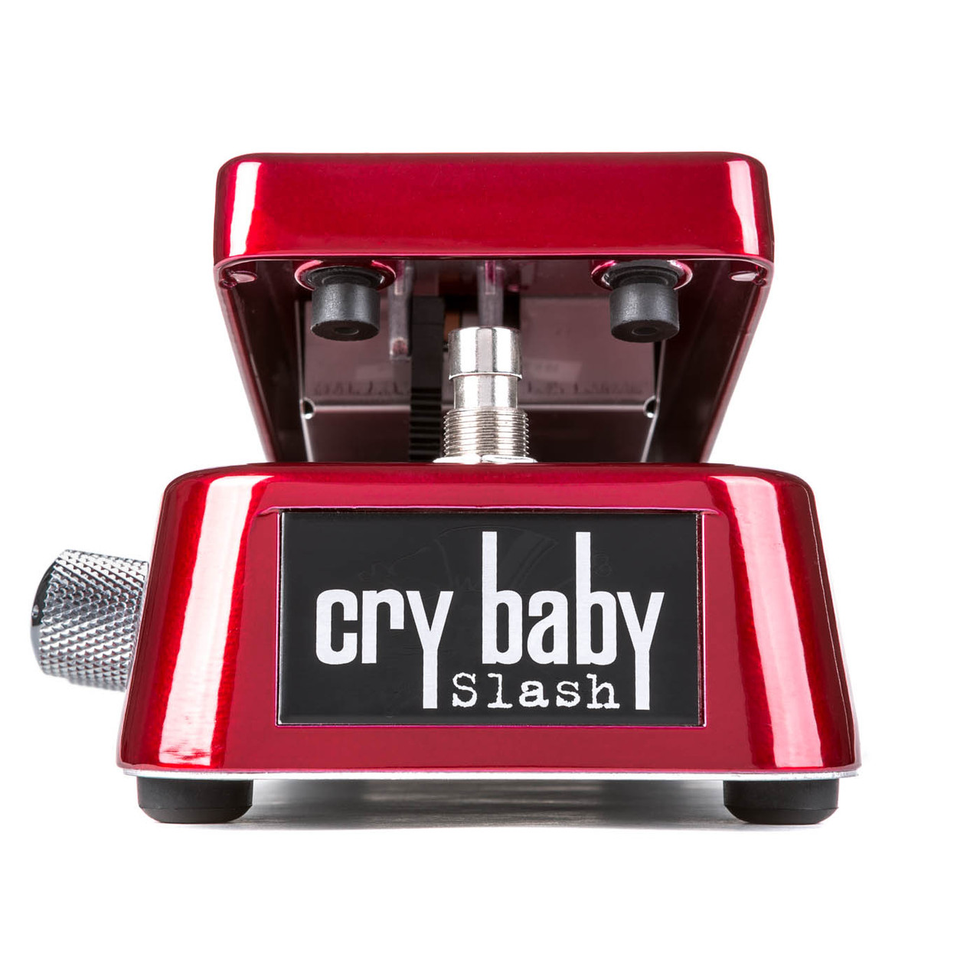
SLASH CRY BABY® WAH
This Cry Baby Wah combines high gain distortion with the Classic circuit for Slash's cutting lead tone, with LEDs to indicate effect status.
This pedal can be powered by two 9-volt batteries, a 18-volt adapter or the DC Brick™, Iso-Brick™ and Mini Iso-Brick™ power supplies.
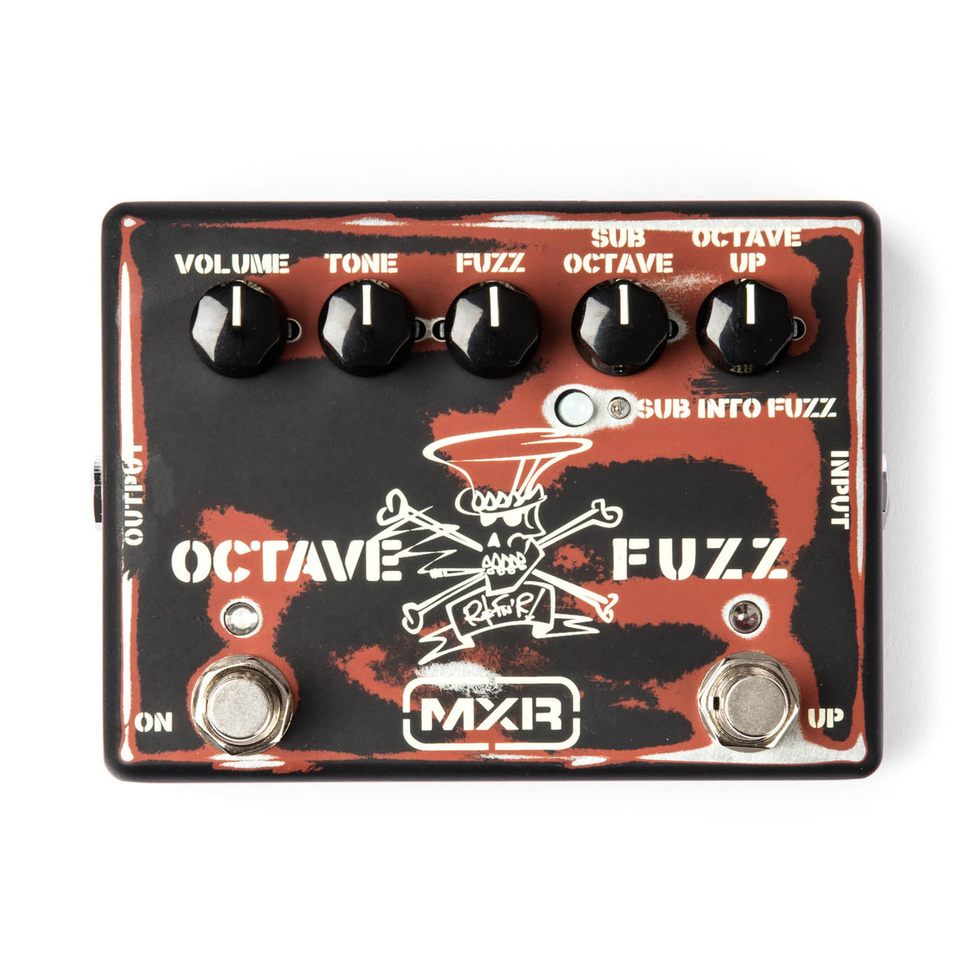
SLASH OCTAVE FUZZ
The Slash Octave Fuzz combines searing fuzz with a sub octave grow and an array of controls for fine-tuning your sinister sound.
This pedal can be powered by a 9-volt battery, a Dunlop ECB003 9-volt adapter, or the DC Brick™, Iso-Brick™, and Mini Iso-Brick™ power supplies (not included).
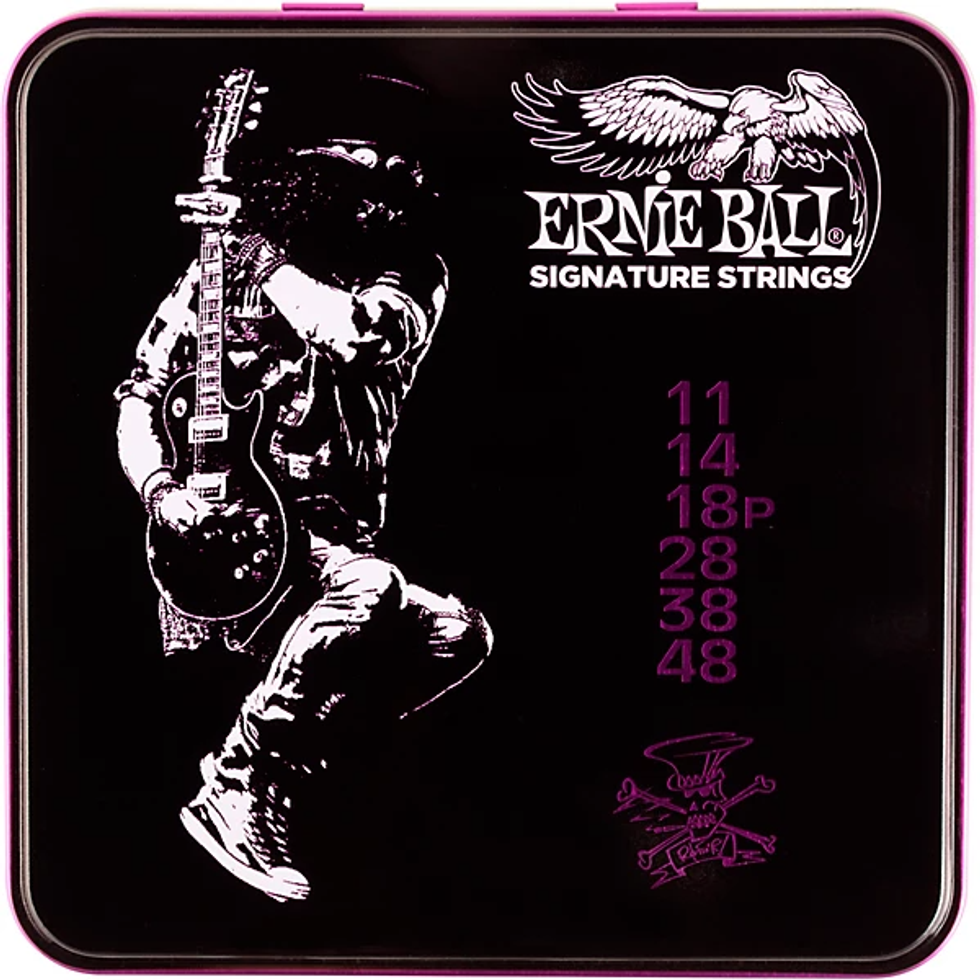
Limited-Edition Slash Signature Strings Set .011-.048
Ernie Ball introduces a limited-edition set of custom-wound Slash signature Slinky strings. Slash’s signature string sets are the culmination of over three decades of Slash and Ernie Ball’s ongoing pursuit to create strings that provide more durability and tuning stability without sacrificing tone or feel. These sets consist of Slash's preferred 11-48 gauge Slinkys wound with Paradigm core wire and plasma-enhanced nickel-plated steel wrap wire, while the Paradigm plain strings are constructed with a heavier brass wire reinforcement at each of the ball ends for better tuning stability and strength. These limited-edition string sets are highly collectible and conveniently packaged in a three-pack embossed tin for easy storage.
DC7
The groundbreaking DC7 has a one-inch (25,4mm) profile and weighs 1.1 pound (500 grams) thanks to the pure 2-stage switch-mode technology inside. The profile may be low but the power ratings are certainly not – the DC7 puts out a maximum of 48W and allows the user to connect multiple high-current effects such as devices from Effectrode, Line 6 and Eventide without noise of any kind.
SOL
SOL is the ultimate solution for bringing life to a small to medium-sized pedalboard setup, especially if you are using power-hungry pedals. SOL is the smallest mains-powered switch-mode power supply we make at CIOKS (no wall-warts here) and the no-frills design plus massive power will leave you free to focus on your creative spark.
Pedalboard Large with Pro Accessory Case 2.0
This is it — the granddaddy of Pedalboard series. The MONO Pedalboard Large is a pro-sized and -featured pedal solution that won't weigh you down in size or cost. The Pedalboard Large is cut from a single piece of anodized aluminum for superior strength, light weight, and an elegant textured surface. Cutouts along the surface hide pedal jumpers and power cables for a streamlined, professional look. Rubber feet on the bottom absorb shock and prevent the Pedalboard Large from sliding across hard surfaces as you stomp.
Studio Instrument Cable
Built for musicians chasing studio-grade clarity, the MONO Studio Instrument Cable delivers pure tone and zero compromise. Inside, 150 strands of 0.08 mm oxygen-free copper give you detailed highs, tight lows, and everything in between. Precision insulation keeps your signal clean from the first take to the final mix.
Instrument Cables
Engineered for clarity with oxygen-free cores with precision insulation and shielding to reduce interference and keep signal clear.
Slash Blueprints Giveaway!

Want to sound like Slash? Grab your chance with the Slash Blueprints Giveaway!
Slash Blue Prints Giveaway
See it in action!
Welcome to our new video series, Blueprints. In the first episode, PG contributor Tom Butwin features Slash and explores the architectural DNA of the top-hatted rocker's legendary sound.
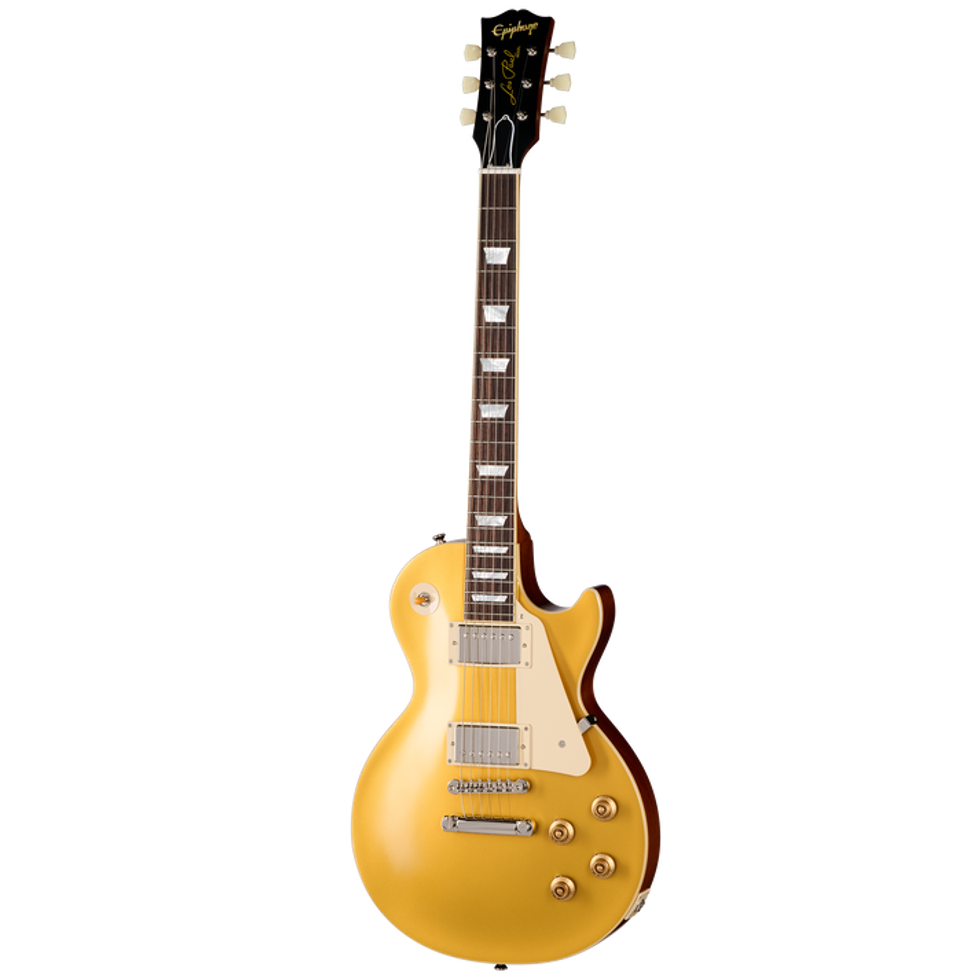
IGC 1957 Les Paul Goldtop Reissue, Double Gold
An Inspired by Gibson Custom reissue of the classic humbucker-equipped ’57 Goldtop –
1957 was the year that the Les Paul™, as most players think of it today, truly came into its own. It was the first full year that it had Patent Applied For humbucker™ pickups installed. The humbuckers, along with the ABR-1 Tune-O-Matic™ bridge and Stop Bar tailpiece that first appeared on a Les Paul with the introduction of the Les Paul Custom in late 1953 and on the Goldtop in late 1955, were defining features that many players still prefer over the earlier models that had a wraparound bridge/tailpiece and P-90 pickups and made the Les Paul into a true fire-breathing rock icon. Now, Epiphone, in collaboration with Gibson Custom, is very proud to introduce the 1957 Les Paul Goldtop Reissue, a stunningly authentic Inspired by Gibson Custom reissue of those early humbucker-equipped Les Paul Goldtops that delivers vintage Les Paul looks and performance at an accessible price. The 1957 Les Paul Goldtop Reissue isn’t just a guitar; it’s a bridge to a symphony of possibilities, willing and ready to help you make your own mark on music history.
SLASH CRY BABY® WAH
This Cry Baby Wah combines high gain distortion with the Classic circuit for Slash's cutting lead tone, with LEDs to indicate effect status.
This pedal can be powered by two 9-volt batteries, a 18-volt adapter or the DC Brick™, Iso-Brick™ and Mini Iso-Brick™ power supplies.
SLASH OCTAVE FUZZ
The Slash Octave Fuzz combines searing fuzz with a sub octave grow and an array of controls for fine-tuning your sinister sound.
This pedal can be powered by a 9-volt battery, a Dunlop ECB003 9-volt adapter, or the DC Brick™, Iso-Brick™, and Mini Iso-Brick™ power supplies (not included).
The Collection: Slash, Standard Edition
This premium coffee table book explores in unprecedented detail the instruments Gibson Global Brand Ambassador and rock legend Slash has used on countless hit records and on stages worldwide, in front of millions of adoring fans.
Gibson Publishing, headquartered in Nashville, Tennessee, is the next major step from Gibson Brands, contributing to the evolution of collaborative artist partnerships and promoting music and music-related topics to fans worldwide. As with the recently launched Gibson Records, the first project for Gibson Publishing is a collaboration with Gibson Global Brand Ambassador and rock legend, Slash.