
Music is the universal language
“Glory to God in the highest heaven, and on earth peace to those on whom his favor rests.” - Luke 2:14
Norse Guitar Feeds
Why Noel Gallagher will never play a Strat live with Oasis, according to Gem Archer: “He doesn’t need all the bells and whistles”
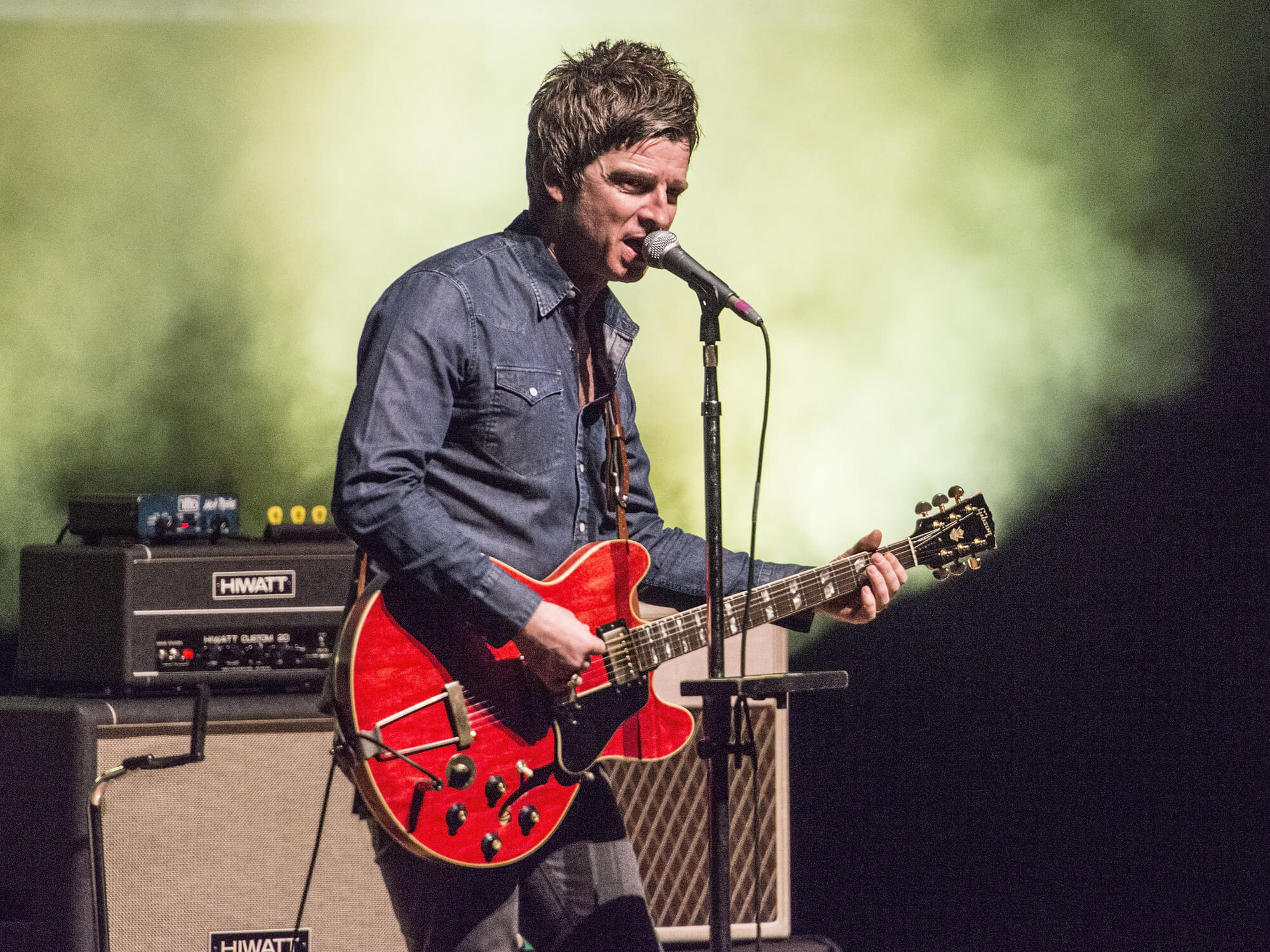
Noel Gallagher may happily reach for a Stratocaster in the studio or on stage with High Flying Birds, but don’t expect to see one slung over his shoulder at an Oasis gig. According to fellow Oasis guitarist Gem Archer, it’s simply not how Noel approaches the band live, as the musician “doesn’t need all the bells and whistles”.
Speaking to Guitar World in a wide-ranging new interview, Archer sheds light on Gallagher’s live guitar philosophy, and shares why certain instruments – however iconic – just don’t fit the Oasis blueprint on stage.
Archer, who rejoined Oasis for their mammoth Live ’25 reunion tour alongside Noel and Liam Gallagher and original rhythm guitarist Paul ‘Bonehead’ Arthurs, says that while Strats have their place elsewhere in Noel’s world, Oasis is a different beast entirely.
“He plays Strats with High Flying Birds, but in Oasis that’s not his thing,” explains Archer. “He doesn’t need all the bells and whistles live – it’s a direct thing, and he’s not gonna go from his wall-of-sound Les Paul to suddenly playing a Strat. It’s not needed.”
That said, despite Noel’s Gibson-heavy reputation, Archer reveals that at least one defining Oasis track was cut with a Fender, much to his own surprise.
“Don’t Look Back in Anger… was done with a Strat on the record,” he says. “I think it was a sunburst Strat. One of the first times I met Noel, I was round his house and he went, ‘Do you wanna come upstairs and see some guitars?’ And he went, ‘This is what I played on Don’t Look Back in Anger.’ I was like, ‘What?’”
Meanwhile, Gallagher himself has previously addressed his mixed feelings about Stratocasters. Speaking to Guitar.com in the past, the Britpop veteran admitted he was “never a fan of Strats” – even if he’s happy to rotate guitars in the studio, noting that “all guitars have got songs in them”.
The post Why Noel Gallagher will never play a Strat live with Oasis, according to Gem Archer: “He doesn’t need all the bells and whistles” appeared first on Guitar.com | All Things Guitar.
“I canceled. That wasn’t how I wanted to spend my time”: Guitar legend Larry Carlton reveals how he quit working with John Lennon after one drunken session

Session ace Larry Carlton has opened up about a chaotic, late-night studio date with John Lennon that turned out to be such a “drag” he ended up quitting after just one night
The session in question was for Rock ’n’ Roll, Lennon’s fifth and final solo album, released in February 1975. A covers record paying tribute to the rock and roll songs of Lennon’s youth, the album’s creation was famously turbulent, unfolding amid Lennon’s legal battle with Morris Levy over The Beatles track Come Together and his separation from Yoko Ono.
- READ MORE: Ed Sheeran is inspiring more people to play the guitar than The Beatles, according to a new study
Speaking to Jonathan Graham on the Thinking About Guitar YouTube channel, Carlton explains that he was booked for what was meant to be a full week of sessions at A&M Studios.
“I didn’t end up on the album,” he says [via Ultimate Guitar]. “Phil Spector, the producer, had booked a lot of us musicians for seven o’clock every night that week, five nights. And so, I went to the session for John on time, and Leon Russell [keyboards], I forget who else was there that night…”
“But anyway, what I’m getting at, is the seven o’clock session. [It’s] nine-thirty, still no John Lennon and Phil Spector. We’re just sitting around A&M Studios, Leon Russel and I went to another studio, he sat at the piano, and we just kind of jammed a little bit.”
When Lennon and Spector finally arrived, Carlton says the atmosphere only deteriorated further.
“So, John and Phil finally got there at ten o’clock or something. I didn’t tell the story for a lot of years, but it was a bad time for John,” Carlton recalls. “He was drinking. And so, we were gonna do a song, Bony Moronie [cover of the 1957 Larry Williams single]. I played Bony Moronie when I was 12 years old. So, I was in my cubby here, and John’s right there, and he had been drinking. He’s calling the chord changes; it’s only three. He’s going, ‘A!’ ‘Oh, I got it!’ ‘D!’ I said, ‘I got it!’…. It was a drag.”
By the end of the night, Carlton had made up his mind.
“It was not professional,” says the guitarist. “So, we finished that night’s session, I drove Leon Russel back to his hotel, and I said, ‘Man, that was a drag, darn it!’ And with his Oklahoma accent, Leon said, ‘You’re kiddin’, I’m back at Tulsa in the mornin’.’ I got home and called Phil Spector’s office, and just left a message at midnight, and said, ‘Sorry, I can’t make it for the rest of the week.’ I canceled. That wasn’t how I wanted to spend my time. It could have been so cool. But, one of those things. For me, it was the right decision. That wasn’t fun.”
That fateful session turned out to be the last time he crossed paths with the Beatles star as well, with Carlton admitting, “I’m an admirer, but that was a bad time.”
The post “I canceled. That wasn’t how I wanted to spend my time”: Guitar legend Larry Carlton reveals how he quit working with John Lennon after one drunken session appeared first on Guitar.com | All Things Guitar.
Trivium’s Matt Heafy names the five up-and-coming metal bands everyone needs to watch in 2026

Matt Heafy is at a transitional point. With his band, Trivium, he’s recently released the EP Struck Dead and is in the process of bringing aboard new drummer Alex Rüdinger while writing album number 11. Things are also changing behind-the-scenes. Revered for years as the busiest man in metal, Heafy is trying to scale things back.
“[Last year] I was doing 15 to 20 to 30 projects at the same time,” the singer/guitarist says, talking to Guitar.com during a down day on Trivium’s North American tour. “I was producing bands, I was managing bands; I was making all these different products and trying all these different things, like scoring video games and scoring a movie and starting a pop-up restaurant.”
The plates that Heafy was spinning all smashed on the ground when he had a self-described “metal breakdowns/mid-life crisis” in 2024. Burnt out more than he realised, his bandmates and loved ones staged an intervention, and he began to attend counselling and cognitive behavioural therapy.
“What we determined through therapy is that I’m naturally very low on serotonin,” says Heafy, explaining why he had to stay so busy for so long. “I have to be on SSRIs to help my very low serotonin. Once I corrected that, we realised that I’ve got intense ADHD, anxiety and OCD. I wanted to figure out what makes me tick. Why do I think this way? How can I stop going to such an extreme point every single time?”
 Image: Mike Dunn
By any other person’s standards, Heafy is still a wildly busy man, balancing Trivium with fatherhood, a regular Twitch presence and his passion for Jiu-Jitsu. However, he’s zeroed in on being a musician and a dad, and the lyrics on the three songs that make up Struck Dead are him interrogating his own thought process.
Opener Bury Me with My Screams is about the spiral that led up to his breakdown, centrepiece Struck Dead (Pain Is Easier to Remember) quotes something that bassist Paolo Gregoletto told him at his intervention, and widescreen finale Six Walls is about trying to break free from mental health struggles.
“I buried myself in my own coffin,” Heafy says, “and the six walls of this wooden coffin are what I pictured. I’m finally trying to break free. It took, like, a year. It was in January [2025] when I started coming to. On the first tour after treatment – after 38, 39 years of living the same way – I was like, ‘Holy shit! I’m having so much fun!’”
 Image: Mike Dunn
Musically, Trivium looked backwards while making Struck Dead: the writing coincided with their rehearsals for a co-headline tour with Bullet for My Valentine, where they played 2005 breakthrough Ascendancy in full. However, the EP is just as forward-thinking as it is nostalgic. Bury Me… closes with a torrent of breakdowns heavy enough to murder a newborn elephant, and the intro of Six Walls brings the shamisen, a Japanese stringed instrument, into Trivium’s world.
Ascendancy’s lyrics were just as bare as Struck Dead’s, with a 19-year-old Heafy opening up about depression and social anxiety. The album catapulted Trivium into metal’s stratosphere, but it was a mixed blessing. As great as all the magazine covers and blockbuster tours were, the band found themselves being bullied by jealous peers and gatekeeping fans.
“It was rough being bullied by our favourite bands, and by their fans,” Heafy reflects today. “We got bottles thrown at us [while onstage]. People tried to accost us by our van. We were on tour with Lamb of God, Machine Head and Gojira in 2006, and we had our sound guy walk out on us. I was going to our bus and some guy said [sarcastically], ‘Good show,’ and flipped me off and walked off.”
Having been through that and come out the other side, Heafy’s now a staunch advocate for new metal bands, not wanting them to be hazed the way he was. Trivium frequently pick young artists to open for them, and Heafy has a radio show dedicated to spotlighting rising talent. So, for the second half of our interview, we asked him to pick five up-and-coming metal acts who are truly impressing him right now. This is who he thinks will take over in 2026:
Fit for an Autopsy
“It was Corey [Beaulieu, Trivium lead guitarist] who first got me into them. I think he sent me Heads Will Hang first. I was like, ‘Holy shit, this is incredibly heavy!’, because it’s that mixture of stuff that I love. It feels a little bit like they would have been in the Gothenburg sound, a little bit like they’re into hardcore, and a little bit like they’re into modern metal. And then I heard Hydra, and I was like, ‘This is one of the best usages of a breakdown essentially being a song that I’ve heard since a band like Pantera.’
“We brought them out on the Trivium, Arch Enemy, While She Sleeps, Fit for an Autopsy North American tour, and they were just such lovely, wonderful guys. I spent hours or days playing games with Joe Bad [frontman Joseph Badolato] while we both streamed. Love him. I love all the guys: I had them all at my house, basically, when my kids were maybe a year old. We got them all Cuban food.
“They’re so freaking good live. They’re just perfect. The stuff that Joe can do, from his super low screams to his high screams and then his singing range, it’s just marvellous. The songs that Will Putney [guitarist/producer] writes… I think Putney is a wonderful songwriter and a great producer. When you hear a Putney record, you know instantly it’s one of his records. There’s this live energy to it while also being perfect. It sounds so well put together.”
Orbit Culture
“I love them so much. I’d say, if someone hasn’t heard them before, I don’t want to pigeonhole them but they’re for fans of Gojira, Machine Head, Fear Factory – the glory days of each of these bands. It reminds me of melodic death metal in a way, but it’s not. It’s got moments of the 2000s vibe of the Gothenburg sound. The songs are awesome, the production is awesome. But, it’s done very differently. I think it’s really cool that, at times, the drums will really just groove. It’ll give almost a Chaos A.D. kind of simplicity, drum-wise [referring to Sepultura’s influential 1993 groove metal album].
“Vocally, Niklas [Karlsson, vocals/guitars] is a powerhouse. Just like Joe, he’s able to do very low screams to very high screams. He has such a great grit scream. His gritty singing reminds me of [classic Metallica album] Ride the Lightning. It doesn’t sound like James Hetfield, but it makes you think of Hetfield from ’84, ’85, ’86.
“Niklas was one of the people who influenced me to get my grit scream back. The first time we toured with them, I was still doing my safe screaming that I’d done for 10 years [Matt adopted a new screaming technique after blowing out his voice in 2014]. I remember hearing Niklas’ voice and I was like, ‘Goddamn!’ He was definitely one of my inspirations to get that back. The fact that a band that’s relatively new can inspire a band that’s been doing it for 27 years, that’s awesome.”
Burner
“Burner’s album [2023’s It All Returns to Nothing] is that perfect fusing of these different sounds and styles and worlds while being its own thing, which is really cool. It so seamlessly blends things together. I think before, maybe in the 2000s, you could really feel the black and white combination of styles. But, I think the way Burner have done it, it’s their own palette they’ve created. It’s hard to say, ‘Hey, did they get this from Mastodon-era bands? From sludgier bands? From hardcore? From extreme metal?’, but you have all those tonalities within it.
“They have a really amazing recording quality, already. Straight out of the gate, hearing the guitar sound and the vocal sound, you know right away that it is Burner. I think that that’s a really important thing. When you can hear that individualism that quickly, that’s a rare thing, because there are a lot of bands today that are kind of chasing the same sound. There are five bands where I’ll hear five singles and go, ‘This all sounds like the same band.’ When you hear a band like Burner, you know right away that this is their sound.
“If I were to give Burner any advice, it would be the advice I gave to bands when I helped produce their records. I would say, imagine yourself playing at 1pm at Wacken or Summer Breeze or something, to 20,000 or 30,000 people who’ve never heard of you before. What is a guitar riff or a beat or a vocal line or a hook that by 2am, when they’re done watching the headliner, they can still remember you for? What’s your Roots Bloody Roots chorus, your Du Hast chorus? Let’s hear Burner’s version of these.”
Heriot
“Our manager’s just like us: he’ll tell us, ‘Hey, check this band out,’ and we’ll check them out. [When I first heard Heriot] I was like, ‘Holy shit, this is pulverisingly heavy.’ There are these kind of moody vibes in between. When I was dropping my kids off at school, another one of the dads was wearing a Heriot shirt. I was like, ‘Oh, man, we’re touring with them [in North America this autumn]!’ He was more excited about Heriot than us.
“Debbie [Gough, singer/guitarist] is fucking awesome and she looks so badass, too. With that Jackson old-school style guitar that she wears, it reminds me of Andreas [Kisser] from Sepultura. The music hearkens back sometimes to old 90s industrial, which is something that is near and dear to my heart: originally, Trivium was meant to be an industrial band. Sometimes I get vibes of Godflesh when I hear them, or if you stripped back and made heavier Napalm Death.
“I just love the visceral heaviness that goes on. I remember watching them a lot on this tour and people being very just, like, ‘Holy shit! This is so heavy! This is so good!’ They’re wonderful people. Rudy [Alex Rüdinger] actually just gave haircuts to a couple of the band members. I love the vibes of people who are just nice, good people, who can play incredibly heavy music. There’s something extra heavy about that!”
Paledusk
“HUGs is the opening song of Gachiakuta, which is a really wild anime. It’s a show where bad people are sent to this trash pit. I don’t want to give too much else away, but it reminds me of Borderlands and Dune and Fallout all in one. Musically, it starts off with this cool singing pattern that has a really heavy scream underneath. It almost reminds me of the screams that I do. And then it just gets really, really wild, like this kind of a new-school, super heavy, Bring Me the Horizons wildness mixed with Mick Gordon [composer of the recent Doom games]. Imagine the Doom score and Bring Me The Horizon when they’re really going heavy and nutty, using digital chops and stutters inside the song. It makes it seem like the music is glitching.
“The vocalist [Kaito Nagai], sometimes he’ll be singing pretty freaking high, and then he’ll go into this ultra-high, really strange, heavy, kind of Architects-three-or-four-records-ago stuff. Really, really cool, really bizarre. That’s what’s happening in the Japanese scene: it’s really weird. Being half-Japanese, I can say, us Japanese folk are pretty strange. It’s really cool that Paledusk are exemplifying that in a new way, with these no-holds-barred song structures. The hook structures don’t always make sense. They really don’t repeat like you’d expect them to. It’s very cool, very weird.”
The post Trivium’s Matt Heafy names the five up-and-coming metal bands everyone needs to watch in 2026 appeared first on Guitar.com | All Things Guitar.
Overloud Adds AIR To THU
RC Davis Launches New Performer Line With The Beast 2-Channel Head
RC Davis Amplification, known for its award-winning boutique tube amplifiers, has launched their new higher-wattage amp series called the Performer line, debuting with a two-channel amp head dubbed The Beast.
Brandishing 65 watts of output power, The Beast features a clean channel with reverb and an overdrive channel, both with individual EQ controls and a 30dB tone stack. The amp’s clean channel offers a balanced, crisp tone with plenty of headroom, radiant reverb and rewarding note bloom. The amp’s footswitchable overdrive channel is capable of kicking out sizzling grind, harmonics, and presence. Dual EQ controls allow each channel access to the trademark RC Davis 30dB-sweep mid control, providing players with a wide spectrum of vintage-inspired tonality.
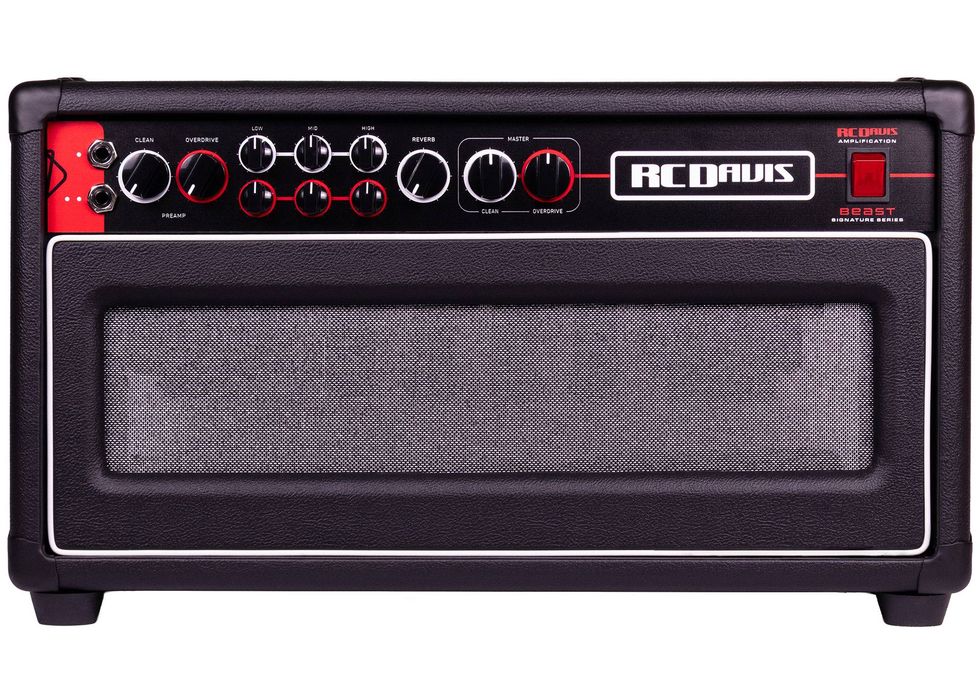
The new model showcases RC Davis’ knack for reimagining vintage tube technology to provide modern stage versatility. After creating an acclaimed series of lightweight tube combo models, Rob Davis developed the Performance line when players such as James DePrato, Ronny North, Joe Bergen, Carl Verheyen and Eric McFadden requested a more powerful amp that still featured the RC Davis signature tone.
- 65 watts of cathode-bias tube-driven power including (4) 6L6GC power tubes
- Dual channel operation, selectable via footswitch: a clean channel (with reverb) and an overdrive channel, both with individual EQ controls
- Hand-wired, point-to-point circuitry for improved tonality and reliability
- Effects loop
- 4/8/16 ohm speaker out with load loop (use virtually any extension cab)
- Box-jointed sturdy, lightweight 13-ply Baltic Birch cabinetry
- Time-tested Heyboer and Hammond transformers
- PRP/Dale resistors, Mallory 150 film capacitors, Vishay 716 film capacitors (orange drops) and solid core silver wire (PTFE) for optimum performance and longevity
- Premium coverings and hardware
The Beast carries a $2995 street price and will debut at the January 2026 NAMM Show in Anaheim at the RC Davis booth #4447. For more information visit rcdavisamps.com.
Overloud Adds AIR to THU
ILIO, leading distributor of virtual instruments and audio processing software, and Overloud, renowned for their innovative audio plug-ins, are pleased to announce the release of AIR or "Amp In Room." This new feature is included in the latest version of THU, Overloud’s flagship guitar amp simulation suite. Available now as a free update for all THU users, AIR brings a new dimension to amp simulation by recreating the feeling of standing in front of a real amp in a real room, adding subtle reflections, room resonance, and air movement that go far beyond a close-mic’d speaker.
Explore the AIR Feature - https://www.ilio.com/overloud-thu#air
AIR Is Free for All THU v2 Users
Whether you own a single Rig Library or the full THU Premium suite, AIR is included at no cost. This continues Overloud’s ongoing commitment to support the THU community with high-value feature updates without subscriptions.
Every Overloud purchase includes a perpetual license, free lifetime updates, and authorization on three computers, with no subscription required.
Browse All THU Plugins - https://www.ilio.com/products/overloud/thu-guitar-effects
What is AIR?
THU is already the most powerful amp simulator in its class. Now, with AIR, it includes a key feature for delivering a finished, authentic guitar tone in one plugin. By modeling how a speaker cabinet interacts with its physical environment, AIR introduces a sense of spatial realism, one that’s rarely captured through traditional cabinet IRs or static mic placements. The result is a tone that feels more lifelike, three-dimensional, and truly “in the room."
How to Use AIR
AIR lives in the Cabinet section of THU and includes:
- An AIR knob that controls the amount of room interaction and spatial detail.
- A dropdown menu offering several ambience types in both Normal and Wide stereo modes.
- Normal mode provides tight spatial cues while Wide mode expands the stereo field for an even more immersive tone
- AIR is also integrated into the SuperCabinet, allowing users to apply room interaction while building their own custom IR blends.
- AIR can be enabled globally from the Master Control section to apply across all presets.
- Transformer: Authentic low-end thickening and high-end sparkle through accurate transformer emulation.
Reader Guitar of the Month: A phoenix rises, with inspiration from Jimmy Page
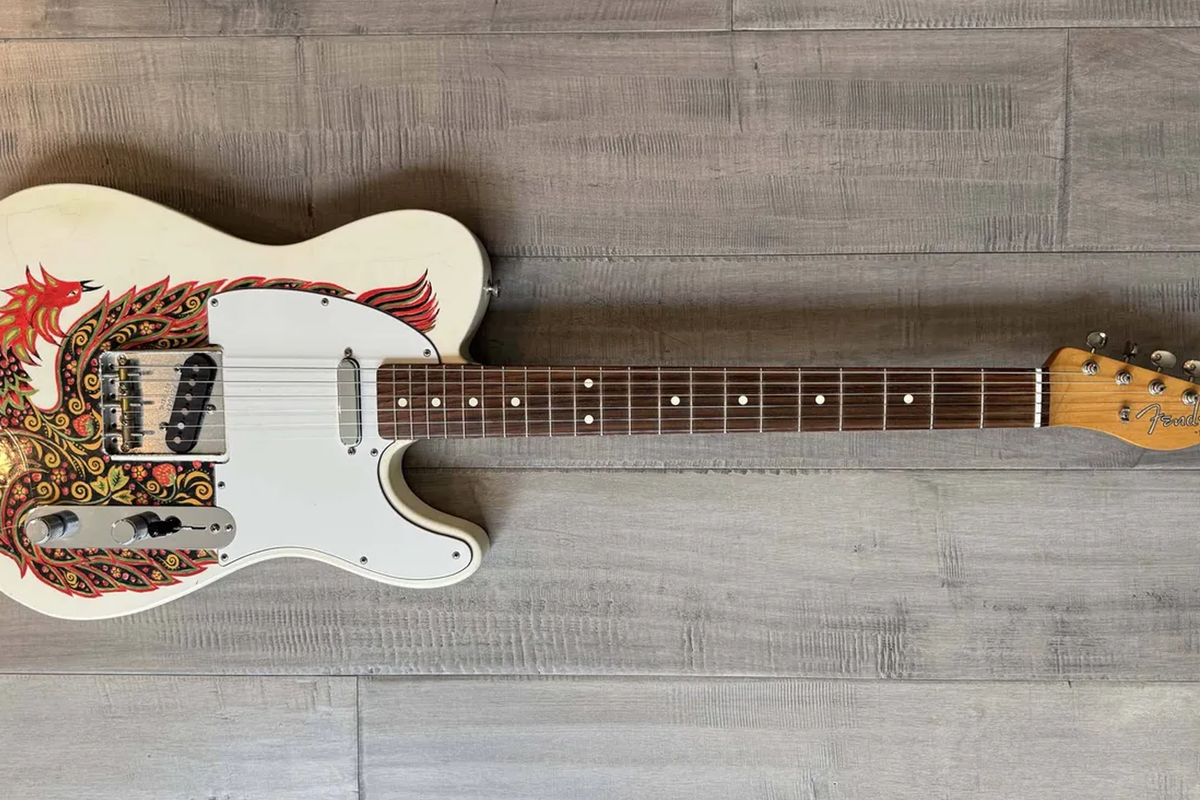
The Phoenix began life as a 2016 Mexico-made Fender Telecaster. But the real inspiration for the guitar came from Jimmy Page’s legendary Dragon Telecaster—the gift from Jeff Beck that Page played in the Yardbirds, on Led Zeppelin’s 1969 debut, and for the solo on “Stairway to Heaven,” among many other moments. I built this guitar a few years before Fender issued their own tribute model, so I knew I’d have to create my own version from the ground up.
I’d always been fascinated by the Dragon and its storied history. And after watching the band’s 1969 television appearances on Supershow and Danmarks Radio (collected on Led Zeppelin DVD) with Page wielding his psychedelic Tele through blazing renditions of “Communication Breakdown” and “Dazed and Confused,” I knew that’s what I wanted my number-one Telecaster to look like. At the time, I owned five different Telecasters, but none had that visual impact. None were truly personal.
“I approached my Russian mother-in-law, who has an art background, with an unconventional request: Could she paint something in the traditional Khokhloma Russian folk-art style?”
Given my performing outlet at the time, there was a certain irony to desiring Page’s Telecaster. Here I was, playing in a busy Bay Area cover band focused primarily on r&b, country, and pop covers, yet dreaming of a guitar that screamed psychedelic rock rebellion.
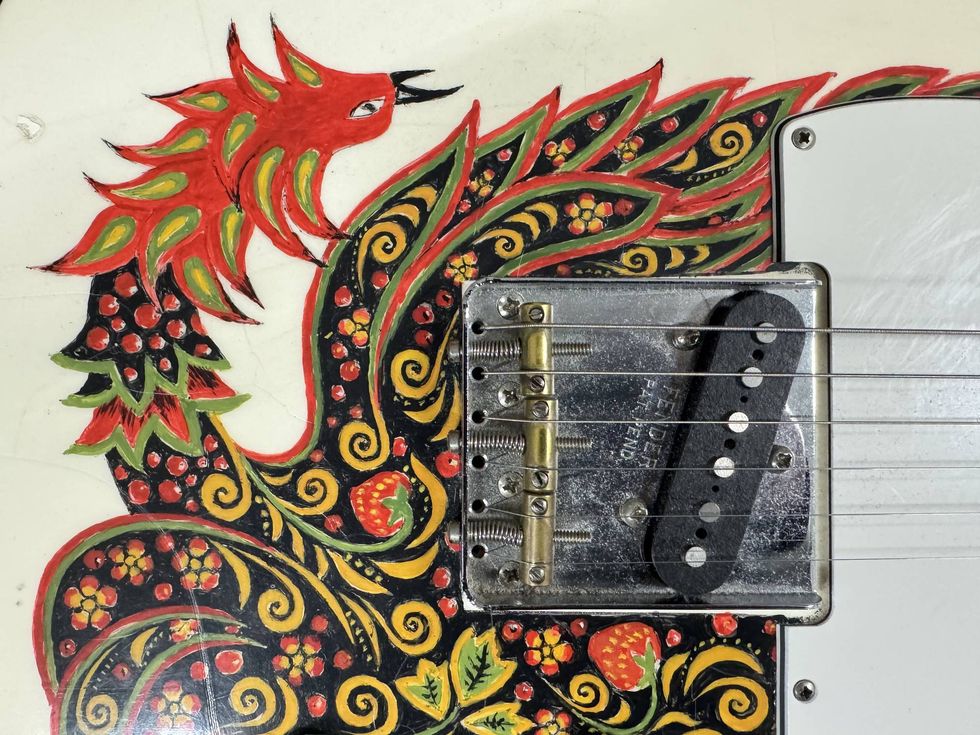
But rather than copying Page’s design, I wanted a twist on the dragon theme. So, I approached my Russian mother-in-law, who has an art background, with an unconventional request: Could she paint something in the traditional Khokhloma Russian folk-art style? And instead of Page’s psychedelic dragon, she painted a fiery Phoenix in brilliant reds, golds, and blacks—the signature colors of Khokhloma decorative painting. At the time, I didn’t realize how apt a depiction of the “rising from the ashes” fable would be for this guitar. Early Telecasters like Page’s, after all, were crafted from ash lumber. The symbolism was too perfect to be intentional.
To complete the transformation, I fitted the Phoenix with a Fender Classic Series ’60s Telecaster neck and Fender Pure Vintage ’51 Telecaster pickup set, giving it a vintage look and voice. The result is a unique confluence of old-world Russian and mid-century American design. It also honors an important moment in rock history, while celebrating my wife and Russian in-laws’ rich cultural heritage. Every time I pick it up, it reminds me that the best guitars aren't just instruments, they’re stories— connections between past and present, between different worlds and traditions, all speaking the universal language of music.
Flight Introduces New Ukulele Models
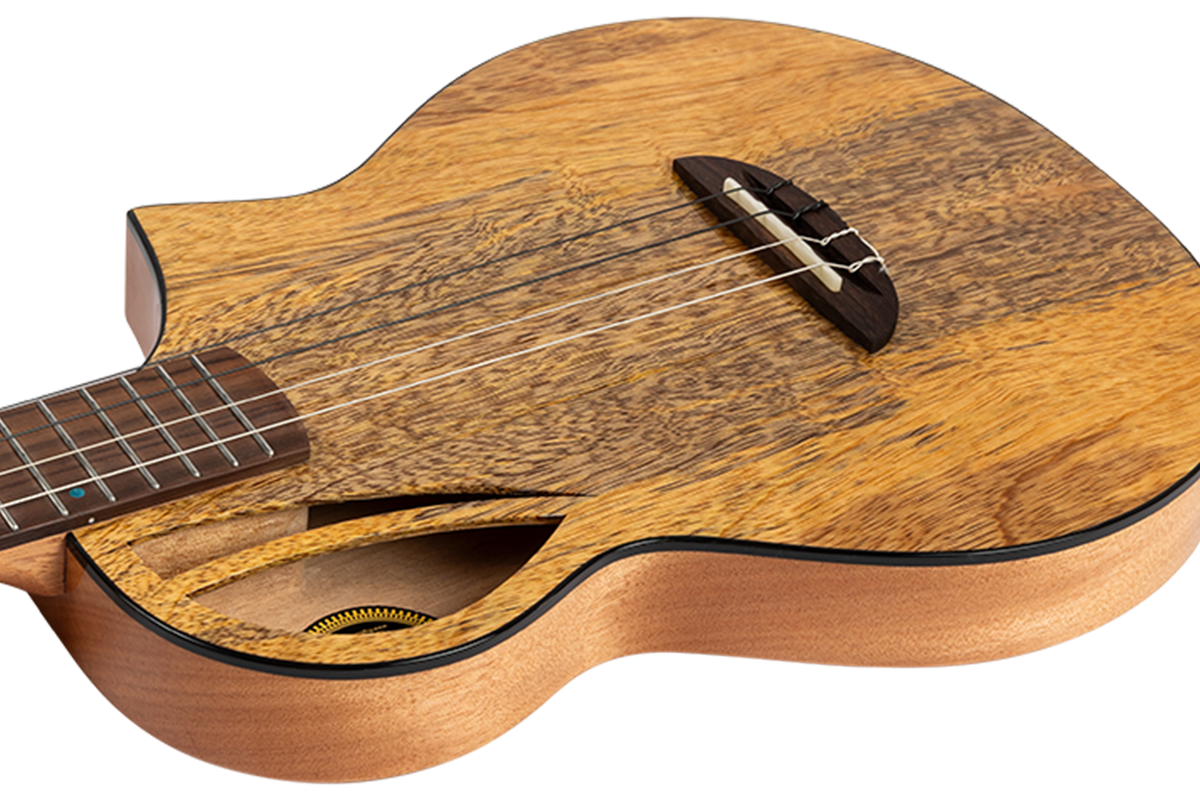
Adding to the company’s diverse array of acoustic instruments, Flight has introduced multiple new ukulele models to their product line.
Leading the way is the Aviator, a new slim ukulele model available in tenor and baritone sizes. The instrument features a solid mango top with solid okoume back and sides, producing a warm, resonant sound with notable sustain. Its slim body profile is designed for comfortable playability while still providing the projection expected from a full-bodied instrument.
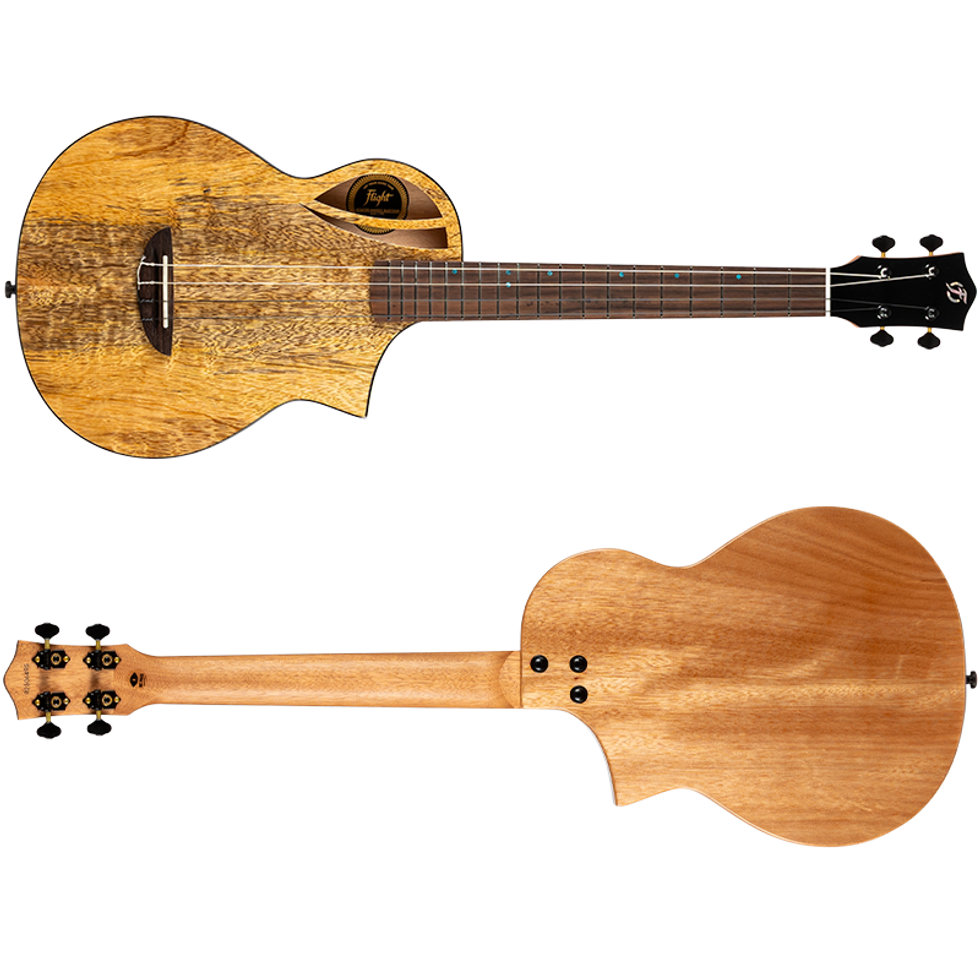
The Aviator includes a rosewood fretboard, bone nut and saddle, and a gloss-finished black headstock. Its construction emphasizes clean lines, natural materials, and balanced ergonomics, supported by the tonal qualities of mango and okoume. Each model comes with Flight’s Deluxe Gig Bag in royal burgundy.
The tenor version is factory-strung with a Low-G setup to extend its lower range, while the baritone provides a deeper register suited for players who prefer a broader tonal spectrum. Together, these models bring well-crafted additions to Flight’s solid-wood lineup.
The Flight Aviator Tenor Mango Ukulele carries a US street price of $379. The Flight Aviator Baritone Mango Ukulele carries a US street price of $416.

Flight has added two new solid top additions to the Princess Series with its first-ever Calantas models: the Iris Calantas Concert and Iris Calantas Tenor. Each ukulele features a solid calantas top paired with laminate mahogany back and sides, introducing a warm, balanced new tone to the Iris family while offering an affordable solid-top option for players looking for great value.
Calantas is a Southeast Asian hardwood known for its smooth response and distinctive natural grain, adding both character and clarity to these instruments. The familiar Iris appointments remain: slotted headstock, offset front markers, white binding, thin rosette, and fluorocarbon strings. Every model includes a padded gig bag, instructional booklet, and Flight sticker pack.
The concert offers a clear, focused sound, while the tenor adds depth and projection, together marking an elegant new chapter for the Iris lineup.
The Flight Iris Calantas Concert carries a $179 US street price and the Flight Iris Calantas Tenor carries a $189 US street price.
Flight has also expanded its Princess Series with the Iris Tinta, an all-solid mahogany model available in concert and tenor sizes, offering players an affordable way to enjoy the richness of an all-solid build. The line adds a striking stained gloss finish in four colors: Natural, Transparent Black, Transparent Blue, and Transparent Purple. Each shade brings out the wood grain differently, offering players a choice that ranges from classic to bold.
The Iris Tinta features a slotted headstock, rear-facing tuners, offset position markers, fluorocarbon strings, and a padded gig bag. Its solid mahogany build delivers a warm, balanced tone suited to many musical styles, while the glossy stained finish and colorful rosette give the instrument a fresh, fun look.
With these new models, Flight offers bright, colorful options for players who want an all-solid mahogany ukulele with an eye-catching, modern finish.
The Flight Iris Tinta Concert carries a US street price of $219 and the Flight Iris Tinta Tenor carries a US street price of $229.
For more information about the Flight ukulele line visit flightmusic.com.
Driving Home For Christmas star Chris Rea dies at 74

Singer-songwriter Chris Rea – the man behind the festive classic Driving Home For Christmas – has died aged 74.
His wife Joan and two daughters Josephine and Julia confirmed in a statement that Rea died “peacefully in hospital… following a short illness”.
Born in Middlesbrough, England in 1951, Rea went on to find considerable success as a musician, releasing 25 studio albums over his multi-decade career – touching on a multitude of genres including pop, blues and rock – and selling more than 30 million albums.
While Driving Home For Christmas has enjoyed a perpetual place on Christmas playlists every year since its release in 1988, Rea had hits with tracks including Looking for the Summer, Fool (If You Think It’s Over), Let’s Dance, Josephine and On the Beach, to name a few.
Chris Rea suffered a number of health issues throughout his life; in the early 2000s he was diagnosed with pancreatic cancer, and had his pancreas removed in 2001. He later suffered a stroke in 2016.
Per the Guardian, he later described the stroke as a “very scary moment,” adding: “I got it into my head that my perception of pitch had gone with the stroke. And it took a lot of convincing from people saying there’s nothing wrong with what you’re playing.”
The post Driving Home For Christmas star Chris Rea dies at 74 appeared first on Guitar.com | All Things Guitar.
Eddie Van Halen once gifted Alice In Chains’ Jerry Cantrell so much gear it filled up his manager’s garage: “I haven’t been able to park my car for months!”

Alice In Chains’ Jerry Cantrell has looked back on his friendship with Eddie Van Halen, sharing how the guitar mastermind gave him so much gear that it completely took over his manager’s garage.
The pair became buds when touring together for Van Halen’s For Unlawful Carnal Knowledge Tour in the early 1990s. Cantrell was originally nervous to play in front of EVH, but soon enough they would hang out together backstage playing ‘name that riff’.
- READ MORE: The Guitar Influences of Eddie Van Halen
In an interview for Gibson TV, Cantrell shares how Eddie generously gave him a guitar for free, and even went the extra mile to gift him even more guitars as well as amp heads and cabs, all for nothing in return.
“The first time I met Ed Van Halen I was getting ready to go onstage [to open] for his band, and he was standing in my pit with Valerie [Bertinelli] right next to him and Wolfie [Wolfgang Van Halen] in her arms. He’s got his guitar on, and he’s running scales like, ‘Hey, dude, what’s up?’ And I’m like, ‘Are you fucking kidding me?’”
He adds, “I think it was probably the worst show I ever played in my life, because I could not stop thinking, ‘He’s right there!’ I couldn’t focus, and I couldn’t wait until the gig was over. After that, it was fine… We ended up being really good friends.
“On that tour he had the [Peavy] 5150 heads that he had kind of made, and he had the [Ernie Ball] Music Man guitars; the EVH Music Man that he had designed. I was like, ‘Man I’d really like to have one of those, think you could give me a good price on one of those?’ And he was like, ‘Fuck that dude, I’ll just give you a guitar! Everybody gives me everything for free now, when I can totally afford it. When I couldn’t afford it, nobody would give me anything. So, let me do that for you. I’ll give you a guitar.”
Cantrell continues, “I remember coming home off that tour, and I was living with [Alice in Chains’ manager] Kelly Curtis and his wife, Peggy… He was like, ‘Hey man, welcome home. You had a good tour? Now you can relax. Hey, by the way, do you think you could clear your shit out of my garage? I need to put my car in there.’
“I’m like, ‘What are you talking about?’ And he says, ‘Eddie Van Halen filled the garage with gear for you. I haven’t been able to park my car in my garage for months.’”
You can watch the full interview with Jerry Cantrell below:
You can watch the full episode of Icons: Jerry Cantrell of Alice In Chains via Gibson TV on YouTube.
The post Eddie Van Halen once gifted Alice In Chains’ Jerry Cantrell so much gear it filled up his manager’s garage: “I haven’t been able to park my car for months!” appeared first on Guitar.com | All Things Guitar.
Ergonomic shred machines, AI amp suites and a real-life acoustic love story: these are my favourite guitar products of 2025

The festive season is finally upon us. And amid the intergenerational wrestling matches that invariably break out over who gets the last Green Triangle in the Quality Street tin, it’s also a time in which we take stock of the past year, of our biggest wins and failures, and the resolutions we might look to carry into 2026.
But there’s a more important order of business on the agenda before you get into your 2026 personal growth plan: my favourite guitar gear of 2025.
I’m Sam – Guitar.com’s News Editor – and my inbox is busier than the Shibuya Crossing with guitar brands the globe over notifying me of exciting new gear releases and product innovations. So choosing my favourites from the past year was no easy feat, let me tell you. That said, there were a few that stood out as particularly innovative, and some I was lucky enough to get my hands on myself.
My identity as a guitar player can be defined in simple terms: metal and digital. A huge metalhead for nearly 20 years, and an avid lover of digital amp modellers and in-the-box tones, I’m genuinely thrilled to see the rapid pace of progress in the amp modeller space – not to mention the throngs of what you might call legacy players who have keenly made the switch. And that brings me to my first pick…
My favourite (amp) of 2025: Positive Grid BIAS X

My colleagues Cillian and Josh started their year-end gear picks lists with their favourite guitars, and I’ll get to mine, but first I have to highlight BIAS X, the groundbreaking new AI-powered amp and effects suite from Positive Grid. Essentially an evolution of the brand’s long-adored BIAS FX 2, BIAS X blew the in-the-box tone market wide open when it landed in September, bringing with it an AI assistant, on hand to turn the tone in your head into a reality, in some cases in seconds.
I get it: auditioning amp sounds can be very fun, and is invariably part of the process when recording music, but how often have you found yourself spending more time than you planned sifting through pages and pages of presets, never landing on the one you’re actually looking for?
Creativity should be the ultimate goal, and the tone-making process taking too long can be a hindrance to that end. With BIAS X, you can enter any prompt (“give me a high-gain tone for modern metal”), and the AI assistant conjures a signal chain from the platform’s vast amp and effects library to best match the vibe you’re going for. Like any AI, it’s not always perfect, but almost always offers a solid starting point which you can then tweak to your heart’s content.
For the record I’m not a fan of any AI which takes creativity out of the hands of humans. But this is an application which expedites the tone-chasing process, and ultimately keeps you in your creative flow, so it’s a big A+ in my book.
My favourite guitar of 2025: Sterling by Music Man Kaizen 6

I’m fortunate enough with this job to have many guitars across my desk, and every now and then there’s one which has me tempted to get my wallet out to persuade the powers that be to let me keep it. When I was delivered the Sterling by Music Man Kaizen 6 last month, it was one of those moments.
I love to experiment with jazz, blues and all manner of other genres, but really I’m a metal player through and through. And the SBMM Kaizen – an affordable take on its Ernie Ball Music Man counterpart, developed in partnership with Animals As Leaders visionary Tosin Abasi – is genuinely up there as one of the best guitars I’ve ever played.
Much is often made of a guitar’s ergonomics, and for good reason. The way it sits in your lap and contours against your body will often be the defining factor in whether you play it casually for 10 minutes or get lost in it for two hours. And when I say I couldn’t put the Kaizen down, I mean I actually couldn’t put it down. I had plans on the evening of the day I received it which I was late for because I was so consumed.
It’s so lightweight and thin that it quickly starts to feel like an extension of yourself – which in my mind is the perfect recipe for creativity. Oh, and I’m not even mentioning the high-gain and clean tones offered up by its duo of ceramic humbuckers. And add to that a floating trem? Take my money.
My favourite acoustic guitar of 2025: Taylor 314ce Studio

Forget the scene when Jack lets go of the door and Rose watches him fade into the icy abyss of the Atlantic Ocean. A real tragic end to a beautiful love story came earlier this year when the UPS courier came to collect the Taylor 314ce Studio I had spent months developing an intimate bond with. I’ve never quite felt heartbreak like seeing that van – carrying what I can only describe as the love of my life – fade into the distance. I won’t be judged for being dramatic.
The Taylor 314ce is among a small crop of the finest instruments I’ve ever played. Everything, to me, is exactly how I want it to be. The action is set up pristinely, which, paired with Taylor’s “easy-playing” neck profile – and satin-finished neo-tropical mahogany neck and West African Crelicam Ebony fingerboard – makes for one of the most luxurious acoustic guitar playing experiences imaginable. The guitar also delivers a stunningly balanced and earthy tone, with satisfying low end projection plus gorgeous sparkly highs, making everything from simple chord strumming to intricate fingerstyle playing an utter delight. I must also note that I had this guitar for months and played it regularly, and somehow the strings still sounded brand-new…
The cost of the Taylor 314ce Studio is lower than that of a fully US-made Taylor, owing to the fact the neck is made in Mexico. Some purists might take issue with that, but when a guitar looks, plays and sounds this good, who really gives a shit?
The post Ergonomic shred machines, AI amp suites and a real-life acoustic love story: these are my favourite guitar products of 2025 appeared first on Guitar.com | All Things Guitar.
Höfner blames effects of US tariffs for bankruptcy, but “business operations will continue” throughout administration

Höfner has given an update on its recent bankruptcy filing, stating that “business operations will continue” throughout the administration process. It has also cited the effects of a challenging export market, particularly due to the recent hike in US tariffs rates.
A new press release from the German guitar and bass manufacturer adds some context to the filings, which were made on 10 December 2025. It claims that around 65% of its most recent turnover of €6.5 million was due to export business – hence, when the recent US tariff changes were made and EU businesses faced much higher export costs, this had an outsized effect on Höfner. The company also points towards a generally unenthusiastic market for musical instruments due to the “tense overall economic situation.”
Klaus Schöller, managing director of Hofner, adds: “This step [filing for insolvency] was necessary in order to open up realistic prospects for the future of the company. Our goal is to work with a strong partner to position the Höfner brand for the future and secure business operations and jobs in the long term.” The press release further clarifies that filing for insolvency has allowed it to continue operations, as employee salaries are secured by the Federal Employment Agency until February.
The company is, of course, best known for making the 500/1 bass, AKA the Violin Bass, made iconic by Paul McCartney. Last week McCartney paid tribute to Höfner, writing on Instagram about his longstanding relationship with Höfner and the instrument that helped shape his playing.
“It is very sad to see Höfner go out of business. They have been making instruments for over 100 years, and I bought my first Höfner bass in the sixties. I have loved it ever since. It’s a wonderful instrument to play: lightweight, and it encourages me to play quite freely. It also offers pleasing variations in tone that I enjoy. So commiserations to everyone at Höfner, and thank you for all your help over the years.”
It’s worth noting that McCartney may have been premature in stating that Hofner is going out of business. Insolvency proceedings could help secure investors in the company and get it back on track.
The post Höfner blames effects of US tariffs for bankruptcy, but “business operations will continue” throughout administration appeared first on Guitar.com | All Things Guitar.
Save an incredible $170 on this Gold Spark PRS SE Silver Sky at Sweetwater

The PRS SE Silver Sky is one of the most popular guitars of the modern day, and Sweetwater is offering a number of festive deals across the lineup – including on a rather spectacular one that caught our eye.
The SE Silver Sky launched in 2022 as a slightly more affordable alternative to the original John Mayer signature Silver Sky released in 2018. It’s gone on to become increasingly popular, having been crowned as the best-selling guitar on Reverb for two years in a row in 2022 and 2023.
If you’d like to get your hands on one as a last minute Christmas present, then look no further than this Gold Spark version, exclusive to Sweetwater.
[deals ids=”6pAkVCTjjCXWLTKDwHtdtt”]
Reduced to $679, saving you $170, this sparkling SE model’s striking finish was personally selected by John Mayer for Sweetwater, and it even has a sparkle-finished, colour-matched truss rod cover. Beneath the aesthetic upgrade lies the beloved SE Silver Sky foundation of a lightweight poplar body, a maple neck, a rosewood fingerboard (with an 8.5-inch radius), and a trio of 635JM “S” pickups.
If gold isn’t to your taste, Sweetwater is also offering a Platinum Spark colourway also at the same reduced price. If you’d like a refresh on how it sounds, then check out the demo below, from none other than John Mayer.
We scored the PRS SE Silver Sky a near-flawless 9/10 in our original 2022 review. We noted that it was incredibly comfortable to play, and that its voice remains balanced with no sharp jumps in volume or tonal character as you change pickups – making it an uber versatile axe.
The range was expanded back in August this year, with new finishes made available for the first time on any PRS model: Derby Red, Trad Blue, Laurel Green, and Dandy Lion (yellow). According to Mayer, each colour was inspired by traditional American fashion.
Get your hands on the Gold Spark exclusive via Sweetwater.
The post Save an incredible $170 on this Gold Spark PRS SE Silver Sky at Sweetwater appeared first on Guitar.com | All Things Guitar.
Silktone Expander review – a refined and versatile drive pedal that does things a little differently

$269/£279, silktone.org
By now we can safely conclude that Charles Henry knows his shit. The man behind Silktone hasn’t exactly flooded the market with amps and pedals, but there’s been a common theme to the stuff he’s put out so far: utter brilliance.
The Expander is his second overdrive. Seeing as we described the first one as an “instant classic”, I’m going to be massively disappointed if this new pedal – notable for its distinctively handsome enclosure design and lack of a conventional tone control – is anything less than stellar.
 Image: Richard Purvis
Silktone Expander – what is it?
OK, it isn’t just an overdrive… and nor is it, despite the name, a studio-style expander. What we’re promised here is one dirt pedal to rule them all, covering everything from subtle enhancement to aggressive drive and even fuzz. And the key to all of that is its novel approach to tone-shaping.
As mentioned, there’s no standard treble-attenuating control, but what you get instead is an interesting double act: a ‘choke’ knob for rolling off bass and a three-way toggle switch for dark, normal or bright voicing. On paper, that should have everything covered – just as soon as your overworked little brain has got a handle on how they interact.
 Image: Richard Purvis
Silktone Expander – usability
Three-knob pedals are never exactly difficult to use, but there is a learning curve with this one just because of those unusual tone controls. Luckily, there’s a card in the box with a basic manual on one side and three suggested settings on the other: an always-on tone-improver, a full-range drive and a Rangemaster-style treble boost.
If you’re wondering where the fuzz is, well so was I… but as so often in life, cranking up the gain will provide all the answers.
 Image: Richard Purvis
Silktone Expander – sounds
I begin with a Telecaster, a clean black-panel amp and the first suggested setting… and it hits the spot like the first cup of tea after being stuck up a tree for two days. It’s light, smooth and crisp-edged, with just enough compression to stop it getting abrasive – something like a sophisticated Rat at a low distortion setting. In fact, it’s a lot like the 1981 Inventions DRV, which is a heck of a start – but there’s lots more to this pedal than that.
The second setting is a mid-gain crunch that keeps the same sweet treble response but fills out the body of the tone a little, marking a step in the direction of transparent overdrive. This could come in very useful for a lot of players, and works just as well with humbuckers as it does with single-coils.
In a sense the third setting is more of the zingy same – lots more, in fact, as the gain is now close to maximum – but this can easily be turned into a more familiar full-range voice simply by flipping the toggle switch to the left, its darkest setting. Does that make it muffled? Actually it’s still quite bright, but you can now turn down the choke knob to let more bass through, which forces the treble to take a step back.
This can feel like a topsy-turvy way of doing things, but there’s no denying it’s effective at shifting the tonal balance. Set the choke to minimum and you can even get properly squelchy splat-fuzz, which is all about the overblown bottom end – and feels a long way away from the shimmery grit of that first suggested setting.
 Image: Richard Purvis
Silktone Expander – should I buy it?
There’s an awful lot of competition in the world of premium dirt – just look at the ‘alternatives’ paragraph below, phwoar! – but the Expander sets itself apart with an emphasis on addictively sugary treble. In that respect it’s very much an equal to the vaunted DRV, but with way more versatility.
It won’t make all your drive and fuzz pedals redundant, but put this thing anywhere near your existing pedalboard and there’s a good chance it’ll have its pick of which one to knock off.
Silktone Expander alternatives
Other ultra-classy overdrives that push all the way into fuzz territory include the Dinosaural Hypoid Drive (£219), Great Eastern FX Co Focus Fuzz Deluxe (£299) and Origin Effects Deluxe55 (£279). See also the 29 Pedals FLWR ($269.99/£285), which lets you shape its tone with a trio of three-way toggle switches.
The post Silktone Expander review – a refined and versatile drive pedal that does things a little differently appeared first on Guitar.com | All Things Guitar.
Presets Are Not a Prescription
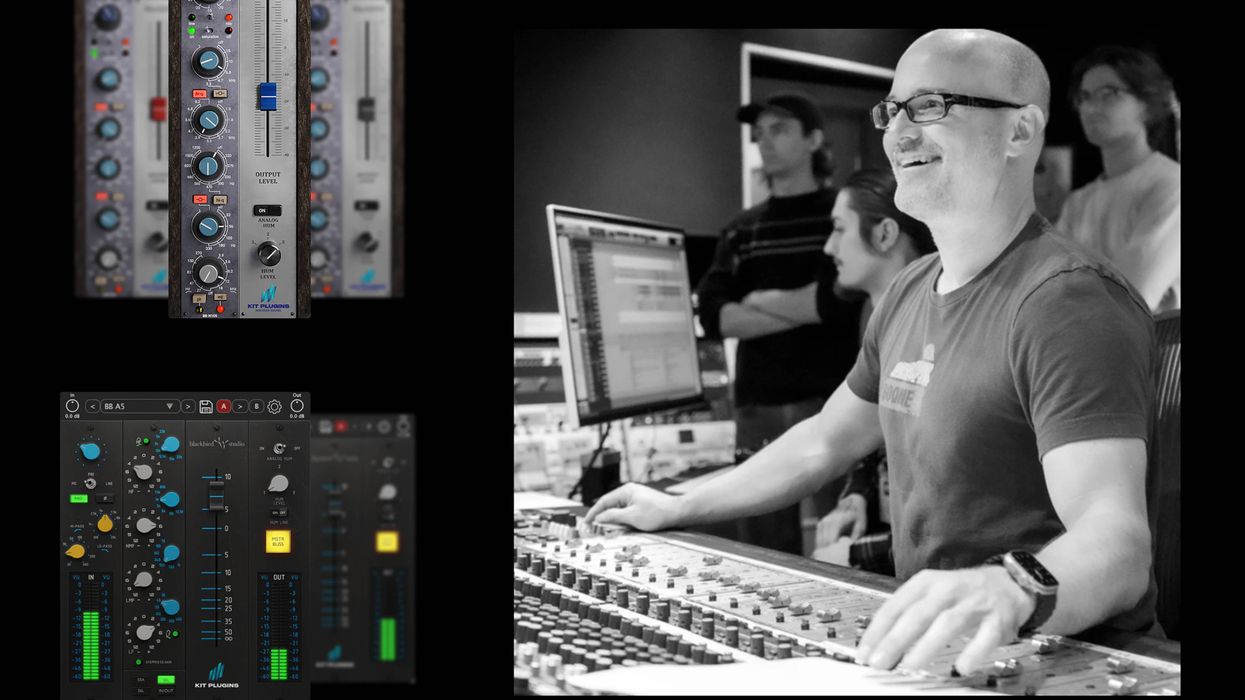
In the modern DAW world, every plugin comes with a buffet of presets promising instant results: “Vocal Gold.” “Drum Bus Glue.” “Radio-Ready Mix.” The implication is that these settings are the magic sauce separating amateurs from professionals. Just load the preset, and you’re done. Right?
Not quite.
Presets can be powerful tools, but only if you understand what they really are: starting points, not finish lines.
I’ve spent years inside some of the best studios in the world, working with world-class players, gear, and engineers, and I’ve seen how subtle context drives every EQ, compressor, and fader move. That experience shapes how I approach presets—and how I think they should be used.
Designing Presets with KIT Plugins
I’ve had the privilege of working closely with the team at KIT Plugins almost since their beginning—as an early beta tester and collaborator on nearly every product they’ve released. When they asked me to design some of the included presets for the BB A5 (a modern interpretation of a 96-channel Legacy API console, $199 Street) and the BB N105 (modeled after Blackbird Studio’s world-famous Neve 8078 console - $99 Street), I felt genuinely honored.
I’d spent years recording and mixing through those very consoles and EQs at Blackbird, and now I had the chance to help translate that analog DNA into the digital world.
When creating my presets, I didn’t approach them as “ready-made sounds.” Instead, I thought of them as guides—compass points that could help an engineer or musician quickly find a tonal direction. Each one reflects a real-world scenario from my own sessions: a slightly edgy vocal that needed midrange presence, a bass guitar fighting for space in a dense mix, a snare that needed to punch through without losing body.
Every preset I made came from that practical place. My goal was to share a bit of the process—how I think about frequency balance, gain staging, and energy within a mix—not to hand anyone a “paint-by-numbers” result. That distinction matters.
The “Preset Mismatch”
Imagine: you open a plugin, scroll through the options, find something like “Vocal Gold,” and think, “Perfect, that’s exactly what I need.” You load it—and suddenly your vocal sounds worse.
What happened?
Every preset, whether it’s mine or someone else’s, was born in a very specific context. Maybe the original source was a male singer with a soft top end and a ragged low midrange. Maybe he was singing into a vintage Neumann U67 through a Neve 1105 preamp, hitting a “Blue Stripe” 1176, inside a mix stacked with distorted guitars and busy drums.
But if you’re recording a lo-fi shoegaze female vocal with an SM57 in a bathroom through an Apollo X2, that same EQ curve will likely make your singer sound potentially worse. (Or will it?)
“Every preset, whether it’s mine or someone else’s, was born in a very specific context.”
The preset didn’t “fail”—it just wasn’t meant for your signal chain.
There are layers of invisible context behind every EQ decision: the performer, the instrument, the mic, the preamp, the compressor, the room, the genre, and the emotional target of the mix. When you remove a preset from that ecosystem, you have to re-interpret it. Otherwise, you’re comparing apples to lava lamps.
How to Use Presets the Right Way
Presets are at their best when you treat them as teachers. Here are four ways to get the most out of them:
- Start, Don’t Stop
Load a preset, listen, and then move a few knobs. Ask yourself why it sounds the way it does. Does it bring clarity, weight, excitement? Or does it tilt things too far? You’ll learn more by adjusting than by accepting. - Reverse-Engineer the Intent
Solo each band or section. If it’s an EQ, sweep the frequencies. If it’s a compressor, change the attack and release. Try to imagine the sound that inspired those moves. That’s how you train your ear. - Ignore the Labels
“Vocal Gold” might be perfect on a snare drum. “Drum Bus Glue” might breathe life into an acoustic guitar. Don’t let the category box you in. Think in terms of function, not title. - Trust Your Ears Over Everything
No preset designer, even the most experienced one, can hear what you’re hearing in your room with your monitors. The final call always belongs to your ears.
The Value of Presets
When I sit down to make presets, I’m not trying to predict your sound—I’m trying to invite you into the process. A well-made preset can accelerate learning, spark curiosity, and remind you that every mix decision has a reason behind it.
They’re saying, “Here’s how I started; now make it yours.” Used that way, presets become more than convenience—they become education. They let you peek over the shoulder of another engineer for a second and understand why a particular setting works.
So, the next time you load one of my KIT Plugins presets, don’t treat it like a rulebook. Twist the knobs, push it too far, pull it back, and most of all, listen. Because presets aren’t prescriptions—they’re invitations.
Podcast 530: Breedlove Guitars’ Pete Mroz and Shannon Pollard
Nearly every guitar player has daydreamed about running their favorite guitar company. On this week’s Fretboard Journal Podcast, we hear from two individuals currently living that dream: Nashville’s Pete Mroz and Shannon Pollard. Earlier this year, these two guitar fanatics and businessmen became the new owners of Bend, Oregon-based Breedlove Guitars.
During our chat, we talk about the realities of running a guitar business in 2025; the surprises they weren’t anticipating; what changes they are implementing at the 35-year-old company; and where they see growth in the guitar space.
Whether or not you’re a Breedlove owner, Pete and Shannon’s enthusiasm for guitars is downright infectious. We think you’ll love this chat.

Our next Fretboard Summit takes place August 20-22, 2026, at the Old Town School of Folk Music in Chicago. https://fretboardsummit.org
Our 58th issue of the Fretboard Journal will mail later this month. Subscribe here to get it.
We are brought to you by Peghead Nation: https://www.pegheadnation.com (Get your first month free or $20 off any annual subscription with the promo code FRETBOARD at checkout).
Stringjoy Strings: https://stringjoy.com


The post Podcast 530: Breedlove Guitars’ Pete Mroz and Shannon Pollard first appeared on Fretboard Journal.
Winzz Guitars Unveils the WGT100 Electric Guitar
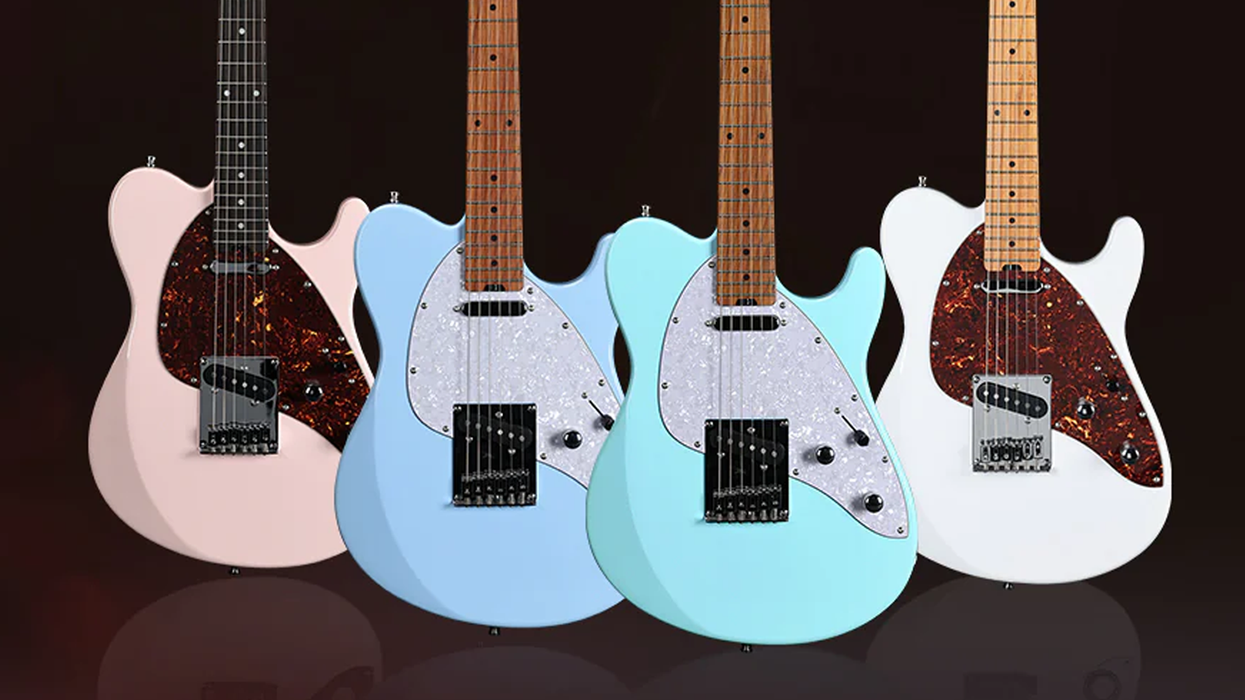
Winzz Guitars announces the WGT100, a new electric guitar designed to blend classic inspiration with modern refinement. The WGT100 introduces a unique combination of ergonomic shaping, upgraded playability, and versatile tonal performance. Built for musicians seeking comfort, stability, and expressive sound, it delivers a fresh interpretation of the electric guitar while staying rooted in time-tested design principles.
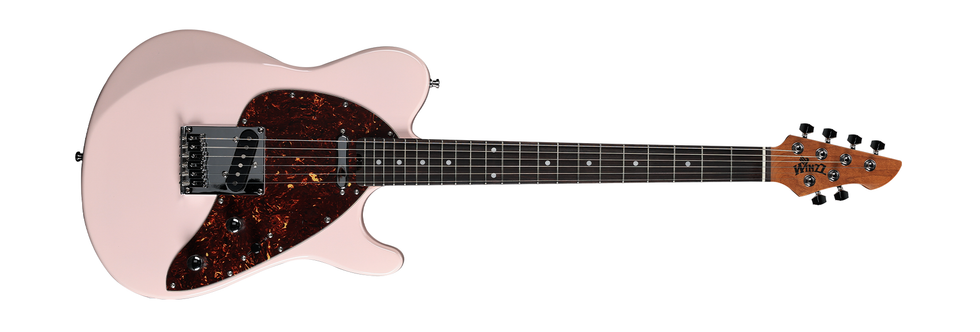
Featuring a selected alder body, the WGT100 pairs a classic silhouette with a delicate offset contour and smooth curved edges that enhance both comfort and visual appeal. A seamless and asymmetric ergonomic neck-body joint ensures easy access to higher frets. The instrument employs a 25.5” scale, roasted maple neck topped with either a rosewood or maple fingerboard and 22 stainless steel, medium frets. The guitar’s signature “glider neck” C+D profile and satin finish make for a fast, fluid feel. This combination, along with a stable five-bolt construction and Luminlay side dots provide comfort and confidence when playing under any circumstances.
For electronics, the WGT100 is fitted with custom ceramic single coil pickups, offering a versatile tonal palette that stays faithful to traditional single-coil clarity while supporting a wide range of modern styles. The upgraded pickups are designed to respond dynamically to picking nuances and playing intensity, providing both warmth and precision. Controls and switching work in a familiar, intuitive layout, allowing players to easily shape their sound onstage, in the studio, or at home.
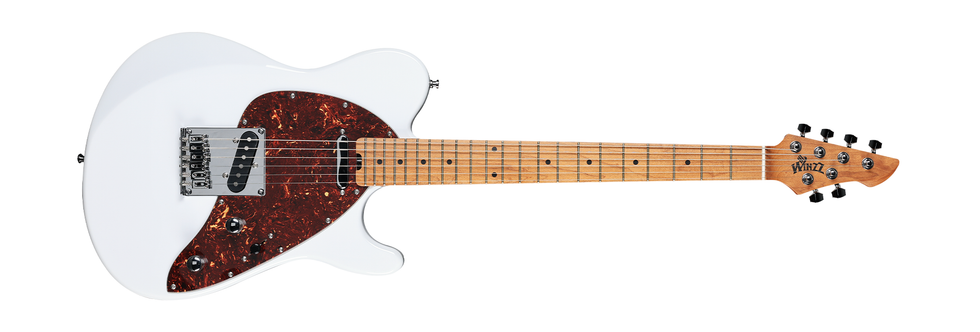
The guitar’s hardware emphasizes tuning stability with modern steel bridge saddles and locking tuners working together to enhance accuracy, performance, and reliability. The instrument’s 4+2 tuner layout further contributes to balanced string tension and improved intonation. A spoke adjustable truss rod provides setup flexibility and playing comfort.
Born from a partnership between passionate guitar builders from Germany’s village of Winz and Aileen Music in China, Winzz Guitars blends German precision with Chinese industriousness — a union that celebrates both artistry and innovation. Guided by the belief that music should be accessible to everyone, Winzz creates instruments that invite players to “find their voice and make every stage their own.” The WGS150 embodies that mission, offering a professional instrument that welcomes beginners, creators, and seasoned musicians alike.
For more details about the WGT100 or to explore more instruments from Winzz Guitars, please visit www.winzzguitars.com
Street Price: $339.99 USD
Diver Down Gets No Respect at All

Just the other day, I was thinking, “Diver Down gets no respect.” (You have to imagine Rodney saying it.)
This lesson is a lighthearted look at one of the David Lee Roth era’s most maligned albums. Does it have too many covers? Probably. Does it seem kinda just thrown together? Sort of. Do I love it? Well, no. Do I like it a whole lot? Yes. Yes, I do. And, as with every VH record, there are some inspired Eddie Van Halen moments. The following is a look at just a few of them, and, if you don’t walk away at the end with at least a couple of fun ideas, well, we won’t ever mention this again.
Not Those Kinds of Pedals
Here’s the scintillating EVH riff that begins “Hang ’em High”:
This unique riff finds Eddie using an inverted pedal point—a re-articulated or sustained note above an accompanying melodic figure. Ex. 1 is inspired by this barnburner; it ends with a Van Halen-style flourish of natural harmonics.
Ex. 1
The opening two beats’ picking pattern incorporates string skipping, which can open up a new world of ideas involving wider intervals. Here that interval is a minor seventh, so, to spark some new ideas, let’s take the B Dorian scale (B–C#–D–E–F#–G#–A) and play it in sevenths, as in Ex. 2. B Dorian is simply A major, but with B as the root or “home base.” Try experimenting with these and other wide intervals in your own playing.
Ex. 2
Just a few bars later, Eddie hints at another pedal (below, this time) to kick-start his nimble fill at 0:10; Ex. 3 expands on his idea. Begin with a mini-barre on the top two strings, allowing the F# on the second string to ring over the pull-offs. The lick ends with a bluesy flourish, as Eddie’s does. So often, he would ground phrases that are a bit off the beaten path by balancing them with something bluesy and down to earth.
Ex. 3
“Secrets” finds Eddie applying a pedal in yet another way, allowing a slightly palm-muted open D-string drone to gently linger below shimmering, melodic chords. Check him out here as he plays the song’s intro on the 12-string neck of his rarely-seen Kramer doubleneck guitar:
Ex. 4 is along the same lines. If you have an ’80s-style chorus pedal, now’s the time to add it back to your pedalboard.
Ex. 4
The Pick’s the Thing (Or Is It?)
My favorite of Diver Down’s covers is VH’s bouncy version of the Motown classic “Dancing in the Streets” by Martha and the Vandellas. The lick that always catches my ear is the wicked descending line Eddie plays at the 2:57 mark of his solo.
The song is in the key of D, and that lick (Ex. 5) is played over an F#m chord. Eddie uses the basic 14th position F#m pentatonic box (F#–A–B–C#–E), but cunningly adds most of the chromatic notes in between those pitches. But he summons even more magic from how he uses his pick. Starting on beat 2, Eddie is using upstrokes only, scratching the edge of his pick along the string to create a grinding squeal. Be sure to play these notes short (as indicated by the staccato dots) by quickly resting your pick back on the string right after the scratching motion. Great stuff.
Ex. 5
More of Eddie’s pick-based antics—likely inspired by ZZ Top’s Billy Gibbons—are found in “The Full Bug.” Over a nasty two-note boogie riff, Eddie conjures a subtle high-pitched countermelody using pinch harmonics.
Pinch harmonics are sounded by lightly touching the string with the flesh of your picking-hand thumb immediately after striking it. In the same way an open string offers harmonics of varying pitches, depending on where you touch it with a fretting-hand finger along its length, the same holds true for your picking-hand thumb, as illustrated in Ex. 6. To match the pitches in the example, begin with your pick about an inch from the bridge pickup—about halfway between the middle and bridge pickups if you’re using a standard Strat. This produces a pitch three octaves and a fifth above the fretted notes. On beat 3 of the third bar, slowly begin moving your picking hand towards the headstock to produce the remaining pitches. But this is rock ’n’ roll, so better to just go for it and find the harmonics that sound good to you.
Ex. 6
Okay, but how about not using your picking hand at all? “Cathedral” has Eddie doing just that, hammering notes with his fretting hand while creatively employing a dotted-eighth-note delay setting. Since a dotted-eighth is equal to three 16-notes, every time a note is played, it repeats itself three 16-notes later. (Eddie sets his delay at approximately 380 ms with just one repeat and Mix set at 100%.) If you swell the volume at a straight eighth-note pace, the repeats will create the bouncy 16th-note pattern of the tune.
Ex. 7 is inspired by “Cathedral” and illustrates how Eddie uses both triads and scales to create classical-sounding melodies.
Ex. 7
Happy Trails…
Let’s close with a look at “Little Guitars,” a Diver Down highlight that Eddie was inspired to write after picking up a pint-sized Les Paul. In the song’s verses, Eddie employs hybrid picking—simultaneously plucking three strings by using the pick, index, and middle fingers.
Eddie again creates drama by playing staccato, quickly resting his pick and fingers back onto the strings after plucking each chord. Ex. 8 is inspired by his approach. (Note you can also play it fingerstyle, if you prefer.) Eddie’s mini Les Paul is tuned up one and a half steps from standard; the example approximates this by using a capo, but feel free to omit it if you prefer. Lastly, try turning down your guitar’s volume knob a bit to reduce the amount of distortion, and note that the final three chords are strummed with the pick.
Ex. 8
In the end, Diver Down may not arguably be Van Halen’s greatest album, but even after all of these years, it still holds its own, bolstered by Eddie’s cleverness and creativity.
Diver Down Gets No Respect at All

Just the other day, I was thinking, “Diver Down gets no respect.” (You have to imagine Rodney saying it.)
This lesson is a lighthearted look at one of the David Lee Roth era’s most maligned albums. Does it have too many covers? Probably. Does it seem kinda just thrown together? Sort of. Do I love it? Well, no. Do I like it a whole lot? Yes. Yes, I do. And, as with every VH record, there are some inspired Eddie Van Halen moments. The following is a look at just a few of them, and, if you don’t walk away at the end with at least a couple of fun ideas, well, we won’t ever mention this again.
Not Those Kinds of Pedals
Here’s the scintillating EVH riff that begins “Hang ’em High”:
This unique riff finds Eddie using an inverted pedal point—a re-articulated or sustained note above an accompanying melodic figure. Ex. 1 is inspired by this barnburner; it ends with a Van Halen-style flourish of natural harmonics.
Ex. 1
The opening two beats’ picking pattern incorporates string skipping, which can open up a new world of ideas involving wider intervals. Here that interval is a minor seventh, so, to spark some new ideas, let’s take the B Dorian scale (B–C#–D–E–F#–G#–A) and play it in sevenths, as in Ex. 2. B Dorian is simply A major, but with B as the root or “home base.” Try experimenting with these and other wide intervals in your own playing.
Ex. 2
Just a few bars later, Eddie hints at another pedal (below, this time) to kick-start his nimble fill at 0:10; Ex. 3 expands on his idea. Begin with a mini-barre on the top two strings, allowing the F# on the second string to ring over the pull-offs. The lick ends with a bluesy flourish, as Eddie’s does. So often, he would ground phrases that are a bit off the beaten path by balancing them with something bluesy and down to earth.
Ex. 3
“Secrets” finds Eddie applying a pedal in yet another way, allowing a slightly palm-muted open D-string drone to gently linger below shimmering, melodic chords. Check him out here as he plays the song’s intro on the 12-string neck of his rarely-seen Kramer doubleneck guitar:
Ex. 4 is along the same lines. If you have an ’80s-style chorus pedal, now’s the time to add it back to your pedalboard.
Ex. 4
The Pick’s the Thing (Or Is It?)
My favorite of Diver Down’s covers is VH’s bouncy version of the Motown classic “Dancing in the Streets” by Martha and the Vandellas. The lick that always catches my ear is the wicked descending line Eddie plays at the 2:57 mark of his solo.
The song is in the key of D, and that lick (Ex. 5) is played over an F#m chord. Eddie uses the basic 14th position F#m pentatonic box (F#–A–B–C#–E), but cunningly adds most of the chromatic notes in between those pitches. But he summons even more magic from how he uses his pick. Starting on beat 2, Eddie is using upstrokes only, scratching the edge of his pick along the string to create a grinding squeal. Be sure to play these notes short (as indicated by the staccato dots) by quickly resting your pick back on the string right after the scratching motion. Great stuff.
Ex. 5
More of Eddie’s pick-based antics—likely inspired by ZZ Top’s Billy Gibbons—are found in “The Full Bug.” Over a nasty two-note boogie riff, Eddie conjures a subtle high-pitched countermelody using pinch harmonics.
Pinch harmonics are sounded by lightly touching the string with the flesh of your picking-hand thumb immediately after striking it. In the same way an open string offers harmonics of varying pitches, depending on where you touch it with a fretting-hand finger along its length, the same holds true for your picking-hand thumb, as illustrated in Ex. 6. To match the pitches in the example, begin with your pick about an inch from the bridge pickup—about halfway between the middle and bridge pickups if you’re using a standard Strat. This produces a pitch three octaves and a fifth above the fretted notes. On beat 3 of the third bar, slowly begin moving your picking hand towards the headstock to produce the remaining pitches. But this is rock ’n’ roll, so better to just go for it and find the harmonics that sound good to you.
Ex. 6
Okay, but how about not using your picking hand at all? “Cathedral” has Eddie doing just that, hammering notes with his fretting hand while creatively employing a dotted-eighth-note delay setting. Since a dotted-eighth is equal to three 16-notes, every time a note is played, it repeats itself three 16-notes later. (Eddie sets his delay at approximately 380 ms with just one repeat and Mix set at 100%.) If you swell the volume at a straight eighth-note pace, the repeats will create the bouncy 16th-note pattern of the tune.
Ex. 7 is inspired by “Cathedral” and illustrates how Eddie uses both triads and scales to create classical-sounding melodies.
Ex. 7
Happy Trails…
Let’s close with a look at “Little Guitars,” a Diver Down highlight that Eddie was inspired to write after picking up a pint-sized Les Paul. In the song’s verses, Eddie employs hybrid picking—simultaneously plucking three strings by using the pick, index, and middle fingers.
Eddie again creates drama by playing staccato, quickly resting his pick and fingers back onto the strings after plucking each chord. Ex. 8 is inspired by his approach. (Note you can also play it fingerstyle, if you prefer.) Eddie’s mini Les Paul is tuned up one and a half steps from standard; the example approximates this by using a capo, but feel free to omit it if you prefer. Lastly, try turning down your guitar’s volume knob a bit to reduce the amount of distortion, and note that the final three chords are strummed with the pick.
Ex. 8
In the end, Diver Down may not arguably be Van Halen’s greatest album, but even after all of these years, it still holds its own, bolstered by Eddie’s cleverness and creativity.
Review: ‘Imaginational Anthem vol. XIV: Ireland’ Finds New Paths Through Old Forms

Pages
