
Music is the universal language
“Glory to God in the highest heaven, and on earth peace to those on whom his favor rests.” - Luke 2:14
General Interest
Positive Grid Spark Pedal review: The Spark ecosystem welcomes another box of tricks

It’s not an exaggeration to say that Positive Grid’s Spark completely redrew the guitar amp map when it burst onto the scene in 2019. Bringing studio-ready tones to the fingertips of guitarists everywhere was the mission, and what a successful ride it has been. The brand has gone from strength to strength in the years that followed, with the Spark now a family of amps that run the gamut from headphones to portable PA systems. Now, however, they’re taking a left turn into the speakerless world of pedals.
On paper, it seems like a very sensible move – pedalboard amps are increasingly popular, both for live use and for playing at home, and so having something compact that puts all the great sounds and ease of use of the amp into a smaller form factor is surely onto a winner.
At least, that’s what we’re all hoping anyway – trying to be both a practice amp, live solution and recording option in one is a lot of hats to wear, we’ll see if any fall off along the way…
What is it?
It won’t surprise people to learn that the Spark Pedal effectively distills the important bit from its amp brethren into a 6×4” floor unit. Now, it’s worth noting that the tech in here is the latest hotness – it uses PG’s HD Tone engine, the same architecture found in the latest Spark 2 amp.
Like its sibling, it comes loaded with 33 high-quality amp models and 43 effects as standard, and crucially that also means you get access to over 100,000 community-created presets courtesy of the hugely useful ToneCloud setup. If you’re a long-time Spark-user that has spent endless hours crafting perfect tones, fear not. You can easily load your saved presets from other Spark products and take them with you on the go. As with the other Sparks, it offers a relatively compact but useful array of bass and acoustic options for extra utility here too.
Sensibly for a floor-based option aimed at live players, it has the facility to be used purely as an effects unit – if you want to bypass the onboard amps, you can – and simply use it as a compact but powerful sound box.
The concessions to streamline its live use don’t stop there either – as with most Sparks, the Pedal has a built-in rechargeable battery, meaning that you won’t have to worry about plugging it into the mains or your PSU and in fact, you can’t – but more on that later. The battery life is promised to be up to seven hours, which is pretty impressive.
On the top you’ll find five chunky rotary knobs for on-the-fly tweaking, plus a trio of multi-function footswitches, while round the back you’ll find the upgraded I/O options that really set out the stall for this being a live tool. In addition to the usual mono input jack, headphone and USB-C output for silent practice and direct recording, you’ll find stereo outputs, an expression pedal socket, and in a first for a Spark product, MIDI in and out as well. Of course, being a Spark you’ll also need to hook this thing up to bluetooth to use the companion app, which is rather essential.
 Image: Adam Gasson
Usability and Build Quality
The concern with any multi-effects that doesn’t have a a screen is that all the useful functionality is going to be hidden in the companion app, and nobody really wants to be whipping their phone out mid-gig do they?
Thankfully, while the Spark app remains a standard setter for both its ease of use and consistent and straightforward connectivity in this sector, there’s plenty you can do on the pedal itself once you spend a little time familiarising yourself with the fundamentals.
The three foot switches are home to up to six presets across two banks. Editing them and saving them using the pedal itself is satisfyingly straightforward. Select the preset you want to modify, do your thing, then press and hold the foot switch to save. No 20-page guide, secret handshake, or ritual sacrifice is needed here – it’s all rather intuitive.
The multifunctional volume knob in the center is responsible for switching between the two operating modes. In FX mode, the knobs control drive type, modulation, delay and reverb. Click that centre knob and the color coded LED light will indicate you are now in Amp mode. This is where you sculpt gain, bass, middle and treble, just like a real amp. Hold the centre knob down and you will activate the basic but welcome built-in tuner.
The built-in 60-second looper is as uncomplicated as one gets. Pressing pedals one and two together activates Looper mode. Recording/overdubbing, play/stop, and undo/redo functions are all handily activated with a footswitch each. If you can count to four, you’re golden here.
It’s an undersold part of the Positive Grid experience that they clearly put a lot of thought into the physical usability of their devices as well as the app-based stuff, and that’s true again here. It would have been very easy to make this pedal look like a Boeing cockpit, but with some simple and intuitive paring back, they’ve kept all the features you’d need mid-show accessible.
 Image: Adam Gasson
That said, the Spark app is absolutely crucial to the experience here. Constructing signal chains and exploring ToneCloud is a total blast. However, on-the-fly adjustments in a live scenario from the pedal alone proved much more difficult. For example, you stomp into your meticulously crafted solo channel but the volume isn’t quite there? Reaching down to turn the main volume knob will sort that out. However, it turns up the volume across all your other channels too, like a master volume knob would. Not ideal.
The app isn’t a bonus feature here, it’s still the star of the show, and a necessary companion when you’re sculpting your sounds. I ended up having my iPhone in a cradle attached to the mic stand during rehearsals, but that’s really not what you wanna be doing during a performance is it?
There are some other compromises here to get it out at the very impressive $199 price point. Compared to the rugged unflapability of a Boss pedal, the Spark Pedal’s aluminium chassis and one-piece silicone cover are perfectly serviceable, but I would wonder how well that cover is going to last after a few months of being knocked about on venue floors and on street corners.
And knock it about you probably will. While the fact that this weighs just 0.58kg is very impressive – that’s significantly less than a Nano Cortex for example – there is a tradeoff there. It’s so lightweight, it’s quite easy for a stray foot to knock it away from where you want it to be – while the sturdy rubber footing stops it flying out into the audience, again I wonder how robust that would be long term.
The footswitches also don’t feel as premium as you’d like – they have resistance and lack that satisfying “click” of other stomp boxes. I’d probably think twice before stamping down on them with gay abandon in a pair of Docs, put it that way.
The pedal’s built-in battery is again both a boon and a potential issue. On the one hand, if you were a busker or were using it as your entire rig, the ability to run it without plugging into anything is potentially the killer app: especially with that seven-hour battery life.
On the flipside, if you wanted to use this alongside other pedals, or as a semi-permanent part of your pedalboard, the fact that it only runs on battery power – you can’t have it plugged into a pedal power supply or any other pass-through adapter – could be a real issue. Do you really want the hassle of having to make sure that one pedal is charged up before every gig? And then there’s the potential of battery degradation in the future that we’re all more than familiar at this point – seven hours at launch is great, but how long will that be in two years of heavy use, or five? This is obviously a problem with any guitar device with a lithium-ion battery in it, but it could be extra problematic for futureproofing with a device that’s designed to be used live without a net.
 Image: Adam Gasson
Sounds
The excellent sound produced by Positive Grid products is no secret in 2026 – if you’ve enjoyed the broad array of amps and effects in any other Spark product to date, expect the same here.
The consumer-friendliness of the entire ecosystem should also be applauded, and there’s a real sense of community here among the ToneCloud regulars. The variety of tonal possibilities never seems to end, and I found myself getting lost for hours just… playing. Headphones on, Metallica backing tracks, completely butchering album upon album’s worth of Kirk Hammett solos. Heaven. It’s also a great tool if you’re in a covers band – with so many song-alike and artist-alike tones in the ToneCloud, dialling in the sound you need is an absolute doddle.
If you’re after the crystalline Vox-adjacent tones of a Matchless or the punishing brutality of a cranked Peavey 5150, the Spark’s HD models do a fine job of recreating the whole gamut of amp types with a faithfulness that belies the Spark Pedal’s humble size – whether you’re running direct into a powered cab, a PA system or just going through headphones. That’s true with drop tunings, heavy riffing, almost anything that might cause a lesser modeller to get a bit glitchy and messy. This isn’t a level of sonic fidelity that can go toe-to-toe with the likes of Neural or Kemper, but remember that this is considerably cheaper than even some of the more affordable amp and effects units out there.
The effects are equally impressive, with the drives sounding thick and chewy, the fuzzes sputtering in the appropriate way, and the reverbs and delays sounding suitably cavernous. Again, this isn’t a HX Stomp, but that’s double the price!
If you don’t fancy that hassle of building a Spark signal chain yourself, the Spark AI tone-prompting feature has been updated to version 2.0 now, and while it’s certainly not foolproof, it’s clear that PG has learned some lessons from the Reactor amp and the results you get are more or less very usable. It’s not essential, but it’s a handy one to have if you’re trying to sketch out song ideas or find inspiration in a hurry.
 Image: Adam Gasson
Should I buy one?
At $199, the Spark Pedal represents a superb amount of functionality and versatility in a small, intelligently designed package. The combination of portability, solid tones, app features and straightforward usability makes this the perfect unit for buskers, jamming musicians, and bedroom players alike.
There are definitely a few drawbacks to consider if you’re a gigging musician looking for a credible live option however. While you can get by with most everyday needs with the on-pedal controls, the thought of having a mid-gig crisis that requires whipping a phone out and trying to pair with your pedal via Bluetooth fills me with a special kind of dread. I’m not wholly convinced by the build quality and long-term battery life either.
Also, if I was to indulge myself slightly, I would love to have a powered speaker output included, allowing the Spark Pedal to power a cab directly. Blackstar’s Amped pedal range has shown just how appealing a true “all-in-one” pedal-amp format can be.
Of course, adding a power-amp stage would demand a totally different power architecture, and likely ruin the Spark’s rechargeable portability, so perhaps I’m asking a Swiss Army knife to pack a chainsaw. Still, it would be dreamy.
Perhaps it’s inevitable that a product aiming to do so much at this price point is going to have some compromises here and there, but this is still a very impressive and fun to use product that ticks a lot of boxes.
If you’re happy to tinker with tones on your phone, and want the flexibility of a unit that can be at home both in the bedroom, the practice room or the street corner, this is a very compelling option. It doesn’t reinvent the wheel, but the Spark is mature technology at this point, instead, it’s trying to build on what it did so well half a decade ago – removing friction from the guitar playing experience.
Alternatives
This space in the market is home to some other excellent and affordable alternatives. Boss’s GX-1 ($229.99/£219) takes its tone DNA straight out of the flagship GX-100, and has a screen and a wah pedal built-in – I’m not convinced the amp models sound as good as the Spark’s though. Blackstar’s Amped 2 is a little more expensive and doesn’t have as many onboard sounds (£391), but the tones are legit and it really packs a punch, and can power a cab directly. The Line 6 POD Express ($179.99/£149) is even more compact than the Spark Pedal, and comes directly from the HX family of processors, but it’s got a limited palette of sounds comparatively.
The post Positive Grid Spark Pedal review: The Spark ecosystem welcomes another box of tricks appeared first on Guitar.com | All Things Guitar.
Gibson Unveils The Ultra-Rare, Limited-Run Des Series
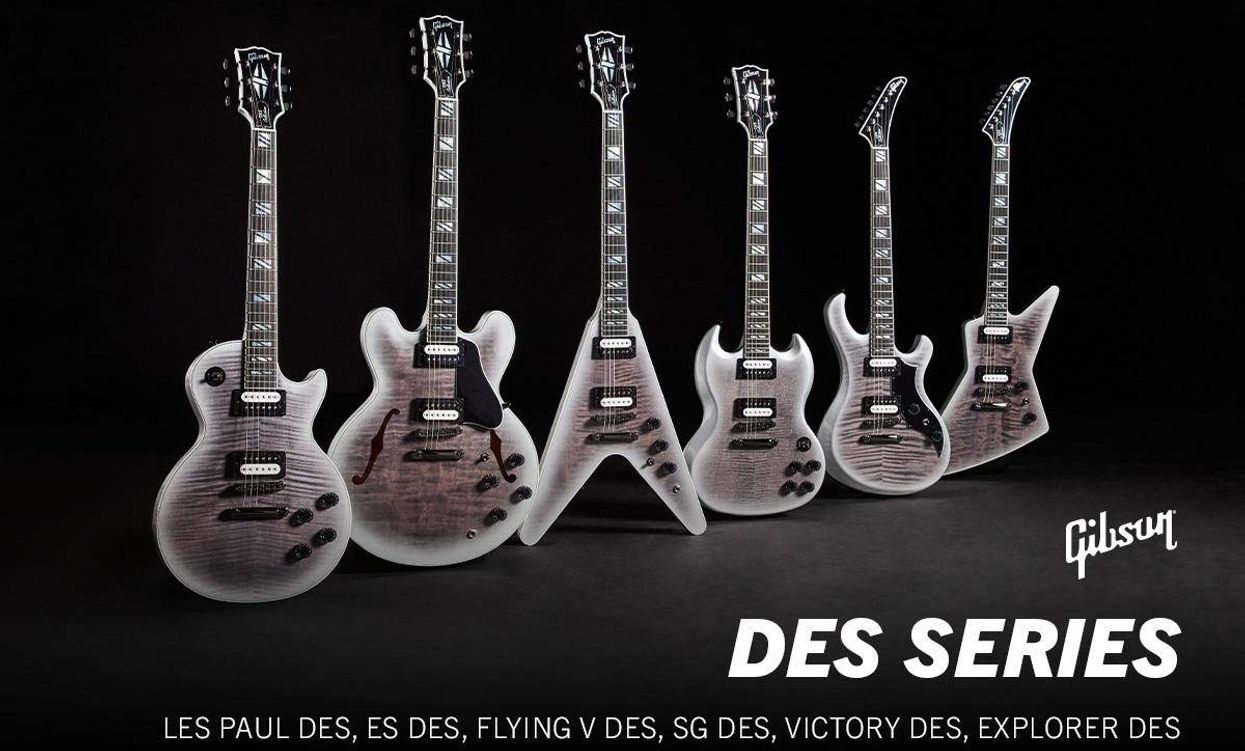
Gibson today unveiled the DES Series, an ultra-limited collection of six guitars available worldwide exclusively through Gibson.com and Gibson Garage locations. The launch coincides with the Gibson Band’s return with the release of a new benefit single “Sanctuary,” written by Gibson board member and artist ambassador Cesar Gueikian. The recording features orchestration and keyboards by Dream Theater’s Jordan Rudess, lead guitar by Mateus Asato and guest vocals by Jagger Davies; Produced by Gueikian and Emery Dobyns. The song will support Save the Music Foundation in partnership with Gibson Gives Foundation , helping to restore, sustain and expand music education programs nationwide.
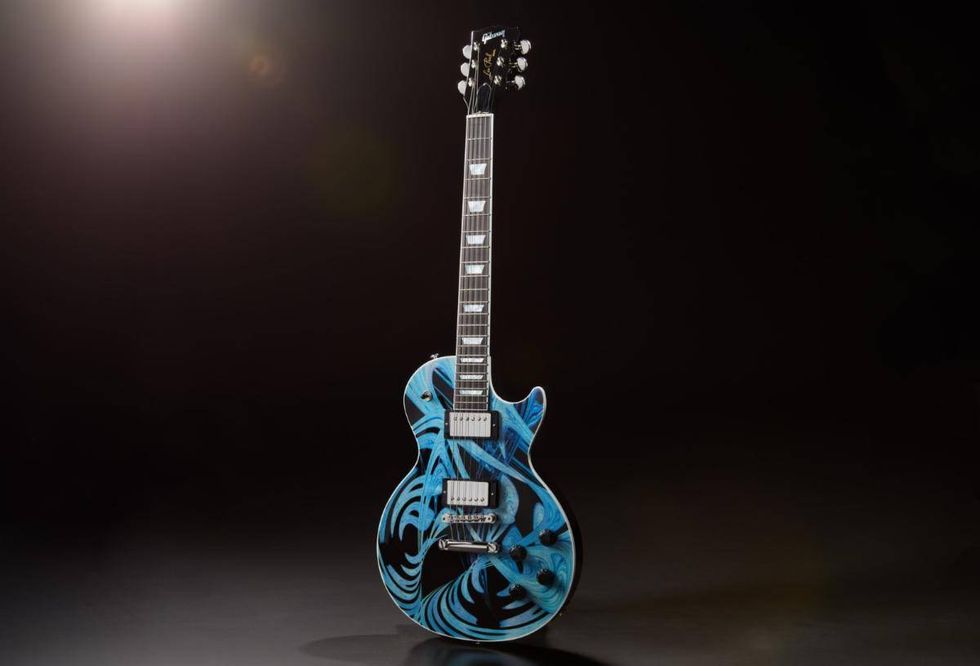
To celebrate the release, and raise additional funds benefitting Save The Music, a one-of-a-kind Gibson “Sanctuary” Soundwaves guitar featuring artwork based on the song’s actual soundwave pattern will be auctioned via RalyUp. The custom artwork was created in collaboration with visual artist Tim Wakefield of Soundwaves Art Foundation. Stream “Sanctuary” on major platforms at HERE , and bid on the Soundwaves guitar through RallyUp at https://go.rallyup.com/744876.
Above: Gibson Gives and RallyUp are auctioning a one-of-a-kind Gibson “Sanctuary” Soundwaves guitar featuring artwork based on the song’s soundwave pattern created in collaboration with Tim Wakefield of Soundwaves Art Foundation. Bid at https://go.rallyup.com/744876 .
Gibson DES Series

In partnership with philanthropic giving, the DES Series launches today and applies a bold new design and modern performance features to six Gibson body shapes: the Les Paul™, SG™, ES™, Explorer™, Flying V™, and Victory; and was developed by Gueikian, Gibson master luthier Jim DeCola and Gibson’s craftspeople.
Each model features a Ghost Burst finish, Super Split Block inlays, a compound-radius ebony fretboard, black nickel hardware and Gibson ELEV8 humbuckers with Alnico 8 magnets. A portion of each DES series guitar purchase supports Gibson Gives Foundation to further its efforts to spread the healing power of music. The Gibson DES Series is available now exclusively via Gibson.com and Gibson Garage locations.
Explore the Gibson DES Series of ultra-limited guitars, available worldwide today on Gibson.com.
Gibson ES DES in Ghost Burst
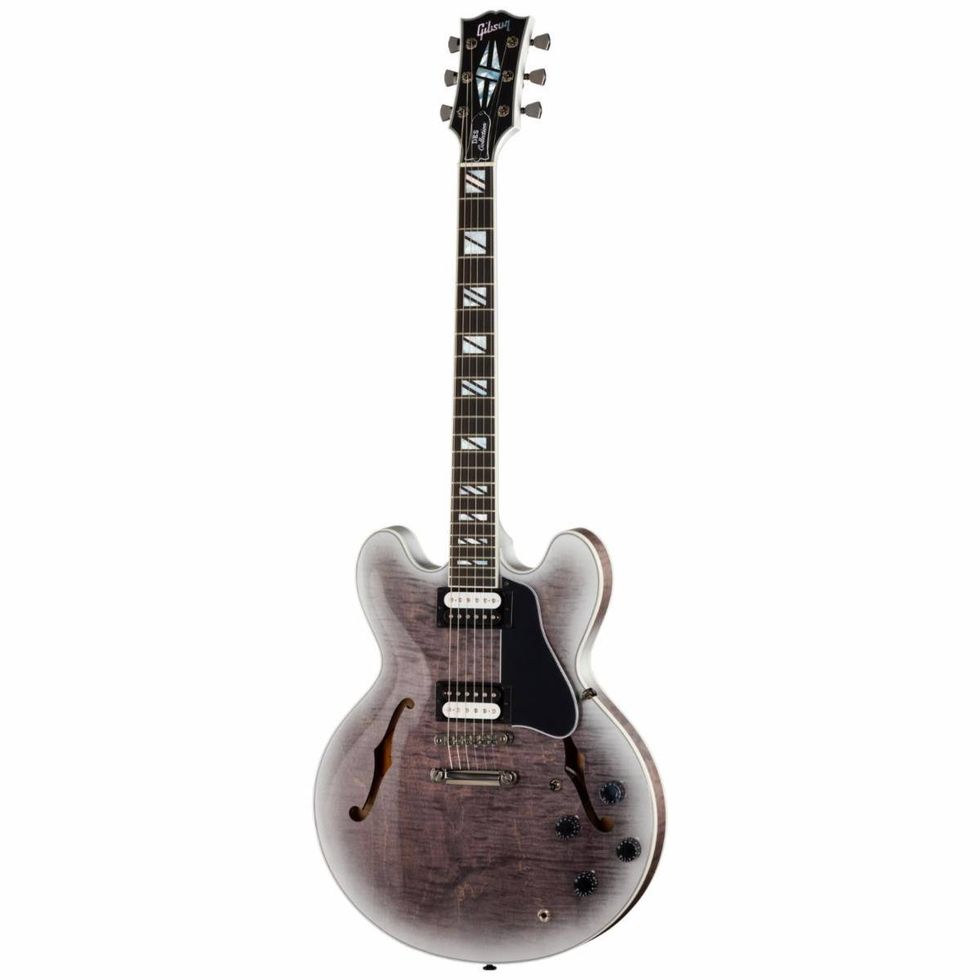
The Gibson ES DES in Ghost Burst, available exclusively on Gibson.com, is part of an ultra-rare, limited collection. Conceived by Gibson Artist Ambassador and Gibson Board Member Cesar Gueikian in collaboration with Master Luthier Jim DeCola and Gibson’s expert craftspeople, this modern semi-hollow guitar pairs a dramatic Ghost Burst gloss nitrocellulose lacquer finish with AAA figured maple, black nickel hardware, and distinctive uncovered zebra-coil pickups. Built for today’s technical players, it features a comfortable Rounded C mahogany neck, an ebony fretboard with a 10"–16" compound radius, 22 medium-jumbo frets, mother-of-pearl Super Split Block inlays, locking Grover tuners, and a Nashville Tune-O-Matic bridge. New Gibson ELEV8 humbuckers with Alnico 8 magnets deliver a powerful, articulate voice, while push/pull coil-tap controls expand its tonal versatility. Complete with a Gibson hardshell case, this limited-production instrument offers exceptional Gibson craftsmanship and modern performance, with a portion of the purchase supporting Gibson Gives.
Gibson Explorer DES, Ghost Burst
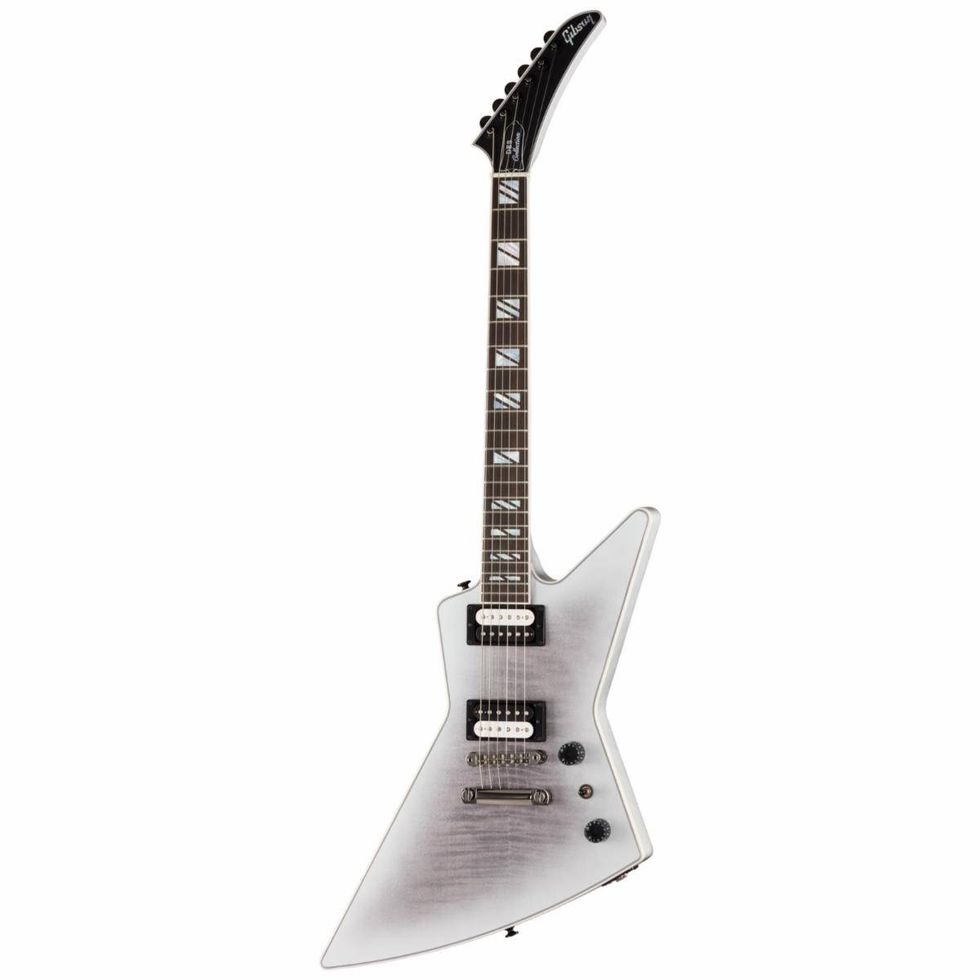
Own an exceptionally rare Gibson Explorer DES in Ghost Burst, part of an ultra-limited collection. Developed through a creative collaboration between Gibson Artist Ambassador and Gibson Gives Board Member Cesar Gueikian, Master Luthier Jim DeCola, and Gibson’s expert craftspeople, this bold instrument features an ’80s Explorer mahogany body topped with a multi-ply-bound AAA figured maple cap. A SlimTaper mahogany neck and compound-radius ebony fretboard provide fast, comfortable playability, while mother-of-pearl Super Split Block inlays, black nickel hardware, and uncovered zebra-coil pickups create a distinctive modern aesthetic. Gibson ELEV8 humbuckers with Alnico 8 magnets deliver powerful, articulate tones ideally suited to high-gain and progressive playing, complemented by intuitive master volume, master tone, and three-way selector controls. Finished in dramatic Ghost Burst gloss nitrocellulose lacquer and supplied with a Gibson hardshell case, this limited-production Explorer offers an extraordinary combination of collectible design, technical performance, and uncompromising Gibson craftsmanship, all while supporting the meaningful mission of Gibson Gives.
Gibson Flying V DES, Ghost Burst
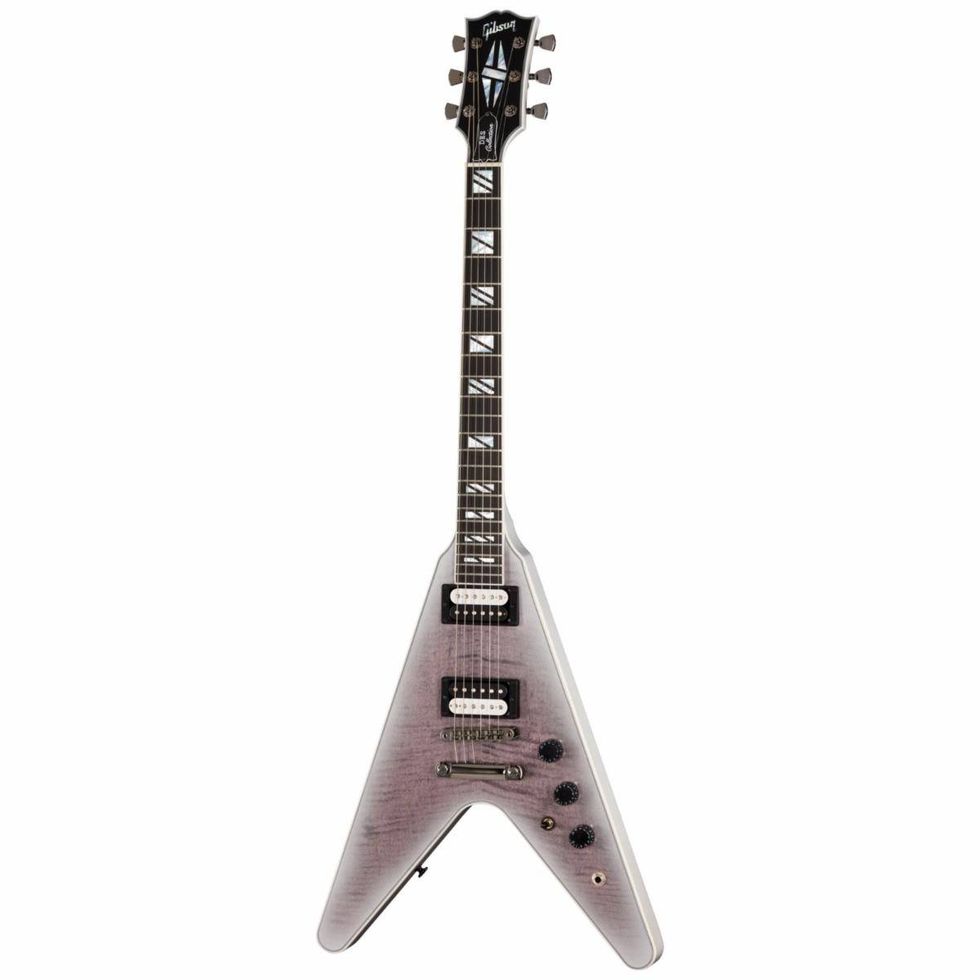
Own an exceptionally rare Gibson Flying V DES in Ghost Burst, part of an ultra- limited collection. Conceived by Gibson Artist Ambassador and Gibson Gives Board Member Cesar Gueikian and brought to life in collaboration with Master Luthier Jim DeCola and Gibson’s expert craftspeople, this striking instrument pairs an ’80s-style mahogany Flying V body with a multi-ply-bound AAA figured maple top. Its SlimTaper mahogany neck, bound ebony fretboard, 10"–16" compound radius, 22 medium-jumbo frets, and mother-of-pearl Super Split Block inlays offer fast, refined playability. A pair of Gibson ELEV8 humbuckers with Alnico 8 magnets delivers a focused, high-output voice with tight lows, clarity, and dynamic articulation, while locking Grover tuners, a Nashville Tune-O-Matic bridge, black nickel hardware, and uncovered zebra pickups complete its bold aesthetic. Finished in dramatic Ghost Burst gloss nitrocellulose lacquer and accompanied by a Gibson hardshell case, this limited-production Flying V offers an extraordinary combination of collectible design, modern performance, and uncompromising Gibson craftsmanship, all while supporting the meaningful mission of Gibson Gives.
Gibson Les Paul DES, Ghost Burst
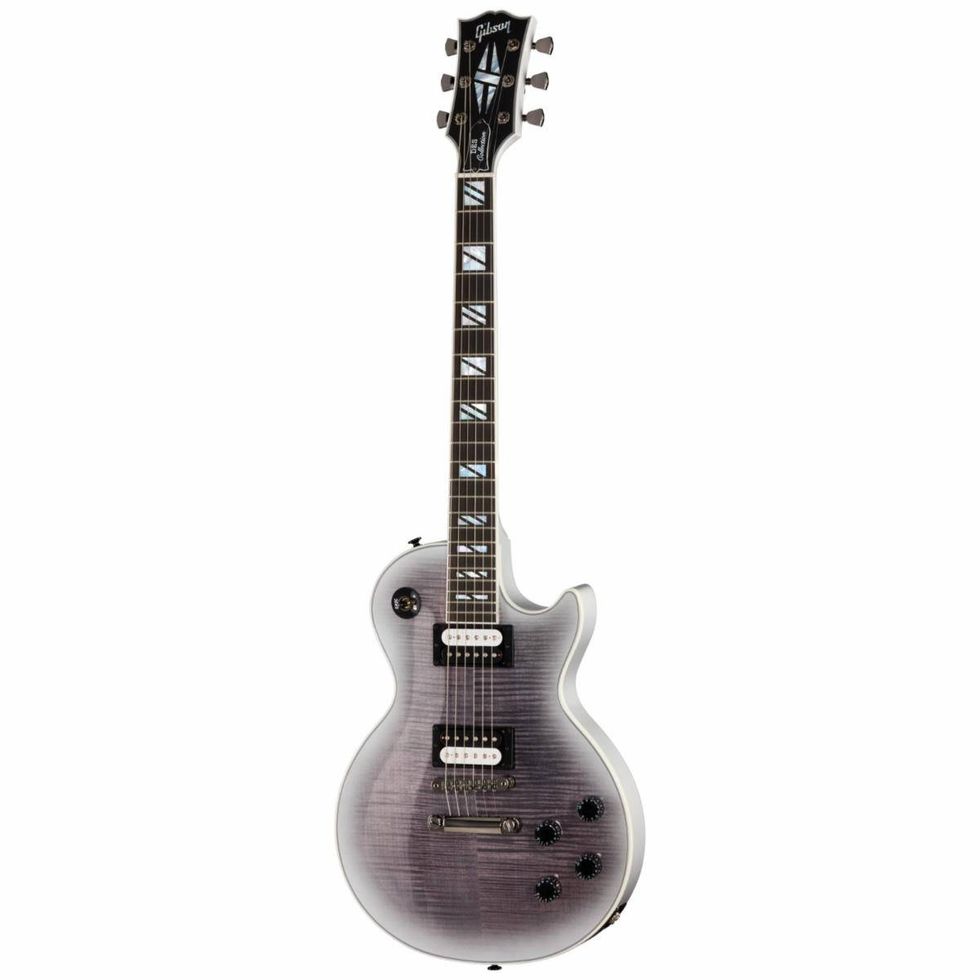
Own an exceptionally rare Gibson Les Paul DES in Ghost Burst, part of a n ultra-limited collection. Developed through a creative collaboration between Gibson Artist Ambassador and Gibson Gives Board Member Cesar Gueikian, Master Luthier Jim DeCola, and Gibson’s expert craftspeople, this performance-focused Les Paul features an Ultra-Modern weight-relieved mahogany body, a multi-ply-bound AAA figured maple top, and a SlimTaper mahogany neck with a Modern Contoured Heel for enhanced upper-fret access. Its bound ebony fretboard has a 10"–16" compound radius, 22 medium-jumbo frets, and elegant mother-of-pearl Super Split Block inlays. Gibson ELEV8 humbuckers with Alnico 8 magnets deliver a bold, high-output voice with exceptional clarity and articulation, while push/pull coil-tap, True Bypass, and Phase controls provide an expansive range of tones. Finished in striking Ghost Burst gloss nitrocellulose lacquer with black nickel hardware, uncovered zebra pickups, locking Grover tuners, and custom Epic/Epic+ switch-ring labels, this remarkable guitar arrives with a Gibson hardshell case.
Gibson SG DES, Ghost Burst.
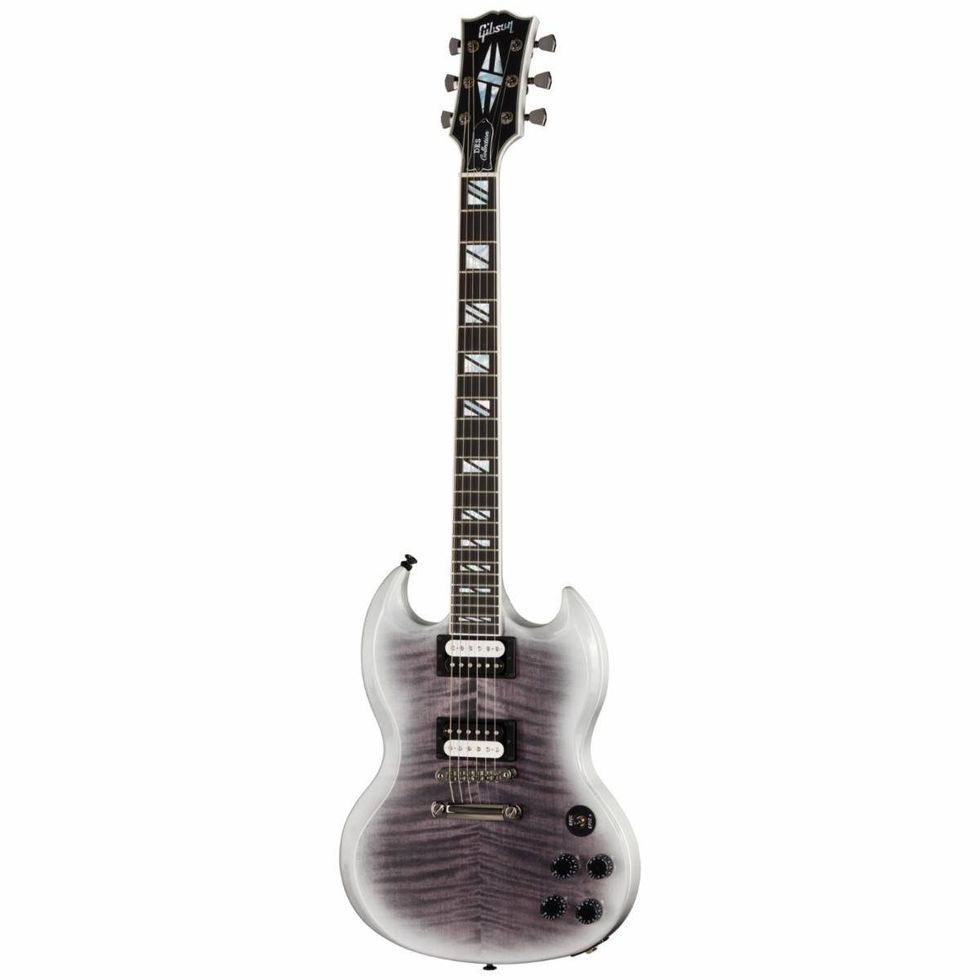
This rare Gibson SG DES in Ghost Burst, is part of an ultra-limited collection. Developed through a collaboration among Master Luthier Jim DeCola, Cesar Gueikian, and Gibson’s expert craftspeople, this modern performance instrument features a sculpted double-cutaway mahogany SG body topped with AAA figured maple. Its fast SlimTaper mahogany neck, ebony fretboard with a 10"–16" compound radius, 24 medium-jumbo frets, and mother-of-pearl Super Split Block inlays provide an extended playing range and effortless access across the neck. Gibson ELEV8 and ELEV8 Plus humbuckers with Alnico 8 magnets deliver a tight, aggressive, and articulate voice ideal for high-gain and contemporary styles, while push/pull coil-tap controls expand the available tonal palette. Finished in striking Ghost Burst gloss nitrocellulose lacquer with black nickel hardware, uncovered zebra pickups, locking Grover tuners, and custom Epic/Epic+ switch-ring labels, this remarkable SG includes a Gibson hardshell case. Own a highly collectible, stage-ready Gibson while supporting the meaningful mission of Gibson Gives.
Gibson Victory DES, Ghost Burst
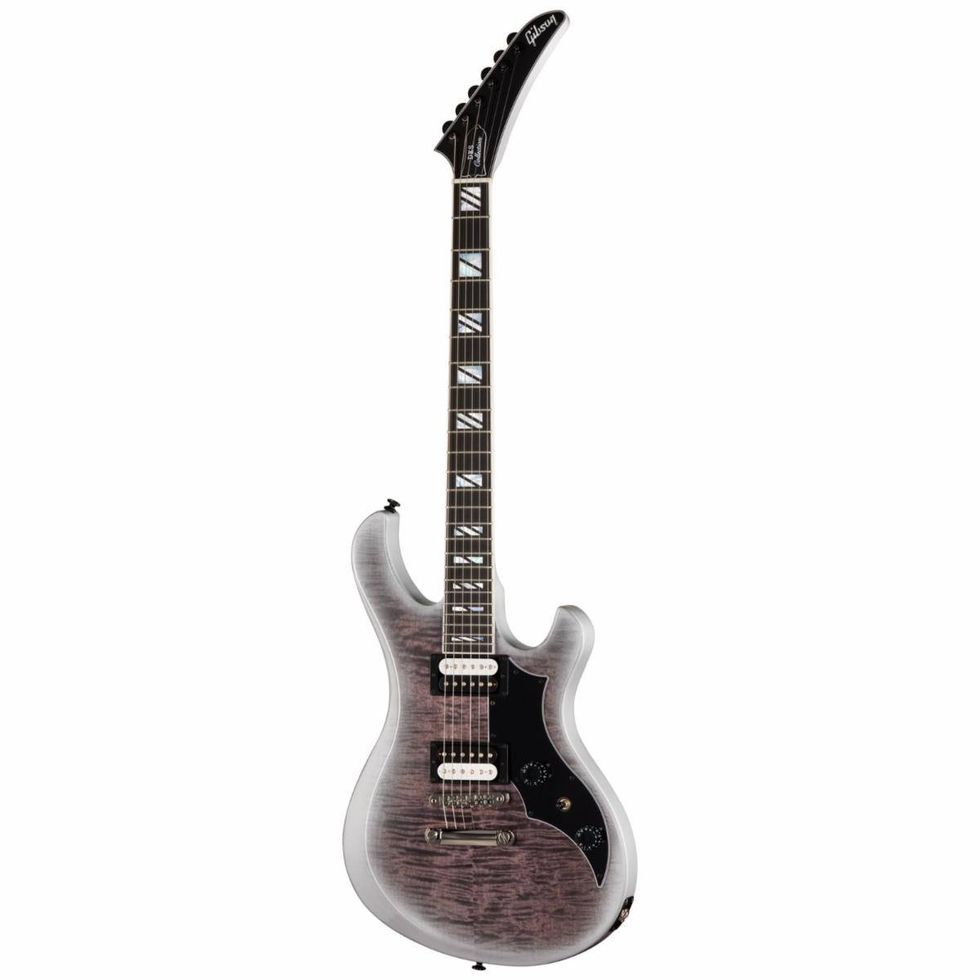
This exceptionally rare Gibson Victory DES in Ghost Burst, is part of an ultra-limited collection. Developed through a creative collaboration among Master Luthier Jim DeCola, Gibson Artist Ambassador and Board Member Cesar Gueikian, and Gibson’s expert craftspeople, this modern performance instrument features a double-cutaway mahogany Victory body topped with an AAA figured maple cap. Its fast SlimTaper mahogany neck, bound ebony fretboard with a 10"–16" compound radius, 24 medium-jumbo frets, and mother-of-pearl Super Split Block inlays provide exceptional playability and a refined appearance. Gibson ELEV8 and ELEV8 Plus humbuckers with Alnico 8 magnets deliver tight, aggressive, and articulate tones ideal for high-gain and contemporary styles, while push/pull coil-split and inner/outer coil-selection controls offer impressive versatility through a streamlined control layout. Finished in stunning Ghost Burst gloss nitrocellulose lacquer with black nickel hardware, uncovered zebra pickups, Grover tuners, and an Explorer-style headstock, this limited-production guitar includes a Gibson hardshell case. This is your opportunity to own a distinctive, highly collectible Gibson while supporting the meaningful mission of Gibson Gives.
Double Your Circuit Options In One Box | NEW Pedals from Sonisfact
Sonisfact arrived with four pedals built on a single idea. Every box holds two circuits. @TomButwin details the VOS line of overdrives, three pedals that each pair two classic drive voices with a 6-band graphic EQ, along with the VCP-80, a chorus and phaser in one enclosure that runs both effects at once.
All three VOS Overdrive Stations run the same architecture. A 6-band EQ on LED faders can sit before or after the drive circuit, and a clean blend folds dry signal back in against the dirt. On the right footswitch, a HIT fader sets the level hitting the drive and stays live when the drive is bypassed. What separates the three is the voice toggle. The green VOS-80 covers the most familiar ground, with Nashville on ODR-1 duty and Texas handling Tube Screamer tones. The gold VOS-81 goes aggressive, pairing the vintage Distortion+ sound Randy Rhoads made famous with the 250 tone Yngwie used to push a non-master amp, and Doug Aldrich has been running it into his tube amp for solos. The blue VOS-82 is the most amp-like of the set, moving from Wide for modern rock to Thick for cranked tube amp territory while holding onto the character of the guitar and amp underneath.
The VCP-80 sits apart from the overdrives. It houses an analog phaser with 45, 90 Vintage, and 90 Modern modes alongside a BBD chorus with low and high cut, and the two can run together through dual outputs.
SHOP SONISFACT PEDALS: https://www.sonisfact.com/
Ashdown Announces Exclusive Guitar Center Distribution in US
Ashdown has announced that the company’s products will be exclusively available across the USA through Guitar Center and Musician’s Friend. The new distribution arrangement marks a watershed for the British company as it aims to build a larger following in America.
For the first time in nearly three decades, Ashdown will have a dedicated footprint across the United States, with products available through 300 Guitar Center stores and online at GuitarCenter.com. From instruments and effects to practice amps and full stadium ready rigs, American musicians will now have more opportunities to plug into Ashdown products.
This new partnership will introduce Guitar Center customers to a wide range of Ashdown gear, including the company’s new Made in England collection of bass and guitar amplifiers. The new Ashdown range comprises nine key product families:
UK - ABM – Ashdown Bass Magnifier: The original Ashdown range and the sound behind countless stages and recordings.
UK - CTM – Classic Tube Magnifier: All-tube amplification for players who still worship at the altar of glass and high voltage.
UK - RBM – Rootmaster Bass Magnifier: Lightweight, powerful and built for working bass players.
UK - OBM – Original Bass Magnifier: Straightforward digital amplification delivering power, tone and simplicity.
UK - PBM – Portable Bass Magnifier: Compact amplification for musicians who need great tone wherever they go.
UK - SBM – Studio Bass Magnifier: Premium UK-built combos that reduce the weight without sacrificing the sound.
UK - Peacemaker: Boutique, tube guitar amplification, handcrafted in England for players demanding exceptional tone, feel and craftsmanship.
Ashdown Roasted Bass Guitars: Distinctive, inspiring instruments built for players at every stage of their journey.
Ashdown Effects and Accessories: Signature pedals, professional tools and everything else needed to complete an Ashdown rig.
The new exclusive partnership with Guitar Center comes as Ashdown approaches its 30th anniversary. Founded by Mark Gooday in 1997, the company is still family owned and based in the UK, with Mark’s son Dan Gooday serving as Managing Director of the growing enterprise.
For more information visit ashdownmusic.co.uk
Fender CEO Bud Cole admits “we could have done this better” over Strat legal threats, but claims the campaign is working

Whatever side you land on, one thing’s absolutely certain: Fender’s campaign to issue cease and desist letters to guitar builders making Stratocaster-reminiscent designs has sent shockwaves through the industry.
A bit of background to catch you up: late last year, Fender won a default judgement in Dusseldorf, Germany after the defendant, Chinese instrument manufacturer Yiwu Philharmonic Musical Instruments, failed to show up to court. The ruling resulted in the Stratocaster body shape being deemed a “work of applied art”, and protectable under copyright law.
Following the ruling, Fender embarked on a campaign to issue guitar companies large and small with cease and desist letters demanding the cessation of production of guitars closely resembling the Stratocaster. Those on the receiving end included Californian boutique builder LsL Instruments, German retail giant Thomann and PRS, one of the world’s largest guitar companies.
But the move was met with widespread criticism from the guitar community, with prominent guitar creators like Rick Beato, Rhett Shull and Tim Pierce distancing themselves from Fender, not to mention legal pushback from some of the companies targeted.
Following the backlash, Fender CEO Edward “Bud” Cole spoke at a dealer event in an attempt to calm things down, clarifying that the brand was “not suing anybody”.
“What we’ve done is reach out thoughtfully and [respectfully] to a handful of companies whose guitars come extremely close to replicating the iconic Fender Stratocaster design,” he said.
Now, some time after the initial cease and desist letters were sent, but while Fender still battles to legally reclaim its Stratocaster body shape, Cole has reflected once again on a turbulent few months for the company in a new interview with Bloomberg.
“There’s been a lot of introspection about this,” he says. “It’s clear to me that this got ahead of us – the legal process got ahead of us – and that we could have done this better.” Despite his reflective comments, though, Cole believes Fender’s campaign to reclaim the Strat is working.
Cole says a large part of Fender’s legal campaign was to urge differentiation and innovation in the guitar industry. “They’re simply copying designs, and that does not help our industry,” he says of builders making S-types. “We all start out with the same piece of wood. There are unlimited ways to design a guitar with that piece of wood.”
Clarifying Fender’s position, Cole says the company is “very, very focused solely on large manufacturers now”, adding: “We are not focused at all now on boutique builders.”
Where that leaves LsL Instruments – the boutique brand that made its presence as a recipient of a Fender cease and desist most known – is unclear. LsL confirmed in June that it had hired veteran guitar industry lawyer Ron Bienstock, who famously won a 2009 trademark case against Fender on behalf of a consortium of guitar brands. It saw Fender’s request to obtain trademarks for its Stratocaster, Telecaster and Precision Bass body shapes rejected.
Whether down to its legal costs is not clear, but LsL recently announced a flash sale in order to “raise $75,000 in a very short amount of time”.
Regardless, Bud Cole continues his reflection, saying Fender’s goal was not legal aggression, but rather to “begin conversations with people” about how brands could “begin to design something that is not a direct copy”. “That has always been our objective,” he says.
You can read the full feature at Bloomberg.
The post Fender CEO Bud Cole admits “we could have done this better” over Strat legal threats, but claims the campaign is working appeared first on Guitar.com | All Things Guitar.
MONO Collabs with Polyphia's Tim Henson on Dual Electric Guitar Case
MONO has introduced the MONO x Tim Henson M80 Limited-Edition Classic Dual Electric Guitar Case, marking MONO’s first-ever artist collaboration.
Designed in collaboration with Polyphia guitarist and virtuoso Tim Henson, the limited-edition case brings together MONO’s design-led philosophy with Henson’s creative perspective. Developed over months of prototyping, from initial concepts to the final build, it reflects a shared commitment to purposeful design and uncompromising functionality.

MONO x Tim Henson M80 Classic Dual Electric Guitar Case features include:
- Built on MONO's patented dual protection design, the case safely carries two guitars within a single streamlined profile.
- A distinctive square-patterned front panel is paired with a custom off-white plush interior for a refined visual statement.
- A specially incorporated front handle provides greater control and versatility when carrying the case.
- A custom Polyphia metal badge adds a signature detail unique to the collaboration.
- Durable, water-resistant Sharkskin™ exterior provides reliable protection for travel and touring.
- A reinforced steel-riveted webbing handle offers lasting strength, comfort and durability.
- MONO’s patented Headlock® neck suspension system securely supports and protects both instruments while in transit.

Beyond his distinctive approach to guitar, Henson has a deep appreciation for design and aesthetics, making him a natural collaborator for MONO. A longtime MONO user alongside his band Polyphia, he has relied on MONO gear throughout his career, making this collaboration a meeting of MONO's industry-leading approach to instrument protection and one of the most innovative guitarists of his generation.
Launching alongside Polyphia’s latest single, “Power in the Blood”, the campaign follows a day in the life of Henson, carrying his Ibanez nylon-string and electric guitars in the MONO x Tim Henson M80 Classic Dual Guitar Case. Henson shares why he partnered with MONO to create his signature case, the thinking behind the features he selected, and how his creative vision shaped the final product.
"I’ve been using MONO gear for years, so I’m very happy to have gotten the opportunity to make my own version of the M80 Classic Dual,“ said Tim Henson. “I’m constantly switching between my electric and nylon-string signature guitars, so having one case that carries both and looks exactly the way I want it to is perfect."
The MONO x Tim Henson M80 Classic Dual Electric Guitar Case carries a street price of US $399.99. To learn more visit: timhenson.monocreators.com.
MONO partners with Polyphia guitarist Tim Henson on signature dual-carry guitar case

[Editor’s note: MONO is part of Vista Musical Instruments, which like Guitar.com, is part of the Caldecott Music Group.]
Polyphia guitarist Tim Henson has further expanded his growing collection of signature gear with a new take on MONO’s M80 Classic Dual guitar case, which is able to carry two guitars at once within a streamlined profile.
Henson, of course, has a number of signature guitars to his name with Ibanez, including his TOD-10 electric, which sports his signature rose-and-thorns inlay across its fretboard, and a number of nylon-strings gear towards virtuosic playing, too.
So with so many guitars in his portfolio, it makes sense that he’d have a signature carry case that can protect more than one at the same time, right?
Though it’s another entry in Henson’s catalogue of signature gear collaborations, the new Tim Henson M80 Classic Dual case marks a big moment in MONO’s history, as it’s the first time the musical accessory company has officially collaborated with an artist. Henson himself has been a user of MONO cases for some time, so the partnership is a natural fit.


You might think it’s just a guitar case, but MONO’s design-led philosophy and meticulous attention to detail is apparent all over the new Tim Henson case, which was developed over months of prototyping.
On the outside, the case sports a distinctive square-patterned front panel with durable, water-resistant Sharkskin material for reliable protection, along with a custom Polyphia metal badge, a specially incorporated front handle and reinforced steel-riveted webbing handle.
Inside, it boasts MONO’s patented dual protection design – which keeps two instruments safe at once – with the brand’s patented Headlock neck suspension system, as well as a custom off-white plush interior.
“I’ve been using MONO gear for years, so I’m very happy to have gotten the opportunity to make my own version of the M80 Classic Dual,” Henson says. “I’m constantly switching between my electric and nylon-string signature guitars, so having one case that carries both and looks exactly the way I want it to is perfect.”
The MONO x Tim Henson M80 Classic Dual Electric Guitar Case is available now for $399.99 via MONO’s website and select authorised dealers.
Learn more at MONO.


The post MONO partners with Polyphia guitarist Tim Henson on signature dual-carry guitar case appeared first on Guitar.com | All Things Guitar.
The iconic British folk guitarist that Richard Thompson claims is the “original guitar hero”

Of the most influential guitar players of all time, heavyweights like Eddie Van Halen and Jimi Hendrix often get the first mentions. But there’s one guitarist who’s somewhat unsung by comparison, and was so influential, in fact, that folk-rock guitarist Richard Thompson calls “the original guitar hero”.
And that’s Davey Graham, the late veteran British guitarist and folk-rock revivalist, credited with popularising DADGAD tuning, among many other accolades.
- READ MORE: Does tonewood really matter? This is how the wood your guitar’s made of affects the sound
“He was a great player, and a great pioneer who took from everything,” Thompson explains in a new interview with Uncut. “He knew enough jazz, North African music, traditional music, Caribbean music, it’s all in there, and if you went to visit him he’d switch from one to the other, like, ‘Have you heard this one? But what about this?’ He was the first. After him comes Bert Jansch, John Renbourn, Martin Carthy, then John Martyn et cetera.”
Though he had a lasting impact on the guitar world, Davey Graham wasn’t without his struggles. In an interview last year, folk legend Martin Carthy spoke of Graham’s battle with heroin addiction, recalling the first time he dabbled in the hard substance and how it affected his creative ability.
“I thought I’d done a really good job, but when I put the record on, I went: ‘What the fuck is that?!’ It was absolutely terrible. I was playing this solo that was nonsense,” Carthy remembered of the pair re-recording a version of Port Mahon, originally written by Sydney Carter.
He went on: “On the way home from that session, Davey told me that he’d had his first fix the night before: ‘Oh, it was great, I’m going to do it again.’”
Continuing in the new interview with Uncut, Richard Thompson says: “One does not judge. People have to get through life, and sometimes you need a bit of fortification to do so.”
Thompson himself is a lifelong teetotaller, a decision he says he made at a “fork in the road” in the 1970s.
“If you’re in the music community you see a lot of damage, you see a lot of people die young,” he says. “In the ‘70s I saw a fork in the road, and I can go this way and I’ll be dead in, you know, seven years, and if I go this way, I might survive. It was a conscious choice.”
The post The iconic British folk guitarist that Richard Thompson claims is the “original guitar hero” appeared first on Guitar.com | All Things Guitar.
You won’t believe how long it took Matt Bellamy’s guitar tech to capture all his amp sounds

For a spectacle that is a Muse show, frontman Matt Bellamy is pretty particular about the sounds he wants onstage. The Manson-toting guitarist is well and truly an amp modeller convert, with a Fractal Audio Axe-Fx III being the heart of his live rig.
Yep, Bellamy’s arsenal of custom electric guitars might be the main attraction for regular folk attending Muse shows. His numero uno, a Floyd Rose-equipped Manson MB and the stunning mirror guitar with an MXR Phase 90 and ZVEX Fuzz Factory built right in, are some notable highlights.
But for us slightly nerdier guitar gear aficionados, what’s lurking within the walls of his rack-mount amp and effects processor is far more intriguing…
- READ MORE: Does tonewood really matter? This is how the wood your guitar’s made of affects the sound
And that’s because it’s packed with heaps of custom amp captures from Vox, Diezel, Laney, Orange, and Fender amps, and even a Gibson amp dating back to 1938. And as his guitar tech Chris Whitemyer explains in a new interview with Premier Guitar, the process of capturing them was so meticulous that it took a whopping 63 days. That’s over two months…
“That was one thing Matt insisted on, was ‘I don’t want anyone else’s amps.’ He wants his amps,” Whitemyer explains, adding that the Muse superstar is the proud owner of “about 35” amps. “There’s kind of oddball ones that are really cool, and they’re all in there [the Axe-FX III].”
The veteran guitar tech, who has also worked with Guns N’ Roses, Whitesnake and Nine Inch Nails, goes on to explain how he and Bellamy are “always” running a combination of amp sounds as opposed to any one on its own, and says he runs three Axe-Fx III units concurrently to get Bellamy’s sound.
“All of those amp sounds [in the Axe-Fx III] are his amps,” Whitemyer says. “[We modelled] everything. 63 days, eight hours a day, left before dinner every day…”
Earlier this year, Manson – which is part-owned by Meng Ru Kuok, CEO of the Caldecott Music Group, which also owns Guitar.com – announced that it had worked with Matt Bellamy to create a production-run model of his iconic Time is Running Out guitar.
Loaded with a slew of integrated systems, including a Sustainiac Sustainer, Z-Vex Fuzz Factory, Manson/Ron Joyce FL Wah, and a MIDI Strip controller, the guitar comes at a hefty price tag, with the more decked out version sitting at £29,999, and a [slightly] more affordable model available at £11,999.
The post You won’t believe how long it took Matt Bellamy’s guitar tech to capture all his amp sounds appeared first on Guitar.com | All Things Guitar.
Does tonewood really matter? This is how the wood your guitar’s made of affects the sound

The wood that your guitar or bass is made from affects your tone as much as any other gear choice you make, as much as pickups, pedals and amps. This is especially true for acoustic guitars, with or without a pickup.
Different woods like alder, ash, mahogany and more add subtle nuance to the resulting tone, in turn changing how you play, pick, dig into strings and the harmonic content bouncing around.
There’s countless arguments, discourse and opinions online about how much each component of a guitar affects the overall sound, extending to discussion around factors off the guitar, such as player’s hands, technique, feel and more. Discourse aside, what is true is that everything matters.
While different woods have different amounts of impact, each component affects sound, which in turn affects feel, affecting technique and subsequently the final signal that has passed through the guitar to an amplifier or out of a soundhole. Even the most simple guitars might have a handful of components doing 1 per cent each, but 20 of those leads to a 20 per cent variance between sonics and sound— a huge amount when you think about it!
The weight and feel of the guitar is largely at the behest of the woods it’s made from, both the body, neck and fretboard, and these also feature wildly different tonal characteristics because of structural integrity, quality and weight.
 Image: Adam Gasson
Fretboards
Fretboard wood varies a little less than body wood, so let’s start there. Many guitars feature either rosewood or maple fretboards, though ebony is another common, albeit premium, choice. Various woods like purpleheart, or amaranth, ovangkol and pau ferro are all often used in situations where rosewood is unavailable, either because of logging restrictions or cost prohibitive situations.
Rosewood is used extensively on electric guitar fretboards. Being a softer wood, it absorbs certain frequencies and accentuates others, often being known for a warmer, more midrange sound, making it a great choice for a mid range instrument like the guitar. Brightness is retained in a controlled way, while low end melts away a little bit without the resulting sound being overtly thin.
Maple is a harder wood, and while retaining the mid range character of rosewood, its bright disposition is thanks to the snap and attack of your playing bouncing off the hard surface instead of vibrating away into the wood. This is augmented by the glossy finish on many maple necks, used both for tone, as well as to protect the clean, light-coloured maple from getting grubby.
Ebony is again, even harder than maple, and is particularly bright, the grain almost invisible on premium cuts of ebony. While rosewood has visible grains and imperfections in the wood, ebony usually offers a particularly glassy finish, both aesthetically and sonically. Furthermore to your choice of wood, designs like a one-piece maple neck can prevent tone from fizzling away between components. While a rosewood fretboard is often glued to a maple neck, for example, the tiny gap between neck and board allows vibrations to escape, while a single piece of maple that serves as neck and fretboard has no gap for that sweet, sweet tone to escape to!
 Image: Adam Gasson
Perfect Pairings
Pairing your fretboard wood with body wood can help to shape and refine the sound. More common warm guitar woods like mahogany for electric guitars or rosewood for acoustic guitar can be paired with snappier fretboards for a controlled tone, while matching a warm fretboard with a warm body wood can provide a more mellow, vintage, mid-range focused sound.
Mahogany is commonly used on Gibson’s Les Pauls, paired with a rosewood fretboard, or ebony on the Custom range. Fender uses alder extensively to provide weight relief compared to the hefty mahogany Gibsons. Alder provides a nice middle ground that harnesses the punch of a rich, firm wood, while its lightness allows a little mud and low end to fizzle away. Fender also commonly uses various species of Ash, even lighter and brighter again, paired with warmer fretboards.
These subtle differences are augmented further by your choice of pickups, so be weary of those pairings! The wrong choice of pickups can either miss out on the richness of your wood, or augment to the point of harshness.
 Image: Adam Gasson
Acoustics
These choices are even more obvious on an acoustic guitar, guitar makers pairing different woods for the top, sides and back of the guitar. These choices, along with the soundhole, serve as the guitar’s amplifier and affect the sound entirely. Variations of maple are commonplace in modern tops for acoustic guitars, the bright demeanour of the wood being perfect for clarity in playing.
More vintage-style acoustics, like parlour guitars, sometimes use rosewood for the top and sides resulting in a warmer, more dimmed sound that allows the mid range to shine through. Both rosewood and ebony are common on acoustic guitars, though the brightness of maple is often overkill for the brightness of acoustics, the resulting sound being brittle and harsh.
The character and controlled acoustic qualities of a tonewood come together in semi-hollow guitars, some of which have a comb of standard electric guitar pickups and piezo systems. The timbre of the tonewoods in semi-hollow electrics harness woods like alder and ash, usually reserved for solid body electrics, tying together acoustic resonance and controlled, mid-forward chime.
While tonewood may have a small effect on its own, the way they allow or prevent vibration from escaping into the ether have a huge effect on the resulting sound. Different designs allow sound to vibrate away differently, either pushing brightness into your pickups or mellowing it out entirely. Harder and softer woods offer brighter or warmer sound respectively, and your choice of body wood yields the same results, this being exacerbated in acoustic guitars because they act as both guitar and amplifier as sound bounces out of the soundhole.
In the pursuit of your perfect sound, you’ve also got to try different tonewoods to see what matches your style, technique and feel, different woods either being great to augment your own playing, or to harness different tonal tools for different jobs. There’s no right answer for everyone, but there might be a wrong one, so try as many guitars as you can.
The post Does tonewood really matter? This is how the wood your guitar’s made of affects the sound appeared first on Guitar.com | All Things Guitar.
Electro-Harmonix Unveils The Adrian Belew Echoflanger
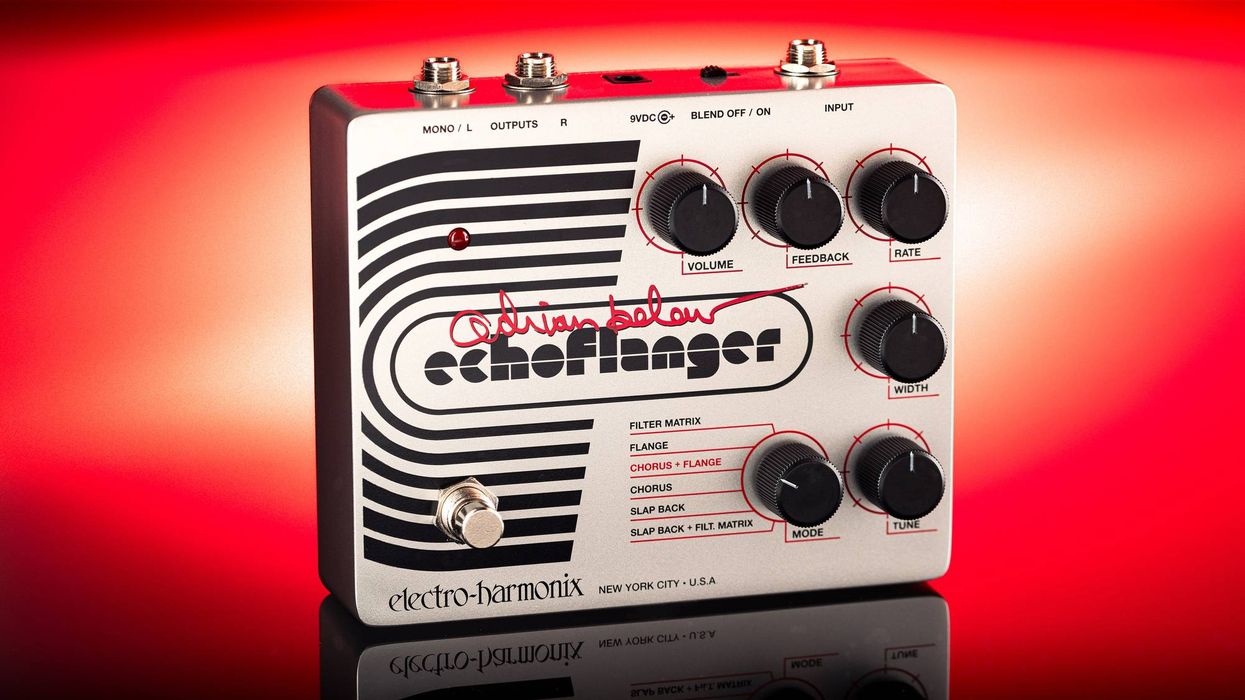
Electro-Harmonix has launched the Adrian Belew Echoflanger, a limited edition signature version of the fabled EHX modulator.
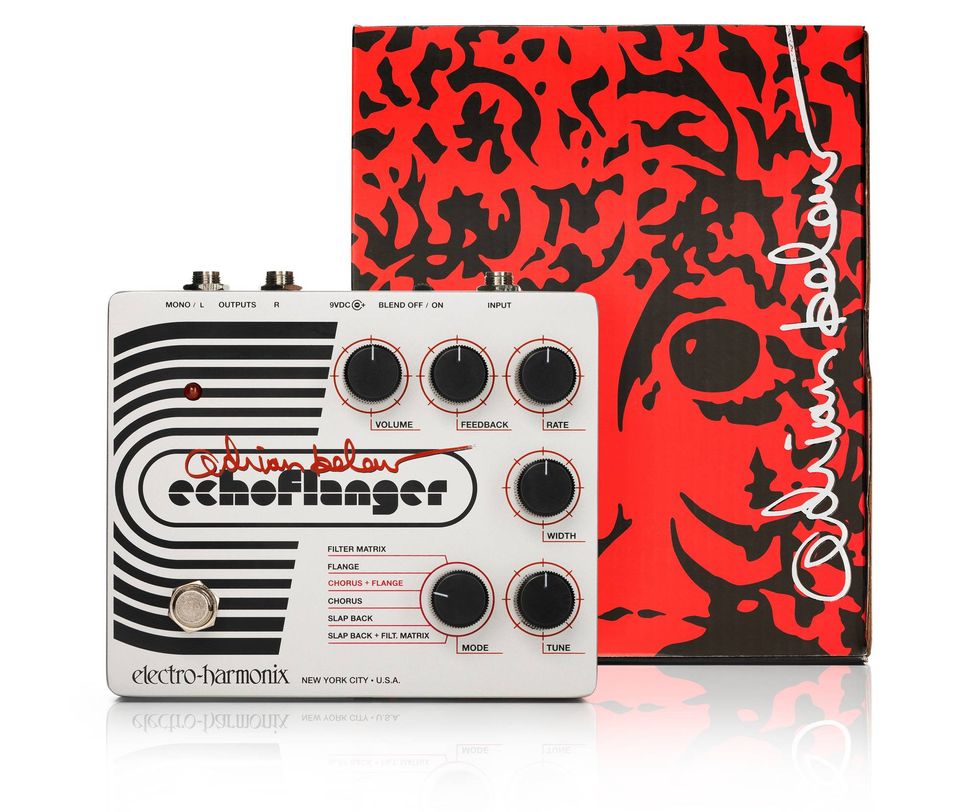
From his career launching stints with Frank Zappa and David Bowie, collaboration with the likes of the Talking Heads and the Tom Tom Club, and his career defining years in King Crimson, Adrian Belew has always been on the cutting edge of using effects for cultivating intriguing and out-of-this-world guitar tones. Ever at his left-hand, the Electro-Harmonix Echoflanger had been employed to create some of Adrian’s most notable sounds.
The new signature Adrian Belew Echoflanger is an all-analog multi-mode modulator capable of sounds from smooth and airy to warped and wild. Classic modes from the original include Filter Matrix, Flange, Chorus, and Slap Back, plus new combination mode: Slap Back + Filter Matrix and Adrian’s signature Chorus + Flange. In addition to standard modulation controls like VOLUME, RATE and WIDTH for setting output, speed, and range of effect, the Echoflanger includes a TUNE knob for dialing in the centerpoint of the modulation waveform, and a FEEDBACK knob to adjust from mild mod to runaway self-oscillation. The BLEND switch adds/removes the dry signal from the effect signal for traditional chorus/flanger-type effects or more intense vibrato sounds.
The new twist on a classic tone twister features stereo outputs, and true bypass with mechanical relays. The pedal ships with standard EHX 9 Volt power supply and has a U.S. Street Price of $239.00.
Dominion Electric Filmotone Review
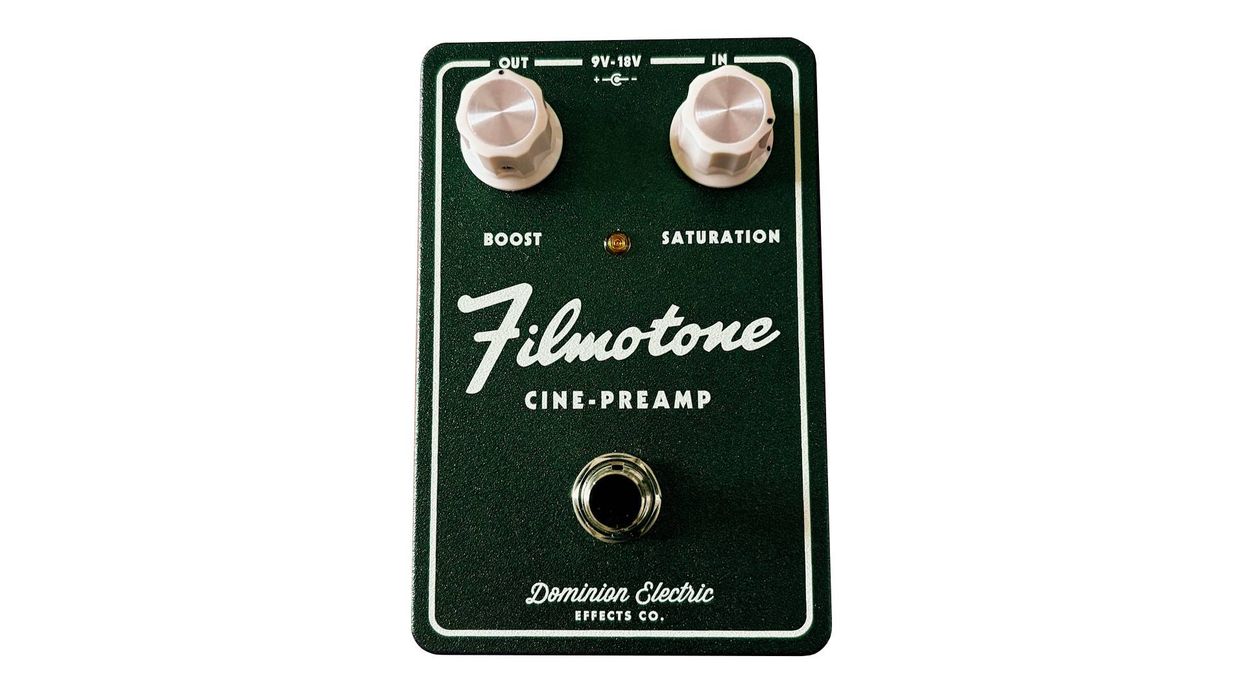
Aaron Sabourin runs Dominion Electric Effects Co., out of Ottawa, Ontario, as a one-man show, building effects using pricey, vintage parts when his day job permits him to. His Faceless Fuzz and Soul Power—inspired by the Fuzz Face and Hendrix’s screaming tone at Fillmore East circa 1970, respectively—are top-shelf recreations of common circuits that have been around for a long time. But it’s Sabourin’s commitment to using premium components in bomb-proof builds that make his pedals so coveted. His latest design, the Filmotone, strays a little further from the guitar-tone canon: It’s an effect pedal designed to approximate the sound and dynamic feel of a single-transistor preamp wrenched from the guts of a Bell & Howell Filmosound film projector.
As far as I can tell, there aren’t a ton of pedals on the market based on DIY amps made from old film projectors. Bell & Howell Filmosounds, with their hefty grab-and-go design, were designed to let owners screen films anywhere, with both image and sound thanks to an integrated tube amplifier. A few decades back, an Ontario amp technician, Bernie Raunig, began stripping the amplification sections, then modding and rehousing them. These low-wattage “projector amps” are still revered for their frankly undeniable mojo, and though there is not one particular manufacturer nor tone that defines the projector-amp sound (the projector amplifier amplifiers themselves evolved over time) the general tonal thumbprint tends to be transparent, warm, full, and very vintage.
Film Foundation
The Filmotone’s handsome dark-green sparkle finish, paired with its classy white font and detailing, is a lovely thing to behold. Sabourin’s pedals all follow a similarly sparse art direction, but the Filmotone might be the prettiest of the bunch.
The pedal’s two controls—a knob for boost and one for saturation—are fairly self-explanatory; boost handles your volume level, and saturation adds just that—and exactly that. It doesn’t really feel like the Filmotone adds dirt, or fuzz, or gain in the strict sense of those terms. Saturation feels like the only adequate descriptor for what it does—almost like liquid gorging and swelling a plank of wood, making it more massive. The only other control on the Filmotone is an internal switch that toggles between “full” and “tight.” The latter cuts some of the pedal’s bass presence when engaged, making the Filmotone a better, more focused fit in some high-gain applications.
Lights, Camera, Saturation!
With the boost knob at noon and saturation all the way counter-clockwise, Filmotone is an immediate signal fixer-upper. It widens and boldens your signal, and blunts sharp edges in your tone for a pleasing, lightly compressed, vintage feel. As you crank the saturation knob, you’re greeted with gentle, organic breakup, with chewy, thick low-end that evokes the output from many vintage, low-wattage tube combos that remain benchmarks for “good tone.” Reducing guitar volume cleans the signal up, but the Filmotone retains low-end authority in these situations. What it brings, essentially, is a feeling of balance and fullness that you might otherwise get only by turning a tube amp up really loud. That makes it a great choice for players who need something to enliven a low-volume stage, home, or practice setup. (Maybe for this reason, I preferred using the pedal with the internal switch set to “full.”)
Stacked against other preamp pedals in my arsenal, Filmotone didn’t get quite as nasty, which is fine, because as a clean and low-to-mid-gain tone-shaping tool, it’s exquisite. None of my other preamp stomps yielded sounds as wide-screen and three-dimensional as the Filmotone, and while these qualities were never more apparent than when it was the only effect engaged, having it upstream from my Fairfield Barbershop or a Fuzz Face clone, among others, demonstrated just how satisfying the Filmotone’s EQ profile is: It focuses extreme frequencies without losing the big picture.
There were times that I wished I could coax more dirt from the Filmotone’s saturation knob. By comparison, Walrus Audio’s Filmosound-inspired amp-in-a-box, the 385, takes players straight through to explosive, gooey distortion and fuzz. Dominion’s Filmotone doesn’t get that filthy, but that’s fine. As a clean boost/tone-sweetener, it’s truly top-tier.
The Verdict
Dominion’s Filmotone is a high-class preamp that stands apart from the pack. For a 2-knob pedal, its price tag is steep, but if exceptional sound, components, and build quality are important factors, you’ll want a ticket for the Filmotone.
Rig Rundown: Steel Beans
PG’s John Bohlinger met up with Jeremy DeBardi, a.k.a. Steel Beans, at the Cannery in Nashville. A one-man-band, DeBardi plays guitar and drums at the same time, and does it through a pair of 1965 Silvertones and two vintage amps run in stereo. Have a look at some quick highlights below, and tune into the new Rig Rundown for all the details.
Brought to you by D’Addario.
Cheap Thrills
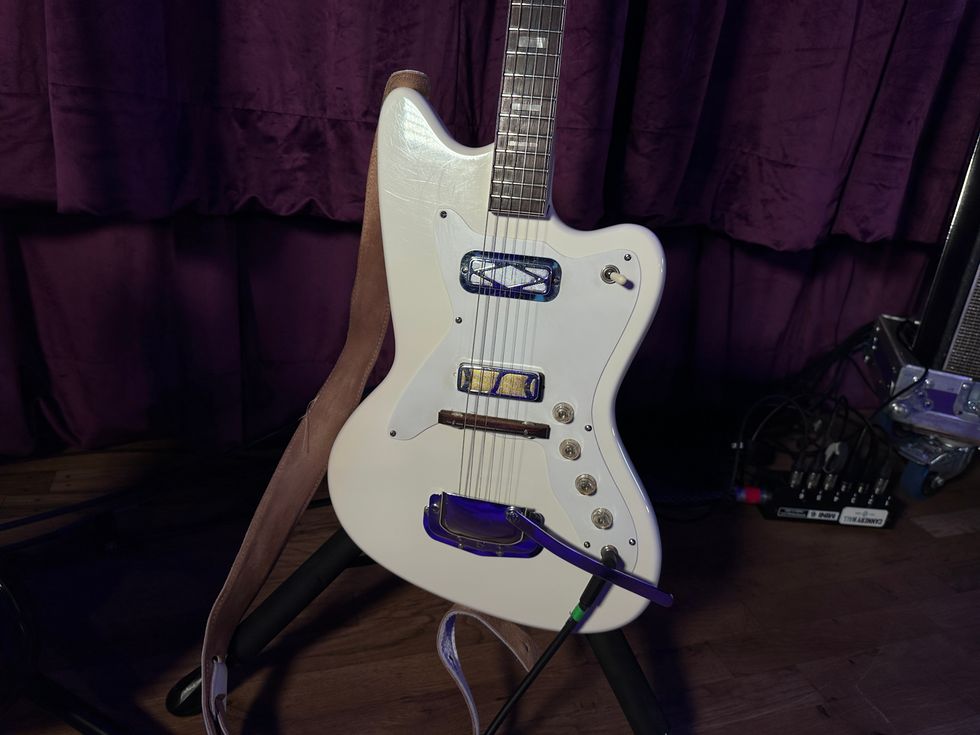
A real Strat or Les Paul was out of reach when he was a teenager, so DeBardi picked up a used 1965 Silvertone at a Guitar Center for under $300 and found it had the sound of every ‘50s and ‘60s record he wanted. He owns five now. The original barely plays—it’s “fretted out”—but he toured with it anyway, carrying it into taco joints and sleeping next to it in hotels. Two of the five have been refinished by a painter in California, including this one in white.
Birthday Present
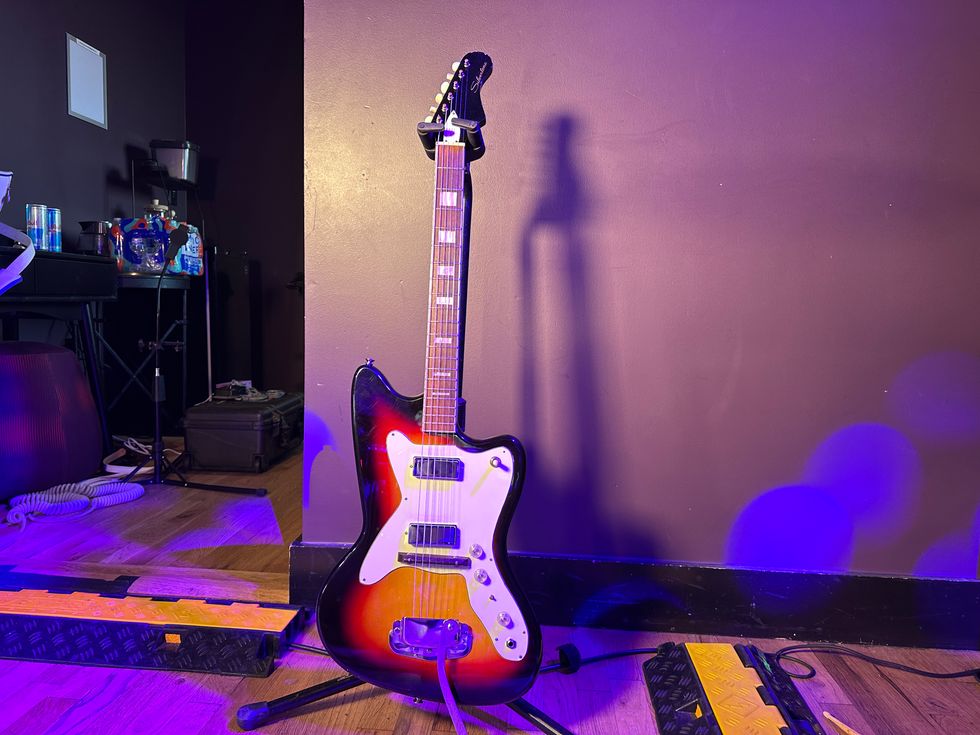
After a show in Boise, a man came up and gave DeBardi this Silvertone, which had been hanging unplayed on his wall at home. At that point DeBardi owned exactly one. Pulling the pickguard to prep it for paint turned up the factory stamp: April 9, 1965, his birthday. It’s also loaded with MojoTone Johnny Winter Firebird pickups.
Bright, Not Shrill
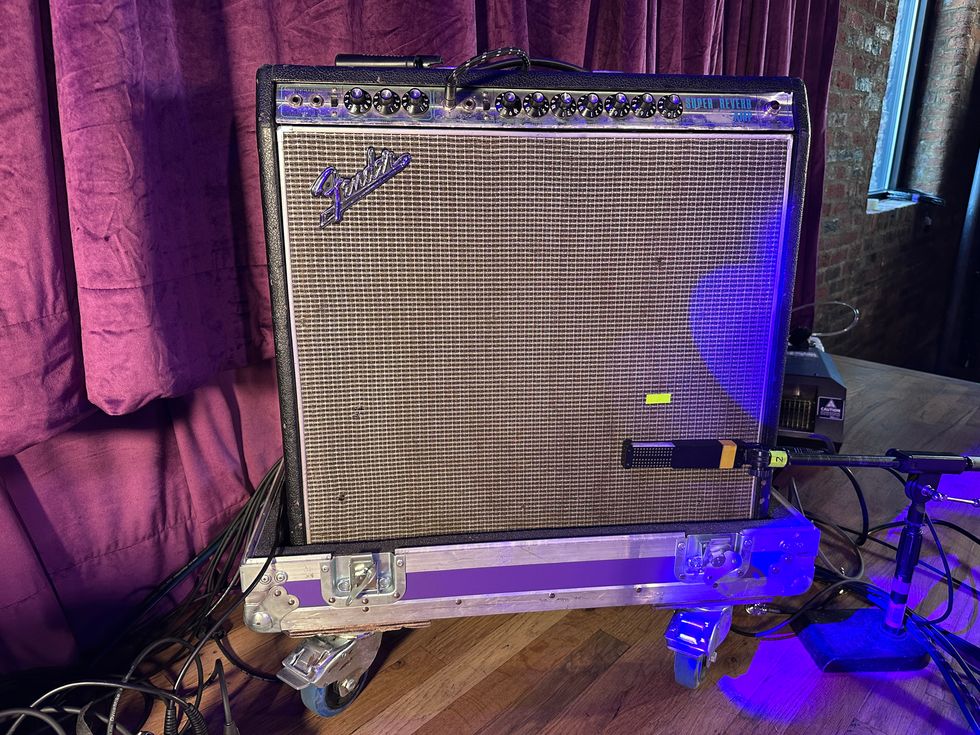
DeBardi played a Twin reissue for a decade and found the bright switch painful with the amp cranked. This 1968 Super Reverb gets bright too, but he calls it bright in a Freddie King way—sharp enough to grab your ear without turning shrill, like an old record.
Sick Trade
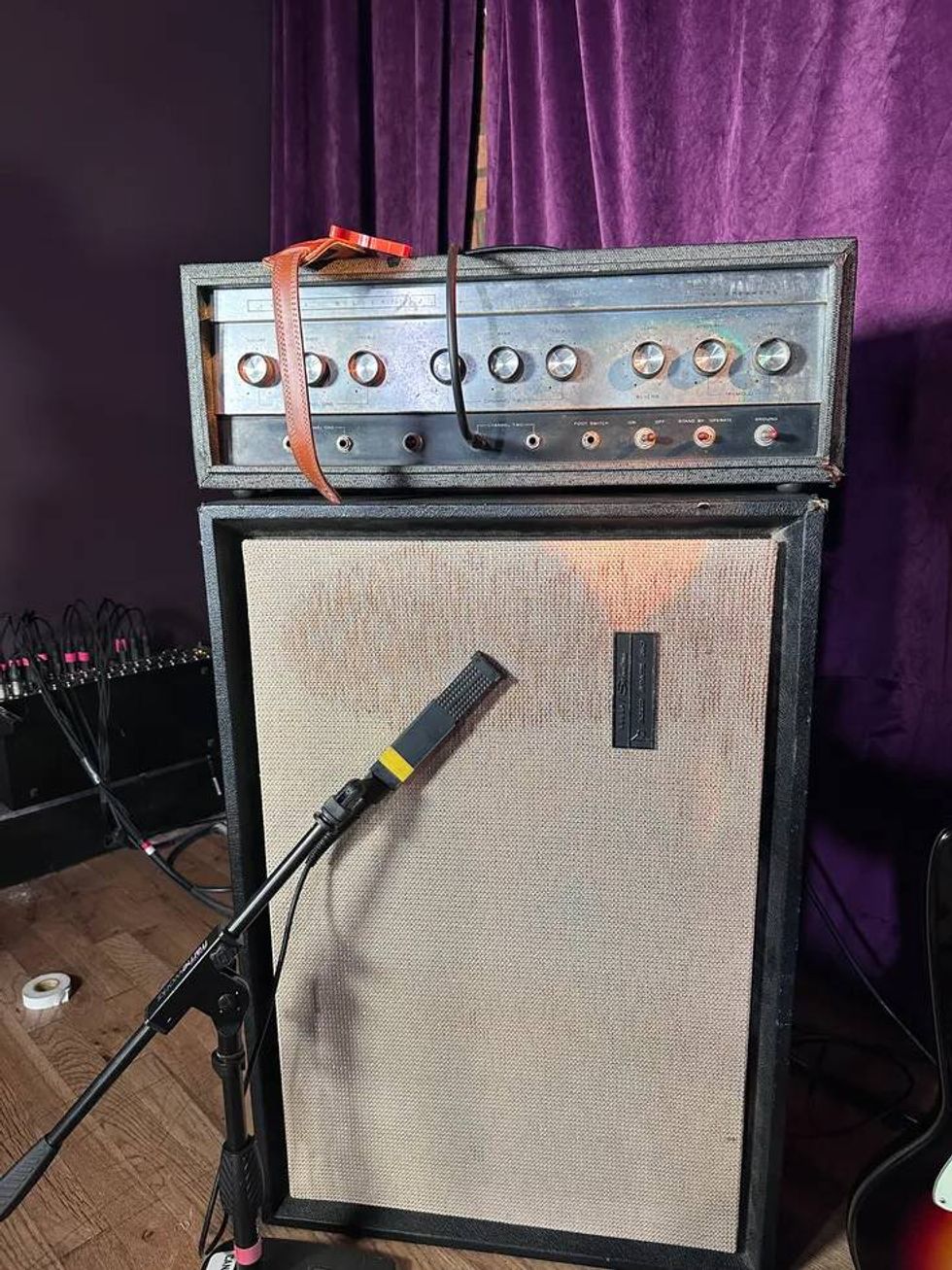
The other half of the stereo pair is a 1965 Silvertone, which DeBardi got by trading away a broken Dual Rectifier that a friend had abandoned in his storage unit after somebody threw up in it. He likes its midrange, and the two amps have been going out together since the Tenacious D tour.
Steel Beans’ Pedalboard
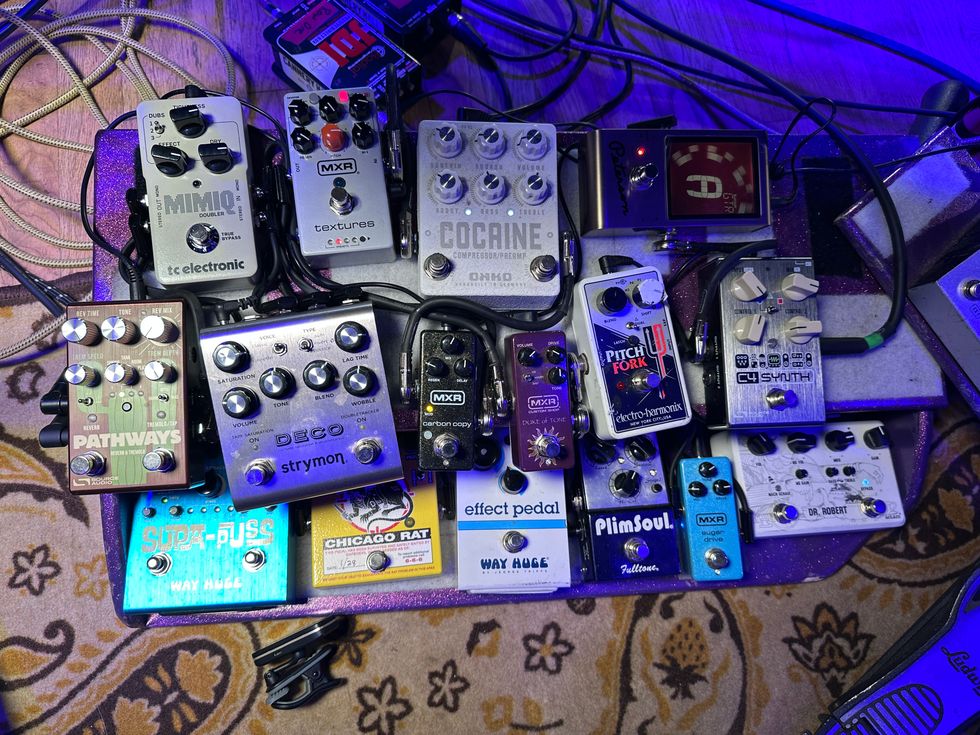
The chain opens with a Source Audio C4 Synth and a Peterson StroboStomp, then an EHX Pitch Fork, MXR Duke of Tone, MXR Carbon Copy, Aclam Dr. Robert, MXR Sugar Drive, and Fulltone PlimSoul. Fuzz comes from a one-off Way Huge pedal Jeorge Tripps sent him—“number 25 or something” of however many exist—and a Daredevil Chicago Rat. A Way Huge Supa-Puss, Source Audio Pathways, TC Electronic Mimiq, MXR Textures, and Okko Cocaine Compressor/Preamp round things out.
Brian May was asked what guitar he’d have used if he hadn’t built the Red Special: the answer may surprise you

Brian May is best known for playing his self-made Red Special, and there’s a reason why he very rarely uses other guitars.
May crafted the original with help from his father as a teenager, but has also been known to play other models from brands like Fender and Gibson; he can even be spotted in the music video for Crazy Little Thing Called Love with a black Telecaster in-hand. Yet, according the Queen guitarist, no other electric models besides his Red Special have ever really felt like the right fit.
In an interview with radio station Planet Rock, May is asked by a listener what guitar he would play as his main instrument if he didn’t have his Red Special, to which he confesses he never found one to have his desired tone.
“Nothing ever really worked for me apart from my own one, it’s odd. I always found the Fenders too thin and scratchy for the sound I was trying to get, and I found the Gibsons a little too much in the other direction, a bit too dark. They didn’t have the crispness and the top end that I wanted.
“My guitar, partly by design and partly by good luck, sits somewhere in the middle. It also has a very wide range of tones because of the way I have hooked it up and wired pickups in series, but in phase and out of phase. So it has a wide range of bright to dark.”
He concludes, “I can only really get my sound with the guitar I created with my dad, or a copy of it. Now we make them, we sell them. I take great pride in the fact that they’re well made and they’re not too expensive… It’s an extension of me and always will be.”
Watch the interview below:
The Red Special might be the perfect fit for May, but other artists who have played it have found its build to be a little peculiar. Namely, Steve Vai recalled getting his hands on the original, and struggling to play it: “The neck is like a bat, it’s got like, what, gauge .08 strings? But it was a miracle to actually have the guitar under my fingers, and he allowed that. And Joe [Satriani] and I have had a great relationship with him since,” he said.
The post Brian May was asked what guitar he’d have used if he hadn’t built the Red Special: the answer may surprise you appeared first on Guitar.com | All Things Guitar.
Fender recreates Lee Sklar’s highly customised P-Bass – but you’ll need to write on it yourself

Fender has made a “faithful recreation” of Lee Sklar’s highly customised Precision Bass, which has accompanied the bassist and session musician throughout his esteemed career.
The Lee Sklar Precision Bass forms part of the Fender Stories Collection and captures the distinctive modifications Sklar made to create a bass that is uniquely his own, minus the sprawling handwriting that covers the original.
The original bass has been used on an estimated 2,000 albums as his “go-to” instrument when in the studio, and is affectionately named Old Frankenstein. The handwriting on its body mostly consists of autographs from other musicians and celebrities.
Sklar’s bass chops have shaped countless recordings from James Taylor and Carole King, to Phil Collins, Toto, Jackson Browne, Linda Ronstadt, Joe Cocker, and Rod Stewart. His P-Bass features on close to an impressive 85 percent of his recorded work.
Sklar transformed the instrument by stripping it down to bare wood. This signature recreation is fitted with a Hipshot BT3 Bass Xtender for “flexible” low-end range changes, dual EMG Active Lee Sklar P pickups, a Badass II Bridge, and a modified Precision Bass neck shaved down to Jazz Bass dimensions and dressed with mandolin frets.
Find out more in the video below:
“It is my go-to instrument when I go in the studio. It’s the first thing I think about when I hear a song. That’s what made this project with Fender and EMG so meaningful to me,” says Lee Sklar.
“We put a lot of time, detail and care into every part of this bass, from the pickups and electronics to the feel and response of the instrument, to make sure it captured what I love about this guitar. At the end of the day, though, the most exciting part is knowing that another player can pick up this bass, make it their own and use it to create some music of their own.”
 Lee Sklar’s original P-Bass. Credit: Fender
Justin Norvell, Chief Product Officer, Guitars, adds: “Whether you know it or not, you’ve heard Sklar’s playing. His ability to weave in and out of different genres, moods and energies is unparalleled and in order to honour such fearless playing, this instrument needed to be crafted with meticulous care.
“Sklar’s P-Bass has been alongside him for an extraordinary portion of that career, so recreating it meant getting the details that make the instrument uniquely his, exactly right. It’s an incredible instrument and a fitting way for Fender to celebrate both Lee’s legacy and 75 years of the Precision Bass.”
The Lee Sklar Precision Bass is priced at $3,499.99 USD/£3,249 GBP. Find out more by visiting Fender.
The post Fender recreates Lee Sklar’s highly customised P-Bass – but you’ll need to write on it yourself appeared first on Guitar.com | All Things Guitar.
Gibson and Baggs tackle muddy live performance sound with the new HiFi DNA acoustic pickup system

Gibson and acoustic amplification company Baggs have partnered together on the new HiFi DNA acoustic pickup system, designed to deliver “the most natural, studio‑grade live tone ever achieved from an acoustic guitar”.
The new HiFi DNA pickup is available on a wide range of Gibson acoustic guitars across its Modern and Original Collections, with a standalone version for individual purchase coming soon that can be installed via a simple peel-and-stick application.
Baggs, formerly known as LR Baggs, changed its name earlier this September as part of its 50th anniversary celebrations, to mark a new, modernised era for the company.
Gibson says the pickup is intended to close the gap between live performance and studio-quality output, marking a “major leap forward” in acoustic amplification.
It works by utilising a dual Class A preamp architecture, which treats two individual sensors as their own independent studio channel. These lighter and larger sensors run through their own custom-voiced Class A preamp before they are blended together, preserving purity and articulation in a unified output.
Overall, the system captures both string detail and body resonance with improved accuracy, meaning it reacts to the guitar as a whole instrument to produce a tone that sounds like “stepping inside the guitar” itself.
Learn more in the videos below:
“HiFi DNA is a big leap forward – dual sensors with their own independently optimised preamps keep each signal pure and deliver unprecedented fidelity with the same gain before feedback as our acclaimed Element Under Saddle Pickup,” says Lloyd R. Baggs, Founder of Baggs.
“The name ‘DNA’ speaks to our character as relentless innovators and to what this new sensor can do. It’s lighter, more flexible, and more responsive. Less mass and stiffness means more life, more breath, more truth from the guitar.”
Baggs goes on to explain, “One of the discoveries that excited me most was bringing dual preamps to market. We’ve known for years how powerful that architecture is, but it was never before feasible at scale. Now, each sensor has its own preamp stage before they’re blended, which keeps both signals pristine. If you combine two mic diaphragms – or two piezos – before amplification, they tug on each other, and the sound can get muddy. Separating them preserves every detail.
“The two sensors work almost like a pair of choir mics: each hears a different part of the instrument, with enough overlap to feel natural and enough focus to stay immediate. You get ambience without losing attack, space without losing touch. It’s a new way of hearing and capturing the acoustic guitar – clear, alive, and deeply connected to the player.”
Robi Johns, Sr. Product Development Manager at Gibson Acoustic, further states: “What we’re able to do now is capture the true timbre and full dynamic range of a real acoustic guitar – so the player’s touch, nuance, and personality finally come through on stage the way they do in the room.
“I’ve been a student of the guitar my entire life, and for decades it’s been a struggle to make an acoustic sound right on stage. In the studio, with a great microphone, you can hear the whole voice of the instrument, but live that colour and character were always compromised. The first time I heard Lloyd’s new HiFi DNA pickup, I was stunned. It felt like I wasn’t listening from a point in space anymore – I was inside the guitar. It was the solution I’d been chasing since the 1970s. For the first time, the individual personality of each guitar comes through in amplified form. It transforms the entire playing experience.”
View the full Gibson x Baggs HiFi DNA collection, or head over to the Baggs website to learn more about the company.
The post Gibson and Baggs tackle muddy live performance sound with the new HiFi DNA acoustic pickup system appeared first on Guitar.com | All Things Guitar.
Learn Some Essential Flatpicking Licks via “Carroll County Blues”

Why Martin’s 16 Series is its most interesting new range in years

Ad feature with Martin Guitar
The iconic shape and look of a natural-finished square-shouldered Martin Dreadnought is so familiar, so legendary, that it’s not just defined the last 100-plus years of Martin, it’s become the thing people who have absolutely no idea about guitars picture when someone tells them to imagine a guitar.
For generations of players, the classic Martin body shapes – be that a Dreadnought, Auditorium or Concert – have become familiar friends, trusted confidants and companions through a lifetime’s musical journey. But Martin didn’t become the most iconic American acoustic guitar brand by resting on its laurels and playing the hits for a century or more – the Pennsylvanian company has forever been pushing the boundaries and trying new things.
That spirit has continued apace over the last few years, whether that’s been through exploring new body shapes like the GPC and the SC, trialling alternative tonewoods in the Inception range, or expanding the visual palette with new finishes like Mezcal Burst, Paisley Ember Burst and Amber Fade Sunburst.
Even by this standard, however, the brand new and reimagined 16 Series is taking Martin’s already big tent, and expanding it for a lot of new guitar players with bold, and unconventional ideas about what a Martin guitar is. In fact, the new 16 Series might be the most interesting new range of guitars the brand has created in a long time – and this is why.
 The Martin DSS-16E guitars. Image: Press
Any Colour You Like
There’s a fun anecdote that Martin’s Mike Dickinson told Guitar.com in our film Perfect Harmony. Back in the 1970s, Johnny Cash asked Martin to build him a guitar, and being The Man In Black, he wanted it to be… well… black. The legend goes that Martin CEO Chris Martin III really wasn’t a fan of painting over the beautiful spruce top of a Martin guitar, and so the Martin team effectively made this guitar in secret, with the company owner not realising it had ever happened until he saw Cash on TV with the guitar, and was delighted.
It’s safe to say that things have changed at Martin in the decades since then, and has expanded the visual palette of its guitars a great deal.
But while signature artists like Cash and Eric Clapton (with his limited run collabs with Hiroshi Fujiwara) have added solid colours to their guitars in the past few decades, it’s safe to say that we’ve seen nothing before like the new 16 Series.
 The Martin DSS-16E in Cherry Cola. Image: Press
Whether its Cherry Cola, Blue Denim, Black Smoke or Cream, the eye-popping new colours that adorn the spruce tops of the 16 Series are as striking as they are appealing – you have to admit, you might never have thought about a bright red Martin guitar before, but now you’ve seen it, it works, right?
These new finish options aren’t just marketing gimmicks either – you don’t have to spend much time looking at stages across the musical spectrum in 2026 to see that plenty of young singer-songwriters are looking to painted-top guitars as a way to stand out on stage – and these new options certainly do that.
Of course, if you’re not a primary colour kind of guitarist, the stunning 1935 Burst gives a modern twist to the shade top look, and there are some natural-finish versions in there, too. What’s more, closer inspection will reveal that while these guitars are bright and colourful, the finish is semi-transparent, allowing you to still see the grain of that beautiful spruce underneath – we’re sure Chris Martin III would appreciate that.
 The Martin 00L-16E in Blue Denim. Image: Press
Shape Sorter
If the finishes were the only departure for the 16 Series, that would still be a big deal, but you’ve probably noticed that this isn’t the biggest change for 2026. While the previous 16 Series guitars were designed to straddle the worlds of traditional and modern acoustic guitars, the new ones do something much more unexpected.
Because in addition to a refreshed take on the modernist GPC platform, the range now comprises three very rarely seen body shapes in the Martin canon – a slope-shouldered Dreadnought, a slope-shouldered 00, and the Jumbo.
Quite aside from the visual point of difference these guitars offer, they also offer a different experience in terms of both playability and sound than the more conventional Martin guitars you might be familiar with.
The DSS-16E Slope-Shouldered Dreadnought offers a punchy midrange, strong treble response, and a focused low end. With a spruce top and mahogany back and sides, it offers a woody, more intimate tone that pairs perfectly with a shorter-than-normal 24.9″ scale length. This gives a more relaxed and comfortable playing feel that complements the DSS’s natural warmth, while forward-shifted scalloped X-bracing enhances both the bass response and resonance.
The Jumbo sized J-16E is another eye-catching entry – this 14-fret spruce/rosewood beast is designed to command a room with a body size that delivers thunderous volume with sparkling top-end response – it’s the perfect Martin guitar for strummers, rhythm players, and anyone who wants to command the stage.
Finally, the smallest guitar in the range, the 00L-16E brings the slope-shouldered style to the classic Martin 00 body style. Compact and intimate, the 00L still has surprising projection for a guitar of its size, with a woody and responsive tonality that’s the perfect pairing for fingerstyle, songwriting, or rhythm work.
 The Martin Grand J-16E 12-string. Image: Press
Martin Magic
These unconventional shapes pair with the striking new finish options to produce some of the most non-traditional Martin guitars ever, while still maintaining that touchstone of heritage and familiarity that players love about the brand.
What’s more, while they may look different to the norm, they remain every bit the Martin guitars that we know and love – just with a slightly different accent.
It goes without saying that these 16 Series guitars aren’t replacing anything – you’ll still be able to buy all the D-18s and 000-28s you want, and these guitars don’t change that at all. What they do instead is create new colours in the crayon box, and new paths for more guitarists than ever to discover the magic of Martin guitars. And that’s something we can all get behind.
Find out more about the Martin 16 Series at martinguitar.com
The post Why Martin’s 16 Series is its most interesting new range in years appeared first on Guitar.com | All Things Guitar.
“Never let a corporation tell you what the rules are”: Former Fender Custom Shop head takes swipe at former employer with pointed S-style build

Earlier this year, Fender shook the guitar industry’s foundations when it sent cease and desist letters to a plethora of small builders demanding they stop making guitars similar in body shape to its iconic Stratocaster design.
Many in the guitar community criticised the move, and significant pushback was mounted by some of the brands targeted, including German retail giant Thomann – which went on the offensive to sue Fender after it was sent a C&D letter, presumably over its S-type Harley Benton guitars – and California-based boutique builder LsL Instruments, which hired the lawyer who successfully beat Fender in a trademark dispute on behalf of a consortium of brands back in 2009.
Now, former Fender Custom Shop head Mike Eldred has apparently made his thoughts about Fender’s legal action clear, with a new S-style build that appears to take aim at his former employer.
Mike Eldred was let go from the Fender Custom Shop a little over a decade ago, after serving as its head for around 17 years. During his time at Fender, he created the Filter’Tron pickup-equipped Cabronita Telecaster, and has continued a similar naming convention since his departure with his line of El Cabron guitars.
His removal made waves at Fender, and was a significant reason why John Mayer left Fender’s artist roster and later joined PRS, where he helped develop the Silver Sky, one of the biggest commercial guitar successes in recent history. Side note: PRS was another brand targeted by Fender’s cease and desist campaign.
Eldred’s new El Cabron Black Corp certainly makes a statement – one which we assume takes aim directly at Fender. Firstly, it’s a S-type guitar at a time Fender is clamping down on Strat copies, and secondly, it features a pointed message across its body: “Never let a corporation tell you what the rules are.”
 Credit: El Cabron
The guitar also features the classic Flower Thrower artwork by UK graffiti artist Banksy, which symbolises the power of peace and love being more powerful than violence and aggression.
We don’t know much in the way of specs, but we do know the guitar features a Gotoh 510TS bridge, and a single humbucker hand-wound by Willy Houston at Rocket Pickups, with voicing designed by Mike Eldred and Grover Jackson.
Perhaps unsurprisingly, the Black Corp guitar has already sold out on Mike Eldred’s El Cabron website, despite its wallet-denting price tag of £5,275…
You can take a closer look at the official El Cabron website.
 Credit: El Cabron
The post “Never let a corporation tell you what the rules are”: Former Fender Custom Shop head takes swipe at former employer with pointed S-style build appeared first on Guitar.com | All Things Guitar.
Gibson unveils two stunning luxury acoustics – a Hummingbird and SJ-200 built using elegant koa wood

Gibson has expanded its Artisan Series with two new acoustic guitars – an SJ-200 and Hummingbird, two of the brand’s most iconic acoustic designs – built using premium koa tonewoods.
Handcrafted by the team at Gibson Acoustic in Bozeman, Montana, both guitars feature a “richly figured” koa back and sides paired with a AAA Sitka spruce top, offering “sparkling high-end clarity that develops greater warmth and complexity with regular play”. A notable aesthetic touch comes by way of a three-rope marquetry strip running across the centre of the back of each guitar.
First up, the new SJ-200 – built on a blueprint introduced in 1937 and that’s come to be widely regarded as the “King of the Flat Tops” – features, alongside its koa back and sides and Sitka spruce top, a rosewood SJ-200 two-bar moustache bridge with abalone bar inlays, a tortoiseshell pickguard with abalone dot inlays and a silver-foil stamp that creates “vivid, shifting iridescence” as the light shifts.
 Credit: Gibson
Elsewhere, the guitar sports a mahogany neck with a Round profile, a bound 20-fret rosewood fingerboard with abalone graduated crown inlays, and a single-ply bound headstock, TUSQ nut and gold-plated Grover Rotomatic tuners.
In terms of electronics, the SJ-200 Elegant Koa is fitted with L.R. Baggs Anthem electronics, which combine an under-saddle Element pickup with an internal mic and preamp to faithfully reproduce the guitar’s unplugged tone.
Meanwhile, the new Hummingbird Elegant Koa features a very similar spec sheet, with the same koa back and sides and Sitka spruce top, Round-profile mahogany neck, 20-fret rosewood fretboard, and TUSQ nut and saddle.
Visually, this one stays true to the design that has made the Hummingbird such a classic, with the familiar artwork on its tortoise pickguard. This art is developed, though, now with gold and silver-foil details that shift as the light changes. This one also features L.R. Baggs electronics, this time a VTC system.
 Credit: Gibson
Premium guitars need premium protection – so each new Elegant Koa acoustic model ships with a Gibson Custom hardshell case.
“The SJ-200 and Hummingbird represent defining chapters in Gibson acoustic history,” says Robi Johns, Gibson Acoustic Senior Product Development Manager.
“With the Elegant Koa models, Gibson Custom honors the character that made these instruments legendary while introducing the beauty, clarity, and evolving warmth of koa. These are guitars designed to form an even deeper connection with players over a lifetime of music.”
These are high-end acoustics, and their price tags reflect that, with the Hummingbird Elegant Koa coming in at $5,199, and the SJ-200 Elegant Koa priced at $6,899. If those figures feel a little outside your budget range, you can check out some of the mouth-watering high-res photos below instead…


These guitars are available now, both at Gibson.com and at the Gibson Garages in Nashville, London and Miami.
The post Gibson unveils two stunning luxury acoustics – a Hummingbird and SJ-200 built using elegant koa wood appeared first on Guitar.com | All Things Guitar.
Pages
